%22%3E%0A%3Cpath%20d%3D%22M0%2018.4539V18.4148C0%2014.0013%203.63064%2010.4783%208.31819%2010.4783C13.0057%2010.4783%2016.5972%2013.9523%2016.5972%2018.3659V18.405C16.5972%2022.8185%2012.9666%2026.3318%208.27904%2026.3318C3.5915%2026.3318%200%2022.8577%200%2018.4442V18.4539ZM11.4791%2018.4539V18.4148C11.4791%2016.6142%2010.2363%2014.9799%208.28883%2014.9799C6.3414%2014.9799%205.1377%2016.5848%205.1377%2018.3659V18.405C5.1377%2020.2057%206.38054%2021.8399%208.32798%2021.8399C10.2754%2021.8399%2011.4791%2020.235%2011.4791%2018.4539Z%22%20fill%3D%22white%22%2F%3E%0A%3Cpath%20d%3D%22M17.9575%2010.1553H22.8897V17.808L25.4341%2014.1578H30.7969L27.0782%2018.9823L30.8556%2026.0185H25.5711L23.8586%2022.7598L22.88%2024.0222V26.0185H17.9478V10.1553H17.9575Z%22%20fill%3D%22white%22%2F%3E%0A%3Cpath%20d%3D%22M31.4232%2010.1553H36.3554V26.0185H31.4232V10.1553Z%22%20fill%3D%22white%22%2F%3E%0A%3Cpath%20d%3D%22M37.5101%2022.6522V22.6131C37.5101%2020.2448%2039.2716%2018.9237%2042.0313%2018.9237C43.0295%2018.9237%2044.3115%2019.139%2044.8301%2019.3543V19.1586C44.8301%2018.0723%2044.1549%2017.446%2042.638%2017.446C41.4246%2017.446%2040.397%2017.7102%2039.3597%2018.1212L38.4887%2014.8429C39.8588%2014.3242%2041.4246%2013.9719%2043.4894%2013.9719C45.8968%2013.9719%2047.4626%2014.471%2048.5097%2015.5181C49.4002%2016.4087%2049.7525%2017.5634%2049.7525%2019.276V26.0382H44.8203V24.8443C43.9983%2025.7348%2042.8827%2026.322%2041.405%2026.322C39.1248%2026.322%2037.5199%2025.0204%2037.5199%2022.6718L37.5101%2022.6522ZM44.8791%2021.6247V21.1256C44.5953%2021.0179%2044.1647%2020.9298%2043.7537%2020.9298C42.7751%2020.9298%2042.2368%2021.517%2042.2368%2022.251V22.2901C42.2368%2022.9849%2042.7359%2023.4449%2043.3622%2023.4449C44.2332%2023.4449%2044.8791%2022.7501%2044.8791%2021.6149V21.6247Z%22%20fill%3D%22white%22%2F%3E%0A%3Cpath%20d%3D%22M51.2205%2010.1553H56.1527V15.7431C56.916%2014.7645%2058.1099%2013.874%2059.7833%2013.874C62.2788%2013.874%2063.8445%2015.5278%2063.8445%2018.1995V26.0185H58.9123V19.7848C58.9123%2018.767%2058.3056%2018.1799%2057.5619%2018.1799C56.8181%2018.1799%2056.1527%2018.767%2056.1527%2019.7848V26.0185H51.2205V10.1553Z%22%20fill%3D%22white%22%2F%3E%0A%3Cpath%20d%3D%22M64.9601%2020.1273V20.0882C64.9601%2016.7414%2067.7394%2013.874%2071.6538%2013.874C75.5683%2013.874%2078.2986%2016.7022%2078.2986%2020.0491V20.0882C78.2986%2023.435%2075.5194%2026.3024%2071.6049%2026.3024C67.6905%2026.3024%2064.9601%2023.4742%2064.9601%2020.1273ZM73.5621%2020.1273V20.0882C73.5621%2018.9139%2072.6912%2017.9842%2071.6049%2017.9842C70.5187%2017.9842%2069.6966%2018.9237%2069.6966%2020.0491V20.0882C69.6966%2021.2625%2070.5676%2022.1922%2071.6538%2022.1922C72.7401%2022.1922%2073.5621%2021.2625%2073.5621%2020.1273Z%22%20fill%3D%22white%22%2F%3E%0A%3Cpath%20d%3D%22M79.5023%2014.1478H84.4345V15.7332C85.1978%2014.7545%2086.3917%2013.864%2088.0162%2013.864C89.6407%2013.864%2090.864%2014.5588%2091.5197%2015.8212C92.5178%2014.6958%2093.7117%2013.864%2095.5417%2013.864C98.0861%2013.864%2099.6519%2015.5179%2099.6519%2018.1895V26.0086H94.7197V19.7259C94.7197%2018.7277%2094.1325%2018.1601%2093.4182%2018.1601C92.7038%2018.1601%2092.0481%2018.7277%2092.0481%2019.7259V26.0086H87.1159V19.7259C87.1159%2018.7277%2086.5287%2018.1601%2085.8144%2018.1601C85.1%2018.1601%2084.4443%2018.7277%2084.4443%2019.7259V26.0086H79.5121V14.1478H79.5023Z%22%20fill%3D%22white%22%2F%3E%0A%3Cpath%20d%3D%22M100.67%2022.6522V22.6131C100.67%2020.2448%20102.431%2018.9237%20105.191%2018.9237C106.189%2018.9237%20107.471%2019.139%20107.99%2019.3543V19.1586C107.99%2018.0723%20107.314%2017.446%20105.798%2017.446C104.584%2017.446%20103.557%2017.7102%20102.519%2018.1212L101.648%2014.8429C103.018%2014.3242%20104.584%2013.9719%20106.649%2013.9719C109.056%2013.9719%20110.622%2014.471%20111.669%2015.5181C112.56%2016.4087%20112.912%2017.5634%20112.912%2019.276V26.0382H107.98V24.8443C107.158%2025.7348%20106.042%2026.322%20104.565%2026.322C102.284%2026.322%20100.679%2025.0204%20100.679%2022.6718L100.67%2022.6522ZM108.029%2021.6247V21.1256C107.745%2021.0179%20107.314%2020.9298%20106.903%2020.9298C105.925%2020.9298%20105.387%2021.517%20105.387%2022.251V22.2901C105.387%2022.9849%20105.886%2023.4449%20106.512%2023.4449C107.383%2023.4449%20108.029%2022.7501%20108.029%2021.6149V21.6247Z%22%20fill%3D%22white%22%2F%3E%0A%3Cpath%20d%3D%22M118.852%2023.7383L121.573%2020.4991C123.227%2021.7615%20125.115%2022.2802%20126.896%2022.2802C127.807%2022.2802%20128.198%2022.0453%20128.198%2021.6245V21.5854C128.198%2021.1548%20127.718%2020.9102%20126.094%2020.5872C122.679%2019.8924%20119.684%2018.9138%20119.684%2015.6942V15.655C119.684%2012.7681%20121.945%2010.5271%20126.143%2010.5271C129.079%2010.5271%20131.251%2011.2219%20133.013%2012.6115L130.537%2016.0465C129.098%2014.9993%20127.386%2014.5492%20125.977%2014.5492C125.213%2014.5492%20124.871%2014.8134%20124.871%2015.1755V15.2146C124.871%2015.6257%20125.282%2015.8899%20126.887%2016.1933C130.772%2016.9076%20133.385%2018.0428%20133.385%2021.1059V21.145C133.385%2024.3353%20130.752%2026.2925%20126.671%2026.2925C123.589%2026.2925%20120.809%2025.4216%20118.872%2023.7286L118.852%2023.7383Z%22%20fill%3D%22white%22%2F%3E%0A%3Cpath%20d%3D%22M134.128%2020.1273V20.0882C134.128%2016.7414%20136.908%2013.874%20140.822%2013.874C144.736%2013.874%20147.477%2016.7022%20147.477%2020.0491V20.0882C147.477%2023.435%20144.697%2026.3024%20140.783%2026.3024C136.868%2026.3024%20134.138%2023.4742%20134.138%2020.1273H134.128ZM142.74%2020.1273V20.0882C142.74%2018.9139%20141.869%2017.9842%20140.783%2017.9842C139.697%2017.9842%20138.875%2018.9237%20138.875%2020.0491V20.0882C138.875%2021.2625%20139.746%2022.1922%20140.832%2022.1922C141.918%2022.1922%20142.74%2021.2625%20142.74%2020.1273Z%22%20fill%3D%22white%22%2F%3E%0A%3Cpath%20d%3D%22M148.299%2020.1273V20.0882C148.299%2016.7414%20151.078%2013.874%20154.992%2013.874C158.907%2013.874%20161.637%2016.7022%20161.637%2020.0491V20.0882C161.637%2023.435%20158.858%2026.3024%20154.943%2026.3024C151.029%2026.3024%20148.299%2023.4742%20148.299%2020.1273ZM156.901%2020.1273V20.0882C156.901%2018.9139%20156.03%2017.9842%20154.943%2017.9842C153.857%2017.9842%20153.035%2018.9237%20153.035%2020.0491V20.0882C153.035%2021.2625%20153.906%2022.1922%20154.992%2022.1922C156.079%2022.1922%20156.901%2021.2625%20156.901%2020.1273Z%22%20fill%3D%22white%22%2F%3E%0A%3Cpath%20d%3D%22M162.841%2014.1478H167.773V15.8017C168.536%2014.8231%20169.73%2013.864%20171.404%2013.864C173.899%2013.864%20175.465%2015.5179%20175.465%2018.1895V26.0086H170.533V19.7748C170.533%2018.7571%20169.926%2018.1699%20169.182%2018.1699C168.438%2018.1699%20167.773%2018.7571%20167.773%2019.7748V26.0086H162.841V14.1478Z%22%20fill%3D%22white%22%2F%3E%0A%3Cpath%20d%3D%22M176.571%2020.1469V20.1078C176.571%2016.5652%20179.115%2013.874%20182.677%2013.874C186.895%2013.874%20188.852%2016.8099%20188.852%2020.4111C188.852%2020.6754%20188.852%2020.9787%20188.833%2021.2332H181.209C181.562%2022.2803%20182.384%2022.8185%20183.45%2022.8185C184.341%2022.8185%20185.085%2022.4075%20185.858%2021.605L188.51%2023.7091C187.335%2025.2259%20185.662%2026.2926%20183.098%2026.2926C179.213%2026.2926%20176.58%2023.8363%20176.58%2020.1469H176.571ZM184.351%2019.0607C184.243%2017.9353%20183.568%2017.2796%20182.697%2017.2796C181.875%2017.2796%20181.288%2017.9744%20181.131%2019.0607H184.351Z%22%20fill%3D%22white%22%2F%3E%0A%3Cpath%20d%3D%22M190.027%2014.1481H194.959V16.5359C195.634%2014.931%20196.72%2013.8839%20198.678%2013.972V19.2075H198.159C196.074%2019.2075%20194.969%2020.3623%20194.969%2022.985V26.0089H190.036V14.1481H190.027Z%22%20fill%3D%22white%22%2F%3E%0A%3Cpath%20d%3D%22M198.756%2024.58L200.429%2021.7812C201.868%2022.6717%20203.473%2023.1023%20204.823%2023.1023C205.303%2023.1023%20205.538%2022.9947%20205.538%2022.7109V22.6717C205.538%2022.4369%20205.322%2022.2803%20204.128%2021.9769C201.134%2021.2332%20199.284%2020.4307%20199.284%2017.9744V17.9353C199.284%2015.3322%20201.369%2013.874%20204.451%2013.874C206.408%2013.874%20208.336%2014.3731%20209.775%2015.2441L208.209%2018.1799C206.947%2017.4851%20205.43%2017.0741%20204.432%2017.0741C203.952%2017.0741%20203.737%2017.2013%20203.737%2017.446V17.4851C203.737%2017.72%20204.001%2017.8765%20205.195%2018.1799C208.19%2018.9237%20210%2019.7457%20210%2022.1824V22.2216C210%2024.8051%20208.062%2026.3024%20204.852%2026.3024C202.553%2026.3024%20200.459%2025.7152%20198.766%2024.5898L198.756%2024.58Z%22%20fill%3D%22white%22%2F%3E%0A%3Cpath%20fill-rule%3D%22evenodd%22%20clip-rule%3D%22evenodd%22%20d%3D%22M219.368%204.36764C225.191%20-1.45588%20234.632%20-1.45588%20240.456%204.36764C246.279%2010.1912%20246.279%2019.6324%20240.456%2025.4559L229.912%2036L219.368%2025.4559C213.544%2019.6324%20213.544%2010.1912%20219.368%204.36764ZM222.009%207.55761C221.948%207.86849%20221.916%208.39718%20221.916%209.14566V10.4189C221.916%2011.1832%20221.948%2011.7198%20222.013%2012.0267C222.078%2012.3317%20222.278%2012.6168%20222.617%2012.8762C222.956%2013.1376%20223.403%2013.3316%20223.958%2013.4623C224.512%2013.593%20225.1%2013.6584%20225.837%2013.6584C226.573%2013.6584%20227.217%2013.591%20227.769%2013.4524C228.322%2013.3158%20228.761%2013.1178%20229.086%2012.8604C229.411%2012.6029%20229.605%2012.3178%20229.666%2012.0069C229.728%2011.6961%20229.759%2011.1674%20229.759%2010.4189V9.14566C229.759%208.38134%20229.728%207.84473%20229.662%207.53781C229.597%207.23287%20229.397%206.94971%20229.058%206.68834C228.72%206.42696%20228.272%206.23291%20227.718%206.10223C227.163%205.97154%20226.536%205.90619%20225.839%205.90619C225.102%205.90619%20224.459%205.97352%20223.906%206.11213C223.352%206.24875%20222.914%206.44677%20222.589%206.70418C222.265%206.9616%20222.071%207.24673%20222.009%207.55761ZM227.276%2024.8638C230.876%2024.8638%20232.557%2024.2064%20232.557%2021.862V21.858V21.3155C232.557%2019.6581%20231.516%2018.971%20228.252%2018.3136C227.278%2018.1136%20226.908%2017.9136%20226.908%2017.3136V16.9414C226.908%2016.6543%20227.177%2016.5117%20227.413%2016.5117C227.749%2016.5117%20227.918%2016.7137%20227.918%2016.9414V18.1136H232.391V17.3988C232.391%2015.4563%20231.347%2014.4266%20227.177%2014.4266C224.15%2014.4266%20221.896%2015.3414%20221.896%2017.3711V17.7433C221.896%2019.5155%20222.805%2020.3155%20226.201%2021.0303C226.28%2021.0472%20226.355%2021.063%20226.427%2021.0781C227.329%2021.2674%20227.647%2021.3341%20227.647%2021.9174V22.2897C227.647%2022.6619%20227.546%2022.8045%20227.142%2022.8045C226.67%2022.8045%20226.637%2022.5471%20226.637%2022.262V21.2897H221.894V21.7471C221.894%2024.149%20223.476%2024.8638%20227.276%2024.8638ZM233.424%2024.5569H237.925V14.7355H233.424V24.5569ZM234.955%2013.5019H237.925V6.06064H235.092V9.411L233.193%206.06064H230.359V13.5019H233.193V10.1199L234.955%2013.5019ZM226.269%2012.152C226.204%2012.2688%20226.055%2012.3262%20225.825%2012.3262L225.827%2012.3282C225.604%2012.3282%20225.459%2012.2767%20225.398%2012.1758C225.336%2012.0748%20225.305%2011.8074%20225.305%2011.3758V7.90068C225.305%207.51852%20225.352%207.28684%20225.445%207.20962C225.538%207.13239%20225.675%207.09279%20225.851%207.09279C226.059%207.09279%20226.198%207.14031%20226.265%207.23734C226.332%207.33239%20226.366%207.55416%20226.366%207.90068V11.3203C226.366%2011.7579%20226.334%2012.0352%20226.269%2012.152Z%22%20fill%3D%22white%22%2F%3E%0A%3C%2Fg%3E%0A%3Cdefs%3E%0A%3CclipPath%20id%3D%22clip0_15181_22447%22%3E%0A%3Crect%20width%3D%22245%22%20height%3D%2236%22%20fill%3D%22white%22%2F%3E%0A%3C%2FclipPath%3E%0A%3C%2Fdefs%3E%0A%3C%2Fsvg%3E%0A)
Media Q&A: What Oklahoma AD Joe Castiglione and President Joe Harroz Said
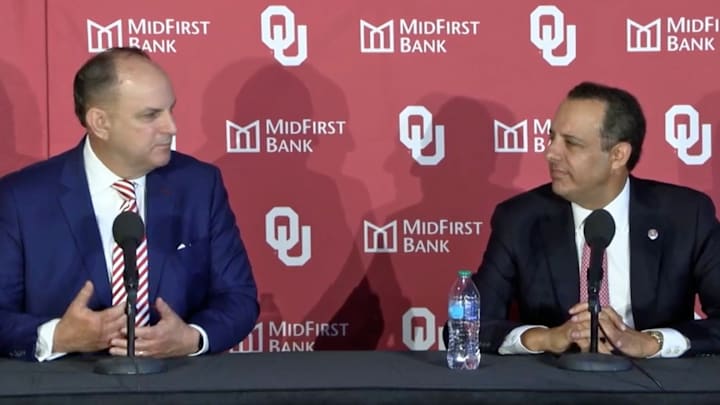
Oklahoma athletic director Joe Castiglione announced his future retirement at a press conference on Tuesday. Here’s the media Q&A portion with Castiglione and OU president Joe Harroz:
President Harroz, just curious about the selection of the next athletic director. If you could walk us through the importance of that hire. I don't know if you'll find somebody will be here for another 30 years, but what are you looking for, and just how important a hire is this?
“Yeah, Joe 2.0 is their actual title. What was the last part of your question?”
The importance of this hire overall for the university?
“Yeah, it's a, you know, everyone knows the evolving landscape of college athletics. It couldn't be more dynamic. One of the great — when we look back at at Sooner athletics history, one of the most important moves strategically that we will see was when Joe Castiglione came to me, when I came into this job six years ago, and said, we have got to make a move, either to the SEC or the Big Ten, then laid out the case for the move to the SEC. And with that counsel and direction, we and Texas became first movers, and that is the reason, the most recent example of the kind of foresight and vision you need as an athletic director to navigate a rapid disruption. And so the athletic director we're looking for next is someone that can identify the landscape and act. I think a lot of people could have identified it and had identified it before Oklahoma and Texas made their move. But Joe identified it and said, ‘We got to move,’ and then, and then that took place. So we look at the attributes that we need for the next athletic director. It's someone that has both the vision, an understanding of the landscape and the ability to act, to move, and this, the changes are going to continue to come. And so I think the most important attribute is someone that understands the changing landscape and has the ability to navigate it. I think that's the central attribute today, and one that will be looking at. We've already announced Randall Stephenson will be leading that search, and that's for a different day. But those are the attributes that we're looking for, and we've been fortunate to have them. I thought it was interesting when chair Holloway talked about the A4, right? (Autonomy conferences; aka Power 4). I mean that that statement alone, the fact that that was the A5 (just) 24, months ago, are, you know, I think, perfectly identifies the acceleration and the breadth of change. And so as we look at this, and as we receive Joe's counsel on this, that is going to be a central attribute that is something that might not have been contemplated four or five years ago, and will be a touchstone as this search takes place.”
Joe, your fingerprints are going to forever be on this program. What are your hopes in your successor and what's the biggest piece of advice you could give them as they take over this program?”
“Well, of course, we want whoever it is to accept the baton and take the program further. The whole idea is to continue to grow. The people inside and part of, but OU athletics directly, you know, connected with our university. That's it. It's a growth mindset. So whoever it is that's what they need to do. And like all of us have said, you know, I’ll be there to be supportive all along the way. But as the president has mentioned, you know, we could talk about the person's skill set, the foresight, technical knowledge and all of that, and that'll get measured. But if you lose the essence of what we're about in college athletics as part of executing on those kinds of ideas, then you've you've decoupled what makes us successful. And so whoever that is needs to take whatever new version of college athletics is and couple it with the brightest and the boldest strategies and tactics. And be unapologetic for loving what you do, building great relationships. I see, now that I’m down here, the light doesn't blind one as much — but you know, I keep looking at so many people in this room, and especially our head coaches. I see my assistant of 21 years, Jan Meeks, here, and my current assistant, Ann Deal, they they've been in the foxhole too, and they see what's going on. But I remember trying to convince coaches to come to Oklahoma, who we were and what we're about. So we were selling these really, key characteristics, and most importantly, the elements of what makes a great culture and how it it grows and develops. So that's got to be part of what this next person brings. And involve the family. I see our First Lady, Ashley Harroz, and we, as the president said, this is just not some kind of sales pitch. When you throw family out there, we are unapologetic for who we are as a family. You're going to see the emotions like you see we're going to just be who we are, because we want people to be authentic. So I'm going to close answer your question is, above all, be authentic.”
Joe C, I'm wondering how much has your job maybe changed over the last couple years, and how does that shape the perspective of the next AD, and what that position looks like moving forward in college athletics? And for Joe H, you talked about Randall Stephenson. What is it about him that gives you confidence that he can find the next right AD in this changing landscape?
Castiglione: “It's not going to fit in a sound bite, unfortunately, but what I will say, succinctly, is first recognizing the moment that change is going to occur and doing your best to be prepared for it. One of the most challenging parts of the period that we're in is there's never been a moment like it — not only in college athletics. I think you could look across various industries. They all go through some moment of disruption and change, and the ones that see the future, that adapt, pivot, be flexible, those are the ones that navigate it and not only survive, but become stronger when they get on the other side. We are just a multi-faceted enterprise that has the complexity, I don't know, like no other. Because we have so many different levels and people that have ways to lean in and how to please too many people. And it's just not like some kind of hierarchy from the top; you can change it, whether it's a board or the leadership. So you have to work with people, and we have to be comfortable with the uncomfortable period that we're in. And that's where we are. So if you're not willing to lean into it, get scarred up, nicked up, you know, try to find the solutions that are necessary in a moment in time, where we're still not structured the way we should be, in a moment in time where we're still using our best experience and knowledge to do what's right, to keep athletes engaged and on campus and programs thriving. Realize sometimes the you don't have full control of everything, but you better exert as much as you can. But lean into the future and don't be afraid to be a change agent. And know what comes with that. It's not going to be always popular, and not everybody is going to understand the elements to it. But I will tell you, the ones that look at what the mission is and keep their eye looking forward, they're the ones that are going to win. And so however you want to define the skills of the next AD, you better be a leader that can lean in, accept and effectuate change of the future, because if it's not up to — if the people in the business don't do the leading, then who is?
Harroz: “I can feel Bob Stoops looking at his watch right now. I think we all can. Yeah, with this answer, I'm going to keep it tight just to avoid the annoying conversation afterwards. What gives me confidence, so Joe and I reached out and brought in Randall back in October, because we recognized how much change there was, and we knew we needed somebody that loved the university, that had truly world class talent at recognizing disruptive change and adapting to it. In his 13 years as CEO of AT&T, that's what he lived in, was disruptive change. He's been involved with the PGA of America. He's done massive media deals. He understands the media landscape. And so we brought him in to give us a hand. I think you saw a product of that, of he and Joe working together with bringing in restructuring, putting in the GM operation, putting Jim Nagy in there, the talent he attracted — and that putting us in first, as I understand it, in the country, position of a true pro GM front office. So what gives me confidence that he will do a great job leading this? Because it's going to combine … it’s not good form to have the predecessor pick the successor. Joe C has agreed to be an advisor to the committee. The committee is going to be tight and really talented and good, and Randall is going to have not just his own background, but that of the committee and Joe C providing advice to help, hopefully bring to bear that collection of talents to find the next Joe C.”
Joe, on your retirement, if you were asked, would you be willing, interested in accepting maybe a larger role in collegiate athletics and trying to figure out how we take this forward?
Harroz: “He's going to stay with us. Thank you for the question.”
Castiglione: “But I do love your suit, Toby. I am really — brother, I've been trying to get you in one for a long time, and you look awesome. Who knows what the future will bring? And I'm not leaving any little dangling things so somebody could drive a wedge into that. I don't know what's going to come. … I appreciate our chairman talking about being a servant leader. I've always wanted to be, first and foremost, a servant leader for the athletes and the coaches and the staff and this university at large. But you know, the business itself has offered me chances over the years to serve in leadership roles on various committees, and so I don't I don't know what that will mean going forward. But I still have a high motor, I still have a lot of passion, and I still know why I made this decision. So whatever it is I do choose, it will be done in concert with what Miss Kristen thinks is best for our family. She deserves, you know, she deserves the utmost respect for that part of the decision.”
Harroz: “That's how you make it 30 years people.”
For Joe Harroz, Joe mentioned the runway he's left here headed into football season. How do you view the timeline on a process like this with Randall Stephenson, his background and the shifting landscape? How does that open up (the search)?
“Yeah, beyond grateful to have the runway, it would be, you know, in most instances you see someone who just leaves and goes somewhere else, and you're stuck. And so in true Joe Castiglione fashion, giving us this runway — and he's given us lots of runway — so it's going to allow us to go through a process that's not rushed, one that is disciplined and that takes into account the landscape that we're in. And so, I feel great about the timeline. We're not — you know, sometimes in athletics, you have a week or two to do your hiring, whether it's a head coach or an AD, and we're just not in that position. And I've got, you know, every confidence in in Randall and the team around him. Again, it's a search committee, and Randall’s expertise, as I said before, coupled with advice from Joe and others on that committee — and we’ll be announcing that committee, hopefully relatively soon, what that committee looks like — I think you'll see from the composition of it, once it's put together, that we've got a committee that can provide both insights into where the landscape is going, also an understanding of our history and tradition, and in coupling those together to get the right person to be here. So it's going to take a little time, but I think we'll have that right team being led by Randall, that moves us forward.”
For the president, you have Heisman Park, and you have the coaches statues. Have you given any thought to how you'd like to see Joe honored eventually?
“I think we're going to — there'll be more news on this front. There is going to be an honor. It will likely be in bronze, and we’ll address that it at a later time. But it is, it's important. It is important. And you've got to recognize those great leaders. Athletics has a tradition of honoring those that have made historic impacts on the enterprise. We even gave Bob Stoops one. And so as we look at this, the answer is, this is an announcement, and there will be celebrations to come, which I hope you will attend, and we'll be properly recognizing Joe's contributions.”
President Harroz, you mentioned just the unique front office structure that you guys have built here. How attractive will that be to prospective hires? And then also, how will having that structure kind of help you and the committee go about this process?
“Yeah, hopefully it allows — it's interesting. When you look at and you speak to Jim about the way he built the team around him, and you look at how quickly he collected that talent that has 60 years of NFL experience, and when you speak to those individuals —when we recruited Nagy, when he recruited those that came with him, they were immediately attracted to the fact that it was a unique structure, and that this athletic director and this institution recognized what today and tomorrow look like, and that we were prepared to lean into that. And so my belief is, is that by having this unique front office structure that it will attract candidates that are very serious people, that want to live at the highest — they want to win at the highest level, and that understand that we're serious about giving the next Joe C the tools necessary to innovate and to lead into a changing landscape. So I think it's a really important attribute that allows us to demonstrate and not just say, that we're innovative, that we're cutting edge, and that we know how to adapt to disruption, and that we're committed to winning in in that environment.”
Joe C, I know you got some time left, but say when you are done, what do you want people with your legacy to be when you look back some of the things that happened since you took over as AD, what are the things that stand out most to you, that you're most proud of?
“Well, just the I think it builds off the theme that I started out my opening remarks. Look, I could do without this setting of an announcement, because it's never, ever been about me, and it never will be. But if I've done anything well, it's to find the right people with the right qualities, with the right passion, the right plan, the ability to teach and build confidence in others — and pour into them, everything, to help them be successful. So I appreciate — it's good to see you Bill, by the way, it’s been a while — but Myron, I appreciate moments like this, where the recognition is coming my way. But you know where I appreciate it the most? Is because it's recognizing everybody else that helped make a moment like this possible. It's not about me. I always thought that if I could help others be the best version of themselves, then I was doing what I was called to do. And I'm — it's never been about an ego. So when I see Bob and Sherri And KJ and Skip and Patty and, you know the other coaches — I can't see because of the lights — Porter, whoever's here, and those that came before them, they're the they're the reason why any AD gets any accolade, not the AD themselves. So if you want to see the people that do it the best, look for the success in the others, and then their success means the person that was in that role to play that point position, to help them be successful, and they're doing the right job. So for me, it's just be able to celebrate them, celebrate others’ success.”
Joe C, we’ve talked about the changing landscape, but when you look at the next couple of years, what are a couple of biggest challenges for athletic directors as college sports continues to restructure itself?
“Well, this is a big question, and one that everybody wrestles with all the time, so it's a good one to ask. If you're looking at one thing that has to be addressed, that's the mesh point between the athletes and the sports they play. Yes, we're working through the best ideas we have at the moment, but the mesh point is where it's going to sustain itself for the longer period of time. It might take different shapes and forms before we get there. But the idea of recognizing the world we're in, the athletes that contribute their time, their talent, and the universities they represent, involves compensation. And it's so much more because we're colleges, not pros. Who knows what the world means, whether it's employee-based or not? And who knows what certain sports do to stay successful? But there's still the mesh point. Like any team, pro or college, high school, junior high, the softball leagues, every team has the connection of the mesh point, why you're part of it, and we've got to be better in that space. And I think Joe mentioned it, you know, we learning how to handle it is also being self aware that we spent pretty much a lifetime building a model that was so different than where we're going, and we’ve got to be able to involve those that have been part of a model similar to what we're going forward, to adapt how they can bring something to it. So I hope, my hope still, is that college athletics stays true to its core that is connected to the North Star, which is education. And that it finds its footing, its structure, to be successful in a changing world where it's OK to celebrate your athletes, and it's OK for them to share in something that is making the overall program successful, and they still want to come and be part of a great university. They want to develop, they want to have the relationships with coaches. They just can do it in a new structure.”
Joe C, you kind of talked about the special projects that you're going to work on the next three years. What do those look like? What are some things you want to accomplish the rest of your time?
Castiglione: “As our President mentioned, you know, we’re just finishing up several important facility projects for sports. We haven't even had the groundbreaking, ribbon-cutting whatever you want, yet. We've had a few the last year or so but our golf facility, our tennis facility, our gymnastics facility, there are various stages of completion or just being completed. But going forward, there's still some needs for several sports, most notably our baseball stadium, and I feel very confident in the, I guess, everything we have in terms of momentum around that, what Coach Johnson has done; thank him for being here. The west side stadium project is a huge — the biggest project we've ever attempted here. It's the first grandstands that the field had when called Owen Field back then. But in fact, Bennie Owen was the one that helped build the stadium, and it hadn't had a lot done to it since, except for maybe the upper deck 50 years ago. And it we've got a transformative plan for that. We still have, you know, great excitement around the entertainment district that we're partnering with our city and our county, and what's good for the citizens and residents of our community, as well as the regional aspect of it. And then — you want to tell that?”
Harroz: “No, it’s your idea.”
Castiglione: “I don't — I like it when somebody else talks about it.”
Harroz: “Yeah, we were talking about this … we were talking about, what really excites and interests Joe, and how do we keep him here longer? He brought up the idea of creating, in the College of Business, or maybe even more broadly, an academic program around sports management, and with the connections that he has, the excellence of the institution, the Price College of Business, the ability to build out a program, not just at the masters level, but more broadly. That could be really engaging and exciting. And then we also had a broader discussion about the potential for sports medicine and the direction that could go with OU Health. So when we think about what this role looks like, we know it involves fundraising so we can complete he hadn't finished the stadium yet. It involves those components and the other capital projects we're looking at. But you know, on brand for Joe, it's also the academic enterprise and opportunities that exist there.”
Castiglione: “So, even in part, to answer the earlier question about what the — and there have been several about what you look for in the next AD, what the future of college athletics is all about — I think this can be the nexus of teaching the next generation of future leaders. One of the things I've been most proud of being in a role as athletic director for 33 years almost, is that I was able to hire a great staff who had a passion to do what I was doing. And there's literally 33 of them that have left wherever they were after I had chance to hire and work with them that have become athletic directors and now two conference commissioners. And so I do have, you know, this sort of gratitude about the mentors that poured into me, and I've always included mentorship as part of a big part of my leadership strategy, if you will. So that's what I think we can do to teach the next generation here and position them for this new world going forward.”
Joe C, there's been a lot of talk today about vision, attributing that to you. I know the last couple of years have been probably really frustrating for you, just the landscape of college football and college sports, spending these next year or two or three, whatever it's going to be, how much do you really want to get your hands dirty, kind of getting that figured out from the University's perspective, and how you handle NIL, and how you handle revenue sharing. I mean, I have to think that it's pretty important to you to kind of leave here clean with all the work that you already put into it.
“Well, that's what excites me. I mean, none of this is perfect. If they if you could put a structure out there said, ‘OK, that's what the new world is supposed to look like,’ we'd all be aggressively attacking the path toward it. The part of it is, you know, the challenge of it, yes, but the excitement of trying to shape and like you said, the most important thing for me is to leave this program pointed upwards. And I truly believe, going into this upcoming year, there are countless examples where you can point to where we're going to take big, positive steps forward and leaning into doing what's necessary to position Oklahoma for success. So … I don't look at the issues or what we don't have. I'm more excited about focusing on the things we either have or need to have to be successful. And I want to work with the President, and obviously, when the new AD comes here to help transition the right way. So we truly keep the momentum that's been started, and it's positive.”
 Add us as a preferred source on Google
John is an award-winning journalist whose work spans five decades in Oklahoma, with multiple state, regional and national awards as a sportswriter at various newspapers. During his newspaper career, John covered the Dallas Cowboys, the Kansas City Chiefs, the Oklahoma Sooners, the Oklahoma State Cowboys, the Arkansas Razorbacks and much more. In 2016, John changed careers, migrating into radio and launching a YouTube channel, and has built a successful independent media company, DanCam Media. From there, John has written under the banners of Sporting News, Sports Illustrated, Fan Nation and a handful of local and national magazines while hosting daily sports talk radio shows in Oklahoma City, Tulsa and statewide. John has also spoken on Capitol Hill in Oklahoma City in a successful effort to put more certified athletic trainers in Oklahoma public high schools. Among the dozens of awards he has won, John most cherishes his national "Beat Writer of the Year" from the Associated Press Sports Editors, Oklahoma's "Best Sports Column" from the Society of Professional Journalists, and Two "Excellence in Sports Medicine Reporting" Awards from the National Athletic Trainers Association. John holds a bachelor's degree in Mass Communications from East Central University in Ada, OK. Born and raised in North Pole, Alaska, John played football and wrote for the school paper at Ada High School in Ada, OK. He enjoys books, movies and travel, and lives in Broken Arrow, OK, with his wife and two kids.
Follow johnehoover