
Oklahoma State Extends Eric Morris in Necessary Move with Long-Term Risk
In this story:
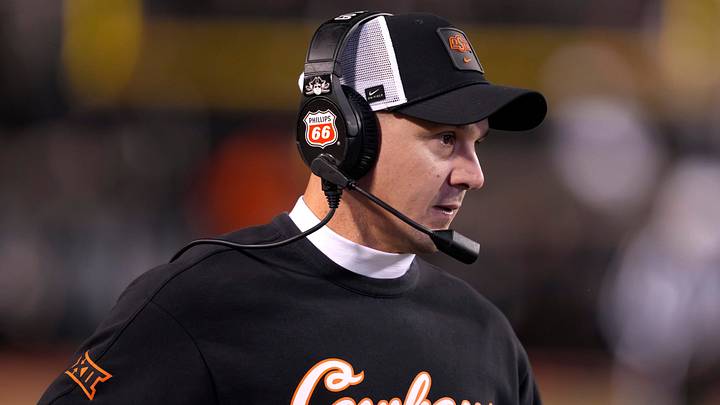
The Oklahoma State Cowboys have given head football coach Eric Morris an early holiday gift.
Per ESPN, the Cowboys have extended Morris’ contract through the 2032 season and raised his pay to an average of $5.25 million per year ($31.5 million total). When he signed his original deal last December it was valued at an average of $4 million per year.
Oklahoma State formally announced the extension on Wednesday but did not announce the terms. It requires Board of Regents approval.
With openings at Baylor and TCU in the Big 12 — along with potential openings around the country after the regular season ends on Saturday — the Cowboys took this step to protect their investment in Morris, who could lead Oklahoma State to an eight-win season with a victory on Saturday over Kansas, which would be a seven-win improvement over last year.
But, by extending him after just one season, the Cowboys are taking a risk, the kind of risk that has drawn criticism around college football circles and has two Big 12 programs weighing potentially expensive buyouts after the season.
The Risk — and Reward — of Extending Eric Morris
Locked In. 🔒️ pic.twitter.com/S2l1iZauyv
— Oklahoma State Athletics (@OSUAthletics) November 25, 2026
The risk is clear. What if Morris can’t continue the program’s rise? Or, at minimum, can’t sustain the current success? Then the Cowboys have an issue, depending upon how the deal is drawn up.
These contracts usually come with buyouts if Morris must be fired at some point. Two current Big 12 contracts — both extensions off originals — show the risk.
Colorado head coach Deion Sanders is in Year 4 with the Buffs. After his 9-4 season in 2024, Colorado extended him. The five-year, $54 million extension features a base salary of $10 to $12 million, depending on the year. If he’s fired without cause — which is usually the case when it comes to wins and losses — he’s owed 75% of the remainder of the deal. If Sanders is fired after this season, his buyout would be around $25 million. That buyout is paid off in installments over a three-year period.


Kansas coach Lance Leipold is another Big 12 coach whose job is on the line after the season. Leipold won nine games in 2023 and signed a five-year extension after the season valued at $7 million per year. His buyout is like Sanders’ — 75% of the remainder. If he’s fired after this season he’s owed more than $17 million, which must be pain installments next year.
Let’s say the figures on Morris’ deal are accurate. The average is $5 million per year. Here is how his buyout would break down if Oklahoma State has to part ways with him, starting after the 2027 season:
After 2027: $19.68 million ($26.25 million left)
After 2028: $15.75 million ($21 million left)
After 2029: $11.81 million ($15.75 million left)
After 2030: $7.87 million ($10.5 million left)
After 2031: $3.93 million ($5.25 million left)
The gamble for Oklahoma State is that Morris keeps building the program, keeps winning and the buyout is nothing more than theoretical. Sanders has won seven games since signing his extension. Leipold has won 14 games since he signed his extension.
Morris’ buyout could be more than $10 million for the first three years of his deal. If his job performance goes south, then that’s part of the athletic department’s math — how long to keep him and how much of a buyout to pay?
There’s the risk. What’s the reward? That’s also simple. Morris has built the Cowboys back into a winning team in Year 1. Now he wants to build a winning program in Year 2 and beyond. The College Football Playoff is about to expand to 24 teams, giving the Cowboys a better chance of making the playoff for the first time in 2027. Securing Morris now protects him from would-be suitors and tells recruits and transfer portal targets alike that he’s in Stillwater to stay.
So, yes there’s risk. Extensions given to head coaches early in their tenures at a university can sometimes go south. But sometimes they don’t. Oklahoma State is taking the risk that it won’t. Right now, after two years lost in college football’s wilderness, it’s a risk worth taking.
 Add us as a preferred source on Google

Matthew Postins is the publisher of Oklahoma State on SI. He is an award-winning sports journalist who was formerly the editor of the College Football America Yearbook and covers the Big 12 Conference for Heartland College Sports.
Follow PostinsPostcard