
Key Takeaways From Penn State Basketball's Loss to Memphis in the Bahamas
In this story:
As soon as No. 24 Memphis and guard Jayden Reid strung together a couple of baskets at the end of the first half, it was effectively over for Penn State men’s basketball. The Nittany Lions didn’t have much of a response before losing 83-70 on Wednesday in the Bahamas.
Reid torched Penn State by scoring a career-high 32 points on 12-for-15 shooting from the field. The Nittany Lions hung around Memphis for much of the first half, but Reid led a 19-9 run before halftime that separated the Tigers.
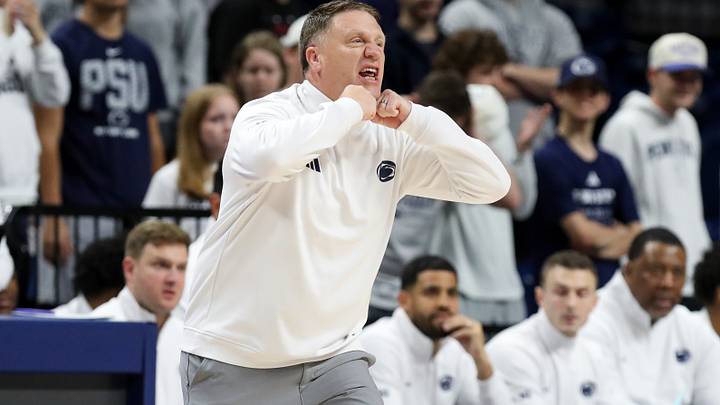
“He's too good of a player to let him get going,” said Penn State coach Mike Rhoades, whose team dropped to 5-2. “We let him get going, and you saw what he did.”
Center Ivan Jurić recorded his seventh consecutive double-double with 19 points and 11 rebounds, but it wasn’t enough to keep Penn State up with Memphis. Here’s what we learned about the Nittany Lions while they lost their first of two games at Battle 4 Atlantis inside Imperial Arena.
Penn State has serious defensive issues

Reid also had nine assists as he led an offense that shot 51.6 percent from the field and 44.8 percent from 3-point range. Memphis had 23 assists on 33 made baskets.
“We just allowed him to space us way too much, and he got the ball hot,” Rhoades said. “A couple times he turned the corner and got into his pull-up that he can get off even against bigger guys contesting him.”
With an average height of 6-7, Penn State had the size advantage over Memphis. Reid is listed at 5-10, and Memphis has an average height of 6-4. But Reid and the Tigers have the speed to make up for that size disadvantage.
Multiple instances saw Penn State’s defense scrambling to try to catch up with Memphis. With the defense out of sorts, the Tigers often found open looks all over the floor, which is why they shot the ball efficiently.
Rhoades said the Nittany Lions want to keep the ball in front of them on defense. Memphis didn’t let that happen with ball screens often opening a lane for Reid to score or allowing him to find an open teammate.
“I thought we got beat off the dribble a lot,” Rhoades said. “That just puts us in rotation. I said it from the start: We have to be able to, on the perimeter, guard the ball, and when you give J-Reid a lot of space, he can go boogie. You're putting us in rotation. You're putting two on the ball to stop him at the rim, and then you're having long closeouts.”
Penn State needs more out of its backcourt

Penn State’s backcourt wasn’t good enough to beat Memphis. Starting point guard Dasonte Bowen had a solid night with nine points and four assists, but he needs help. Guard Thomas Allard went 0-for-6 from 3-point range, and backup point guard Jay Rodgers was a minus-12 in 10 minutes.
The Tigers also pressed Penn State, which had ball-handling issues that made it difficult for the offense to get in rhythm.
“We gotta have more pop in the backcourt,” Rhoades said. “You gotta help each other as well. [It’s] something we've been working on. Everyone's gonna do it to us until we finally make people pay.”
At this point, the best solution seems to be getting the backcourt fully available to play. Guard Roberts Blums missed his sixth straight game due to a broken finger, and Rhoades didn’t have an update on him postgame. Penn State is also waiting on the arrival of point guard commit Savo Drezgic, who’s reportedly joining the team during winter break.
Blums would likely take most of Allard’s minutes once he returns. Allard played 23 minutes against Memphis. Blums, who shot 40 percent from 3-point range at Davidson last season, would help with Penn State having a better shooting day than 5-for-21 from deep.
Rhoades called Blums a “backcourt weapon that we desperately need.” Meanwhile, Drezgic could help take the load off of Bowen, who was productive at times but doesn’t seem to be able to handle a full game’s workload.
“Our backcourt's got to really improve,” Rhoades said. “I really like those guys. They're very coachable. We just got to continue to get tougher and better.”
Penn State needs to get more shots for Brant Byers

Penn State’s key to this season is playing consistent inside-out basketball. Jurić and forward Roko Prkačin often were doubled when they got the ball against Memphis, so finding the open shooter is going to be important.
In particular, wing Brant Byers took only two attempts from 3-point range in the first half. The Nittany Lions have to increase that because of his potential as a shooter. Byers shot over 39 percent from 3-point range last season at Miami (Ohio).
Byers finished with 16 points and 3-for-7 shooting from 3-point range, but five of those attempts came when Penn State was already down by a significant margin in the second half.
Prkačin didn’t respond well to the double, shooting 4-for-11 from the field, which was mostly layup and dunk attempts. Some of those shots could’ve gone to Byers instead to try to add another threat to the offense, which is too reliant on drawing fouls down low.
In addition to getting Byers more shots, other players need to knock down their open looks at a better rate. Forward Josh Reed had 14 points but shot 1-for-5 from 3-point range. Allard never found his mark against Memphis.
Penn State can create an advantage by drawing fouls and did that by shooting 23-for-30 from the free-throw line. But that didn’t come close to factoring into the outcome of the game, which is why the Nittany Lions need more 3-point attempts. It’ll also take a ton of pressure off Jurić and Prkačin.
Sign up to our free Penn State Nittany Lions newsletter, follow us on social media and add Penn State on SI as a Preferred Source on Google.
 Add us as a preferred source on Google

Will Horstman is a journalism student at Penn State University who has covered football, men’s basketball, women’s volleyball and men’s volleyball for The Daily Collegian. He’s covering Penn State sports for Penn State on SI. Follow him on X @WillHorstman_.
Follow WillHorstman_