%22%3E%0A%3Cpath%20d%3D%22M4.44772%2012.9274H0V8.64893H13.945V12.9274H9.49725V23.7693H4.44772V12.9274Z%22%20fill%3D%22white%22%2F%3E%0A%3Cpath%20d%3D%22M14.1895%2016.256V16.209C14.1895%2011.6955%2017.7063%208.3291%2022.2198%208.3291C25.5485%208.3291%2027.7865%209.94646%2029.0653%2012.2596L24.8997%2014.6951C24.3355%2013.6137%2023.5363%2012.8615%2022.154%2012.8615C20.452%2012.8615%2019.3236%2014.3472%2019.3236%2016.162V16.209C19.3236%2018.1743%2020.4896%2019.5565%2022.154%2019.5565C23.5833%2019.5565%2024.3825%2018.7761%2025.0032%2017.6571L29.1688%2020.0079C27.8993%2022.2553%2025.7836%2024.0889%2022.0223%2024.0889C17.8379%2024.0889%2014.1895%2020.9388%2014.1895%2016.256Z%22%20fill%3D%22white%22%2F%3E%0A%3Cpath%20d%3D%22M30.1002%2016.9895V8.6582H35.2344V16.9236C35.2344%2018.8043%2036.2029%2019.6036%2037.5664%2019.6036C38.9298%2019.6036%2039.8984%2018.8701%2039.8984%2017.0365V8.6582H45.0325V16.886C45.0325%2022.0484%2042.0329%2024.0795%2037.5194%2024.0795C33.0058%2024.0795%2030.0908%2022.0108%2030.0908%2016.9989L30.1002%2016.9895Z%22%20fill%3D%22white%22%2F%3E%0A%3Cpath%20d%3D%22M52.3008%208.6582H57.3503V13.9898H61.9673V8.6582H67.0168V23.7692H61.9673V18.3529H57.3503V23.7692H52.3008V8.6582Z%22%20fill%3D%22white%22%2F%3E%0A%3Cpath%20d%3D%22M68.3428%2017.9205V17.8735C68.3428%2014.5447%2071.1073%2011.6956%2074.9909%2011.6956C78.8744%2011.6956%2081.6013%2014.4977%2081.6013%2017.8265V17.8735C81.6013%2021.2022%2078.8368%2024.0514%2074.9532%2024.0514C71.0697%2024.0514%2068.3428%2021.2398%2068.3428%2017.9205ZM76.8903%2017.9205V17.8735C76.8903%2016.7075%2076.0252%2015.7766%2074.9438%2015.7766C73.8625%2015.7766%2073.0444%2016.7075%2073.0444%2017.8265V17.8735C73.0444%2019.0395%2073.9095%2019.9704%2074.9909%2019.9704C76.0722%2019.9704%2076.8903%2019.0395%2076.8903%2017.9205Z%22%20fill%3D%22white%22%2F%3E%0A%3Cpath%20d%3D%22M82.7861%2011.9776H87.6852V14.3566C88.3528%2012.758%2089.4342%2011.7237%2091.3807%2011.8083V17.0083H90.8635C88.7948%2017.0083%2087.6852%2018.1555%2087.6852%2020.7602V23.7598H82.7861V11.9682V11.9776Z%22%20fill%3D%22white%22%2F%3E%0A%3Cpath%20d%3D%22M92.3115%2011.9775H97.2106V13.6231C97.9629%2012.6546%2099.1571%2011.7048%20100.812%2011.7048C103.294%2011.7048%20104.846%2013.3504%20104.846%2016.0021V23.7786H99.9469V17.5818C99.9469%2016.5663%2099.3451%2015.9833%2098.6117%2015.9833C97.8782%2015.9833%2097.2106%2016.5663%2097.2106%2017.5818V23.7786H92.3115V11.9869V11.9775Z%22%20fill%3D%22white%22%2F%3E%0A%3Cpath%20d%3D%22M105.955%2017.9393V17.8923C105.955%2014.3755%20108.485%2011.6956%20112.02%2011.6956C116.205%2011.6956%20118.151%2014.6106%20118.151%2018.1932C118.151%2018.4565%20118.151%2018.7574%20118.132%2019.0113H110.553C110.901%2020.0456%20111.719%2020.591%20112.782%2020.591C113.666%2020.591%20114.399%2020.1773%20115.18%2019.378L117.813%2021.4749C116.647%2022.9888%20114.982%2024.042%20112.434%2024.042C108.569%2024.042%20105.955%2021.6066%20105.955%2017.9299V17.9393ZM113.685%2016.8579C113.581%2015.7389%20112.904%2015.0901%20112.039%2015.0901C111.174%2015.0901%20110.638%2015.7766%20110.487%2016.8579H113.685Z%22%20fill%3D%22white%22%2F%3E%0A%3Cpath%20d%3D%22M118.97%2017.958V17.911C118.97%2014.1779%20121.217%2011.6955%20124%2011.6955C125.796%2011.6955%20126.784%2012.4759%20127.545%2013.3128V8H132.445V23.7598H127.545V22.3117C126.746%2023.1768%20125.843%2024.0419%20124.047%2024.0419C121.198%2024.0419%20118.97%2021.5594%20118.97%2017.9486V17.958ZM127.649%2017.8922V17.8452C127.649%2016.6792%20126.812%2015.7294%20125.684%2015.7294C124.555%2015.7294%20123.718%2016.6604%20123.718%2017.8452V17.8922C123.718%2019.077%20124.565%2020.0079%20125.684%2020.0079C126.803%2020.0079%20127.649%2019.077%20127.649%2017.8922Z%22%20fill%3D%22white%22%2F%3E%0A%3Cpath%20d%3D%22M139.704%208.6582H152.361V12.9743H144.763V14.8925H151.825V18.8231H144.763V23.7692H139.713V8.6582H139.704Z%22%20fill%3D%22white%22%2F%3E%0A%3Cpath%20d%3D%22M153.498%2011.9776H158.397V14.3566C159.065%2012.758%20160.146%2011.7237%20162.093%2011.8083V17.0083H161.575C159.507%2017.0083%20158.397%2018.1555%20158.397%2020.7602V23.7598H153.498V11.9682V11.9776Z%22%20fill%3D%22white%22%2F%3E%0A%3Cpath%20d%3D%22M162.544%2017.9205V17.8735C162.544%2014.5447%20165.308%2011.6956%20169.192%2011.6956C173.076%2011.6956%20175.802%2014.4977%20175.802%2017.8265V17.8735C175.802%2021.2022%20173.038%2024.0514%20169.154%2024.0514C165.271%2024.0514%20162.544%2021.2398%20162.544%2017.9205ZM171.091%2017.9205V17.8735C171.091%2016.7075%20170.226%2015.7766%20169.145%2015.7766C168.064%2015.7766%20167.246%2016.7075%20167.246%2017.8265V17.8735C167.246%2019.0395%20168.111%2019.9704%20169.192%2019.9704C170.273%2019.9704%20171.091%2019.0395%20171.091%2017.9205Z%22%20fill%3D%22white%22%2F%3E%0A%3Cpath%20d%3D%22M176.734%2025.8004L178.248%2022.8384C179.564%2023.5248%20180.881%2023.9574%20182.498%2023.9574C184.332%2023.9574%20185.31%2023.0076%20185.31%2021.3715V21.0236C184.642%2021.7758%20183.542%2022.6409%20181.896%2022.6409C178.85%2022.6409%20176.649%2020.4782%20176.649%2017.2247V17.1776C176.649%2013.8771%20178.897%2011.6956%20181.614%2011.6956C183.345%2011.6956%20184.36%2012.3444%20185.216%2013.2283V11.9777H190.115V20.7885C190.115%2022.97%20189.663%2024.4557%20188.582%2025.5371C187.52%2026.5903%20185.902%2027.2673%20183.269%2027.2673C180.636%2027.2673%20178.624%2026.7501%20176.725%2025.8004H176.734ZM185.329%2017.2058V17.1588C185.329%2016.1433%20184.548%2015.3252%20183.363%2015.3252C182.179%2015.3252%20181.398%2016.1715%20181.398%2017.2058V17.2529C181.398%2018.2684%20182.179%2019.0677%20183.363%2019.0677C184.548%2019.0677%20185.329%2018.2496%20185.329%2017.2152V17.2058Z%22%20fill%3D%22white%22%2F%3E%0A%3Cpath%20d%3D%22M190.829%2022.34L192.493%2019.5566C193.923%2020.4406%20195.512%2020.8731%20196.857%2020.8731C197.336%2020.8731%20197.571%2020.7697%20197.571%2020.4876V20.4406C197.571%2020.2055%20197.355%2020.055%20196.17%2019.7541C193.189%2019.0207%20191.356%2018.2214%20191.356%2015.7766V15.7295C191.356%2013.1343%20193.424%2011.6956%20196.49%2011.6956C198.436%2011.6956%20200.355%2012.1939%20201.784%2013.059L200.232%2015.974C198.982%2015.2876%20197.468%2014.8738%20196.471%2014.8738C195.991%2014.8738%20195.785%2015.0055%20195.785%2015.2406V15.2876C195.785%2015.5227%20196.048%2015.6731%20197.233%2015.974C200.214%2016.7075%20202%2017.5256%20202%2019.9422V19.9892C202%2022.5563%20200.082%2024.0514%20196.885%2024.0514C194.6%2024.0514%20192.522%2023.4684%20190.839%2022.3494L190.829%2022.34Z%22%20fill%3D%22white%22%2F%3E%0A%3Cpath%20fill-rule%3D%22evenodd%22%20clip-rule%3D%22evenodd%22%20d%3D%22M211.368%204.36764C217.191%20-1.45588%20226.632%20-1.45588%20232.456%204.36764C238.279%2010.1912%20238.279%2019.6324%20232.456%2025.4559L221.912%2036L211.368%2025.4559C205.544%2019.6324%20205.544%2010.1912%20211.368%204.36764ZM214.009%207.55761C213.948%207.86849%20213.916%208.39718%20213.916%209.14566V10.4189C213.916%2011.1832%20213.948%2011.7198%20214.013%2012.0267C214.078%2012.3317%20214.278%2012.6168%20214.617%2012.8762C214.956%2013.1376%20215.403%2013.3316%20215.958%2013.4623C216.512%2013.593%20217.1%2013.6584%20217.837%2013.6584C218.573%2013.6584%20219.217%2013.591%20219.769%2013.4524C220.322%2013.3158%20220.761%2013.1178%20221.086%2012.8604C221.411%2012.6029%20221.605%2012.3178%20221.666%2012.0069C221.728%2011.6961%20221.759%2011.1674%20221.759%2010.4189V9.14566C221.759%208.38134%20221.728%207.84473%20221.662%207.53781C221.597%207.23287%20221.397%206.94971%20221.058%206.68834C220.72%206.42696%20220.272%206.23291%20219.718%206.10223C219.163%205.97154%20218.536%205.90619%20217.839%205.90619C217.102%205.90619%20216.459%205.97352%20215.906%206.11213C215.352%206.24875%20214.914%206.44677%20214.589%206.70418C214.265%206.9616%20214.071%207.24673%20214.009%207.55761ZM219.276%2024.8638C222.876%2024.8638%20224.557%2024.2064%20224.557%2021.862V21.858V21.3155C224.557%2019.6581%20223.516%2018.971%20220.252%2018.3136C219.278%2018.1136%20218.908%2017.9136%20218.908%2017.3136V16.9414C218.908%2016.6543%20219.177%2016.5117%20219.413%2016.5117C219.749%2016.5117%20219.918%2016.7137%20219.918%2016.9414V18.1136H224.391V17.3988C224.391%2015.4563%20223.347%2014.4266%20219.177%2014.4266C216.15%2014.4266%20213.896%2015.3414%20213.896%2017.3711V17.7433C213.896%2019.5155%20214.805%2020.3155%20218.201%2021.0303C218.28%2021.0472%20218.355%2021.063%20218.427%2021.0781C219.329%2021.2674%20219.647%2021.3341%20219.647%2021.9174V22.2897C219.647%2022.6619%20219.546%2022.8045%20219.142%2022.8045C218.67%2022.8045%20218.637%2022.5471%20218.637%2022.262V21.2897H213.894V21.7471C213.894%2024.149%20215.476%2024.8638%20219.276%2024.8638ZM225.424%2024.5569H229.925V14.7355H225.424V24.5569ZM226.955%2013.5019H229.925V6.06064H227.092V9.411L225.193%206.06064H222.359V13.5019H225.193V10.1199L226.955%2013.5019ZM218.269%2012.152C218.204%2012.2688%20218.055%2012.3262%20217.825%2012.3262L217.827%2012.3282C217.604%2012.3282%20217.459%2012.2767%20217.398%2012.1758C217.336%2012.0748%20217.305%2011.8074%20217.305%2011.3758V7.90068C217.305%207.51852%20217.352%207.28684%20217.445%207.20962C217.538%207.13239%20217.675%207.09279%20217.851%207.09279C218.059%207.09279%20218.198%207.14031%20218.265%207.23734C218.332%207.33239%20218.366%207.55416%20218.366%207.90068V11.3203C218.366%2011.7579%20218.334%2012.0352%20218.269%2012.152Z%22%20fill%3D%22white%22%2F%3E%0A%3C%2Fg%3E%0A%3Cdefs%3E%0A%3CclipPath%20id%3D%22clip0_15206_214935%22%3E%0A%3Crect%20width%3D%22237%22%20height%3D%2236%22%20fill%3D%22white%22%2F%3E%0A%3C%2FclipPath%3E%0A%3C%2Fdefs%3E%0A%3C%2Fsvg%3E%0A)
When Does College Football Stop Being College Football?
In this story:
A quick note about how this story came to be: Some of our best story ideas at KillerFrogs start in our group text. Someone drops a piece of news, somebody has an opinion, someone else disagrees, and before we know it, we're going back and forth about college football. That's exactly what happened when former TCU center Coltin Deery entered the transfer portal. Jason Phillips had one reaction. JD Andress had another. The debate that followed was too good not to turn into a story. So instead of picking a side, we decided to bring the conversation to you.
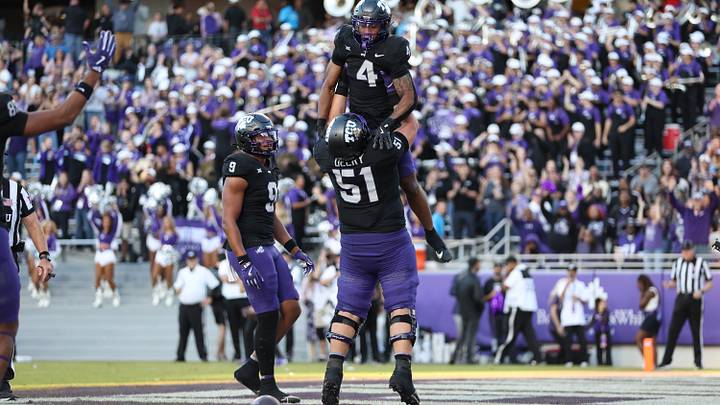
Former TCU center Coltin Deery entered the transfer portal this week, and one question immediately came up in our KillerFrogs group text.
Wait. Wasn't he just in the NFL?
The answer is yes. And no.
Deery went undrafted in the 2026 NFL Draft and participated in the New York Giants' rookie minicamp in May as a tryout invitee. He was not among the undrafted free agents the Giants announced as signed before rookie minicamp.
That distinction matters. A player attending an NFL tryout still has paperwork and participation requirements, but that's not the same thing as signing an NFL Player Contract. The NFL's collective bargaining agreement specifically distinguishes tryout participation from an NFL Player Contract.
Where Is the Line?
It also sparked a debate in the group that lasted considerably longer than any normal group text probably should.
Former TCU linebacker and NFL player Jason Phillips saw Deery's name in the portal and had an immediate reaction.
“So he was in the NFL and now he's in the transfer portal?”
KillerFrogs writer JD Andress quickly corrected him.
“No, mini-camp invite only. Wasn't drafted.”
Jason wasn't convinced that made the bigger issue go away.
And that's where our conversation stopped being about Coltin Deery.
It became a question about college football itself.
Where exactly should college football end and professional football begin?
Deery's Case Isn't as Simple as It Sounds
Before answering that question, it's important to understand exactly how Deery got here.
Deery played his freshman season at Maryland prior to transferring to TCU, where he became a three-year starter. He played four seasons and, under the rules in place at the time, his college career appeared to be over.
Then, he did exactly what you'd expect a college football player with NFL aspirations to do.
He pursued the NFL.
Deery wasn't drafted but participated in the Giants' May rookie minicamp as a tryout player.
For the purpose of this debate, it's important to understand that players have paperwork and participation requirements for a minicamp tryout; they don't have an NFL Player Contract.
Separately, the Giants announced the players they signed as undrafted free agents before the camp, and Deery was not on that list.
Then College Football Changed Again.
On June 23, more than six weeks after the Giants' rookie minicamp, the NCAA approved a new age-based eligibility model. It has often been called “five-for-five,” but the NCAA says that description isn't technically accurate.
The new age-based model generally creates a continuous five-year eligibility period for athletes who meet its enrollment and age requirements. It replaces the old system built around seasons of competition, redshirts and various waiver rules.
But there was a catch.
Student-athletes who used their final season under the previous rules during 2025-26 were not automatically given additional eligibility under the transition rules.
That included Deery.
He filed suit against the NCAA in Tarrant County this week seeking a fifth season of eligibility.
So Deery isn't simply taking advantage of an extra year the NCAA handed him. He's challenging a transition rule that left players in his position out.
That distinction changed the conversation.
The Case for Letting Him Play
JD's argument was about timing and fairness.
When Deery accepted the Giants' rookie minicamp opportunity, the NCAA hadn't adopted its new eligibility model yet.
His college career appeared to be over.
What exactly was he supposed to do?
“He had no choice but to accept an invite to them because that was the only option available,” JD argued in our text exchange.
Then the rules changed.
JD's point wasn't that anyone who fails to make an NFL roster should automatically get to return to college.
His argument was much narrower.
Deery made decisions based on the rules that existed at the time. If the NCAA's new eligibility structure had existed before the NFL Draft, Deery might have had another option.
“Anyone who has a chance to make more money, or further themselves in life, would be unwise to turn it down,” JD said. “That's just what most of these guys are doing.”
That's a pretty reasonable argument.
But Jason sees another side to it.
Somebody Is Always Going to Miss the Cutoff
Jason played at TCU from 2005-08 and started more than 50 games before becoming a fifth-round NFL Draft pick.

He played college football in a completely different world.
There was no NIL.
There was no transfer portal as we know it today.
There weren't multimillion-dollar revenue-sharing pools for college athletes.
Jason helped TCU win football games and build the foundation for what the program became under Gary Patterson. Then he watched the rules change for the generations that followed him.
“I didn't make a single penny,” Jason said during the text thread.
His point wasn't that today's players shouldn't make money.
It was that every major rule change creates a group that barely misses the benefit.
“So you know, I'm gonna go back to my life-is-it-fair point,” Jason said. “There's always gonna be a cutoff year. There's always gonna be a class that gets screwed. There's always gonna be somebody who just didn't have the timing.”
That's the uncomfortable part of changing rules.
Someone will always be the last player who couldn't transfer freely.
Someone was the last player who couldn't profit from NIL.
Someone was the last player who played under the old eligibility system.
The question is whether there can be an exception.
“We can't jeopardize the integrity of college football because a select group of players got gypped and just timing didn't work out for them,” Jason said.
That may be blunt, but his question is fair.
At some point, doesn't there have to be a line?
Deery Isn't Even the Hardest Case
This is where things get a lot messier.
Deery's NFL experience stopped at a rookie minicamp tryout. Wright and Harris went a lot further.

- Dae'Quan Wright signed with the Philadelphia Eagles as an undrafted free agent. Philadelphia waived him, Cleveland claimed him, and Cleveland later waived him.
- Zxavian Harris signed with the New Orleans Saints as an undrafted free agent before being waived.
Both have sought to return to college football at LSU, and their cases have become part of a much larger legal fight over whether former professional players can return to the college game.
A Louisiana judge has since granted a preliminary injunctionallowing Wright and Harris to join LSU's roster, although LSU left both players off its roster for the season opener against Clemson as the legal fight continued.
That's a lot different from attending rookie minicamp as an unsigned tryout player.
Even JD, who argued Deery should have the opportunity to return, saw the distinction immediately.
“The LSU guy who was on the Browns roster is completely different,” he said.
And now we're getting somewhere.
Because perhaps the real question isn't whether former NFL players should be allowed back into college football.

Maybe the question is:
What makes someone a professional football player?
Where Do We Draw the Line?
Consider the possibilities.
Stage | What it means | Where is the line |
|---|---|---|
NFL rookie minicamp invite / tryout | Player participates in an NFL camp on a tryout basis; not the same as an NFL Player Contract | Is simply trying out for an NFL team enough to end college eligibility? |
Signed NFL Player Contract | Player signs with an NFL club, including as an undrafted free agent | Does signing the professional contract cross the line? |
NFL offseason / training-camp roster | Player practices and competes for an NFL roster spot under contract | Has the player now clearly entered professional football? |
NFL preseason appearance | Player appears in an NFL preseason game | Should taking an NFL game snap make the line permanent? |
Practice squad / regular-season roster | Player holds an in-season NFL job | Could college eligibility ever reasonably survive this point? |
That progression is why the wording around Deery matters. Saying he “signed with the Giants” would put him in the same category as Wright and Harris when the known facts don't support that. Saying he attended Giants rookie minicamp as a tryout player accurately describes how far he went into the NFL process without erasing the distinction between a tryout and an NFL Player Contract.
And that's Jason's concern.
Where does this stop?
Is rookie minicamp the line? Signing an NFL Player Contract? Training camp? A preseason snap? A practice squad? A regular-season game?
College football needs an answer because courts, conferences, schools and players are already testing the boundaries.
College Football Has Changed. Again.
JD made another point during our conversation that is difficult to argue with.
“Different times in college football,” he said. “What the rulings are now don't take away from what the players of the past did, or continue to do for programs.”
He's right.
The sport Jason played and the sport Deery is navigating barely operate under the same system.
NIL changed it.
The transfer portal changed it.
Revenue sharing changed it.
Now eligibility rules are changing it again.
That doesn't make every change bad. Some were badly needed.
And it doesn't mean players should turn down opportunities available to them simply because previous generations didn't have those same opportunities.
Jason eventually acknowledged that part, too.
“But I do agree with you that college football is changing, and right now rapidly,” he said.
That's probably the one thing everyone in our group text agreed on.
The harder question is what happens next.
Deery's case might actually be the easiest one to understand. He exhausted his eligibility, went undrafted, attended an NFL rookie minicamp as a tryout player and then watched the NCAA approve a new eligibility model more than six weeks later.
Maybe that deserves another look.
But Wright and Harris push the question further. They signed NFL Player Contracts.
The next player may push it further still.
Eventually, college football is going to have to decide what makes a college athlete a professional athlete and when crossing that line becomes permanent.
Jason and JD don't completely agree on where that line should be.
After listening to both of them, I'm not sure I do either.
But Jason said something during our group-text debate that keeps coming back to me.
There's always going to be a cutoff.
And wherever college football finally decides to put it, somebody is going to be standing on the wrong side.
Editor's note: This article reflects the status of NCAA eligibility rules and related litigation as of Sept. 6, 2026. Court rulings and NCAA or conference actions could change the eligibility status of the players discussed.
 Add us as a preferred source on Google
Ryann Zeller is the co-owner and managing partner of KillerFrogs.com and managing editor and publisher of TCU Horned Frogs On SI. She secured KillerFrogs’ partnership with Sports Illustrated and led the September 14, 2021, launch of KillerFrogs FanNation, now TCU Horned Frogs On SI. She leads the editorial team’s coverage of TCU athletics, with work spanning football, baseball, basketball and the people and traditions that shape the Horned Frog community. She writes the “Dear Opponent” letters and connects fans through original coverage, The Weekly Croak newsletter and KillerFrogs events. Zeller earned her bachelor’s degree in 1998 and master’s degree in 2006 from TCU, where she was a co-ed cheerleader and a member of Kappa Kappa Gamma. She helps carry forward the KillerFrogs community, whose online roots date to 1997. Stay Connected Visit KillerFrogs.com and join the conversation in the KillerFrogs Forum. Follow KillerFrogs on X, Facebook, Instagram, LinkedIn, Threads and YouTube for TCU coverage, interviews and Horned Frog community updates.

Jason Phillips is a TCU Athletics Hall of Fame linebacker, four-time All Mountain West selection, and 2009 NFL Draft pick who spent five seasons in the pros before returning to TCU as a coach. Now writing for KillerFrogs, he brings an authentic, insider perspective to TCU On SI. In his weekly column, The Phillips Standard, Phillips breaks down game film, program culture, and Horned Frog football with the insight only a former player and coach can provide.
Follow MadeMan39
JD is the voice of TCU On SI. He is the writer of the weekly “What Did We Learn” article on football, basketball, and baseball. He covers all things football, MBB, WBB, Baseball. JD hosts many of TCU ON SI’s podcasts, including host of “The Bullpen” (baseball), co-host of “Splash Pad” (women’s basketball), co-host of “Gridiron Frogs” (football), and co-host of “Campus Tour” (multiple sports). Stay up to date by following him on X. Fight em’ till Hell Freezes over and then fight em’ on the ice.
Follow Jdandress11