
UConn's Dan Hurley Blasts NCAA Eligibility Rules
In this story:
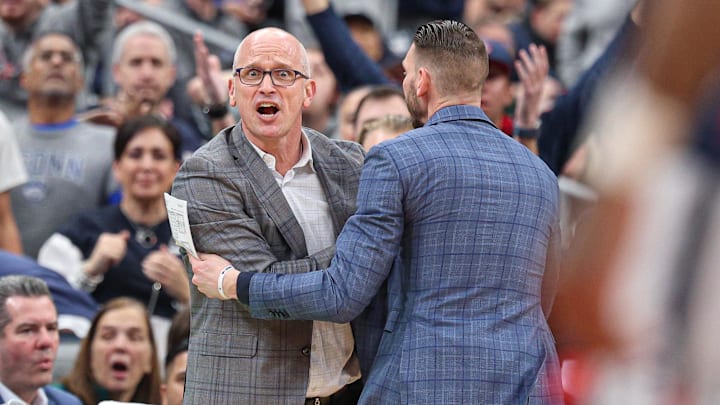
Dan Hurley did not intend to stir controversy when he shared a lighthearted movie clip on social media, but the timing placed him squarely in the middle of college basketball’s latest eligibility debate.
As legal challenges reshape long-standing NCAA policies, the UConn Huskies' head coach used humor to underline a deeper concern: the sport’s rules are becoming increasingly difficult to defend.
Hurley made clear his post was not a criticism of Nate Oats or Alabama, but rather a reflection of how unusual the current landscape has become as professional players find pathways back into college competition.
Hurley’s Remark Highlights a Growing NCAA Dilemma
The moment that sparked conversation came after former Alabama center Charles Bediako secured a temporary court ruling that allowed him to rejoin the Crimson Tide, despite NCAA rules barring players who sign two-way NBA contracts from returning to college.
Bediako, who spent the past three seasons in the NBA G League, is expected to play against Tennessee during the ten-day window granted by a Tuscaloosa Circuit Court judge.
Hurley said he attempted to contact Oats before posting a clip from the Rodney Dangerfield comedy "Back to School", hoping to avoid any misinterpretation. He ultimately chose humor as a way to comment on what he sees as a confusing system.
— Dan Hurley (@dhurley15) January 21, 2026
“I just try to make light of it,” Hurley said. “Can a player that only played three years in football and enters the NFL Draft, can they leave the Arena League next year and go [back to college and] play? … I mean, s--- is absurd.”
While Hurley stressed that Alabama followed the rules available to it, he described the broader environment bluntly.
“It is a sh--show,” he said. “We’ve got just a lot of issues. Anybody that pretends … that everything is going well and that this is normal, that is just … what are we doing?”
His comments reflect frustration shared quietly by many coaches navigating eligibility questions that now stretch beyond the NCAA’s traditional authority.
Bediako Case Puts NCAA Rules Under Legal Pressure
Bediako’s situation underscores why the debate has intensified. After playing for Alabama in the 2021-22 and 2022-23 seasons, he entered the NBA Draft, went undrafted, and signed a two-way deal with the San Antonio Spurs.
Although he never appeared in an NBA game, he logged 45 G League appearances, including 34 last season with the Grand Rapids Gold, where he averaged 10.4 points and 9.3 rebounds in 25.2 minutes per game.
NCAA bylaws prohibit players who sign such contracts from returning to college. Bediako challenged that restriction in court, arguing unequal treatment compared with players who compete professionally overseas. A full hearing on the matter is scheduled for Jan. 27, but the temporary ruling has already allowed him to rejoin Alabama practices and games.
Hurley said his own program will not pursue players with professional experience, noting that he aligns with the philosophy of Tom Izzo at Michigan State.
“We want to recruit high school players, develop them, keep them,” Hurley said. “If at some point the sport has changed so much that you can’t be effective doing it that way, then either I will get out of college coaching, or I don’t know.”
As lawsuits mount and precedents shift, Hurley’s reference landed because it captured a serious truth. College basketball is operating in unfamiliar territory, and even its most successful coaches are openly questioning where the lines should be drawn.
- Geno Auriemma Sees Rare Potential in UConn Newcomer
- UConn Building Title Case Around Sarah Strong’s Historic Pace
- Looking Back On UConn's Game-Changing Two Year Run
- UConn Lands Michigan Assistant for Offensive Line Role
- Azzi Fudd Joins Exclusive UConn Record Club
 Add us as a preferred source on Google
Aman Sharma is a sports writer who covers college, professional football, and basketball with an eye for detail and storytelling. With over two years of experience writing for outlets like The Sporting News, Pro Football & Sports Network, Sportskeeda, and College Football Network, he’s covered from the NFL and NBA to the NCAA and breakout athletes with a fan’s instinct and depth. Off the field, Aman is a gym and badminton enthusiast.