
Looking Back On UConn's Game-Changing Two Year Run
In this story:
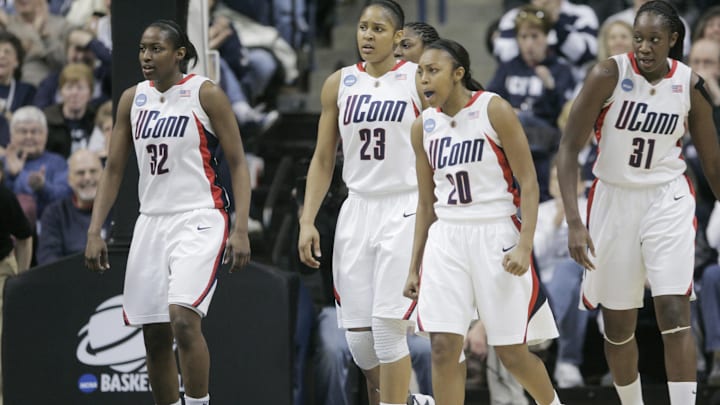
Between 2008 and 2010, the UConn Huskies women’s basketball team didn’t just dominate the sport — they redefined it.
Under Geno Auriemma, the Huskies went an astonishing 78–0 across two seasons, winning back-to-back national titles. They set a new standard for excellence, changing how programs approached recruiting, player development, and team culture.
Powered by Maya Moore and Tina Charles, UConn didn’t merely win games — they made perfection look inevitable.
In those two years, they elevated women’s college basketball from a regional draw into a national benchmark for sustained greatness, proving that dominance could be both beautiful and relentless.

What followed wasn’t just a dynasty — it was a transformation of how success in college basketball would forever be measured.
The Perfection That Rewrote the Standard
From 2009 to 2010, the UConn Huskies went a combined 78–0, the only women’s program ever to record back-to-back undefeated seasons. Led by Maya Moore and Tina Charles, they overwhelmed opponents, winning 60 of those games by 20 points or more.
Only one matchup during that span was decided by single digits. This wasn’t against soft competition — they beat Oklahoma twice, North Carolina twice, Stanford twice, Duke, Florida State twice, Baylor, Texas, and a ranked Big East field that included Notre Dame, Louisville, and West Virginia.
In women’s college basketball, only one program has ever run off back-to-back undefeated seasons: the UConn Huskies. Led by Maya Moore and Tina Charles, they went 39–0 in 2009 and duplicated the feat in 2010.
— I talk hoops 🏀 (@trendyhoopstars) October 23, 2025
Across those seasons, Moore produced (19.1) points, (8.6) rebounds,… pic.twitter.com/0rTXukLm1v
Moore averaged 19.1 points, 8.6 rebounds, 3.6 assists, 2.0 steals, and 1.3 blocks per game, while Charles added 17.3 points, 9.2 rebounds, and 2.0 blocks.
Together, they formed one of the most complete inside-out duos the game has ever seen. Charles’ 25-point, 19-rebound performance in the 2009 national championship remains one of the most dominant in history — her 19 boards are the third-most ever in a title game.
Moore’s 2010 tournament run was equally historic: 24.0 points, 8.3 rebounds, and 2.8 assists per game in just 26.7 minutes. Scaled to a starter’s workload, she averaged nearly 29 points and 10 rebounds.
Her 34-point, 12-rebound showing against Baylor in the Final Four remains the most points ever scored by a player on a championship team in that round.
She saved her best for the moment that defined the dynasty. In the 2010 national championship, UConn trailed Stanford at halftime before Moore erupted for 18 points in the second half, finishing with 23 points and 11 rebounds to seal perfection again.
UConn launched a 90-game winning streak, the longest in NCAA women’s history at the time. UConn later broke its own record with 111 straight wins, but it was the 2009–10 teams that built the blueprint.
They changed the game’s expectations. UConn proved that excellence could be sustainable, that women’s basketball could dominate headlines, and that precision, conditioning, and unselfish play could produce greatness year after year.
The program’s model — built on leadership from stars like Renee Montgomery, depth from Kalana Greene, Tiffany Hayes, and Caroline Doty, and relentless accountability — became the gold standard every other contender studied.
Since that run, UConn has won 12 national championships and produced 12 AP National Players of the Year, from Rebecca Lobo to Paige Bueckers. Auriemma, now with 1,217 career victories, stands as the winningest coach in college basketball history.
Those two seasons didn’t just crown a champion — they changed the way college basketball defines one
- UConn's Azzi Fudd Gets Real About Excitement of Healthy Season
- UConn Fans React to Azzi Fudd's Silence on Paige Bueckers' Birthday
- UConn’s Joe Fagnano Puts On a Show vs. Boston College
- UConn Lands 4-Star Forward Commitment
- UConn Season Opener Could Face Major Changes
 Add us as a preferred source on Google
Aman Sharma is a sports writer who covers college, professional football, and basketball with an eye for detail and storytelling. With over two years of experience writing for outlets like The Sporting News, Pro Football & Sports Network, Sportskeeda, and College Football Network, he’s covered from the NFL and NBA to the NCAA and breakout athletes with a fan’s instinct and depth. Off the field, Aman is a gym and badminton enthusiast.