%22%3E%0A%3Cpath%20d%3D%22M0%2016.7191V3.98413H7.85305V16.614C7.85305%2019.4801%209.33386%2020.7029%2011.4165%2020.7029C13.4992%2020.7029%2014.98%2019.5852%2014.98%2016.7764V3.98413H22.8331V16.5567C22.8331%2024.4384%2018.2474%2027.5433%2011.3497%2027.5433C4.45197%2027.5433%200%2024.3811%200%2016.7286V16.7191Z%22%20fill%3D%22white%22%2F%3E%0A%3Cpath%20d%3D%22M23.492%2023.6165L27.6191%2018.706C30.1222%2020.6167%2032.9978%2021.4096%2035.7015%2021.4096C37.0867%2021.4096%2037.6791%2021.0466%2037.6791%2020.4161V20.3492C37.6791%2019.69%2036.953%2019.3269%2034.4786%2018.8302C29.3006%2017.7793%2024.7435%2016.2889%2024.7435%2011.407V11.3401C24.7435%206.95503%2028.1732%203.55396%2034.5455%203.55396C38.9975%203.55396%2042.2935%204.60485%2044.9685%206.71619L41.2043%2011.9325C39.0261%2010.3466%2036.418%209.6587%2034.278%209.6587C33.122%209.6587%2032.5966%2010.0504%2032.5966%2010.6141V10.6809C32.5966%2011.3115%2033.2271%2011.7032%2035.6633%2012.1617C41.5674%2013.2509%2045.5226%2014.9609%2045.5226%2019.6135V19.6804C45.5226%2024.5337%2041.5292%2027.4953%2035.3289%2027.4953C30.6476%2027.4953%2026.4249%2026.1769%2023.4824%2023.607L23.492%2023.6165Z%22%20fill%3D%22white%22%2F%3E%0A%3Cpath%20d%3D%22M46.9082%2015.601V15.5341C46.9082%208.63642%2052.2869%203.49658%2059.175%203.49658C64.2575%203.49658%2067.6873%205.97096%2069.6362%209.49624L63.2735%2013.2221C62.4137%2011.5694%2061.1908%2010.4229%2059.089%2010.4229C56.4809%2010.4229%2054.7708%2012.6967%2054.7708%2015.4672V15.5341C54.7708%2018.5339%2056.5478%2020.6453%2059.089%2020.6453C61.2673%2020.6453%2062.4901%2019.4606%2063.4455%2017.741L69.8082%2021.3331C67.8592%2024.7629%2064.6301%2027.5716%2058.8884%2027.5716C52.4875%2027.5716%2046.9178%2022.7566%2046.9178%2015.601H46.9082Z%22%20fill%3D%22white%22%2F%3E%0A%3Cpath%20d%3D%22M85.8395%2010.5188H79.0469V3.98413H100.351V10.5188H93.5588V27.0752H85.8395V10.5188Z%22%20fill%3D%22white%22%2F%3E%0A%3Cpath%20d%3D%22M101.707%209.06638H109.197V12.6967C110.219%2010.251%20111.872%208.67468%20114.833%208.80843V16.757H114.041C110.878%2016.757%20109.187%2018.5053%20109.187%2022.4987V27.0845H101.697V9.06638H101.707Z%22%20fill%3D%22white%22%2F%3E%0A%3Cpath%20d%3D%22M115.531%2018.1425V18.0756C115.531%2012.9931%20119.754%208.64624%20125.687%208.64624C131.619%208.64624%20135.785%2012.9358%20135.785%2018.0183V18.0852C135.785%2023.1677%20131.562%2027.5241%20125.62%2027.5241C119.677%2027.5241%20115.521%2023.2346%20115.521%2018.1521L115.531%2018.1425ZM128.591%2018.1425V18.0756C128.591%2016.2987%20127.272%2014.8752%20125.62%2014.8752C123.967%2014.8752%20122.715%2016.2891%20122.715%2018.0088V18.0756C122.715%2019.8526%20124.034%2021.2761%20125.687%2021.2761C127.339%2021.2761%20128.591%2019.8622%20128.591%2018.1425Z%22%20fill%3D%22white%22%2F%3E%0A%3Cpath%20d%3D%22M135.164%2032.1958V27.8107H135.728C137.113%2027.8107%20137.677%2027.2852%20137.677%2025.6707V9.06653H145.167V25.7949C145.167%2030.9443%20142.53%2032.4537%20138.145%2032.4537C137.056%2032.4537%20135.967%2032.2913%20135.174%2032.1862L135.164%2032.1958ZM137.533%203H145.281V7.78635H137.533V3Z%22%20fill%3D%22white%22%2F%3E%0A%3Cpath%20d%3D%22M147%2021.9638V21.8969C147%2018.3048%20149.675%2016.2889%20153.859%2016.2889C155.378%2016.2889%20157.327%2016.6233%20158.111%2016.9481V16.652C158.111%2014.9992%20157.089%2014.0438%20154.777%2014.0438C152.933%2014.0438%20151.385%2014.4355%20149.799%2015.0661L148.481%2010.0887C150.554%209.29571%20152.933%208.77026%20156.066%208.77026C159.725%208.77026%20162.104%209.525%20163.69%2011.1109C165.047%2012.4675%20165.572%2014.2158%20165.572%2016.8144V27.075H158.082V25.2598C156.831%2026.6164%20155.149%2027.5049%20152.904%2027.5049C149.446%2027.5049%20147%2025.5273%20147%2021.9638ZM158.187%2020.4161V19.6614C157.757%2019.499%20157.098%2019.3652%20156.468%2019.3652C154.987%2019.3652%20154.156%2020.2537%20154.156%2021.381V21.4479C154.156%2022.4988%20154.91%2023.1962%20155.875%2023.1962C157.194%2023.1962%20158.187%2022.1453%20158.187%2020.4256V20.4161Z%22%20fill%3D%22white%22%2F%3E%0A%3Cpath%20d%3D%22M167.817%209.06663H175.307V11.5697C176.463%2010.0889%20178.279%208.63672%20180.82%208.63672C184.613%208.63672%20186.991%2011.1398%20186.991%2015.2V27.0752H179.501V17.6075C179.501%2016.0599%20178.575%2015.1618%20177.457%2015.1618C176.339%2015.1618%20175.317%2016.0503%20175.317%2017.6075V27.0752H167.827V9.06663H167.817Z%22%20fill%3D%22white%22%2F%3E%0A%3Cpath%20d%3D%22M187.947%2024.8969L190.489%2020.6456C192.667%2022.0022%20195.103%2022.6614%20197.147%2022.6614C197.873%2022.6614%20198.236%2022.499%20198.236%2022.069V22.0022C198.236%2021.6391%20197.902%2021.4098%20196.096%2020.9513C191.549%2019.8335%20188.74%2018.6106%20188.74%2014.8847V14.8179C188.74%2010.8627%20191.902%208.64624%20196.593%208.64624C199.564%208.64624%20202.497%209.40097%20204.676%2010.7289L202.297%2015.1809C200.386%2014.13%20198.074%2013.4995%20196.555%2013.4995C195.829%2013.4995%20195.504%2013.7001%20195.504%2014.0631V14.13C195.504%2014.493%20195.896%2014.7223%20197.711%2015.1809C202.259%2016.2987%20205%2017.5597%20205%2021.2474V21.3143C205%2025.2408%20202.067%2027.5146%20197.186%2027.5146C193.689%2027.5146%20190.527%2026.6261%20187.947%2024.9065V24.8969Z%22%20fill%3D%22white%22%2F%3E%0A%3Cpath%20fill-rule%3D%22evenodd%22%20clip-rule%3D%22evenodd%22%20d%3D%22M214.368%204.36764C220.191%20-1.45588%20229.632%20-1.45588%20235.456%204.36764C241.279%2010.1912%20241.279%2019.6324%20235.456%2025.4559L224.912%2036L214.368%2025.4559C208.544%2019.6324%20208.544%2010.1912%20214.368%204.36764ZM217.009%207.55761C216.948%207.86849%20216.916%208.39718%20216.916%209.14566V10.4189C216.916%2011.1832%20216.948%2011.7198%20217.013%2012.0267C217.078%2012.3317%20217.278%2012.6168%20217.617%2012.8762C217.956%2013.1376%20218.403%2013.3316%20218.958%2013.4623C219.512%2013.593%20220.1%2013.6584%20220.837%2013.6584C221.573%2013.6584%20222.217%2013.591%20222.769%2013.4524C223.322%2013.3158%20223.761%2013.1178%20224.086%2012.8604C224.411%2012.6029%20224.605%2012.3178%20224.666%2012.0069C224.728%2011.6961%20224.759%2011.1674%20224.759%2010.4189V9.14566C224.759%208.38134%20224.728%207.84473%20224.662%207.53781C224.597%207.23287%20224.397%206.94971%20224.058%206.68834C223.72%206.42696%20223.272%206.23291%20222.718%206.10223C222.163%205.97154%20221.536%205.90619%20220.839%205.90619C220.102%205.90619%20219.459%205.97352%20218.906%206.11213C218.352%206.24875%20217.914%206.44677%20217.589%206.70418C217.265%206.9616%20217.071%207.24673%20217.009%207.55761ZM222.276%2024.8638C225.876%2024.8638%20227.557%2024.2064%20227.557%2021.862V21.858V21.3155C227.557%2019.6581%20226.516%2018.971%20223.252%2018.3136C222.278%2018.1136%20221.908%2017.9136%20221.908%2017.3136V16.9414C221.908%2016.6543%20222.177%2016.5117%20222.413%2016.5117C222.749%2016.5117%20222.918%2016.7137%20222.918%2016.9414V18.1136H227.391V17.3988C227.391%2015.4563%20226.347%2014.4266%20222.177%2014.4266C219.15%2014.4266%20216.896%2015.3414%20216.896%2017.3711V17.7433C216.896%2019.5155%20217.805%2020.3155%20221.201%2021.0303C221.28%2021.0472%20221.355%2021.063%20221.427%2021.0781C222.329%2021.2674%20222.647%2021.3341%20222.647%2021.9174V22.2897C222.647%2022.6619%20222.546%2022.8045%20222.142%2022.8045C221.67%2022.8045%20221.637%2022.5471%20221.637%2022.262V21.2897H216.894V21.7471C216.894%2024.149%20218.476%2024.8638%20222.276%2024.8638ZM228.424%2024.5569H232.925V14.7355H228.424V24.5569ZM229.955%2013.5019H232.925V6.06064H230.092V9.411L228.193%206.06064H225.359V13.5019H228.193V10.1199L229.955%2013.5019ZM221.269%2012.152C221.204%2012.2688%20221.055%2012.3262%20220.825%2012.3262L220.827%2012.3282C220.604%2012.3282%20220.459%2012.2767%20220.398%2012.1758C220.336%2012.0748%20220.305%2011.8074%20220.305%2011.3758V7.90068C220.305%207.51852%20220.352%207.28684%20220.445%207.20962C220.538%207.13239%20220.675%207.09279%20220.851%207.09279C221.059%207.09279%20221.198%207.14031%20221.265%207.23734C221.332%207.33239%20221.366%207.55416%20221.366%207.90068V11.3203C221.366%2011.7579%20221.334%2012.0352%20221.269%2012.152Z%22%20fill%3D%22white%22%2F%3E%0A%3C%2Fg%3E%0A%3Cdefs%3E%0A%3CclipPath%20id%3D%22clip0_15197_212890%22%3E%0A%3Crect%20width%3D%22240%22%20height%3D%2236%22%20fill%3D%22white%22%2F%3E%0A%3C%2FclipPath%3E%0A%3C%2Fdefs%3E%0A%3C%2Fsvg%3E%0A)
Gary Patterson Speaks Candidly About New Role With USC Trojans, Lincoln Riley
In this story:
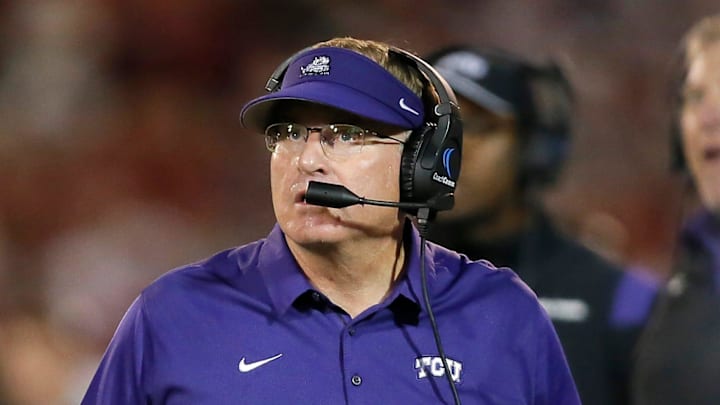
USC Trojans defensive coordinator Gary Patterson spoke at length with the media on Friday, explaining some of his defensive concepts and cornerstones while also revealing his impressions of his first five weeks within the USC program, working for Trojans coach Lincoln Riley.
See everything that Patterson had to say:
On his first few weeks:
"Great. Seems like it's been almost five since the last week of January, so it flew by," Patterson said.

"Yeah, it's been good. You get a chance to get to know the kids. The last time you you've me you said what's the difference as a head coach? Well, it's really not a head coach, but as a coordinator, you get a chance to work with the kids a lot more in the spring, before spring ball, and then after and then in the summertime. So, you know, for me I've never had this luxury, so it's awesome. Which I consider myself a good teacher."
"And we have, I don't know, over 50 percent of our team is new, right? So how do you grow up, all your freshmen, all your transfers, all those guys, comes in when you have this much more time. You get three, basically, lifting cycles. And then you also get the amount of time that you get to where you can teach and show them through things. And freshman, no longer by the time they get to August, they shouldn't be like freshman anymore, so that's the goal," Patterson continued.
On USC's new defensive coaches Sam Carter, Paul Gonzales:
"Well, they talk just like I do. So the key for them, it allows you to speak at speed, and then it speeds up the rest of the room, because if I'm not around, they answer questions. One of the things that's advanced, they did some good things. They did some good things last year defensively, some of the things we've incorporated. So initially it took a little bit more time, how we called things, how we interacted. I was doing this for a long time, so all the stuff the way I call it, we changed it. So people didn't know. Speaking to a mic, there's still times where you're gonna have to signal," said Patterson.
"So how we signal, how we talk into the mic, how we talk to the defense itself. One of the things we're doing this spring, nowadays, both offense and defense have gone with one word calls. You have to memorize. Well, for a new team, like we have, a lot of pressure and stuff. That's a lot of information. So what we're doing is we're actually giving them the whole, I call it an English sentence. So it tells everybody exactly what to do. So a young player actually speeds up his learning process. And then the farther we get into spring, we'll start eliminating words," the USC defensive coordinator said.
"And so by the time you get to first game in September, you're back down to one word, but your whole team is down to one word" said Patterson. "So now your freshmen, they've caught up with your seniors. So I told them, the first time I used a whole sentence to make a call, and then the older guys looked at me. And I said, 'Look, this is not based off of what you guys know. We're only gonna be as good as our whole team is gonna be when we get to the first ballgame.' And so it's really helped."

"And then there's already a group of calls that we have that they've already learned that we weren't kind of worried about. So really it's about doing it over and over again like anything else. And you learn, you do it. And so it's been, for me, the thing that I like best about coaching is young coaches, young players, get a chance to do all that, watching them progress, mature, not just on the field, but off the field. So a lot of fun," he said.
On having two defensive calls for a play:
"It's easier now because you've got a microphone to tell them what to do up front or in the secondary. And so for me, the thing is, when you get into one-word calls, then sometimes you're just going to have the guy on the microphone come get it, but then he just tells everybody. And we'll use all of the above, depending on how fast you're going, what they're trying to do to you. The biggest thing is to explain to the kids what we're doing," said Patterson.
"I think that's one of the things that's, for me to think that 50 percent of the defense is new, especially the secondary, and you're gonna ask them to stay up with the guys who've been doing it for two years, especially the staff," said Patterson. "So what we've done is all the stuff that they did here before, we don't have to work on it as much. So it's allowed us to be more multiple because the kids already know, you got one scheme that you did, and so we're going to add another scheme to it."
"And so what happens is you can teach them the stuff that they don't know as well a lot more, catch them up with where they know what they do what they've already played for the last two years. So for me it's it's easier. That's why I was always hoarse at the end ball games to try at the last moment to check something. Well now you're telling the guy on the microphone what to look for. Give him the call, then tell him what to look for. 'Hey, tell everybody, 3rd and 10, usually they run the quarterback draw.' That's what everybody does."

"So then what you see offenses doing, they shut the microphone off 15 seconds. So you see them now where they'll huddle, and they get close to the line of scrimmage, and they wait till 15's done, so then you can't do that," said Patterson.
"That's when the double call helps you, because I can call the front, tell him the blitz, and then I can tell the secondary after they break the huddle what I want. So there's a plethora of different ways that we can do it, depending on how they decide they want to run their offense. Big Ten, a lot of the offenses are a lot lot slower coming out of the huddle, which gives us a lot more concept of how we want to do it," he continued.
MORE: USC Fans Will Love Makai Lemon's Player Comparison Before the NFL Draft
MORE: What Lincoln Riley Said About New USC Defensive Tackles Coach Skyler Jones
MORE: The Biggest Question USC Faces at Running Back
SIGN UP FOR OUR NEWSLETTER HERE!
On holding players accountable:
"Just depends on what's your age, what's the problem, how many chips did they have in the game? You know, everybody's going to be held accountable, but it's never an equal world. The world outside of football's not that way, so when people put chips in the game, they're always right, and they screw up once it's one thing. . . . But, you know, that's where I like the answer, where the answer comes really easy. Now that I'm not the head coach, that's a question for Coach Riley," said Patterson.
What he's looking for from new players.
"It's no different. It's not different. I mean, 47 years, every year you start the same. Go back to the beginning. It's just like John Wooden's pyramid. John Wooden's pyramid at the bottom was accountability, trust, work ethic, all of the stuff. Whether they're older or younger, it doesn't matter. Everybody starts a clean slate, and everybody builds their resume. How do you lift? How do you run? How do you learn. Do you spend extra time? It's all the same, not only just with players, but as coaches," said Patterson.
"I mean, it's our job to put them in a situation to be successful. And we're not doing something that we aren't, then you change. And I'm one of those guys, that's how you stay somewhere for 25 years," he continued. "I laugh because people go online and they see my teaching tapes. Well, I made those in 1998. Well, it's only about 28 years since I made it. . . ."
"'Coach P plays the 4-2-5,' No, not really," Patterson said. "There's some things that are a little bit the same, but I mean, 28 years, when you run the same stuff, and you stay somewhere 25 years, you have to be able to tweak it, and you have to evolve. And so we've evolved. And the fun thing to be about here is there's things that they did really well defensively, and we're gonna keep those. There's things that maybe we need to tweak, or maybe it wasn't quite as good. And then we'll add stuff in that, 'Hey, I think it allows us to have, schematically allows us to do things.'"
"For example, you know, I think we have a very high level of defensive ends, rush guys. We dropped them a lot last year, so it's like Ed Orgeron told Dave Aranda the year they won the national championship. The guy that played for LSU that was rushing in is now with the Patriots. He said, 'No, we're not gonna drop you. This is what he gets paid for. He gets paid to rush the passer.' And so as we're going right now, we're looking at how do we take our strengths and we go on within the scheme."
"How do we work on our weaknesses within the scheme," Patterson said. "And then here shortly, once we get about the end of spring ball, we'll start breaking down our first eight opponents. And then, so in the summer, when you come into two-a-days, there's things within what they do that we don't have an answer for. You start working on them in fall camp, you don't work on them starting Sunday night, the first week of the plan. And so what does that mean? Less vacation."
"Like I said in a comment back at the Davey O'Brien Award, I didn't come to California for the sun. I came here to get better on defense and get done what needed to get done. We do that and if I have time for a little sun or a little ocean or whatever, then great. But that's not the goal, so," he continued.

If any personalities have stood out to him:
"Kids nowadays all have personalities. I mean, the key is, to enjoy each other when we do, but understand when it's time that we're trying, because they all feel like they could be in the NFL. You know, and I've always been one of those guys that you teach so that a guy that's maybe only ability-wise can be an undrafted free agent or a seventh or sixth round pick. We do things in the program and give them an opportunity to get in the camp," said Patterson.
"If you do that, it's always going to work for the first or second rounders. If you're working in the weight room like that if you're working how to practice like that, you do all that well, then it always helps. It always helps your first and second graders," he continued. "But it really helps the guys that everybody says, 'Ah, he'll never make it.' I mean, I think, and I'm not, you know, counting the guys the last couple of years that we've recruited that have been at TCU, you know, we're probably around 55, 60 graduates. But I think we're around 150 counting free agents over 25 years," he continued.
"And so those are the numbers, because there's guys that made it, that were undrafted, that made teams for four, 10 years. So a lot of people get on. That's why I was one of those guys that could take a tailback and turn them into a defensive end. You gotta trust your abilities to be able to change people. The only person I don't try to change is my wife, as you guys understand. I just say 'Yes, dear,' and it all works from that standpoint."
"Everybody else, including me, I think if you're gonna be a leader, one thing you have to do is look yourself in the mirror and look at yourself and say, 'Did I do what I needed to do to make it successful.' And so that's what I'm doing right now," said Patterson. "It's like practice in spring ball. Out of 15 practices, the first five are teaching. Everybody's learning. Then the second five are evaluation, and you're getting better, working on getting better. And the last five are evaluation, trying to figure out who your top 22 to 30 different players are," said Patterson.
"And then when you get to fall, then you get 25 practices. Then you're about at seven teaching, about nine or 10 improving. And then you have about six to eight somewhere there that you're getting ready for the next opponent. And so that's kind of the way I look at this. So right now, We're still part of the five-day deal."
"We haven't started practice, but all the things we're doing is all about teaching right now. Trying to make sure that before we touch the first day of practice, that we have touched everything that we're going to teach in our scheme. So, long answer to a short question, right? You've got to be careful what you ask for."
On instilling new practice habits:
"They're already finding that out. Number one in this day and age, because everybody's on the phones, everything to do with their fingers, as far as texting and doing all this, they don't communicate. The best thing about defense, kind of like the quarterback, the quarterback couldn't audible, then you've got a problem. But on defense, you've got to be able to communicate, period," said Patterson.
"You've got to be able to tell, the corner's got to be able to tell the inside player that the wide receiver's coming in, the guy on the inside's got to be able to tell the corner that the wide receiver's coming out. How we're lining up, how we're blitzing, how we're covering, all of it. Communication is really the number one thing anywhere. When I went to Texas, Baylor, and here at the NTC, it's all about everybody has to become a quarterback. You've got to be able to communicate. When you do, you're a lot more accountable because coaches can't be on the field. So it helps them if they work together how to fix those," he continued.
On the keys to a great defense:

"You've got to be physical, you've got to tackle, and you've got to play with leverage. Leverage means you don't let them deeper than you are. Lou Holtz had a saying, 'Inside and in front.' So you start outside the ball, you don't let the ball cross your face, and you start inside the ball, you don't let the ball cross your face," said Patterson.
"If you do that, then there's no big plays happening. Anytime that happens, usually when a big play happens, those kind of things happen too. So those, you don't need to make everything. I mean, our safety is told, 'Don't go till you know.' When you're playing play action, don't be go running up. Don't be going running back until you know," USC's defensive coordinator continued.
Any Trojans who are standing out:
"Well, number one, here's what you're gonna learn from me. Coach Riley's job is to be high and low. I'm an understate over play person. Defensive guys in general, 'How do we hold them to one less point.' That's what my job is. And so, I really like the group. I think they're good people, I think there's a lot of ability in the group. Potential doesn't do much for us. So how do we put guys in position, like I was saying earlier, how do we put guys in position to be successful and use their abilities? Do we have weaknesses?" said Patterson.
"How do we do a good job of changing coverages or fronts or whatever we need to do to hide them? Everybody has them, usually the team that doesn't have them. I was talking to one of the quarterbacks who's in the final four. He said we probably won't have one first or second round draft choice on this side of the ball. But they were in the last four teams playing in the playoffs. So how do you play well together? How do you do things? And so all that stuff is taken into consideration."
"Because really after those first five, six practices in the spring, then you're all about, now it's about they should know it, or they've already heard it. So how do we improve it? And then you get in the last five, and it's about how do we move forward and make them, How do we put them all together so we have top 22, so you're two deep, maybe 25, you're lucky you have 30. There's always guys we know that are gonna keep improving, especially we have so many freshmen, 'cause the class was so good."
"We've got guys at the end of the group that we're really doing things where we make sure that three huddles get a chance to learn it all and do it. So that way the freshmen, because there's some very talented freshmen also besides the older guys, that they're learning right now. We're not just standing and waiting, and then you run off. In the NFL, usually they work one huddle. Everybody has to get visual reps," said Patterson.
"In college, it's not the way it works. In the NFL, you can't touch anybody up to five yards. We can touch people everywhere, as far as being able to get down the field where we can be physical and do things," he continued. "And so the game's just different. And so it allows the defense to be a little bit more, and we need to make sure we take advantage of that."
On rushing the passer:
"What's the one that gets the guy over? Because you're breaking protections. Everybody said, well, who's your best blitzer? The guy that's not blocked. And to be honest with you, it's about as simple as that. My job is to get guys who are breaking schemes down that we get a guy that's unblocked. So that's the best blitzer we can have is a guy that we break the protection where you have a guy coming free. . . ."
 Add us as a preferred source on Google
Charlie Viehl is the deputy editor for the Oregon Ducks, Colorado Buffaloes, and USC Trojans on SI. He has written hundreds of articles for SI and has covered events like the Big Ten Championship and College Football Playoff Quarterfinals at the Rose Bowl. While pursuing a career in sports journalism, he is also a lifelong musician, holding a degree in Music and Philosophy from Boston College. A native of Pasadena, California, he covered sports across Los Angeles while at Loyola High School and edited the Gabelli Presidential Scholars Program’s magazine at BC. He is excited to bring his passion for storytelling and sports to fans of college athletics.