%22%3E%0A%3Cpath%20d%3D%22M0%205.12903H12.8817C17.559%205.12903%2020.5268%206.30107%2022.3762%208.13977C23.9569%209.7204%2024.7848%2011.6881%2024.7848%2014.3978V14.4731C24.7848%2018.3118%2022.7848%2020.9892%2019.5805%2022.5375L25.7203%2031.5052H15.6558L10.6774%2023.9676H8.79565V31.5052H0V5.12903ZM12.6236%2017.6773C14.7311%2017.6773%2016.0107%2016.7311%2016.0107%2015.1182V15.043C16.0107%2013.344%2014.6881%2012.5161%2012.6558%2012.5161H8.81716V17.6773H12.6236Z%22%20fill%3D%22white%22%2F%3E%0A%3Cpath%20d%3D%22M25.8506%2021.3008V21.2256C25.8506%2015.4191%2030.6785%2010.4514%2037.4527%2010.4514C44.2268%2010.4514%2048.9795%2015.3546%2048.9795%2021.1503V21.2256C48.9795%2027.032%2044.1516%2031.9997%2037.3774%2031.9997C30.6032%2031.9997%2025.8506%2027.0965%2025.8506%2021.3008ZM40.7752%2021.3008V21.2256C40.7752%2019.1933%2039.2699%2017.5697%2037.3882%2017.5697C35.5064%2017.5697%2034.0763%2019.1933%2034.0763%2021.1503V21.2256C34.0763%2023.2578%2035.5817%2024.8814%2037.4634%2024.8814C39.3451%2024.8814%2040.7752%2023.2578%2040.7752%2021.3008Z%22%20fill%3D%22white%22%2F%3E%0A%3Cpath%20d%3D%22M50.4629%2021.3762V21.301C50.4629%2014.7849%2054.3768%2010.4516%2059.237%2010.4516C62.3661%2010.4516%2064.0972%2011.8064%2065.4198%2013.2795V4H73.9681V31.5052H65.4198V28.9784C64.022%2030.4837%2062.4413%2031.9891%2059.3123%2031.9891C54.3338%2031.9891%2050.4629%2027.6558%2050.4629%2021.3655V21.3762ZM65.6133%2021.258V21.1827C65.6133%2019.1505%2064.1402%2017.4945%2062.1833%2017.4945C60.2263%2017.4945%2058.7532%2019.1182%2058.7532%2021.1827V21.258C58.7532%2023.3332%2060.2263%2024.9461%2062.1833%2024.9461C64.1402%2024.9461%2065.6133%2023.3225%2065.6133%2021.258Z%22%20fill%3D%22white%22%2F%3E%0A%3Cpath%20d%3D%22M76.0537%2021.3333V21.2581C76.0537%2015.1183%2080.4623%2010.4409%2086.6451%2010.4409C93.9569%2010.4409%2097.3439%2015.5269%2097.3439%2021.7849C97.3439%2022.2366%2097.3439%2022.7634%2097.3009%2023.215H84.0752C84.6773%2025.0215%2086.1074%2025.9677%2087.9569%2025.9677C89.5053%2025.9677%2090.7848%2025.2473%2092.1397%2023.8602L96.731%2027.5161C94.6988%2030.1505%2091.7956%2031.9999%2087.344%2031.9999C80.6021%2031.9999%2076.043%2027.7419%2076.043%2021.3333H76.0537ZM89.5375%2019.4516C89.344%2017.4946%2088.1827%2016.3656%2086.6773%2016.3656C85.172%2016.3656%2084.2257%2017.5699%2083.9677%2019.4516H89.5483H89.5375Z%22%20fill%3D%22white%22%2F%3E%0A%3Cpath%20d%3D%22M98.7305%2021.3008V21.2256C98.7305%2015.4191%20103.558%2010.4514%20110.333%2010.4514C117.107%2010.4514%20121.859%2015.3546%20121.859%2021.1503V21.2256C121.859%2027.032%20117.031%2031.9997%20110.257%2031.9997C103.483%2031.9997%2098.7305%2027.0965%2098.7305%2021.3008ZM113.655%2021.3008V21.2256C113.655%2019.1933%20112.15%2017.5697%20110.268%2017.5697C108.386%2017.5697%20106.956%2019.1933%20106.956%2021.1503V21.2256C106.956%2023.2578%20108.462%2024.8814%20110.343%2024.8814C112.225%2024.8814%20113.655%2023.2578%20113.655%2021.3008Z%22%20fill%3D%22white%22%2F%3E%0A%3Cpath%20fill-rule%3D%22evenodd%22%20clip-rule%3D%22evenodd%22%20d%3D%22M131.368%204.36764C137.191%20-1.45588%20146.632%20-1.45588%20152.456%204.36764C158.279%2010.1912%20158.279%2019.6324%20152.456%2025.4559L141.912%2036L131.368%2025.4559C125.544%2019.6324%20125.544%2010.1912%20131.368%204.36764ZM134.009%207.55761C133.948%207.86849%20133.916%208.39718%20133.916%209.14566V10.4189C133.916%2011.1832%20133.948%2011.7198%20134.013%2012.0267C134.078%2012.3317%20134.278%2012.6168%20134.617%2012.8762C134.956%2013.1376%20135.403%2013.3316%20135.958%2013.4623C136.512%2013.593%20137.1%2013.6583%20137.837%2013.6583C138.573%2013.6583%20139.217%2013.591%20139.769%2013.4524C140.322%2013.3158%20140.761%2013.1178%20141.086%2012.8604C141.411%2012.6029%20141.605%2012.3178%20141.666%2012.0069C141.728%2011.6961%20141.759%2011.1674%20141.759%2010.4189V9.14566C141.759%208.38134%20141.728%207.84473%20141.662%207.53781C141.597%207.23287%20141.397%206.94972%20141.058%206.68834C140.72%206.42696%20140.272%206.23291%20139.718%206.10223C139.163%205.97154%20138.536%205.90619%20137.839%205.90619C137.102%205.90619%20136.459%205.97352%20135.906%206.11213C135.352%206.24875%20134.914%206.44677%20134.589%206.70418C134.265%206.9616%20134.071%207.24673%20134.009%207.55761ZM139.276%2024.8638C142.876%2024.8638%20144.557%2024.2064%20144.557%2021.862V21.858V21.3155C144.557%2019.6581%20143.516%2018.971%20140.252%2018.3136C139.278%2018.1136%20138.908%2017.9136%20138.908%2017.3136V16.9414C138.908%2016.6543%20139.177%2016.5117%20139.413%2016.5117C139.749%2016.5117%20139.918%2016.7137%20139.918%2016.9414V18.1136H144.391V17.3988C144.391%2015.4563%20143.347%2014.4266%20139.177%2014.4266C136.15%2014.4266%20133.896%2015.3414%20133.896%2017.3711V17.7433C133.896%2019.5155%20134.805%2020.3155%20138.201%2021.0303C138.28%2021.0472%20138.355%2021.063%20138.427%2021.0781C139.329%2021.2674%20139.647%2021.3341%20139.647%2021.9174V22.2897C139.647%2022.6619%20139.546%2022.8045%20139.142%2022.8045C138.67%2022.8045%20138.637%2022.5471%20138.637%2022.262V21.2897H133.894V21.7471C133.894%2024.149%20135.476%2024.8638%20139.276%2024.8638ZM145.424%2024.5569H149.925V14.7355H145.424V24.5569ZM146.955%2013.5019H149.925V6.06064H147.092V9.411L145.193%206.06064H142.359V13.5019H145.193V10.1199L146.955%2013.5019ZM138.269%2012.152C138.204%2012.2688%20138.055%2012.3262%20137.825%2012.3262L137.827%2012.3282C137.604%2012.3282%20137.459%2012.2767%20137.398%2012.1757C137.336%2012.0748%20137.305%2011.8074%20137.305%2011.3758V7.90068C137.305%207.51852%20137.352%207.28684%20137.445%207.20962C137.538%207.13239%20137.675%207.09279%20137.851%207.09279C138.059%207.09279%20138.198%207.14031%20138.265%207.23734C138.332%207.33239%20138.366%207.55416%20138.366%207.90068V11.3203C138.366%2011.7579%20138.334%2012.0352%20138.269%2012.152Z%22%20fill%3D%22white%22%2F%3E%0A%3C%2Fg%3E%0A%3Cdefs%3E%0A%3CclipPath%20id%3D%22clip0_15247_3552%22%3E%0A%3Crect%20width%3D%22157%22%20height%3D%2236%22%20fill%3D%22white%22%2F%3E%0A%3C%2FclipPath%3E%0A%3C%2Fdefs%3E%0A%3C%2Fsvg%3E%0A)
Burt Reynolds Was the Biggest Star in the World. Ty Murray Was the Cowboy He Admired.
On the eighth anniversary of Burt Reynolds’ death at 82, we remember the life of the biggest movie star on the planet and a friendship formed with one of the world’s most accomplished rodeo stars, Ty Murray.
Reynolds, holding a five-year grip on being the world’s top box office draw beginning in 1978, arguably had more fame and success than any Hollywood actor today.
When he starred in films like Smokey and the Bandit, Hooper, Semi-Tough and Cannonball Run, the media landscape was different. Choices were limited. Nobody had a curated stream. Everyone watched what everyone else watched.
Megastars of today like Tom Cruise, Dwayne Johnson, and Scarlett Johansson may bring in billions, but their biggest box office successes like Mission: Impossible, Fast & Furious, and The Avengers rely on a franchise model and special effects. Comparatively, Burt Reynolds on screen was the special effect. In standalone, original films, without a corporate franchise machine driving collector cups and toy tie-ins, it was Burt, his mustache, his muscles, and his charm. No CGI or fast-food promotions required.
It’s hard to imagine one of today’s top stars centering a green-lit pitch about city bros on a canoe trip turning into a terrorized nightmare scored with a hillbilly banjo riff. Deliverance was an award-winning blockbuster.
Reynolds had the presence to help pull off an unlikely hit like that along with a string of successful goofball comedies. Commercial endorsements naturally came, and for one of them, he was paired with the most recognized rodeo cowboy of the day.
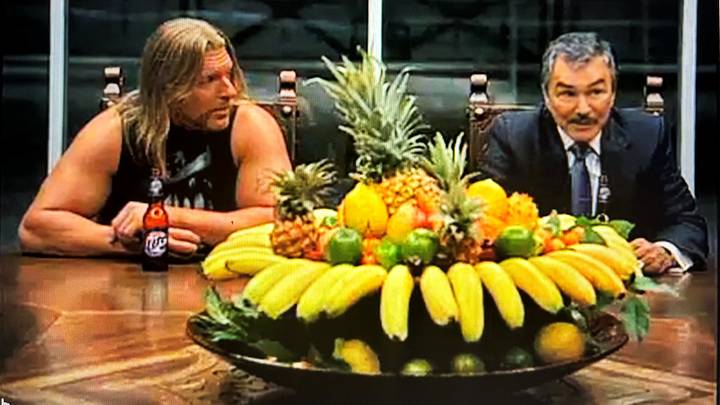
For a Miller Lite campaign, Reynolds joined a group of men chosen for their macho toughness who’d create silly laws guiding male behavior and beer drinking.
The spots were tongue-in-cheek, but it’s unlikely this could play today. Two decades ago, however, a beer company staging a bawdy guy conversation to declare “Man Laws” feareth not the outraged hashtag.
One of the studs chosen to sit at the “Men of the Square Table” (a parody on King Arthur’s “Knights of the Round Table”) was Murray, a 7-time World Champion and PBR co-founder who retired from professional bull riding in 2002.
The advertising agency Crispin Porter also brought in rugged celebrities like football star Jerome Bettis, boxer Oscar de la Hoya, and adventurer Aron Ralston, who was so tough he sawed off his own arm in a mountain climbing mishap, chronicled in the film 127 Hours.
At the square table, they addressed topics like retiring the high five, the wait time before dating a best friend’s ex-girlfriend, and, most famously, a question Murray posed: “Is it cool for men to put a lime wedge in their beer?”
When the agency reportedly wanted a cowboy to help craft the Man Laws, it didn’t take a lot of research to land on Murray for the role. The cowboy’s life story had recently been told in the book, King of the Cowboys, and he was a hot commodity on the cusp of breakthrough stardom.
After the golden age of westerns on television and film – roughly the 1940’s through 1960’s – and before “Yellowstone” and its spin-offs, it is often assumed cowboys weren’t seen much on mainstream television. But Murray was having his moment. He was paired with “Baby Bob” in a funny ad for Quiznos, and the Miller Lite work would help draw more acting roles on shows like “CSI” followed by a deep run on “Dancing with the Stars” when America fell in love with a gritty, plainspoken cowboy.
By 2006, when Miller was pushing to be socially current with a winking response to cries of sexism in advertising, Reynolds was no longer the box office champion. In fairness, nobody could have sustained his torrid run of silver screen success, dominating the box office in a way not seen since Bing Crosby in the 1940’s.
The perpetually wisecracking, ruggedly good-looking actor represented a hunky, hairy-chested, ultimately harmless machismo now coffin-nailed and dust-binned to the cultural outskirts of Turner Classic Movies and Grit. He was perfect to preside over the creation of “Man Laws.”
At the ad shoot, Murray, an accomplished gymnast before turning to western sports, found athletics to be a common dominator with the charismatic actor.
In high school in Florida, Reynolds had taken to football as all-state running back. He was recruited heavily by powerhouse programs including Miami, Florida and Georgia, ultimately choosing Florida State University.
His football career effectively ended in 1955 when seriously injured in an automobile accident after colliding with a stalled truck. To reset, Reynolds enrolled in Palm Beach Junior College. An English professor, drawn to his deep voice and dynamic presence, coaxed him to try out for a school play. A new career path was set.
Among the films Reynolds made were car-chase blockbusters, and Murray was a fan, enjoying daredevil bandits in borderline raunchy situations. He wasn’t alone; in 1977, only Star Wars earned more than Smokey and the Bandit.
The rodeo star was in awe of Reynolds, and the Hollywood heartthrob was equally enamored with the world champion cowboy. Reynolds had followed Murray’s career and considered himself a PBR fan.
Arriving on the set, Reynolds brought Murray an armful of merchandise to autograph. Reynolds presented Murray with a signed “Smokey” DVD.
While Reynolds was a rare actor who could upstage a film, as de facto head of the “Men of the Square Table,” he didn’t take over the Miller Lite set.
“Burt was aging at that point and had a little trouble remembering his lines,” Murray said. “Still, he was very funny and very much like his personality on screen – a real quick wit. That group of guys always got to laughing pretty fast.”
During two multi-day shoots, the celebrities sat for hours around the square table, shooting the breeze and telling jokes. Nobody had better Hollywood stories than Burt Reynolds, including his hilarious account of a fistfight outside a Manhattan bar with a stubborn hard-throwing smaller Italian who turned out to be racing legend Mario Andretti.
He also shot one of the iconic images of the 1970’s, a centerfold for Cosmopolitan sprawled on a bear rug in his birthday suit, one arm strategically placed in front of what he called his “tallywacker.” Becoming the first male appearing nude in a mainstream magazine was a world-class PR stunt. The 1.3 million-copy print run sold out.
But Reynolds regretted that the Hollywood establishment missed the humor of the gambit. One photo done on a lark (and after a quart of vodka, he would claim) and a few fun lightweight flicks made it hard for critics and producers to consider him a serious actor even though he’d shown his chops on shows like “The Twilight Zone” and the landmark, culture-defining Deliverance.

That wasn’t a consideration at the Square Table, where Reynolds was again playing an exaggeration of himself.
During down time on the set, Reynolds was asked about the sexiest celebrity he’d ever, shall we say, befriended.
“Ever the gentleman, Burt said he couldn’t name names,” Murray said. “But after a pause, he did add, ‘I guess I can give you her first name: Bridget.’”
When the cameras rolled, the group’s chemistry was captured and the buddy-humor translated. The ad campaign became wildly popular.
Awareness of the spots was off the charts. Young men were circulating their own Man Laws. The lines were entering pop culture.
None of it was helping Miller Lite.
“Most people actually believed we were advertising Bud Light,” Murray said. “That didn’t make the people at Miller Lite very happy.”
Murray was familiar with that other brand. He’d won $395,725 on the PBR Bud Light Cup tour in 1999, the most of any rider, and narrowly lost the overall championship even after winning World Finals.
Seven years later, Miller Lite’s “Man Laws” couldn’t be missed on primetime TV.
Murray’s celebrity rocketed.
“I’d get stopped all the time on the street by people telling me don't fruit the beer!” he said. “Total strangers would yell out, ‘You poke it, you own it!’”
Murray’s ascendancy as a recognizable cowboy spawned more opportunities. A new television show called “Dancing with the Stars” came calling.
“It was the dumbest idea I’d ever heard. I gave it thought for about a half second,” he said. “The fact is I’d never even heard of ballroom dancing. I thought dancing was doing the 2-step at a beer joint.”
When pro football Hall of Famer Emmitt Smith won the competition a few years later, the show reconnected with the rough stock athlete. This time, Murray decided he’d make the commitment to train seriously for the show – to the point where he could barely walk.

When Reynolds passed in 2018 as he was preparing for a role in the film Once Upon A Time in Hollywood, Murray reflected on the twists and turns life can take – in this instance his path converging with a larger-than-life actor who took as much interest in Murray as the rodeo star did in being regaled with splendid tales sounding like fiction.
“You look back and see all the opportunities you’ve had, and it’s pretty cool to consider,” he said. “Burt was just one of the guys. We all had a mutual rapport, and that’s why the commercials worked. He was the biggest movie star of the time, an international sex symbol but very respectful and down to earth. We had a pretty good time on that set with Burt Reynolds. I’d love to see the outtakes.”
 Add us as a preferred source on Google
Andrew Giangola, who has held high-profile public relations positions with Pepsi-Cola, Simon & Schuster, Accenture, McKinsey & Co., and NASCAR, now serves as Vice President, Strategic Communications for PBR. In addition to serving in high-profile public relations positions over the past 25 years, Andrew Giangola is the author of the critically acclaimed books The Weekend Starts on Wednesday: True Stories of Remarkable NASCAR Fans and Love & Try: Stories of Gratitude and Grit in Professional Bull Riding, which benefits injured bull riders and was named the best nonfiction book of 2022 at the 62nd Annual Western Heritage Awards. Giangola graduated from Fordham University, concentrating in journalism, when he was able to concentrate. He lives in Brooklyn with his wife Malvina.