%22%3E%0A%3Cpath%20d%3D%22M0.0221339%205.15112H8.83163V15.0009L16.3131%205.15112H26.5392L17.3534%2016.5946L26.7162%2031.4911H16.2245L11.0672%2023.1464L8.8095%2025.8911V31.4911H0V5.15112H0.0221339Z%22%20fill%3D%22white%22%2F%3E%0A%3Cpath%20d%3D%22M27.3584%204.02197H36.19V9.46704H27.3584V4.02197ZM27.4912%2010.9279H36.0351V31.4687H27.4912V10.9279Z%22%20fill%3D%22white%22%2F%3E%0A%3Cpath%20d%3D%22M38.1816%2021.3091V21.2427C38.1816%2015.4877%2042.6971%2010.4854%2049.4038%2010.4854C53.9192%2010.4854%2057.1066%2012.8095%2058.7003%2016.1739L52.569%2019.6269C51.8607%2018.3209%2050.9532%2017.5684%2049.5587%2017.5684C47.7437%2017.5684%2046.3935%2019.1399%2046.3935%2021.1763V21.2427C46.3935%2023.3897%2047.7437%2024.9391%2049.4481%2024.9391C50.9532%2024.9391%2051.8164%2024.1866%2052.6354%2022.8585L58.8331%2026.4C56.9959%2029.8308%2053.875%2032%2048.9832%2032C42.7413%2032%2038.1816%2027.064%2038.1816%2021.3091Z%22%20fill%3D%22white%22%2F%3E%0A%3Cpath%20d%3D%22M60.3164%204.02213H68.8603V17.2585L73.265%2010.9281H82.5615L76.1204%2019.2727L82.6722%2031.4688H73.5307L70.5646%2025.8245L68.8603%2028.0158V31.4688H60.3164V4V4.02213Z%22%20fill%3D%22white%22%2F%3E%0A%3Cpath%20d%3D%22M81.7207%2028.9896L84.6203%2024.1422C87.0994%2025.6916%2089.8883%2026.4442%2092.2124%2026.4442C93.0314%2026.4442%2093.4519%2026.2671%2093.4519%2025.758V25.6916C93.4519%2025.2711%2093.0757%2025.0055%2091.0172%2024.4964C85.8156%2023.2126%2082.6282%2021.8181%2082.6282%2017.5683V17.5019C82.6282%2012.9865%2086.2361%2010.4631%2091.5927%2010.4631C94.9792%2010.4631%2098.3215%2011.3264%20100.801%2012.8315L98.1002%2017.9003C95.9089%2016.705%2093.2749%2015.9746%2091.5484%2015.9746C90.7294%2015.9746%2090.3531%2016.196%2090.3531%2016.6165V16.6829C90.3531%2017.1035%2090.7958%2017.3691%2092.8765%2017.8782C98.078%2019.162%20101.199%2020.5786%20101.199%2024.8062V24.8726C101.199%2029.3438%2097.8567%2031.9557%2092.2788%2031.9557C88.2946%2031.9557%2084.6867%2030.9375%2081.7428%2028.9896H81.7207Z%22%20fill%3D%22white%22%2F%3E%0A%3Cpath%20fill-rule%3D%22evenodd%22%20clip-rule%3D%22evenodd%22%20d%3D%22M111.368%204.36764C117.191%20-1.45588%20126.632%20-1.45588%20132.456%204.36764C138.279%2010.1912%20138.279%2019.6324%20132.456%2025.4559L121.912%2036L111.368%2025.4559C105.544%2019.6324%20105.544%2010.1912%20111.368%204.36764ZM114.009%207.55761C113.948%207.86849%20113.916%208.39718%20113.916%209.14566V10.4189C113.916%2011.1832%20113.948%2011.7198%20114.013%2012.0267C114.078%2012.3317%20114.278%2012.6168%20114.617%2012.8762C114.956%2013.1376%20115.403%2013.3316%20115.958%2013.4623C116.512%2013.593%20117.1%2013.6583%20117.837%2013.6583C118.573%2013.6583%20119.217%2013.591%20119.769%2013.4524C120.322%2013.3158%20120.761%2013.1178%20121.086%2012.8604C121.411%2012.6029%20121.605%2012.3178%20121.666%2012.0069C121.728%2011.6961%20121.759%2011.1674%20121.759%2010.4189V9.14566C121.759%208.38134%20121.728%207.84473%20121.662%207.53781C121.597%207.23287%20121.397%206.94972%20121.058%206.68834C120.72%206.42696%20120.272%206.23291%20119.718%206.10223C119.163%205.97154%20118.536%205.90619%20117.839%205.90619C117.102%205.90619%20116.459%205.97352%20115.906%206.11213C115.352%206.24875%20114.914%206.44677%20114.589%206.70418C114.265%206.9616%20114.071%207.24673%20114.009%207.55761ZM119.276%2024.8638C122.876%2024.8638%20124.557%2024.2064%20124.557%2021.862V21.858V21.3155C124.557%2019.6581%20123.516%2018.971%20120.252%2018.3136C119.278%2018.1136%20118.908%2017.9136%20118.908%2017.3136V16.9414C118.908%2016.6543%20119.177%2016.5117%20119.413%2016.5117C119.749%2016.5117%20119.918%2016.7137%20119.918%2016.9414V18.1136H124.391V17.3988C124.391%2015.4563%20123.347%2014.4266%20119.177%2014.4266C116.15%2014.4266%20113.896%2015.3414%20113.896%2017.3711V17.7433C113.896%2019.5155%20114.805%2020.3155%20118.201%2021.0303C118.28%2021.0472%20118.355%2021.063%20118.427%2021.0781C119.329%2021.2674%20119.647%2021.3341%20119.647%2021.9174V22.2897C119.647%2022.6619%20119.546%2022.8045%20119.142%2022.8045C118.67%2022.8045%20118.637%2022.5471%20118.637%2022.262V21.2897H113.894V21.7471C113.894%2024.149%20115.476%2024.8638%20119.276%2024.8638ZM125.424%2024.5569H129.925V14.7355H125.424V24.5569ZM126.955%2013.5019H129.925V6.06064H127.092V9.411L125.193%206.06064H122.359V13.5019H125.193V10.1199L126.955%2013.5019ZM118.269%2012.152C118.204%2012.2688%20118.055%2012.3262%20117.825%2012.3262L117.827%2012.3282C117.604%2012.3282%20117.459%2012.2767%20117.398%2012.1757C117.336%2012.0748%20117.305%2011.8074%20117.305%2011.3758V7.90068C117.305%207.51852%20117.352%207.28684%20117.445%207.20962C117.538%207.13239%20117.675%207.09279%20117.851%207.09279C118.059%207.09279%20118.198%207.14031%20118.265%207.23734C118.332%207.33239%20118.366%207.55416%20118.366%207.90068V11.3203C118.366%2011.7579%20118.334%2012.0352%20118.269%2012.152Z%22%20fill%3D%22white%22%2F%3E%0A%3C%2Fg%3E%0A%3Cdefs%3E%0A%3CclipPath%20id%3D%22clip0_15247_3595%22%3E%0A%3Crect%20width%3D%22137%22%20height%3D%2236%22%20fill%3D%22white%22%2F%3E%0A%3C%2FclipPath%3E%0A%3C%2Fdefs%3E%0A%3C%2Fsvg%3E%0A)
Bryce Harper Unveils Under Armour Harper 10 "MADHOUSE"
In this story:
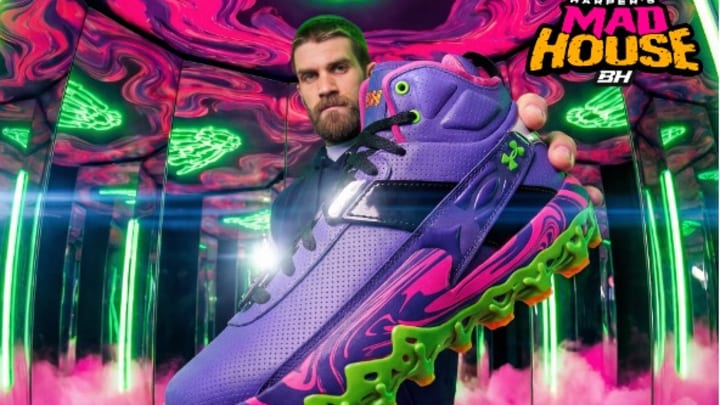
Step right up. The lights are spinning. The colors are loud. The funhouse mirrors have no interest in showing you anything normal.
That's the Harper 10 MADHOUSE, and just in time for spring training. It arrives in cleat and trainer options for kids and adults at UA.com.
Philadelphia Phillies slugger Bryce Harper and Under Armour have dropped the final colorway of the Harper 10, closing out one of the most creative chapters in baseball footwear history, the only way they know how, with maximum energy and zero apologies.

The MADHOUSE is built around a deep purple base and lit up with vibrant pink, green, and yellow accents. On paper, it sounds chaotic. On foot, it looks like exactly what it is: a boardwalk funhouse come to life.
The inspiration is straight from Harper's own offseason, specifically, his love for spending time at the Jersey Shore with his family during the early years of his career in Philadelphia. That mix of sticky summer nights, neon game rooms, and the sensory overload of a boardwalk midway is baked right into every color decision. It's not just a colorway. It's a memory. A memory that speaks loudly, like Harper's game on the diamond.
The detailed touch is the hand gesture of "I love you" in sign language that is formed on Harper's hand every time he rounds second base. You can see this gem created as an accessory with the MADHOUSE cleats.
That specificity is what separates the Harper line from almost everything else in baseball footwear. The best releases in this series have always been about something real: a person, a place, a feeling, a moment you can point to, and there is intent behind the colors, the style, and the detail.
The MADHOUSE connects to where Harper actually spent his time. The Jersey Shore wasn't a marketing brief. It was his life. And that authenticity is exactly what makes you look at this shoe and feel something before you even try it on.

How The Harper 10 Was Built
To really appreciate the MADHOUSE, you need the full story of the Harper 10 era. Because it went places nobody else in baseball footwear was willing to go.
Last spring training, Under Armour launched the "Bring the Juice" Harper 9, an electrifying, orange-soaked design built to embody the refreshing spirit of spring baseball and help players squeeze every drop out of their game. That set the tone early: the Harper line wasn't slowing down. It was turning up.

Then came the Harper 10's Rivalry Pack, and Harper did something genuinely wild. The series featured 'The Three Line,' 'Chop ATL,' 'Miami Bryce,' and 'Capital Star,' designed specifically for his NL East rivals: the New York Mets, Atlanta Braves, Miami Marlins, and his former team, the Washington Nationals. He wore other teams' colors. On purpose. On his feet. In-game. On one Monday night, he lit Mets fans up with his colorway, and the internet did the rest.
The Rivalry Pack wasn't just a clever marketing move. It was a case study in how a cleat line can drive genuine sports conversation, not just sneaker conversation. Harper wasn't releasing shoes. He was creating moments. There's a difference, and most athletes never figure out how to do it.
The MADHOUSE lands as the Harper 10 era's curtain call. Deep purple. Pink. Green. Yellow. The Jersey Shore at closing time, all bottled into a cleat. It's a proper send-off. But this isn't really a send-off at all.

The Bigger News: They're Not Done
Here's what reframes everything about the MADHOUSE drop.
Last month, Harper and Under Armour announced a new, long-term contract extension. His footwear free agency, which had briefly raised eyebrows in January when his previous deal expired, lasted all of about a week before both sides made it official: they're staying together.
"Under Armour has been part of my baseball career and journey for 15 years, and that's not changing," Harper said. "I am proud to continue partnering with Under Armour on the longest-running active signature series footwear in baseball history. I look forward to this next chapter as we continue to push the limits of what's possible!"

There it is. Fifteen years. The longest-running active signature series in baseball history. And they're just now entering the next chapter.
Under Armour confirmed that Harper's 11th signature cleat will launch later in 2026. Which means the MADHOUSE isn't an ending. It's the final piece of a completed chapter, the bookend that makes the new beginning mean something.
Think about what that run looked like. Harper initially signed with Under Armour in 2011, before he'd taken a single MLB at-bat. In 2016, he signed a historic 10-year extension that was, at the time, the largest endorsement deal in baseball history.
That deal gave both sides the runway to take real risks: Betsy Ross, Wawa collabs, PSA baseball card-inspired colorways, a Phillies Phanatic drop, and a Rivalry Pack that made division rivals' fanbases genuinely emotional. You don't get to a boardwalk funhouse on your feet without the kind of trust that takes fifteen years to build.

Why This Matters for Baseball Footwear
Zoom out for a second and appreciate what Harper and Under Armour have built because it's rarer than it looks.
Baseball has never really had a footwear culture the way basketball does. For most of the sport's history, cleats were utilitarian. You wore what your team gave you. You swapped them out when they wore down.
The idea of a signature cleat line, an actual numbered series with annual drops, capsule collections, and cultural storytelling built around a single player, barely existed in baseball until the Harper line arrived and proved it could work.

Harper became one of the few MLB players to receive a signature cleat line, beginning with the Harper One in 2016. The series has continued annually, reaching the Harper 10s in 2025, making him one of the longest-running baseball players with a signature shoe line.
That's a decade of proof of concept. And Under Armour's baseball roster, which now includes Freddie Freeman, Gunnar Henderson, Juan Soto, Fernando Tatis Jr., Bobby Witt Jr., and Junior Caminero, has grown substantially in that same window. Harper wasn't just selling his own shoes. He was building the case that baseball players could carry a footwear brand.
What Comes Next
The Harper 11 drops later this year. One would have to imagine that Under Armour and Harper have something in their soles for the 2026 Major League Baseball All-Star Game this year, as it takes place in Philadelphia, PA.
We don't know the colorway yet. We don't know the theme. But based on fifteen years of evidence, we know a few things: it will be specific, not generic.
It will connect to something real in Harper's life or the culture around him. It will be designed for kids who want to wear what he wears, and adults who remember watching him debut. And it will give us something to talk about before a single pitch has been thrown in 2026.
That's the Harper standard now. And with the new contract locked in, it's not going anywhere. The MADHOUSE is the party at the end of one era. The Harper 11 is about to be an ELITE one. Stay locked into Sports Illustrated's Kicks On SI for all your footwear news from MLB and beyond.
 Add us as a preferred source on Google
Dr. Caleb Mezzy is a college professor in New Jersey leveraging his decade of sports marketing and branding experience. He has worked with various brands, teams, athletes, and sports organizations on their marketing efforts. An avid collector of cards and memorabilia, he can be found on Instagram at @caleb_mezzy or via email: CSMezzy@gmail.com.