%22%3E%0A%3Cpath%20d%3D%22M0%204.9397H7.3484V12.6932H14.0649V4.9397H21.4133V26.912H14.0649V19.037H7.3484V26.912H0V4.9397Z%22%20fill%3D%22white%22%2F%3E%0A%3Cpath%20d%3D%22M23.6572%204H31.0299V8.55326H23.6572V4ZM23.7788%209.77664H30.9003V26.9121H23.7788V9.77664Z%22%20fill%3D%22white%22%2F%3E%0A%3Cpath%20d%3D%22M32.7241%2029.861L34.9197%2025.5589C36.8317%2026.5635%2038.7519%2027.1955%2041.1014%2027.1955C43.7669%2027.1955%2045.1848%2025.8101%2045.1848%2023.4281V22.9258C44.2125%2024.0276%2042.6084%2025.2834%2040.2264%2025.2834C35.8028%2025.2834%2032.6025%2022.1399%2032.6025%2017.4084V17.3436C32.6025%2012.5392%2035.8676%209.37134%2039.8213%209.37134C42.3329%209.37134%2043.8074%2010.3112%2045.0632%2011.5994V9.77643H52.1848V22.5855C52.1848%2025.7533%2051.5285%2027.9246%2049.9568%2029.4883C48.4174%2031.0277%2046.0679%2031.9999%2042.2357%2031.9999C38.4035%2031.9999%2035.4868%2031.2464%2032.7241%2029.8691V29.861ZM45.2172%2017.3679V17.3031C45.2172%2015.8285%2044.091%2014.6376%2042.3572%2014.6376C40.6234%2014.6376%2039.4972%2015.8609%2039.4972%2017.3679V17.4327C39.4972%2018.9073%2040.6234%2020.0658%2042.3572%2020.0658C44.091%2020.0658%2045.2172%2018.8748%2045.2172%2017.3679Z%22%20fill%3D%22white%22%2F%3E%0A%3Cpath%20d%3D%22M54.3145%204H61.436V12.0695C62.5379%2010.6597%2064.2636%209.37155%2066.6779%209.37155C70.2914%209.37155%2072.5437%2011.7535%2072.5437%2015.6181V26.9202H65.4221V17.9109C65.4221%2016.4364%2064.5471%2015.5857%2063.4777%2015.5857C62.4082%2015.5857%2061.436%2016.4364%2061.436%2017.9109V26.9202H54.3145V4Z%22%20fill%3D%22white%22%2F%3E%0A%3Cpath%20d%3D%22M80.8983%2023.6146L84.8196%2018.9398C87.2016%2020.7627%2089.9319%2021.5162%2092.5083%2021.5162C93.8289%2021.5162%2094.388%2021.1678%2094.388%2020.5764V20.5116C94.388%2019.8796%2093.6993%2019.5393%2091.3417%2019.0694C86.4157%2018.0648%2082.0812%2016.6551%2082.0812%2012.0046V11.9398C82.0812%207.76732%2085.3463%204.53467%2091.4065%204.53467C95.6437%204.53467%2098.7792%205.5393%20101.323%207.54857L97.7421%2012.5069C95.6681%2011%2093.1889%2010.3437%2091.1472%2010.3437C90.0454%2010.3437%2089.543%2010.7245%2089.543%2011.2511V11.3159C89.543%2011.9155%2090.1426%2012.2882%2092.4597%2012.7257C98.0743%2013.7627%20101.842%2015.3912%20101.842%2019.8148V19.8796C101.842%2024.4977%2098.0419%2027.3172%2092.1437%2027.3172C87.6877%2027.3172%2083.6692%2026.0614%2080.874%2023.6146H80.8983Z%22%20fill%3D%22white%22%2F%3E%0A%3Cpath%20d%3D%22M102.838%2018.4374V18.3726C102.838%2013.5682%20106.605%209.39575%20112.187%209.39575C115.955%209.39575%20118.62%2011.3402%20119.941%2014.1354L114.829%2017.0196C114.229%2015.9178%20113.476%2015.2939%20112.317%2015.2939C110.81%2015.2939%20109.684%2016.6145%20109.684%2018.3078V18.3726C109.684%2020.1631%20110.81%2021.4513%20112.228%2021.4513C113.484%2021.4513%20114.205%2020.8194%20114.893%2019.7256L120.071%2022.6747C118.531%2025.5347%20115.931%2027.3495%20111.847%2027.3495C106.638%2027.3495%20102.838%2023.2338%20102.838%2018.4374Z%22%20fill%3D%22white%22%2F%3E%0A%3Cpath%20d%3D%22M121.164%204H128.286V12.0695C129.387%2010.6597%20131.113%209.37155%20133.528%209.37155C137.141%209.37155%20139.393%2011.7535%20139.393%2015.6181V26.9202H132.272V17.9109C132.272%2016.4364%20131.397%2015.5857%20130.327%2015.5857C129.258%2015.5857%20128.286%2016.4364%20128.286%2017.9109V26.9202H121.164V4Z%22%20fill%3D%22white%22%2F%3E%0A%3Cpath%20d%3D%22M140.867%2018.405V18.3402C140.867%2013.5033%20144.886%209.36328%20150.533%209.36328C156.18%209.36328%20160.142%2013.4466%20160.142%2018.2753V18.3402C160.142%2023.177%20156.123%2027.317%20150.476%2027.317C144.829%2027.317%20140.867%2023.2337%20140.867%2018.405ZM153.295%2018.405V18.3402C153.295%2016.6469%20152.04%2015.2939%20150.468%2015.2939C148.896%2015.2939%20147.705%2016.6469%20147.705%2018.2753V18.3402C147.705%2020.0335%20148.961%2021.3865%20150.533%2021.3865C152.104%2021.3865%20153.295%2020.0335%20153.295%2018.405Z%22%20fill%3D%22white%22%2F%3E%0A%3Cpath%20d%3D%22M161.203%2018.405V18.3402C161.203%2013.5033%20165.222%209.36328%20170.869%209.36328C176.516%209.36328%20180.477%2013.4466%20180.477%2018.2753V18.3402C180.477%2023.177%20176.459%2027.317%20170.812%2027.317C165.165%2027.317%20161.203%2023.2337%20161.203%2018.405ZM173.631%2018.405V18.3402C173.631%2016.6469%20172.376%2015.2939%20170.804%2015.2939C169.232%2015.2939%20168.041%2016.6469%20168.041%2018.2753V18.3402C168.041%2020.0335%20169.297%2021.3865%20170.869%2021.3865C172.44%2021.3865%20173.631%2020.0335%20173.631%2018.405Z%22%20fill%3D%22white%22%2F%3E%0A%3Cpath%20d%3D%22M182.139%204H189.26V26.9121H182.139V4Z%22%20fill%3D%22white%22%2F%3E%0A%3Cpath%20fill-rule%3D%22evenodd%22%20clip-rule%3D%22evenodd%22%20d%3D%22M199.368%204.36764C205.191%20-1.45588%20214.632%20-1.45588%20220.456%204.36764C226.279%2010.1912%20226.279%2019.6324%20220.456%2025.4559L209.912%2036L199.368%2025.4559C193.544%2019.6324%20193.544%2010.1912%20199.368%204.36764ZM202.009%207.55761C201.948%207.86849%20201.916%208.39718%20201.916%209.14566V10.4189C201.916%2011.1832%20201.948%2011.7198%20202.013%2012.0267C202.078%2012.3317%20202.278%2012.6168%20202.617%2012.8762C202.956%2013.1376%20203.403%2013.3316%20203.958%2013.4623C204.512%2013.593%20205.1%2013.6583%20205.837%2013.6583C206.573%2013.6583%20207.217%2013.591%20207.769%2013.4524C208.322%2013.3158%20208.761%2013.1178%20209.086%2012.8604C209.411%2012.6029%20209.605%2012.3178%20209.666%2012.0069C209.728%2011.6961%20209.759%2011.1674%20209.759%2010.4189V9.14566C209.759%208.38134%20209.728%207.84473%20209.662%207.53781C209.597%207.23287%20209.397%206.94972%20209.058%206.68834C208.72%206.42696%20208.272%206.23291%20207.718%206.10223C207.163%205.97154%20206.536%205.90619%20205.839%205.90619C205.102%205.90619%20204.459%205.97352%20203.906%206.11213C203.352%206.24875%20202.914%206.44677%20202.589%206.70418C202.265%206.9616%20202.071%207.24673%20202.009%207.55761ZM207.276%2024.8638C210.876%2024.8638%20212.557%2024.2064%20212.557%2021.862V21.858V21.3155C212.557%2019.6581%20211.516%2018.971%20208.252%2018.3136C207.278%2018.1136%20206.908%2017.9136%20206.908%2017.3136V16.9414C206.908%2016.6543%20207.177%2016.5117%20207.413%2016.5117C207.749%2016.5117%20207.918%2016.7137%20207.918%2016.9414V18.1136H212.391V17.3988C212.391%2015.4563%20211.347%2014.4266%20207.177%2014.4266C204.15%2014.4266%20201.896%2015.3414%20201.896%2017.3711V17.7433C201.896%2019.5155%20202.805%2020.3155%20206.201%2021.0303C206.28%2021.0472%20206.355%2021.063%20206.427%2021.0781C207.329%2021.2674%20207.647%2021.3341%20207.647%2021.9174V22.2897C207.647%2022.6619%20207.546%2022.8045%20207.142%2022.8045C206.67%2022.8045%20206.637%2022.5471%20206.637%2022.262V21.2897H201.894V21.7471C201.894%2024.149%20203.476%2024.8638%20207.276%2024.8638ZM213.424%2024.5569H217.925V14.7355H213.424V24.5569ZM214.955%2013.5019H217.925V6.06064H215.092V9.411L213.193%206.06064H210.359V13.5019H213.193V10.1199L214.955%2013.5019ZM206.269%2012.152C206.204%2012.2688%20206.055%2012.3262%20205.825%2012.3262L205.827%2012.3282C205.604%2012.3282%20205.459%2012.2767%20205.398%2012.1757C205.336%2012.0748%20205.305%2011.8074%20205.305%2011.3758V7.90068C205.305%207.51852%20205.352%207.28684%20205.445%207.20962C205.538%207.13239%20205.675%207.09279%20205.851%207.09279C206.059%207.09279%20206.198%207.14031%20206.265%207.23734C206.332%207.33239%20206.366%207.55416%20206.366%207.90068V11.3203C206.366%2011.7579%20206.334%2012.0352%20206.269%2012.152Z%22%20fill%3D%22white%22%2F%3E%0A%3C%2Fg%3E%0A%3Cdefs%3E%0A%3CclipPath%20id%3D%22clip0_15247_3714%22%3E%0A%3Crect%20width%3D%22225%22%20height%3D%2236%22%20fill%3D%22white%22%2F%3E%0A%3C%2FclipPath%3E%0A%3C%2Fdefs%3E%0A%3C%2Fsvg%3E%0A)
How Sierra Canyon’s Alicia Komaki Built a Girls Basketball Powerhouse — and Coached JuJu Watkins
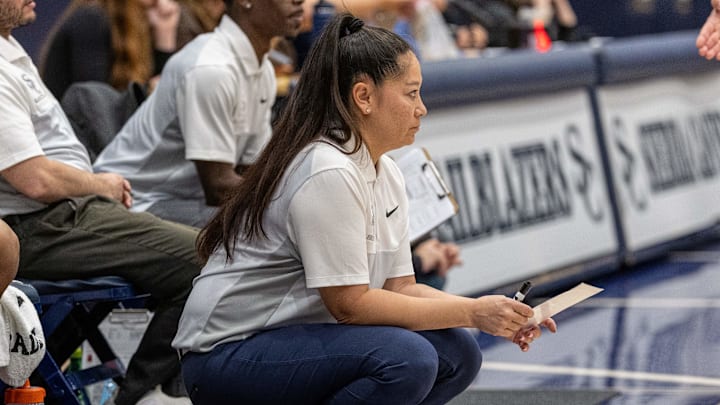
One of the preeminent girls basketball coaches in the country, Alicia Komaki’s sideline presence is just as impressive as her sparkling resume. The intensity, competitiveness and confidence are glaringly obvious.
But even if you saw her outside the gym, say at a grocery store or just walking down the street and unaware of her accomplishments as the girls basketball coach at Sierra Canyon, her glow and aura would make you say, “I don’t know who that lady is, but I know she’s somebody!”
2022 Was a Year of Honors for Alicia Komaki
In 2022, she was named the Women’s Basketball Coaches Association Pat Summit National Coach of the Year. She’s also previously been honored as the Los Angeles Times and California High School Sports Coach of the Year.
It Was Followed by a National Championship in 2023
In 2023, led by the incomparable JuJu Watkins, when Komaki’s No.1 ranked squad won the prep National Championship, she was a finalist for the Naismith National Coach of the Year award and was selected to coach in the Jordan Brand All-American game, which she also accomplished in 2019.

After last season, she served as an assistant coach with the Team USA squad at the Nike Hoops Summit. Entering her 14th year as the Trailblazers head coach, she’s led her teams to five California State Championships.
Upon recently returning from the Las Vegas Border League, where Sierra Canyon got to test itself prior to this season’s official tipoff in a few weeks, Komaki sat down with High School On SI to talk about her journey, competitive fire, coaching the likes of JuJu Watkins and chasing greatness.
A Coach Whose Presence Commands Respect
Shed some light on your younger self before sports and basketball became a significant part of your life.
“I don’t actually remember a time when sports wasn’t a part of my life. My mom was an educator and my dad, a retired dentist, was a huge sports fan. My grandma always had sports on the television. I played everything early on - volleyball, golf, swimming, soccer, softball. When I was in the third grade I saw a sign on the fence at a local high school advertising basketball tryouts for youth girls and I asked my dad to take me.”
Did you take to hoops right away?
“Immediately. It was more than just a game to me from the very beginning. I knew I loved it early on. Everything else was too slow and boring. My dad saw that I had talent and was very supportive of me. He wanted me to play the right way and not just shoot the ball every time I touched it. So he’d bribe me and pay me cash for every assist I got. I guess that’s why I fell in love with passing the ball.”
Excellent coaches all have great mentors and teachers along the way. Who were some of yours?
“I went to a small elementary/middle school for grades K through 8. Carl Caldwell was our athletic director and P.E. teacher and he coached every sport, but basketball was his main sport. Back then, he seemed like the biggest, fastest, strongest athlete in the world. He became close with a lot of families. We’d have him over for dinner and he eventually became like a big brother to me. He knew how much I loved hoops, was a great teacher and very instrumental in my journey. He’s still very supportive and in my life today.”
Where did you ball in high school?
“Troy High School in Fullerton. It was a magnet school that my older sister went to and you had to test into there. I went for academics but they also had a really good girls basketball program. Kevin Kiernan was the winningest coach in California girls history and I wound up starting as a freshman. I played for a CIF championship every year, had a pretty storied career and my jersey’s retired there.”
You were definitely a big deal because the Los Angeles Times ran a story about you committing to play at Pepperdine. How did your college career shake out?
“I blew out my knee toward the end of my freshman year. But as good as my high school career was, I was pretty burned out and mentally exhausted after the injury. I leaned on my faith and felt like God was telling me it was time to do something different. I was at peace with it because I never had any ambitions of playing past college. I always knew that I wanted to coach, so that actually helped me get a jump start on my coaching career.”
What was your first coaching job?
“I became the Junior Varsity head coach at my old high school when I was 19 years old. I wasn’t on scholarship anymore, so I transferred to Long Beach and had to work my way through school where I was majoring in Recreation Administration and eventually got my Master’s in Athletic Administration. Coach Kiernan was a great mentor, along with everyone who coached me in high school that was still there at Troy.”
How long were you the JV coach there?
“I was there for three years. Coach Kiernan left to go to Mater Dei and asked me to go with him. And I said, ‘Absolutely not!’ If you know anything about high school sports in Orange County, Mater Dei was always seen as the enemy. I was 22 years old and tried to get the head coaching job at Troy. The Athletic Director thought I was too young and I didn’t get the job. He now says it was one of the biggest mistakes he ever made.”
So what was your next move?
“I became the varsity associate head coach under Roger Anderson, another great coach and he had a different style than coach Kiernan. I learned so many different things working with him and he gave me a lot of responsibility, seeing that he had this young coach with all this energy who was willing to work her butt off. Coach Kiernan kept calling, though, asking me to consider making the move over to Mater Dei.”
How was he selling that?
“He knew that my ambition at the time was to become a college head coach. He had some really good kids over there including the best player in the country, Kaleena Mosqueda-Lewis, who went on to win three national championships at UCONN. He told me that I’d have an opportunity to network with the best college coaches over there.”
And how did that work out, making the move to Mater Dei?
“We won two state championships and a national championship. Then I started applying for head coaching jobs. I was sending out resumes and mailing them out with cover letters in envelopes.”
Was Sierra Canyon a top job that you were hoping to get?
“I knew absolutely nothing about the school. The school was relatively new. We just had our 17th graduating class and this is my 14th year there now. They’d had some success early on, winning a CIF championship in the lowest division and they had some talent with some good local kids. But I knew none of that. The job appealed to me because it came with a full time job as a PE teacher. But the girls soccer coach got the PE job.”
What did you do?
“They offered me the job and it came with a bare bones stipend of $17,500 to also be the Assistant Athletic Director. I took it on a prayer. I had to move 60 miles and rented a room from a family that lived down the street from the school. And I’ve been here ever since.”
How was your first year as a varsity head coach?
“That first season we had six kids, but one of them was Kennedy Burke, who’s now playing in the WNBA with the New York Liberty. That’s a pretty good kid to have when you’re starting out your career.”

You’ve had some amazing success and curated an enviable culture at Sierra Canyon. How have you been able to maintain that?
“People often ask me, ‘What’s the secret sauce at Sierra Canyon?’ Well, I had a great Athletic Director in Rock Pillsbury who insisted on hiring the best coaches. He took a chance on me coming from Mater Dei. I’ve also been fortunate and had some luck in being able to coach some very talented players who are also good people, in addition to being surrounded by great, supportive parents and school administrators. I’m at the best school I’ll ever work at. And there was some definite intentionality with my plans and processes for maintaining a very high standard over the years.”
I imagine some college programs have been calling over the years in the same way that coach Kiernan did when he was trying to woo you over to Mater Dei.
“The original dream was to be a college coach and if someone were to call, if an opportunity were to arise that makes sense, I’ll consider it. People think I turn down offers all the time, but the fact is that I’ve actually never had one.”
At the Hoophall Classic a few years back in Massachusetts, I came to watch JuJu Watkins and even with all of the hype and highlights I’d seen, I was completely blown away. Completely! Of all the players I’ve seen there over the years, she was right at the very top of the most amazing prep talents I ever saw alongside guys like Cooper Flagg, Lonzo Ball, Bam Adebayo, Jayson Tatum and Zion Williamson. What is it like to coach such a phenomenal, generational talent like that?
“JuJu transferred over to us as a junior from one of our rival schools, Winward. We were well aware of who she was and had seen her up close since she was in the seventh grade. We had some good talent, and the question was, ‘Can we bring in this mega-superstar, the top kid in the country, and put her in the mix with players who all want to be All-Americans and add this massive talent to a team that is already really good?’ After the first couple of days, I said, ‘Ooooh, this is gonna be really good.’”
What made you say that?
“JuJu was playing with USA Basketball and that was still going on when we started school. She missed the first few days. She called me when she got home and said, ‘Hey coach, I’m back and ready to go.’ We had an early practice session the next morning and she had just flown back in that night, so I told her I’d see her at school the next day. She said, ‘No coach, I’ll see you at practice.’”
You mentioned the challenge of incorporating this mega-talent into the construct of a team that was already really good. How did that first practice session go?
“Her competitiveness stood out immediately. Here she is at a 6:00am practice after having just flown in a few hours before, a practice that she did not have to be at, and she was going hard! When you have a player that is supremely talented with that type of work ethic, that makes everyone else buy into it. I knew from that first practice that things were going to work out very well.”
What’s your top priority and overall philosophy as it relates to building your team culture?
“That better people make better basketball players. We do a lot of character building exercises, classes and workshop sessions in a classroom setting. It all centers around ‘The Teammate’. We call it ‘The Assist Academy’. We explore all of what encompasses the consummate teammate, what that entails and looks like, not just on the court and in the weightroom, but in a larger life sense as well. The expectations and essentials of our team culture are alive and well. I don’t have to teach them any more because our players are serious about taking ownership, and they pass those expectations down to the new kids that come into our program every year. That’s what makes us so strong.”
 Add us as a preferred source on Google
Alejandro Danois is a freelance sports writer, documentary film producer and the author of the critically acclaimed book The Boys of Dunbar: A Story of Love, Hope and Basketball. His feature stories have been published by The New York Times, ESPN, Bleacher Report, The Baltimore Sun, Ebony Magazine, The Los Angeles Times, Sporting News and SLAM Magazine, The Baltimore Banner and the Naismith Memorial Basketball Hall of Fame, among others. He began writing for High School On SI in 2024.
Follow alidanois