%22%3E%0A%3Cpath%20d%3D%22M0%204.9397H7.3484V12.6932H14.0649V4.9397H21.4133V26.912H14.0649V19.037H7.3484V26.912H0V4.9397Z%22%20fill%3D%22white%22%2F%3E%0A%3Cpath%20d%3D%22M23.6572%204H31.0299V8.55326H23.6572V4ZM23.7788%209.77664H30.9003V26.9121H23.7788V9.77664Z%22%20fill%3D%22white%22%2F%3E%0A%3Cpath%20d%3D%22M32.7241%2029.861L34.9197%2025.5589C36.8317%2026.5635%2038.7519%2027.1955%2041.1014%2027.1955C43.7669%2027.1955%2045.1848%2025.8101%2045.1848%2023.4281V22.9258C44.2125%2024.0276%2042.6084%2025.2834%2040.2264%2025.2834C35.8028%2025.2834%2032.6025%2022.1399%2032.6025%2017.4084V17.3436C32.6025%2012.5392%2035.8676%209.37134%2039.8213%209.37134C42.3329%209.37134%2043.8074%2010.3112%2045.0632%2011.5994V9.77643H52.1848V22.5855C52.1848%2025.7533%2051.5285%2027.9246%2049.9568%2029.4883C48.4174%2031.0277%2046.0679%2031.9999%2042.2357%2031.9999C38.4035%2031.9999%2035.4868%2031.2464%2032.7241%2029.8691V29.861ZM45.2172%2017.3679V17.3031C45.2172%2015.8285%2044.091%2014.6376%2042.3572%2014.6376C40.6234%2014.6376%2039.4972%2015.8609%2039.4972%2017.3679V17.4327C39.4972%2018.9073%2040.6234%2020.0658%2042.3572%2020.0658C44.091%2020.0658%2045.2172%2018.8748%2045.2172%2017.3679Z%22%20fill%3D%22white%22%2F%3E%0A%3Cpath%20d%3D%22M54.3145%204H61.436V12.0695C62.5379%2010.6597%2064.2636%209.37155%2066.6779%209.37155C70.2914%209.37155%2072.5437%2011.7535%2072.5437%2015.6181V26.9202H65.4221V17.9109C65.4221%2016.4364%2064.5471%2015.5857%2063.4777%2015.5857C62.4082%2015.5857%2061.436%2016.4364%2061.436%2017.9109V26.9202H54.3145V4Z%22%20fill%3D%22white%22%2F%3E%0A%3Cpath%20d%3D%22M80.8983%2023.6146L84.8196%2018.9398C87.2016%2020.7627%2089.9319%2021.5162%2092.5083%2021.5162C93.8289%2021.5162%2094.388%2021.1678%2094.388%2020.5764V20.5116C94.388%2019.8796%2093.6993%2019.5393%2091.3417%2019.0694C86.4157%2018.0648%2082.0812%2016.6551%2082.0812%2012.0046V11.9398C82.0812%207.76732%2085.3463%204.53467%2091.4065%204.53467C95.6437%204.53467%2098.7792%205.5393%20101.323%207.54857L97.7421%2012.5069C95.6681%2011%2093.1889%2010.3437%2091.1472%2010.3437C90.0454%2010.3437%2089.543%2010.7245%2089.543%2011.2511V11.3159C89.543%2011.9155%2090.1426%2012.2882%2092.4597%2012.7257C98.0743%2013.7627%20101.842%2015.3912%20101.842%2019.8148V19.8796C101.842%2024.4977%2098.0419%2027.3172%2092.1437%2027.3172C87.6877%2027.3172%2083.6692%2026.0614%2080.874%2023.6146H80.8983Z%22%20fill%3D%22white%22%2F%3E%0A%3Cpath%20d%3D%22M102.838%2018.4374V18.3726C102.838%2013.5682%20106.605%209.39575%20112.187%209.39575C115.955%209.39575%20118.62%2011.3402%20119.941%2014.1354L114.829%2017.0196C114.229%2015.9178%20113.476%2015.2939%20112.317%2015.2939C110.81%2015.2939%20109.684%2016.6145%20109.684%2018.3078V18.3726C109.684%2020.1631%20110.81%2021.4513%20112.228%2021.4513C113.484%2021.4513%20114.205%2020.8194%20114.893%2019.7256L120.071%2022.6747C118.531%2025.5347%20115.931%2027.3495%20111.847%2027.3495C106.638%2027.3495%20102.838%2023.2338%20102.838%2018.4374Z%22%20fill%3D%22white%22%2F%3E%0A%3Cpath%20d%3D%22M121.164%204H128.286V12.0695C129.387%2010.6597%20131.113%209.37155%20133.528%209.37155C137.141%209.37155%20139.393%2011.7535%20139.393%2015.6181V26.9202H132.272V17.9109C132.272%2016.4364%20131.397%2015.5857%20130.327%2015.5857C129.258%2015.5857%20128.286%2016.4364%20128.286%2017.9109V26.9202H121.164V4Z%22%20fill%3D%22white%22%2F%3E%0A%3Cpath%20d%3D%22M140.867%2018.405V18.3402C140.867%2013.5033%20144.886%209.36328%20150.533%209.36328C156.18%209.36328%20160.142%2013.4466%20160.142%2018.2753V18.3402C160.142%2023.177%20156.123%2027.317%20150.476%2027.317C144.829%2027.317%20140.867%2023.2337%20140.867%2018.405ZM153.295%2018.405V18.3402C153.295%2016.6469%20152.04%2015.2939%20150.468%2015.2939C148.896%2015.2939%20147.705%2016.6469%20147.705%2018.2753V18.3402C147.705%2020.0335%20148.961%2021.3865%20150.533%2021.3865C152.104%2021.3865%20153.295%2020.0335%20153.295%2018.405Z%22%20fill%3D%22white%22%2F%3E%0A%3Cpath%20d%3D%22M161.203%2018.405V18.3402C161.203%2013.5033%20165.222%209.36328%20170.869%209.36328C176.516%209.36328%20180.477%2013.4466%20180.477%2018.2753V18.3402C180.477%2023.177%20176.459%2027.317%20170.812%2027.317C165.165%2027.317%20161.203%2023.2337%20161.203%2018.405ZM173.631%2018.405V18.3402C173.631%2016.6469%20172.376%2015.2939%20170.804%2015.2939C169.232%2015.2939%20168.041%2016.6469%20168.041%2018.2753V18.3402C168.041%2020.0335%20169.297%2021.3865%20170.869%2021.3865C172.44%2021.3865%20173.631%2020.0335%20173.631%2018.405Z%22%20fill%3D%22white%22%2F%3E%0A%3Cpath%20d%3D%22M182.139%204H189.26V26.9121H182.139V4Z%22%20fill%3D%22white%22%2F%3E%0A%3Cpath%20fill-rule%3D%22evenodd%22%20clip-rule%3D%22evenodd%22%20d%3D%22M199.368%204.36764C205.191%20-1.45588%20214.632%20-1.45588%20220.456%204.36764C226.279%2010.1912%20226.279%2019.6324%20220.456%2025.4559L209.912%2036L199.368%2025.4559C193.544%2019.6324%20193.544%2010.1912%20199.368%204.36764ZM202.009%207.55761C201.948%207.86849%20201.916%208.39718%20201.916%209.14566V10.4189C201.916%2011.1832%20201.948%2011.7198%20202.013%2012.0267C202.078%2012.3317%20202.278%2012.6168%20202.617%2012.8762C202.956%2013.1376%20203.403%2013.3316%20203.958%2013.4623C204.512%2013.593%20205.1%2013.6583%20205.837%2013.6583C206.573%2013.6583%20207.217%2013.591%20207.769%2013.4524C208.322%2013.3158%20208.761%2013.1178%20209.086%2012.8604C209.411%2012.6029%20209.605%2012.3178%20209.666%2012.0069C209.728%2011.6961%20209.759%2011.1674%20209.759%2010.4189V9.14566C209.759%208.38134%20209.728%207.84473%20209.662%207.53781C209.597%207.23287%20209.397%206.94972%20209.058%206.68834C208.72%206.42696%20208.272%206.23291%20207.718%206.10223C207.163%205.97154%20206.536%205.90619%20205.839%205.90619C205.102%205.90619%20204.459%205.97352%20203.906%206.11213C203.352%206.24875%20202.914%206.44677%20202.589%206.70418C202.265%206.9616%20202.071%207.24673%20202.009%207.55761ZM207.276%2024.8638C210.876%2024.8638%20212.557%2024.2064%20212.557%2021.862V21.858V21.3155C212.557%2019.6581%20211.516%2018.971%20208.252%2018.3136C207.278%2018.1136%20206.908%2017.9136%20206.908%2017.3136V16.9414C206.908%2016.6543%20207.177%2016.5117%20207.413%2016.5117C207.749%2016.5117%20207.918%2016.7137%20207.918%2016.9414V18.1136H212.391V17.3988C212.391%2015.4563%20211.347%2014.4266%20207.177%2014.4266C204.15%2014.4266%20201.896%2015.3414%20201.896%2017.3711V17.7433C201.896%2019.5155%20202.805%2020.3155%20206.201%2021.0303C206.28%2021.0472%20206.355%2021.063%20206.427%2021.0781C207.329%2021.2674%20207.647%2021.3341%20207.647%2021.9174V22.2897C207.647%2022.6619%20207.546%2022.8045%20207.142%2022.8045C206.67%2022.8045%20206.637%2022.5471%20206.637%2022.262V21.2897H201.894V21.7471C201.894%2024.149%20203.476%2024.8638%20207.276%2024.8638ZM213.424%2024.5569H217.925V14.7355H213.424V24.5569ZM214.955%2013.5019H217.925V6.06064H215.092V9.411L213.193%206.06064H210.359V13.5019H213.193V10.1199L214.955%2013.5019ZM206.269%2012.152C206.204%2012.2688%20206.055%2012.3262%20205.825%2012.3262L205.827%2012.3282C205.604%2012.3282%20205.459%2012.2767%20205.398%2012.1757C205.336%2012.0748%20205.305%2011.8074%20205.305%2011.3758V7.90068C205.305%207.51852%20205.352%207.28684%20205.445%207.20962C205.538%207.13239%20205.675%207.09279%20205.851%207.09279C206.059%207.09279%20206.198%207.14031%20206.265%207.23734C206.332%207.33239%20206.366%207.55416%20206.366%207.90068V11.3203C206.366%2011.7579%20206.334%2012.0352%20206.269%2012.152Z%22%20fill%3D%22white%22%2F%3E%0A%3C%2Fg%3E%0A%3Cdefs%3E%0A%3CclipPath%20id%3D%22clip0_15247_3714%22%3E%0A%3Crect%20width%3D%22225%22%20height%3D%2236%22%20fill%3D%22white%22%2F%3E%0A%3C%2FclipPath%3E%0A%3C%2Fdefs%3E%0A%3C%2Fsvg%3E%0A)
From a Coach’s Son to a State Legend: The Making of Rochester’s Derek Leonard
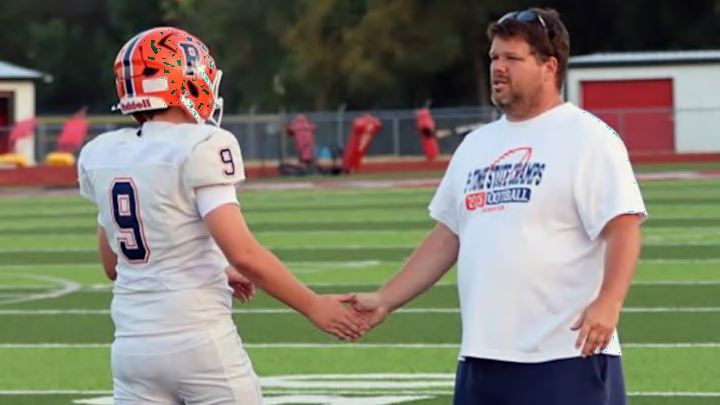
In 21 years at Illinois’ Rochester High School, head football coach Derek Leonard has compiled an overall record of 217-40 and won nine state championships.
Under his stewardship, Rochester has had four of the top ten total offenses in Illinois high school history. They’re also the only public school ever to win five state championships in a row.
Leonard got an early start on his coaching education
Leonard began preparing for his career earlier than most, almost from the moment he began to tag along and accompany his dad, Ken, to work as a little kid.
Ken Leonard is a legendary name on the Illinois high school sports landscape, a member of the Springfield Sports Hall of Fame and the state’s winningest football coach ever. During 41 years at Sacred Heart-Griffin, he won 420 games and six state titles.

So Derek’s Leonard’s passion for coaching and impacting others may have been latent in his DNA and absorbed while growing up in his household, but his acumen and rare success has certainly also been a byproduct of his sharp mind, leadership skills, the mentors he’s studied under, hard work, dedication and his exceptional abilities as a motivator and teacher.
We sat down with him fresh off of Rochester’s tenth appearance in the state championship game to talk about the road he’s travelled, and perhaps where it might eventually lead.
Q&A with Rochester's Derek Leonard
What was it like for you as a kid growing up in your household?
“My dad was a football coach, a high school teacher and an athletic director. My mom was a kindergarten teacher and they were two different personalities who both placed a high value on education. I have a younger brother, Brad, who coached with me at Rochester for about ten years. He’s in the banking and insurance industry and the demands of his job are pretty time consuming so he’s no longer coaching. He likes football, but he likes money a little bit more so I guess he was smarter than me and my dad. His son was our starting quarterback this year.
We also had an older brother, Phil. Our family adopted him when he was nine years old. He passed away in a car accident when he was about 24 years old.”
Talk a little bit about Phil and how he became a part of the Leonard family.
“We played on the same youth basketball team as kids and everyone would always come over to our house after practices and games. Phil lived in a group home and my mom took a liking to him. It started off with him spending the night once. Then it was an occasional weekend. Then it was every weekend. After about a year, he was living with us.”
What were some of the lessons that experience taught you that perhaps you didn’t fully realize until later on in life?
“My parents were educators who didn’t have a lot of money. My mom was such a caring person who loved everybody. When you’re young, you don’t really understand the sacrifices because we were just having a great time. But looking back, you start to understand what went into that, the responsibility of raising a child that’s not your own with limited resources, what they gave up to make that happen for a kid who had a very rough upbringing before he became a part of our family.”
What was your earliest introduction to playing organized sports?
“I got started at a young age and played everything - basketball, football, soccer and baseball. I always had a practice to go to. And if I wasn’t at my own practices, I’d be following behind my dad at his practices and games or playing basketball in the gym while he was working.”
You were an outstanding high school athlete. When did you get serious about football and think that it was something you wanted to pursue once you were done playing?
“I always knew that I wanted to be a coach. From a very young age, I’d be watching film with my dad and his assistant coaches in his office and enjoyed stuff like talking to the offensive line coach about blocking schemes. That was what fascinated me, the schematics and the planning that went into being successful.”
How did your career as a high school quarterback play out?
“I was the backup on varsity as a sophomore and we advanced to the state championship game. That was special because it was the first time that one of my dad’s teams made it that far. As the starter during my junior year, we made it to the quarterfinals. I had a better year individually and statistically as a senior but we lost in the second round of the state playoffs.”
And college?
“I was a three-year starter at Illinois College, a Division III school about 30 minutes west of Springfield. I broke all of the passing records there and am in the school’s athletics Hall of Fame.”

When did you go into coaching?
“As soon as I finished up my student teaching assignment in the spring semester of my senior year I got a job as a physical education teacher and football coach at Prairie Central High School. My first year I was the quarterbacks coach and we made it to the state championship game. My second year I was the offensive coordinator. I got the head coaching job at Rochester after that, in 2005, and have been there ever since.”
That was pretty quick. How old were you?
“Twenty-three years old. And I fully understand how that happened for me. My dad’s one of the greatest coaches in Illinois state history so my name is what got me in the door.”
It’s one thing to get in the door, but if you weren’t successful you wouldn’t still be there. Your offenses over the years have been prolific, what’s the philosophy behind the way your teams pile up yardage and points?
“We spread it out, play at a fast pace with no huddle and throw it around. I’ve had 12 quarterbacks in the 21 years that I’ve been at Rochester and ten of them have been Division I players, including Hank Beatty, who’s one of the best wide receivers in the Big Ten right now at Illinois. He’s just that dude, the first player ever in our conference to have over 1,000 career rushing, passing and receiving years.”
Let’s get a little more technical in terms of your offensive attack.
“This year we ran for over 2,500 yards and passed for over 2,500. We play a lot of gap scheme, similar to the quick game that Lincoln Riley ran at Oklahoma and now runs at USC. My dad taught me “The Man Offense," which is very simple. You get “The Man,” your best player, the ball as many times as you can. It might be a running back one year, a receiver the next, so you need to adapt your offense every year to take advantage of the skills of your best players.”
Todd Monken, the Baltimore Ravens offensive coordinator who won a national championship at the University of Georgia and considered to be one of the game's greatest offensive minds, is a friend and mentor of yours. How did that relationship develop?
“His family, like mine, is big in Illinois high school football and, like me, he played quarterback at a small Illinois college. His dad and uncles were close with my dad and he took a liking to me. We’ve grown close over the years and he’s a salt-of-the-earth kind of guy and still a high school coach in heart and spirit. He’s a brilliant offensive coach that, despite his accolades at the highest levels in college and the pros, is just a normal guy that loves to talk football and he can do it all day. If you didn’t know who he was and you saw him in my office, you’d think he was just one of our coaches.”

You’ve had an incredible run in your 21 years at Rochester. It’s pretty mind boggling, the consistent level of excellence and success that you’ve achieved.
“We’ve had some great players and outstanding coaches that have contributed to us winning nine state championships during my tenure. Prior to last week, we were undefeated, 9-0, in state championship games. But we lost this year, so we’ve been to ten and lost one.”
There was a situation with the team last year where there was some off the field turbulence when some of your upperclassmen were accused of hazing and bullying. Let’s talk about that for a minute.
“In about 2007 or 2008, our quarterback Sean Robinson told me that he wanted to start some player-led sessions that he called “Bleachers.” It took place on Thursdays during the season. Sean was serious about his faith so it was a kind of bible study, pep talk and discussion group where the guys got together to bond on their own and talk about leadership, what that encompassed and meant to them. Sean was a great kid who went on to play quarterback at Purdue and switched to linebacker as a junior and senior. He became a team captain there and his linebacker coach was Marcus Freeman, who’s now the head coach at Notre Dame.”
So it started out with awesome intentions, but then last year’s “Bleachers” sessions became known for something else. When did you become aware of the hazing and bullying accusations?
“I heard what they were being accused of during the fourth week of the season. And it was dumb stuff that had absolutely no place within our team culture, the hazing, bullying, shooting air guns at one another, etc. I had no clue about any of this. I’d never attended a single “Bleachers” session since it started from the very beginning because it was a player-led movement that was for them and by them, a positive activity that added to what we were building as coaches. Those sessions, from the very beginning, were a part of what made our team, and the relationships that were built within a team, special.
What was your reaction when you first heard about stuff that was possibly happening last year?
My first reaction was that I was absolutely stunned. An investigation was already in motion and I said, ‘Let me know the full extent of what was going on and I will get to the bottom of it and take care of it.’ But they didn’t tell me any specific information at that time and I wasn’t allowed the opportunity to discipline my players.”
So the school board is investigating, but won’t allow you the chance to be a part of the process? It seems that you would have been an asset in getting to the bottom of things and making sure that the proper discipline was dolled out.
“The investigation went on for four weeks. At this point, it’s turning the community inside out. I was crushed. Eventually, no players got charged with any wrongdoing and they ultimately suspended me for the final game of the regular season. At that point, it was like, ‘Let me take this bullet so we can move on and get us ready for the playoffs.’ And we wound up losing in the first round of the playoffs for the first time since 2008.”
That must have been a tough pill to swallow, but you guys moved past it this season and made another run to the state championship game. With your level of success and reputation for having such a bright offensive mind, I’m sure you’ve had overtures from colleges asking if you’d be interested in making a jump up to the next level?
“I have two sons. One is a high school freshman and the youngest is in fifth grade. I love my life and where I’m at. I see what these college coaches go through and it can be really tough on them and their families. From a schematic and competitive standpoint, I’d love to try it. But the quality of life I have right now is priceless. This is my home, I love it here and I love coaching in high school because you can truly make a difference in the lives of young people, molding and helping to create good men.”

Hypothetically, after you’ve had a chance to see your youngest son graduate, is being a college football coach something you might consider?
“I might consider it at that point. If it was the right opportunity and the chance to work with the right people in the right situation and environment, I’d definitely think seriously about it.”
 Add us as a preferred source on Google
Alejandro Danois is a freelance sports writer, documentary film producer and the author of the critically acclaimed book The Boys of Dunbar: A Story of Love, Hope and Basketball. His feature stories have been published by The New York Times, ESPN, Bleacher Report, The Baltimore Sun, Ebony Magazine, The Los Angeles Times, Sporting News and SLAM Magazine, The Baltimore Banner and the Naismith Memorial Basketball Hall of Fame, among others. He began writing for High School On SI in 2024.
Follow alidanois