%22%3E%0A%3Cpath%20d%3D%22M0%204.9397H7.3484V12.6932H14.0649V4.9397H21.4133V26.912H14.0649V19.037H7.3484V26.912H0V4.9397Z%22%20fill%3D%22white%22%2F%3E%0A%3Cpath%20d%3D%22M23.6572%204H31.0299V8.55326H23.6572V4ZM23.7788%209.77664H30.9003V26.9121H23.7788V9.77664Z%22%20fill%3D%22white%22%2F%3E%0A%3Cpath%20d%3D%22M32.7241%2029.861L34.9197%2025.5589C36.8317%2026.5635%2038.7519%2027.1955%2041.1014%2027.1955C43.7669%2027.1955%2045.1848%2025.8101%2045.1848%2023.4281V22.9258C44.2125%2024.0276%2042.6084%2025.2834%2040.2264%2025.2834C35.8028%2025.2834%2032.6025%2022.1399%2032.6025%2017.4084V17.3436C32.6025%2012.5392%2035.8676%209.37134%2039.8213%209.37134C42.3329%209.37134%2043.8074%2010.3112%2045.0632%2011.5994V9.77643H52.1848V22.5855C52.1848%2025.7533%2051.5285%2027.9246%2049.9568%2029.4883C48.4174%2031.0277%2046.0679%2031.9999%2042.2357%2031.9999C38.4035%2031.9999%2035.4868%2031.2464%2032.7241%2029.8691V29.861ZM45.2172%2017.3679V17.3031C45.2172%2015.8285%2044.091%2014.6376%2042.3572%2014.6376C40.6234%2014.6376%2039.4972%2015.8609%2039.4972%2017.3679V17.4327C39.4972%2018.9073%2040.6234%2020.0658%2042.3572%2020.0658C44.091%2020.0658%2045.2172%2018.8748%2045.2172%2017.3679Z%22%20fill%3D%22white%22%2F%3E%0A%3Cpath%20d%3D%22M54.3145%204H61.436V12.0695C62.5379%2010.6597%2064.2636%209.37155%2066.6779%209.37155C70.2914%209.37155%2072.5437%2011.7535%2072.5437%2015.6181V26.9202H65.4221V17.9109C65.4221%2016.4364%2064.5471%2015.5857%2063.4777%2015.5857C62.4082%2015.5857%2061.436%2016.4364%2061.436%2017.9109V26.9202H54.3145V4Z%22%20fill%3D%22white%22%2F%3E%0A%3Cpath%20d%3D%22M80.8983%2023.6146L84.8196%2018.9398C87.2016%2020.7627%2089.9319%2021.5162%2092.5083%2021.5162C93.8289%2021.5162%2094.388%2021.1678%2094.388%2020.5764V20.5116C94.388%2019.8796%2093.6993%2019.5393%2091.3417%2019.0694C86.4157%2018.0648%2082.0812%2016.6551%2082.0812%2012.0046V11.9398C82.0812%207.76732%2085.3463%204.53467%2091.4065%204.53467C95.6437%204.53467%2098.7792%205.5393%20101.323%207.54857L97.7421%2012.5069C95.6681%2011%2093.1889%2010.3437%2091.1472%2010.3437C90.0454%2010.3437%2089.543%2010.7245%2089.543%2011.2511V11.3159C89.543%2011.9155%2090.1426%2012.2882%2092.4597%2012.7257C98.0743%2013.7627%20101.842%2015.3912%20101.842%2019.8148V19.8796C101.842%2024.4977%2098.0419%2027.3172%2092.1437%2027.3172C87.6877%2027.3172%2083.6692%2026.0614%2080.874%2023.6146H80.8983Z%22%20fill%3D%22white%22%2F%3E%0A%3Cpath%20d%3D%22M102.838%2018.4374V18.3726C102.838%2013.5682%20106.605%209.39575%20112.187%209.39575C115.955%209.39575%20118.62%2011.3402%20119.941%2014.1354L114.829%2017.0196C114.229%2015.9178%20113.476%2015.2939%20112.317%2015.2939C110.81%2015.2939%20109.684%2016.6145%20109.684%2018.3078V18.3726C109.684%2020.1631%20110.81%2021.4513%20112.228%2021.4513C113.484%2021.4513%20114.205%2020.8194%20114.893%2019.7256L120.071%2022.6747C118.531%2025.5347%20115.931%2027.3495%20111.847%2027.3495C106.638%2027.3495%20102.838%2023.2338%20102.838%2018.4374Z%22%20fill%3D%22white%22%2F%3E%0A%3Cpath%20d%3D%22M121.164%204H128.286V12.0695C129.387%2010.6597%20131.113%209.37155%20133.528%209.37155C137.141%209.37155%20139.393%2011.7535%20139.393%2015.6181V26.9202H132.272V17.9109C132.272%2016.4364%20131.397%2015.5857%20130.327%2015.5857C129.258%2015.5857%20128.286%2016.4364%20128.286%2017.9109V26.9202H121.164V4Z%22%20fill%3D%22white%22%2F%3E%0A%3Cpath%20d%3D%22M140.867%2018.405V18.3402C140.867%2013.5033%20144.886%209.36328%20150.533%209.36328C156.18%209.36328%20160.142%2013.4466%20160.142%2018.2753V18.3402C160.142%2023.177%20156.123%2027.317%20150.476%2027.317C144.829%2027.317%20140.867%2023.2337%20140.867%2018.405ZM153.295%2018.405V18.3402C153.295%2016.6469%20152.04%2015.2939%20150.468%2015.2939C148.896%2015.2939%20147.705%2016.6469%20147.705%2018.2753V18.3402C147.705%2020.0335%20148.961%2021.3865%20150.533%2021.3865C152.104%2021.3865%20153.295%2020.0335%20153.295%2018.405Z%22%20fill%3D%22white%22%2F%3E%0A%3Cpath%20d%3D%22M161.203%2018.405V18.3402C161.203%2013.5033%20165.222%209.36328%20170.869%209.36328C176.516%209.36328%20180.477%2013.4466%20180.477%2018.2753V18.3402C180.477%2023.177%20176.459%2027.317%20170.812%2027.317C165.165%2027.317%20161.203%2023.2337%20161.203%2018.405ZM173.631%2018.405V18.3402C173.631%2016.6469%20172.376%2015.2939%20170.804%2015.2939C169.232%2015.2939%20168.041%2016.6469%20168.041%2018.2753V18.3402C168.041%2020.0335%20169.297%2021.3865%20170.869%2021.3865C172.44%2021.3865%20173.631%2020.0335%20173.631%2018.405Z%22%20fill%3D%22white%22%2F%3E%0A%3Cpath%20d%3D%22M182.139%204H189.26V26.9121H182.139V4Z%22%20fill%3D%22white%22%2F%3E%0A%3Cpath%20fill-rule%3D%22evenodd%22%20clip-rule%3D%22evenodd%22%20d%3D%22M199.368%204.36764C205.191%20-1.45588%20214.632%20-1.45588%20220.456%204.36764C226.279%2010.1912%20226.279%2019.6324%20220.456%2025.4559L209.912%2036L199.368%2025.4559C193.544%2019.6324%20193.544%2010.1912%20199.368%204.36764ZM202.009%207.55761C201.948%207.86849%20201.916%208.39718%20201.916%209.14566V10.4189C201.916%2011.1832%20201.948%2011.7198%20202.013%2012.0267C202.078%2012.3317%20202.278%2012.6168%20202.617%2012.8762C202.956%2013.1376%20203.403%2013.3316%20203.958%2013.4623C204.512%2013.593%20205.1%2013.6583%20205.837%2013.6583C206.573%2013.6583%20207.217%2013.591%20207.769%2013.4524C208.322%2013.3158%20208.761%2013.1178%20209.086%2012.8604C209.411%2012.6029%20209.605%2012.3178%20209.666%2012.0069C209.728%2011.6961%20209.759%2011.1674%20209.759%2010.4189V9.14566C209.759%208.38134%20209.728%207.84473%20209.662%207.53781C209.597%207.23287%20209.397%206.94972%20209.058%206.68834C208.72%206.42696%20208.272%206.23291%20207.718%206.10223C207.163%205.97154%20206.536%205.90619%20205.839%205.90619C205.102%205.90619%20204.459%205.97352%20203.906%206.11213C203.352%206.24875%20202.914%206.44677%20202.589%206.70418C202.265%206.9616%20202.071%207.24673%20202.009%207.55761ZM207.276%2024.8638C210.876%2024.8638%20212.557%2024.2064%20212.557%2021.862V21.858V21.3155C212.557%2019.6581%20211.516%2018.971%20208.252%2018.3136C207.278%2018.1136%20206.908%2017.9136%20206.908%2017.3136V16.9414C206.908%2016.6543%20207.177%2016.5117%20207.413%2016.5117C207.749%2016.5117%20207.918%2016.7137%20207.918%2016.9414V18.1136H212.391V17.3988C212.391%2015.4563%20211.347%2014.4266%20207.177%2014.4266C204.15%2014.4266%20201.896%2015.3414%20201.896%2017.3711V17.7433C201.896%2019.5155%20202.805%2020.3155%20206.201%2021.0303C206.28%2021.0472%20206.355%2021.063%20206.427%2021.0781C207.329%2021.2674%20207.647%2021.3341%20207.647%2021.9174V22.2897C207.647%2022.6619%20207.546%2022.8045%20207.142%2022.8045C206.67%2022.8045%20206.637%2022.5471%20206.637%2022.262V21.2897H201.894V21.7471C201.894%2024.149%20203.476%2024.8638%20207.276%2024.8638ZM213.424%2024.5569H217.925V14.7355H213.424V24.5569ZM214.955%2013.5019H217.925V6.06064H215.092V9.411L213.193%206.06064H210.359V13.5019H213.193V10.1199L214.955%2013.5019ZM206.269%2012.152C206.204%2012.2688%20206.055%2012.3262%20205.825%2012.3262L205.827%2012.3282C205.604%2012.3282%20205.459%2012.2767%20205.398%2012.1757C205.336%2012.0748%20205.305%2011.8074%20205.305%2011.3758V7.90068C205.305%207.51852%20205.352%207.28684%20205.445%207.20962C205.538%207.13239%20205.675%207.09279%20205.851%207.09279C206.059%207.09279%20206.198%207.14031%20206.265%207.23734C206.332%207.33239%20206.366%207.55416%20206.366%207.90068V11.3203C206.366%2011.7579%20206.334%2012.0352%20206.269%2012.152Z%22%20fill%3D%22white%22%2F%3E%0A%3C%2Fg%3E%0A%3Cdefs%3E%0A%3CclipPath%20id%3D%22clip0_15247_3714%22%3E%0A%3Crect%20width%3D%22225%22%20height%3D%2236%22%20fill%3D%22white%22%2F%3E%0A%3C%2FclipPath%3E%0A%3C%2Fdefs%3E%0A%3C%2Fsvg%3E%0A)
The Whistles Fall Silent: Mercersburg Academy Ends Its 130-Year Football Tradition
MERCERSBURG, Pa. — Tuesday, Aug. 19, on what would have been the opening day of football practice at Mercersburg Academy, the school's football field was silent. The usual sounds of chirping whistles, the thud of linemen crashing into blocking dummies, and the barking of a quarterback have all been replaced by utter silence.
The End of an Era
There is no longer football at Mercersburg Academy.
And that is news worth noting.
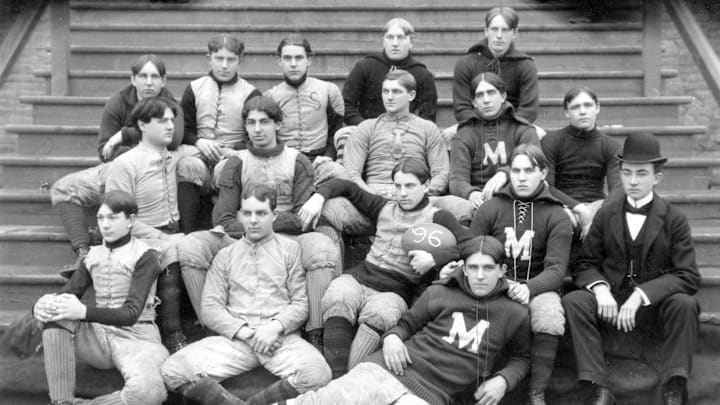
Since its inaugural team in 1894, the year after the school’s founding, Mercersburg Academy has fielded football teams every fall. ‘The Academy,’ as it’s colloquially known in South Central Pennsylvania, played uninterrupted through two World Wars even as nearby college programs shut down for the war effort. It managed a one-game season during the Great Flu epidemic of 1918 when many East Coast schools were shuttered. And Mercersburg Academy even held a few scrimmage games during the recent COVID-19 Pandemic in 2020.
Simply put, for 130 years, football was a fixture at this school – until Tuesday.
A Reflection of the Times
The termination of Mercersburg Academy’s football program is not only a blow to this historical institution but also serves as a broader reflection of the times. While football at its highest levels is flush with money, fan interest, and media attention, some parts of the pipeline are drying up.
At one end of the high school football spectrum are the teams that appear in nationally televised games with major college-bound players, some even receiving NIL money. At the opposite end are the programs struggling to compete, often with rosters barely large enough to hold a full inner-squad scrimmage. Smaller schools tend to be at a greater disadvantage, especially when top players from weaker teams leave for better opportunities, further widening the gap between high school football’s haves and have-nots.
Mercersburg Academy found itself caught in the middle – a small school with limited enrollment and a growing international student body, yet competing in a football conference far beyond its weight class. Even after trying to save the sport by going to 8-man football, the school realized that getting out was the only viable option.
“It hit hard,” Mercersburg Academy’s Head of School Quentin McDowell said of the decision to discontinue the football program, which was made earlier this calendar year. “My head knew it was the right decision, but part of my heart was broken.”
A Magical Campus, Built on Tradition
Mercersburg Academy is a magical place, located in a valley near the Appalachian foothills, about 90 minutes northwest of Washington, D.C., and just over two hours from Philadelphia and Baltimore. The Academy’s 300-acre campus is picturesque with Georgian-style architecture, tree-lined walkways, and the awe-inspiring Irvine Memorial Chapel that reaches high into the sky. The setting for this residential school is peaceful and secluded, yet within reach of major metropolitan areas.
It is a school of significant wealth, despite an enrollment of only 440 students, evenly split between male and female. Mercersburg Academy boasts an endowment of more than $400 million, which is nearly twice the size of the median college endowment, as tracked by NACUBO-Commonfund Study of Endowments. Evidence of this abundance is visible across campus, from the 209,000-square-foot Goldthorpe Athletic Complex, featuring state-of-the-art squash and aquatic centers, to the 14-court Smoyer Tennis Center.

The school showcases its sporting past with larger-than-life artwork in the Goldthorpe hallways. This includes tributes to many of its Olympians – among them nine gold medalists, most recently swimmer Melvin Stewart at the 1992 Summer Games. The displays leave Goldthorpe Athletic Complex as both a sports museum and an active athletic facility.
Of course, Mercersburg Academy wasn’t always so lavish.
A school named Marshall College was founded at this location in 1836. In 1853, Marshall College merged with Franklin College to become the modern-day Franklin & Marshall, which relocated to Lancaster, Pa., about a two-hour drive from Mercersburg. After a series of iterations (Marshall Academy, Marshall Collegiate Institute, Mercersburg College), Mercersburg Academy was christened in 1893 under the leadership of Dr. William Mann Irvine.
Football at the Core of Mercersburg’s Identity
To say this school was built on football would not be a stretch.
Irvine, The Academy’s founding headmaster, was a starting lineman for Princeton’s football team for five years, during which the Ivy League power compiled a 43-3-2 record and won three straight national championships. Irvine was named to the College Football Hall of Fame’s 1880s All-Decade Team.
Mercersburg Academy opened its doors in 1893, and the following year it fielded a football team that promptly won both of its official contests. Details of the inaugural game are lost to history, other than a simple one-sentence summary in the Oct. 30, 1894, Hagerstown (Maryland) Daily Herald and Torch Light: “The Mercersburg College foot ball (sic) team defeated the Chambersburg Academy boys by the score of 18 to 0.” The only other thing known about the game was that it was played on Oct. 27 in Chambersburg, Pa. Mercersburg Academy, mislabeled as Mercersburg College in that newspaper report, later that fall defeated Dickinson College 14-6.

While official games were few and far between, and “seasons” could often be defined as two or three games, Mercersburg became a regional prep powerhouse. It would take three years before Mercersburg suffered its first high school football defeat. And the dominance was just beginning. The 1896 team went 6-0, which included wins over Dickinson College and Shippensburg University.
During Irvine’s tenure as headmaster, which ended when he died on June 11, 1928, a few days after sustaining a stroke during commencement ceremonies, Mercersburg Academy sported a record of 138-40-28. Nineteen of those losses were to the freshmen teams of Princeton and the University of Pennsylvania. Meanwhile, this high school/prep school team was racking up results against small college programs and JV teams of more established college programs.
Counted among the victories are a 59-0 win over Franklin & Marshall JV in 1901, a 74-0 thrashing of Dickinson JV in 1902, and a head-popping 102-0 shellacking of Blue Ridge College in 1924. In total, between 1894 and 1927, Mercersburg Academy recorded 73 shutout wins over college teams, and another eight contests finished in scoreless ties, according to records kept by former Penn State professor Roger Saylor.
14 NFL Players Have Suited Up for the Blue and White
Although much of Mercersburg’s early success came before the modern professional game, eight of the school’s 14 future NFL players suited up for the Blue and White during Irvine’s tenure as headmaster. The most noteworthy was Heinie Miller, a three-time college All-American at UPenn. After college, Miller helped the Buffalo All-Americans to an 18-2-3 record in his two years with the team and later coached three Philadelphia-area college football programs, including Temple.
Football success at Mercersburg Academy outlived Irvine for another decade. Between 1894 and 1938, the program suffered only two losing seasons, and even those were narrow, finishing 2-3-3 in 1914 and 2-3-1 in 1919. During those 45 years, there were 12 undefeated and 15 one-loss seasons. No team lost more than three games.
A Century of Highs and Lows
But as World War II neared, the football program’s fortunes changed.
Despite returning 23 players on a 41-man roster, Mercersburg Academy went 1-4-1 during the 1940 season, playing a split of high school and college teams. It was the program’s worst record up to that date. But that dismal 1940 campaign was followed up by a 1-5 showing in 1941 and another 1-4-1 season in 1942.
Newspaper articles at the time do not provide any specific reason – or set of reasons – for the drastic decline. Each year, local newspapers provided a similar narrative – stellar turnout with ample experience. Yet, each year, Mercersburg Academy failed to deliver results.
Mercersburg Academy slipped into a familiar cycle of highs and lows typical of small schools, posting undefeated seasons in 1948 (6-0) and 1950 (5-0-2), bookended by a 4-3 campaign in 1949 and a 3-4 finish in 1951.
Then, it was mostly downhill for the next four-plus decades. Between 1951 and 1994, a stretch of 44 seasons, Mercersburg Academy won only 98 games while losing 227. There were six winless seasons and nine one-win campaigns.

In a rare winning season in 1988, Mercersburg Academy delivered one of the great all-time come-from-behind victories, a performance immortalized with a commemorative display in the Goldthorpe Athletic Complex.
A Comeback for the Ages
Kiski School (Pa.) had the ball and a 22-7 lead with only 1:26 left in its home contest against Mercersburg Academy. The rally started as Chris Eldridge recovered a Kiski fumble at the Kiski 35. Mercersburg quarterback Sam Hopple drove the team down the field and completed a 5-yard scoring pass to Bobby Jordan with 26 seconds left. Jordan ran in the two-point conversion, pulling Mercersburg within 22-15.
After recovering the onside kick, Mercersburg faced a fourth-and-12 when Hopple connected with Jordan on a 45-yard pass play, moving the ball to the 2. Mike Corbi then scored on the final play in regulation, making it 22-21 with the PAT pending. Mercersburg, riding the momentum, opted for another two-point conversion, and this time Hopple connected with Doug Phillips for the 23-22 victory. The football from that game-winning play is on display in the athletic complex.
Interestingly, that win was during Ron Simar’s first year as athletic director. Simar’s initial contact with Mercersburg Academy was as a student from a rival prep school in the 1960s. He joined Mercersburg Academy in 1988 and served as athletic director for more than 20 years.
He could not speak to the struggles before he arrived in 1988, but acknowledged that some coaching hires before and during his time as AD had not worked out as planned. A few former college coaches were brought in to lead the program, yet the demands of prep and post-grad recruiting and the prep school lifestyle proved a poor fit, leading them to return quickly to the college ranks.
In 1995, the program briefly re-emerged under coach Andy Schroyer, fueled by a new conference and a sudden influx of athletic talent.
Simar was behind the creation of the Mid-Atlantic Conference, which debuted in 1995 with Mercersburg Academy, Maret School (D.C.), Potomac School (Va.), and St. James School (Md.). Mercersburg Academy went 8-1 that season, losing only to St. James, which finished 9-0.
The Mercersburg team was led by athletic quarterback Chris Benson, who would later follow a baseball path to Clemson, and receiver Haven Barnes, who would later become a track All-American at UConn. Supplemented by some NCAA Division I-bound basketball imports and post-grads, Mercersburg Academy finished out the decade with three more seven-win seasons. But the seeds of change had been sown.
Too OId, Too Good
Simar said the hope was that the MAC, which started as a boys-only athletic conference, would evolve into a coed conference. After five years in the league, he said, two things became apparent: first, the MAC would never be coed, and secondly, Mercersburg Academy’s post-grads were creating too much of a competitive advantage in several sports.
“No one cared when we had post-grads and were losing,” Simar recalled. “But when we started winning, PGs became the problem. We could see the handwriting on the wall. The PG “problem” and not being a coed league led us to look around.”
The Move to the MAPL
The Mid-Atlantic Prep League (MAPL), which had gone coed in 1998, seemed to be the answer for Mercersburg Academy. The league is made up of elite prep schools from Pennsylvania and New Jersey.
Though Simar stepped down as athletic director in 2008 and retired in 2014, he remains one of the school’s greatest advocates. He maintains that the move to MAPL was best for the school and the entire athletic program, boys and girls.
“We are where we should be, in a league with PGs,” he said.
At first, it was hard to disagree with that sentiment.
Shortly after hiring Dan Walker as head coach, Mercersburg Academy delivered a 9-1 season in 2005 with a team featuring future NFL player Vinne Rey.
After that, Simar said, things changed in the league, and much to Mercersburg’s football misfortune. He said rival schools started to prioritize football and pointed toward Hun School (N.J.) as a case study. In 2005, Mercersburg defeated Hun, 9-3. A year later, Mercersburg Academy was dealt a 53-13 defeat by Hun en route to the program’s only 0-10 season in school history.
“All of a sudden, we were taking a knife into a gunfight,” Walker said, pointing to how quickly the program’s fortunes changed.
Simar then repeated and qualified an earlier statement, “We are where we should be (in MAPL), just not in football.”
Walker remained the head coach at Mercersburg Academy through the 2018 season, experiencing a modest level of success as MAPL rivals, especially Hun School and Peddie School (N.J.), were emerging football powers.
The Shift to 8-Man Football: The Beginning of the End
By 2018, Mercersburg Academy and Walker had had enough.
Declining interest, low participation, and mounting losses forced a serious reevaluation of a program that had once been the centerpiece of The Academy’s athletic offerings. Walker, who is still a teacher at the school, stepped down as head coach, and Mercersburg Academy attempted to salvage the program by turning to 8-man football while leaving the MAPL football conference.
While not originally in favor of 8-man football, Walker had a simple outlook: “Anything to save football. Football is so valuable to our men and women.” [And, yes, he had two female placekickers during his tenure as head coach.] “Football teaches valuable lessons.”
Mercersburg Academy became a charter member in the creation of the Keystone State Football League, which was established in 2019 and also included Delaware County Christian School, Perkiomen School, and Valley Forge Military Academy, all Pennsylvania schools offering 8-man football. Andy Brown took over the reins and coached Mercersburg Academy to a 5-3 season.
Following the Pandemic year, Mercersburg Academy delivered a 7-1 showing in 2021, winning the Keystone title. As the league grew, Mercersburg Academy’s success started to decline, first going 5-2 in 2022, 2-4 in 2023, and 1-6 this past year. Jamar Galbreath, a former Mercersburg player under Walker, coached the final season. Mercersburg Academy won its season opener and then lost the last six games.
Both Walker and Simar said the move to 8-man probably ended any serious attempt for The Academy to return to traditional football.

“The key [to successful football] is participation, and the final years in MAPL, we were down to 17-, 18-, 19-player rosters,” Simar said. “We went to 8-man football and all of a sudden we had 30-35 players, but half of them had never played football before, since many of them were international students.”
Walker said the school stopped actively recruiting football players once the program shifted to 8-man. McDowell, the Head of School, added that, in this format, 8-man football became more of a participation sport rather than a serious varsity pursuit.
Simar said, “I agreed (with the administration) when we went to 8-man. I agreed with the move to drop football. Now, I say that, and I wouldn’t have wanted to be the AD in either of those moments, but we were on the verge of football simply being unhealthy for us.”
Football’s National Decline
Every year since 1970, the National Federation of High School (NFHS) has released its annual participation survey. While the survey does not include every high school program in the U.S., it serves as a fair barometer of high school participation trends.
There is no question that football, in general, has been under attack, especially regarding concussions. The situation at Mercersburg Academy, seeing a program end, does not seem to be isolated.
According to the NFHS, there were 13,788 11-man high school football programs during the 2023-2024 school year, a number that has remained relatively stagnant since the Pandemic, but still well below the 14,247 programs in 2019 (when Mercersburg abandoned 11-man football) and the all-time high of 15,233 in 1976. Meanwhile, 8-man programs have steadily increased, reaching 1,143 in 2023-2024, up from 946 in 2019 and 552 in 1976. Overall, the total number of high school football programs has declined by roughly 1.5 percent since the Pandemic.
The Lasting Legacy
Following the 2024 fall season, McDowell said there was a review of all after-school programs.
“The decision was not about football in a vacuum,” McDowell said. “It was part of a much bigger review to determine what afternoon programming at this boarding school made the most sense for the most students.”
McDowell acknowledged that several of the schools' MAPL rivals had increased their commitment to football.
“We had to ask the questions: what does it take (to become more competitive) and are we willing to make that investment?” he said. “With football, there are a number of pressure points … Either we double down and increase exponentially our investment in football, or we let it go.”
McDowell stressed that finances were never at issue here; it was human capital. With roughly 200 male students, could Mercersburg Academy ever return to a high level of football, or is it better served spreading those individuals to other sports?
The school has recently placed greater emphasis on lacrosse, highlighted by the hiring of former Navy head coach Rick Sowell. By distributing those former football players across other sports, since students must meet participation requirements, several existing programs could be strengthened, McDowell said.
Once the Board of Trustees voted to discontinue football, McDowell said he had the task of personally calling many members of the Mercersburg Academy community.
“About 85 percent of the people I spoke to understood,” he said. “Times have changed. A few were outraged, and some didn’t even know we had gone to 8-man football.”
Walker said he found out through a campus-wide email and was disappointed in the decision.
“Logically, it’s hard to deny the facts,” McDowell said. “You want to hold on, to honor the heritage (and keep football), but it’s not 1894 anymore.”
Visible Signs of Change
It’s not unusual for a school struggling with football player participation or results to cancel a season to reestablish itself. But at Mercersburg Academy, this feels more permanent.
Visible signs of change appeared in July, when the pressbox and bleachers were removed from the football field, which is one of the region’s most unique high school facilities. The setup was unusual as the pressbox and bleachers were tucked inside the track, placing fans right on top of the coaches during football season. Yet, during the spring track season, 400-meter races disappeared behind the pressbox and out of view as runners charged down the back straightaway.
By late July, all that remained was the fading grid, the goalposts, and the scoreboard. The field had been lined one last time during the summer as Mercersburg Academy honored its commitment to two fellow private schools that use the facility as a summer retreat before the start of formal football practice. Soon, the goalposts will be gone, and the field will be repurposed.
The great irony in dismantling the stadium was that only weeks earlier, a framed, signed Cincinnati Bengals jersey from Rey, the 2006 Mercersburg graduate who captained the program’s last great team, had been placed on display in the Goldthorpe Athletic Complex, positioned near a window overlooking the field. Rey is likely to remain the last of the 14 Mercersburg alumni to reach the NFL.
While the end of football at Mercersburg Academy has arrived, Simar delivered one last observation.
“We have a name for the track (Curran Track), the pool (Lloyd Aquatic Center), the basketball courts (Plantz Courts), the squash courts (Davenport Squash Center), the baseball field (Cannon Field), the tennis courts (Smoyer Tennis Center),” Simar said. “Everything has a name. But [even after 130 years], the football field never had a name.
“Perhaps that was telling us something all along.”
 Add us as a preferred source on Google
Sheldon Shealer is an award-winning sports journalist with more than 30 years of state and national high school sports coverage, which includes creating the Maryland high school football media state rankings and state records. His previous stops include editor positions with ESPN, Student Sports, The Frederick News-Post, and Hagerstown Herald-Mail, and time as a reporter with The Washington Post. He is also a professor of sports journalism at Mount St. Mary's University and a PhD candidate at Penn State University. He began contributing to High School On SI in 2025.