%22%3E%0A%3Cpath%20d%3D%22M0%205.37646H8.15061L17.4195%2016.8819V5.37646H26.0647V31.4412H18.3227L8.64523%2019.4196V31.4412H0V5.37646Z%22%20fill%3D%22white%22%2F%3E%0A%3Cpath%20d%3D%22M29.2041%205.37649H43.8064C47.4193%205.37649%2049.6989%206.1937%2051.2258%207.72059C52.1505%208.64533%2052.8172%2010.0002%2052.8172%2011.7851V11.8497C52.8172%2014.9465%2050.9462%2016.8389%2048.172%2017.8067C51.5269%2018.7744%2053.6774%2020.5594%2053.6774%2024.1293V24.1938C53.6774%2028.3659%2050.258%2031.4197%2043.6558%2031.4197H29.2041V5.35498V5.37649ZM44.258%2013.7637C44.258%2012.6024%2043.3333%2011.9787%2041.4623%2011.9787H37.6988V15.6346H41.5053C43.3763%2015.6346%2044.258%2015.011%2044.258%2013.8497V13.7852V13.7637ZM42.0859%2020.9895H37.6988V24.8605H42.0644C43.9569%2024.8605%2044.9247%2024.0863%2044.9247%2022.968V22.9035C44.9247%2021.7852%2043.9999%2021.011%2042.0859%2021.011V20.9895Z%22%20fill%3D%22white%22%2F%3E%0A%3Cpath%20d%3D%22M64.8174%205.18286H73.4627L84.452%2031.4411H74.9896L73.6132%2027.9357H64.4949L63.1615%2031.4411H53.8496L64.8389%205.18286H64.8174ZM71.4412%2021.7636L69.054%2015.441L66.6669%2021.7636H71.4412Z%22%20fill%3D%22white%22%2F%3E%0A%3Cpath%20d%3D%22M95.2695%205.37646H105.248C115.592%205.37646%20120.775%2010.4733%20120.775%2018.1938V18.2583C120.775%2025.9788%20115.485%2031.4412%20104.947%2031.4412H95.2695V5.37646ZM104.001%2012.9679V23.8497H105.463C109.442%2023.8497%20112.022%2022.2153%20112.022%2018.4518V18.3873C112.022%2014.6239%20109.463%2012.9894%20105.463%2012.9894H104.001V12.9679Z%22%20fill%3D%22white%22%2F%3E%0A%3Cpath%20d%3D%22M123.098%2011.1182H131.549V15.2258C132.711%2012.4731%20134.56%2010.6881%20137.915%2010.8387V19.8065H137.012C133.442%2019.8065%20131.528%2021.785%20131.528%2026.2797V31.4625H123.076V11.1182H123.098Z%22%20fill%3D%22white%22%2F%3E%0A%3Cpath%20d%3D%22M137.808%2025.6772V25.6127C137.808%2021.5482%20140.818%2019.2901%20145.55%2019.2901C147.27%2019.2901%20149.464%2019.6557%20150.345%2020.0428V19.6987C150.345%2017.8277%20149.184%2016.7524%20146.582%2016.7524C144.496%2016.7524%20142.754%2017.204%20140.969%2017.9137L139.485%2012.3008C141.829%2011.3975%20144.517%2010.8169%20148.044%2010.8169C152.173%2010.8169%20154.862%2011.6771%20156.646%2013.4621C158.173%2014.989%20158.776%2016.9675%20158.776%2019.9137V31.5052H150.324V29.4622C148.904%2030.9891%20147.012%2031.9999%20144.474%2031.9999C140.56%2031.9999%20137.808%2029.7633%20137.808%2025.7417V25.6772ZM150.431%2023.9138V23.0536C149.937%2022.86%20149.206%2022.7095%20148.496%2022.7095C146.818%2022.7095%20145.894%2023.7202%20145.894%2024.9891V25.0536C145.894%2026.2364%20146.754%2027.0321%20147.829%2027.0321C149.313%2027.0321%20150.431%2025.8493%20150.431%2023.9138Z%22%20fill%3D%22white%22%2F%3E%0A%3Cpath%20d%3D%22M162.883%2017.6345H160.496V11.1183H162.883C162.926%208.96778%20163.442%207.20433%20164.711%205.9355C166.088%204.55915%20167.872%204%20170.668%204C173.163%204%20174.69%204.21506%20175.851%204.55914V9.84951C175.034%209.65596%20174.217%209.54843%20173.141%209.54843C171.83%209.54843%20171.163%2010.0646%20171.163%2011.1829V11.3334H175.851V17.6345H171.335V31.4411H162.883V17.6345Z%22%20fill%3D%22white%22%2F%3E%0A%3Cpath%20d%3D%22M178.883%2024.6238V17.613H176.496V11.0968H178.883V6H187.335V11.0968H192.023V17.613H187.335V22.7528C187.335%2024.2797%20188.045%2024.8389%20189.378%2024.8389C190.152%2024.8389%20191.055%2024.6238%20191.937%2024.2152V30.7314C190.604%2031.4411%20188.582%2031.8927%20186.539%2031.8927C181.55%2031.8927%20178.862%2029.5916%20178.862%2024.6238H178.883Z%22%20fill%3D%22white%22%2F%3E%0A%3Cpath%20fill-rule%3D%22evenodd%22%20clip-rule%3D%22evenodd%22%20d%3D%22M201.368%204.36764C207.191%20-1.45588%20216.632%20-1.45588%20222.456%204.36764C228.279%2010.1912%20228.279%2019.6324%20222.456%2025.4559L211.912%2036L201.368%2025.4559C195.544%2019.6324%20195.544%2010.1912%20201.368%204.36764ZM204.009%207.55761C203.948%207.86849%20203.916%208.39718%20203.916%209.14566V10.4189C203.916%2011.1832%20203.948%2011.7198%20204.013%2012.0267C204.078%2012.3317%20204.278%2012.6168%20204.617%2012.8762C204.956%2013.1376%20205.403%2013.3316%20205.958%2013.4623C206.512%2013.593%20207.1%2013.6583%20207.837%2013.6583C208.573%2013.6583%20209.217%2013.591%20209.769%2013.4524C210.322%2013.3158%20210.761%2013.1178%20211.086%2012.8604C211.411%2012.6029%20211.605%2012.3178%20211.666%2012.0069C211.728%2011.6961%20211.759%2011.1674%20211.759%2010.4189V9.14566C211.759%208.38134%20211.728%207.84473%20211.662%207.53781C211.597%207.23287%20211.397%206.94972%20211.058%206.68834C210.72%206.42696%20210.272%206.23291%20209.718%206.10223C209.163%205.97154%20208.536%205.90619%20207.839%205.90619C207.102%205.90619%20206.459%205.97352%20205.906%206.11213C205.352%206.24875%20204.914%206.44677%20204.589%206.70418C204.265%206.9616%20204.071%207.24673%20204.009%207.55761ZM209.276%2024.8638C212.876%2024.8638%20214.557%2024.2064%20214.557%2021.862V21.858V21.3155C214.557%2019.6581%20213.516%2018.971%20210.252%2018.3136C209.278%2018.1136%20208.908%2017.9136%20208.908%2017.3136V16.9414C208.908%2016.6543%20209.177%2016.5117%20209.413%2016.5117C209.749%2016.5117%20209.918%2016.7137%20209.918%2016.9414V18.1136H214.391V17.3988C214.391%2015.4563%20213.347%2014.4266%20209.177%2014.4266C206.15%2014.4266%20203.896%2015.3414%20203.896%2017.3711V17.7433C203.896%2019.5155%20204.805%2020.3155%20208.201%2021.0303C208.28%2021.0472%20208.355%2021.063%20208.427%2021.0781C209.329%2021.2674%20209.647%2021.3341%20209.647%2021.9174V22.2897C209.647%2022.6619%20209.546%2022.8045%20209.142%2022.8045C208.67%2022.8045%20208.637%2022.5471%20208.637%2022.262V21.2897H203.894V21.7471C203.894%2024.149%20205.476%2024.8638%20209.276%2024.8638ZM215.424%2024.5569H219.925V14.7355H215.424V24.5569ZM216.955%2013.5019H219.925V6.06064H217.092V9.411L215.193%206.06064H212.359V13.5019H215.193V10.1199L216.955%2013.5019ZM208.269%2012.152C208.204%2012.2688%20208.055%2012.3262%20207.825%2012.3262L207.827%2012.3282C207.604%2012.3282%20207.459%2012.2767%20207.398%2012.1757C207.336%2012.0748%20207.305%2011.8074%20207.305%2011.3758V7.90068C207.305%207.51852%20207.352%207.28684%20207.445%207.20962C207.538%207.13239%20207.675%207.09279%20207.851%207.09279C208.059%207.09279%20208.198%207.14031%20208.265%207.23734C208.332%207.33239%20208.366%207.55416%20208.366%207.90068V11.3203C208.366%2011.7579%20208.334%2012.0352%20208.269%2012.152Z%22%20fill%3D%22white%22%2F%3E%0A%3C%2Fg%3E%0A%3Cdefs%3E%0A%3CclipPath%20id%3D%22clip0_15247_3640%22%3E%0A%3Crect%20width%3D%22227%22%20height%3D%2236%22%20fill%3D%22white%22%2F%3E%0A%3C%2FclipPath%3E%0A%3C%2Fdefs%3E%0A%3C%2Fsvg%3E%0A)
2026 NBA Draft: The Productive Junior Query
In this story:
The Productive Junior Query
- Introduction: The Study
- Productive Junior Query: Player Outcomes
- Projecting Into the Future
- Who Qualified for the Productive Junior Query this past Season?
- Conclusion
Introduction: The Study
The new era of NIL has changed the landscape of the 2026 NBA Draft, with projected first round picks like Braylon Mullins, Patrick Ngongba II, and Thomas Haugh all returning to college. Other prominent prospects, like Montiejus Krivas and Ivan Kharchenkov, also decided to return. In total, there were only 71 early entrants--the lowest number since 2003. As a result, this draft may see an increased contrast between the one-and-done lottery selections, the sophomore breakouts, the few first round upperclassman, and the larger group of players who have exhausted their eligibility.
Expect most players who have not exhausted their eligibility and are not guaranteed a roster spot (usually picks 1-40ish) to return to school. This impact of NIL was evident in the 2025 NBA Draft as well: 22 college players were taken in the second round. Of those 22, only three players were not seniors or graduate students. For context, those three players were Rasheer Fleming, Adou Thiero, and Tyrese Proctor -- all three signed contracts with at least the first two years being guaranteed.
In an ever-changing draft landscape, there is increased uncertainty -- including amongst "the few first round upperclassman" group mentioned earlier. To reduce uncertainty, it has become increasingly popular to design statistical queries to identify NBA talent.
Throughout the past two years, the creation of The Productive Young Athlete Query, Productive Sophomore Query, Productive Junior Query (as we'll look at today), and the Efficient Tall Freshman Query, has helped bring an increased level of analytics and certainty to my scouting process. Far from an exact science, the beauty of scouting is the uncertainty surrounding it. A field that is difficult and nearly impossible to truly master, adding in a pinch of analytics to the film, intel, and injury history can add to the work of art that is scouting.
Read More: 2026 NBA Draft: The Productive Young Athlete Query
Read More: 2026 NBA Draft: The Productive Sophomore Query
The Study
Before we dive into the statistical analysis, it’s important to define what “stick” means in my study. In this case, I considered a prospect to “stick” if they played five-plus seasons in the NBA.
There were 38 juniors throughout the 12 college basketball seasons from 2010-2021 who played at least 40% of their team's minutes, had a Box Plus-Minus of at least +10, and met the minimum athletic threshold of four total dunks. 63.2% (24/38) of those juniors have played five-plus years in the NBA.
The purpose of this query is to find juniors with production so impactful that it has the potential to reliably predict NBA talent -- something that's only increasing in importance as uncertainty surrounding second round picks increases. Juniors who meet this criteria are being trusted to play almost a majority of their team's minutes, meet a certain production threshold, and also meet a minimum athletic threshold throughout the season.
Productive Junior Query: Player Outcomes
Sticking in the NBA is one thing, but how impactful were the players who stuck? Below I grouped the 38 players who have met the Productive Junior Query from 2010-2021 into four subcategories based on Draft Express Pick Expectations.
Players were grouped into the following five categories:
Did Not Stick
Players who met the Productive Junior Query (PJQ) but did not stick in the NBA: Jackson Emery ('10), Tai Wesley ('10), Jeff Withey ('12), Malcolm Miller ('13), KJ McDaniels ('14), Kyle Wiltjer ('15), Ron Baker ('15), Jarrod Uthoff ('15), Derek Willis ('16), Nigel Williams-Goss ('17), Ethan Happ ('18), Juwan Morgan ('18), Anthony Lamb ('19), and Jared Butler ('21)
Backup: Five NBA seasons, with career 10-24 minutes per game, or over 4000 career NBA minutes
Backup Players who met the Productive Junior Query: Jon Leuer ('10), James Anderson ('10), Doug McDermott ('13), Kelly Olynyk ('13), Gorgui Dieng ('13), Delon Wright ('14), Frank Kaminsky ('14), Anthony Gill ('15), Justin Anderson ('15), Gary Payton II ('15), Dean Wade ('18), Keita Bates-Diop ('18), Grant Williams ('19), Brandon Clarke ('19), Luka Garza ('20), Xavier Tillman ('20), and Neemias Queta ('21)
Starter: Career 24 minutes per game or higher, or started over half of career NBA games (minimum 21 minutes per game)
Starters who met the Productive Junior Query: Evan Turner ('10), CJ McCollum ('12), Victor Oladipo ('13), Taurean Prince ('15), Willie Cauley-Stein ('15), and Mikal Bridges ('18)
All-Star: Two or more appearances in the NBA All-Star Game
All-Star Players who met the Productive Junior Query: Draymond Green ('11)
The Results
Out of the 38 players who have met the Productive Junior Query from the 2010-2021 college basketball seasons...
- ~38.6% of them did not stick in the NBA (14 players)
- ~44.7% of them became Backups (17 players)
- ~15.8% of them became Starters (6 players)
- ~2.6% of them became multi-time All-Stars (1 player)

To put these outcomes into context, let's compare it to the results of draft picks over a similar timeframe.
If we analyze the 2010-2021 NBA Draft classes utilizing Draft Express Pick Expectations, players who met the Productive Junior Query produced outcomes comparable to Picks 26-30, where 22% of players became multi-time All-Stars or Starters, 40% became Backups, and 38% of players did not stick in the NBA.

Let's compare the Productive Junior Query to the Productive Young Athlete Query and Productive Sophomore Query:


Outcome | PYA Query | PSQ | PJQ |
|---|---|---|---|
All-Star | 17.8% | 6.9% | 2.6% |
Starter | 32.2% | 37.9% | 15.8% |
Backup | 27.8% | 27.6% | 44.7% |
Did Not Stick | 22.2% | 27.6% | 38.6% |
Here we can see that players who meet the Productive Young Athlete Query are approximately 2.6X more likely to become a multi-time All-Star than a player who meets the Productive Sophomore Query. Players who meet the Productive Sophomore Query are also approximately 2.7X more likely to become a multi-time All-Star than a player who meets the Productive Junior Query.
Additionally, 50% of players who have met the PYA Query became Starters/multi-time All-Stars, while this number is 45% for the PSQ and 17.4% for players who have met the Productive Junior Query. Lastly, 77.8% of players who have met the PYA Query have stuck in the NBA, compared to 72.4% for players who have met the Productive Sophomore Query and 63.2% for players who have met the Productive Junior Query. The Productive Young Athlete query is based on a sample size of 90 players, 58 for the PSQ, and 38 for the Productive Junior Query.
Lastly, it's clear that production (in this case measured in Box Plus-Minus) is less predictive of NBA success for college prospects as years of experience increase.
Read More: 2026 NBA Draft: The Productive Young Athlete Query
Read More: 2026 NBA Draft: The Productive Sophomore Query
Projecting Into the Future
Players who met the Productive Junior Query from 2022-2025:
2022: Oscar Tshiebwe, David Roddy, E.J. Liddell, and Orlando Robinson
2023: Zach Edey, Jaylen Clark, and Adama Sanogo, and Ryan Kalkbrenner
2024: DaRon Holmes II, Devin Carter, and Jonathan Mogbo
2025: Joshua Jefferson
Who Qualified for the Productive Junior Query this past Season?
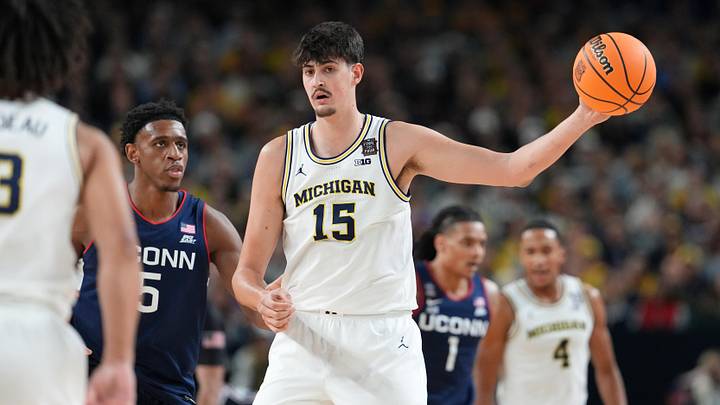
One player met the Productive Junior Query this past season: Aday Mara.

The 7-foot-3 center averaged 12.1 points, 6.8 rebounds, 2.4 assists, 0.4 steals, and 2.6 blocks per game this past season while shooting 81.1% at the rim (196 attempts) and 41.1% on non-rim twos (95 attempts) on his way to a national championship. He also recorded a 10.4 offensive rebound percentage, an assist percentage of 19, and a block percentage of 12 -- impacting the game as a passer from the DHO, offensive rebounder, play-finisher, and as a rim protector.
Recap
Players in the 2026 NBA Draft who met the Productive Junior Query this past season or a prior season: Joshua Jefferson ('25) and Aday Mara ('26)
Conclusion
The Productive Junior Query is best used when attempting to identify talent or when weighing the potential risks of drafting a player.
For example, if a college basketball player is on track to meet the four criteria during the season, then the player may be worth looking into. Similarly, if you're considering drafting a player who's met the Productive Junior Query, it may be a sense of comfort that 63% of players to hit the same criteria have played five-plus seasons in the NBA.
This is especially important to take into account when you realize only 65% of players picked between picks 21-30 from the 2010-2021 NBA Drafts have stuck in the NBA. This number drops to 47% for picks 31-40, 37% for picks 41-50, and 15% for picks 51-60.
Additionally, while 18.4% of players who have met the Productive Junior Query became multi-time All-Stars or NBA starters, only 15% of players picked between 31-40 from the 2010-2021 NBA Draft classes became multi-time All-Stars or Starters. This number drops to 4% for players picked 41-50 and 1% for players picked 51-60.
The PJQ query should be used in conjunction with film, other key statistics, intel, intangibles, and medical information when evaluating a prospect.
 Add us as a preferred source on Google
Jordan is a senior at Cornell University where he is an analytics consultant for the men’s basketball team and Co-President of the Cornell ILR Sports Business Society. He has also interned for Sports Aptitude, where he helped interview former front office members and current professional basketball players with the goal of improving the pre-draft process.
Follow JMonacoScouting