
Subgrade Rankings: What Matters Most to Collectors and Experts
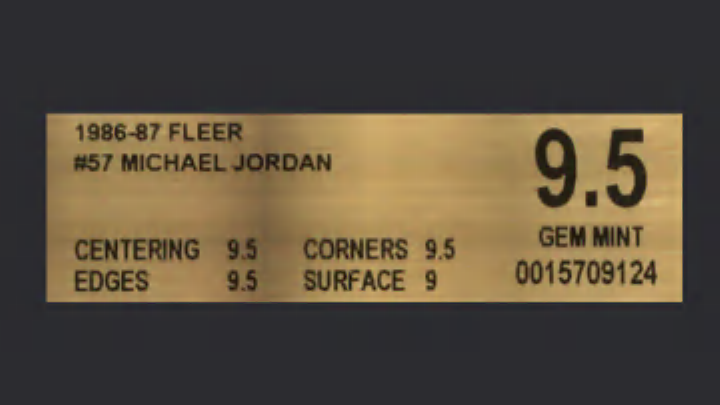
Not every card is pristine or mint. When flaws are inevitable, collectors are left to decide which imperfections matter most. Centering, corners, edges, and surface are the four areas grading companies evaluate when determining a card's overall condition.
When it comes to which of the four subgrades matters the most, opinions vary. We asked several voices from around the hobby to weigh in.
1. Collector Community Ranking and Perspective

1. Centering
2. Corners
3. Surface
4. Edges
When people were asked for their subgrade rankings in the Sports Cards Nonsense and Vintage Baseball Cards Facebook groups, collectors overwhelmingly ranked centering as the most important subgrade, citing its immediate visual impact and influence on a card’s overall appeal. Corners followed closely in second place. The most liked comment was by Drew O’Brien. “You can hide a rough edge or a soft corner in a slab, but bad centering jumps out immediately.”
2. Expert Ranking and Pespective: Tyler Nethercott, SVP of Product at Market Movers (Also known as T-Pott)

1. Centering
2. Corners
3. Edges
4. Surface
Tyler Neathercott is a highly respected voice in the hobby and added great nuance to his rankings. "Surface tends to rank last in most cases, but it also has the potential to be the most important. A scratch or blotch across a player’s face, for example, can ruin a card more than rounded corners or chipped edges. So while I would generally rank surface last, it is also the category with the widest range of impact."
Other key points and nuance added by Tyler Nethercott:
"Context matters. The importance of each subgrade depends heavily on the type of card.
Borderless cards: Centering is much less noticeable and therefore less important.
Bordered cards: Poor centering is immediately distracting, making it the most critical factor.
Corners: Universally understood as important. Sharp corners have been valued since childhood collecting days, and flaws here are easily visible.
Edges: Noticeable but slightly less critical than corners. Edge wear and chipping can affect eye appeal, but usually not as much as centering or corners.
Surface: While ranked last in a general sense, surface defects can sometimes outweigh all the other factors.
Example: A scratch across a player’s face on a vintage card is far more damaging than corner rounding or edge chipping.
Conversely, a surface flaw in an unnoticeable part of the card might matter less than worn corners or edges."
3. Baseball Card Experts Ranking: Chris and Jeff from "Blabbin about Slabbin"

(Chris and Jeff's "Blabbin Bout Slabbin" podcast is a hidden gem for modern baseball card collectors. They are incredibly knowledgeable and their PSA reveal videos/live streams are fun to watch.)
Chris’s ranking:
1. Corners - I feel like it’s always been this way. First thing I do when I look at a card is check each corner. I did it in the 80’s and I still do it now. 2. Centering - I have to admit terrible centering is immediately noticeable, but outside of that, this is probably the most debated subgrade. The difference between 55/45 and 70/30 is so minuscule, it’s probably ended friendships. 3. Surface - if you like to grade cards, the surface is more important than if you don’t. Scratches, print lines, and indents all look fine in a one touch. But under a loupe, your cards can look like a complete mess. Tough to tell in photos, so buying online can be tricky. Surface issues have prevented more 10’s than any other issue for me.
4. Edges - factory rough cut? 1980’s OPC? Edges can vary and I have to admit it’s the last part of the card iI check. And if I see a BGS 9 sub grade on edges, I definitely feel like crossing to a PSA 10 is possible.
Jeff's Ranking: 1. Centering - if a card is off center, it’s the first and easiest thing to notice: even from a distance. An otherwise perfect card that is off center is a travesty to me: an eyesore. And I avoid them at almost all costs, for my own sanity. 2. Corners - a big, ol’ ding on a front corner might be the number 1 concern, but often corner issues are some whiting on the back of a card, or tiny touches on the front. Especially if you’re grading, those are troublesome and annoying. Sharp corners are great and right behind centering in my view.
3. Surface - again, a huge surface problem like a giant scratch across the player’s face is big red flag, but often surface issues are only noticeable upon close inspection. When grading, they often knock a card down, but from the naked eye they might go unseen. 4. Edges - the least important in my view. Many products have “factory cuts” that leave edges a little hairy. Unless an edge is actually peeling up, it’s not as big of a concern for me as the other three.
4. Shop Owner Ranking and Perspective: Peter Alewine (5th Quarter Sports Cards)

Peter, owner and operator of the biggest sports card shop in the Augusta, GA area, approaches subgrades differently for vintage and modern cards:
Vintage: 1. Centering, 2. Corners, 3. Surface, 4. Edges
Modern: 1. Surface, Corners, Centering, Edges
“For vintage cards, centering is king. With older sets being hand cut, well-centered cards carry bigger premiums and stronger eye appeal.”
“For modern, surface has taken over. Print lines, dimples, and scratches can completely ruin Prizm and Chrome cards. When someone asks if a card is clean, they’re really asking about surface.”
5. Card Show Promoter Ranking and Perspective: Frank DeMotte (CardFest Promotions)

Frank promotes and operates large card shows throughout the southeastern U.S. and he offered his rankings:
1. Centering
2. Corners
3. Surface
4. Edges
“There are a lot of variables — modern vs. vintage, paper vs. chrome, color, thickness — but the collector has spoken. Centering will always be king.”
Frank added that scratches on Chrome cards are grading killers, while edge wear tends to be more forgiving.
“Bad corners stick out even in a toploader. Edges don’t bother me as much, but poor centering? Everyone notices that first.”
Final Tally: Expert and Collector Consensus
1. Centering- The most visually obvious flaw; affects eye appeal instantly.
2. Corners- Universally valued and easily spotted.
3. Surface- Critical for modern cards; has the potential to be most important subgrade for some cards
4. Edges- Least noticeable once in a slab or top-loader; minor wear often forgiven.
Final Thoughts: A nicely centered card always demands a premium and is easier to resell. My biggest takeaway from putting this article together is that centering is the most important subgrade to most collectors. People always say “Location, location, location” when it comes to real estate.
In the hobby, it’s “Centering, centering, centering.”
The deeper I dug into this topic, the more I realized how much context matters when it comes to subgrades. Vintage versus modern, paper versus chrome, and even the type of set or surface finish can change how each subgrade is valued. As a collector with mostly vintage cards, I don't mind if my 1933 Goudey cards have rounded corners, but I want them to have a decent surface so they are nice to look at.
In conclusion, beauty is in the eye of the holder and you should buy what you like. Just keep in mind that you may decide or trade your card one day, so if you are deciding between two similar cards, go with the one with the great centering!
TOP TRENDING COLLECTIBLES ARTICLES:
 Add us as a preferred source on Google
David is a collector based in Georgia and a lifelong fan of the New York Yankees, New York Giants, and New York Knicks. He is an avid sports card collector with a strong passion for vintage baseball cards and vintage on-card autographs. David enjoys obtaining autographs through the mail and loves connecting with other knowledgeable collectors to discuss the history and evolution of the hobby. He also previously wrote about the New York Giants for GMENHQ.com