
The 6 Most Valuable and Iconic 1989 Upper Deck Baseball Cards
In this story:
Paying $1 for a pack of baseball cards today sounds too good to be true. In 1989, it sounded too expensive. Upper Deck entered the baseball card market with packs selling for $.99, more than double the 45-cent price of a pack of Topps. To collectors at the time, charging a whole dollar for a pack of baseball cards seemed outrageous.

But Upper Deck wasn't charging more for the same product. The set was unlike anything collectors were accustomed to, and they quickly took a liking to it. It featured tamper-resistant foil packs instead of traditional wax wrappers. The cards had a crisp, clean design with full-color photography on both sides. A hologram on the back of every card helped deter counterfeiting, and Upper Deck even ditched the traditional stick of bubble gum that would often stain the cards.
Demand became so strong that packs with a suggested retail price of 99 cents were soon selling for several times that amount. The groundbreaking design and premium feel weren't the only reasons collectors wanted them. Upper Deck put together a loaded 800-card checklist, headlined by the now-iconic Ken Griffey Jr. rookie card. Remarkably, one of the people entrusted with putting that checklist together was a kid fresh out of high school.

Tom Geideman was just 18 when he became Upper Deck's first employee. He wanted a top prospect to lead the set's 'Star Rookie' subset, reportedly using a Baseball America magazine to help make his decision. He narrowed the choice to four of baseball's most highly touted young players: Gregg Jefferies, Gary Sheffield, Sandy Alomar Jr., and Ken Griffey Jr.

Griffey was not the obvious choice. He had yet to play above Double-A, while Jefferies had already reached the majors and entered 1989 as one of baseball's most hyped young players. Geideman, however, was a Mariners fan. He went with Griffey, who had yet to play a Major League game, and the decision helped produce one of the most recognizable baseball cards ever made.

Griffey's rookie card ultimately became the most iconic baseball card of the modern era, but the importance of the set extends far beyond its most famous card. The checklist features multiple Hall of Fame rookies, memorable variations, and some of the biggest stars of the 1980s. Below are six cards that helped make 1989 Upper Deck one of the most iconic baseball card sets of the Junk Wax Era.
6. Gary Sheffield 1989 Upper Deck #13 Star Rookie

Recent PSA 10 Sale: $56 (Pop: 2,939)
Recent PSA 9 Sale: $5.50 (Pop: 4,409)
Upside-Down SS Variation PSA 10 Sale: $500 (Pop: 43)
Upside-Down SS Variation PSA 9 Sale: $35 (Pop: 180)
Total PSA Population: 9,884
Total PSA Population of Upside-Down SS Variation: 670
Card Info: Sheffield was ranked #1 on Geideman's original prospect list, well ahead of Griffey. "Sheff" had a Hall of Fame-caliber career, but alleged PED use has kept him out for now. His rookie also has an "SS Upside Down" error variation, which is much rarer than the regular version. PSA's population report shows only 670 total graded examples of the error.
5. John Smoltz 1989 Upper Deck #17 Star Rookie

Recent PSA 10 Sale: $75 (Pop: 2,674)
Recent PSA 9 Sale: $15 (Pop: 2,430)
Total PSA Population: 7,252
Card Info: This is considered the most popular and desirable mainstream John Smoltz rookie card. The action shot of the Hall of Fame pitcher was a refreshing departure from the posed portraits and close-up headshots common on baseball cards of the era. A PSA 10 autographed version of this card recently sold for $491.
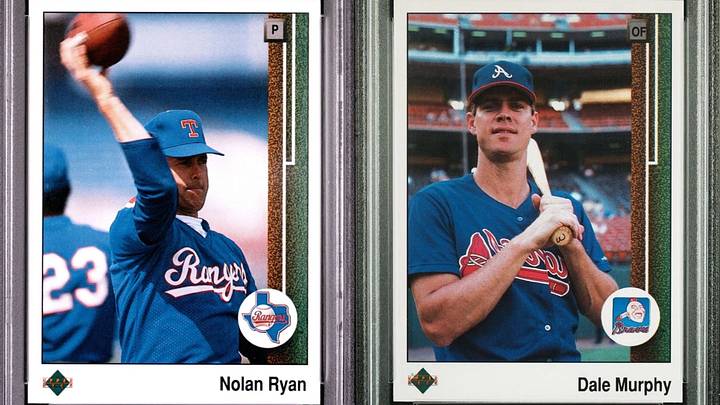
4. Nolan Ryan 1989 Upper Deck #774

Recent PSA 10 Sale: $198 (Pop: 918)
Recent PSA 9 Sale: $38 (Pop: 1,369)
Total PSA Population: 3,401
Card Info: This is known as the "Nolan Ryan Throwing Football card." Ryan actually appeared twice in the 1989 Upper Deck set. Card #145 features a triple-exposure pitching image. Throughout his career, the "Nolan Express" frequently threw a football during warm-ups and between starts. He used the heavier weight and mechanics of throwing a football to stretch his arm out and keep his shoulder loose. An autographed version of this card set an all-time high on September 1st, selling for $1,078.
3. Randy Johnson 1989 Upper Deck #25 Star Rookie

Recent PSA 10 Sale: $267 (Pop: 5,604)
Recent PSA 9 Sale: $36 (Pop: 18,563)
Total PSA Population: 37,878
Card Info: Despite winning five Cy Young awards and being one of the greatest pitchers in baseball history, the iconic Upper Deck Randy Johnson is surprisingly affordable. Raw copies cost less than $5. Collectors frequently search for Marlboro "errors" of this card, but they are confusing it with his 1989 Fleer rookie.
2. Dale Murphy 1989 Upper Deck #357 Reverse Negative

Recent PSA 10 Sale: $2,000 (Pop: 141)
Recent PSA 9 Sale: $400 (Pop: 411)
Total PSA Population: 1,134
Card Info: Dale Murphy was a two-time National League MVP, seven-time All-Star, and five-time Gold Glove winner. The photo ‘negative’ was accidentally flipped backward during the printing plate stage. Because Dale Murphy was a right-handed batter, flipping the image makes it look like Murphy was batting left-handed. Since it was corrected so quickly, the error version is scarce. Its popularity and value have also led to many counterfeits, so collectors should look for the metallic Upper Deck hologram on the lower back of the card.
1. Ken Griffey Jr. 1989 Upper Deck #1 Star Rookie

PSA 10 Sale: $6,215 (Pop: 4,252)
Recent PSA 9 Sale: $496 (Pop: 33,866)
Total PSA Population: 130,663
Card Info: This might be the most obvious #1 pick in baseball card ranking history. Upper Deck reportedly printed special 100-card sheets consisting entirely of Griffey rookies to keep up with overwhelming demand. With more than 200,000 graded copies, the 1989 Upper Deck Griffey is the most graded sports card of all time. The original photo featured Griffey wearing a San Bernardino Spirit hat and uniform. Upper Deck airbrushed over the uniform, removing the Spirit logo and adding a Seattle Mariners “S."

 Add us as a preferred source on Google
David is a collector based in Georgia and a lifelong fan of the New York Yankees, New York Giants, and New York Knicks. He is an avid sports card collector with a strong passion for vintage baseball cards and vintage on-card autographs. David enjoys obtaining autographs through the mail and loves connecting with other knowledgeable collectors to discuss the history and evolution of the hobby. He also previously wrote about the New York Giants for GMENHQ.com