
The First All-Star Baseball Card Was Earlier Than You Think!
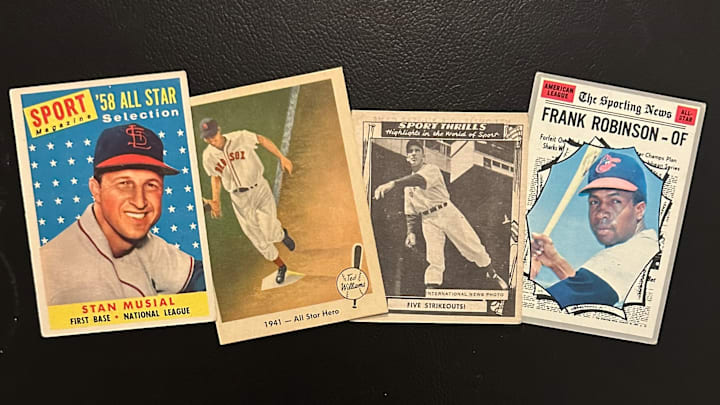
Ask most vintage collectors to name the first All-Star cards, and there's a good chance they'll tell you 1958. Indeed, 1958 was the first year that Topps included an All-Star subset as part of its flagship offering, and what a subset it was! Mickey Mantle, Willie Mays, Hank Aaron, Ted Williams, and Stan Musial were just five of the players included and set against blue (National League) or red (American League) star-spangled backdrops.

Topps kept up its tradition of All-Star sets through 1962 but then took several years off before picking things up again from 1968-1970. Then once again, for whatever reason, All-Stars fell into another brief hiatus before embarking on a 22-year run from 1974-1995.

RELATED: The Topps All-Star Cards Nobody Had
But were those 1958 All-Star cards the very first? Not at all. If there's one truism in the Hobby, it's that almost every "first" has predecessors. In the case of All-Star cards, one could make a case that the 1958 cards weren't even the first Topps All-Stars! Just seven years earlier in 1951, Topps put out two small sets of All-Star cards.
One was a set of all-time all-stars selected by manager Connie Mack and dubbed "Connie Mack All-Stars." As you can imagine, it included players like Babe Ruth, Lou Gehrig, and Honus Wagner. The other, known today as "Major League All-Stars" or just "Current All-Stars," featured contemporary players such as Larry Doby, Robin Roberts, and Yogi Berra. While the Connie Mack selections may be all-star cards in name only, the more modern player selections do seem to qualify as true all-star cards.

RELATED: Home Run Derby Champ Cal Raleigh Not on Topps Chrome Checklist
Still, are these 1951 cards the very first all-stars? At this point, it may depend on your definition of an all-star card. Take, for example, the 1948 Swell "Sport Thrills" set, which included two cards commemorating exceptional All-Star Game feats: Carl Hubbell's five consecutive strikeouts in 1934 and a Ted Williams walk-off homer in 1941.

Or if you like, find Hubbell's same strikeout feat beautifully commemorated on a 1938 box of Wheaties.

Still, are these true all-star cards? That's hard to say. Yes, they focus on the All-Star Game, so there's that. But shouldn't true all-star cards come the year of (or year after) the game itself? Regardless, there are even earlier all-star cards to look at. How about these premiums from the 1934 Goudey set, which feature the 1933 AL and NL squads from inaugural Midsummer Classic?


RELATED: 1933 Goudey Babe Ruth Card Draws Collectors to NYC’s MLB Store
Perhaps some collectors would disqualify the Goudey premiums since they are more like team cards than cards of individual all-stars. On the other hand, you can't get much earlier than 1934. Or can you? Again, it depends what you count, but take a look at this 1933 Goudey card of Charlie Gehringer, likely issued in September 1933, and note the first line of his bio: "No selection of an American League All-Star team would be complete without considering Charley Gehringer of the Detroit Tigers." Still, are we really counting backs?

So what was the very first all-star card? Was it 1951, 1948, 1938, 1934, or even 1933? As the Hobby has no formal definition of "all-star card," it may well be up to the individual collector to decide. Either way, there is no shortage of pre-1958 options for hobbyists to consider as they make their determination.
TOP TRENDING COLLECTIBLES ARTICLES:
 Add us as a preferred source on Google
Jason A. Schwartz is a collectibles expert whose work can be found regularly at SABR Baseball Cards, Hobby News Daily, and 1939Bruins.com. His collection of Hank Aaron baseball cards and memorabilia is currently on exhibit at the Atlanta History Center, and his collectibles-themed artwork is on display at the Honus Wagner Museum and PNC Park.