%22%3E%0A%3Cpath%20d%3D%22M0%205.45386H11.9512C14.9106%205.45386%2016.7638%206.12517%2018.0213%207.37323C18.7872%208.13909%2019.3356%209.23588%2019.3356%2010.7014V10.7581C19.3356%2013.2826%2017.8133%2014.8427%2015.5252%2015.637C18.2672%2016.4312%2020.0353%2017.8967%2020.0353%2020.8183V20.8751C20.0353%2024.2883%2017.2271%2026.7845%2011.8377%2026.7845H0V5.45386ZM12.3199%2012.3182C12.3199%2011.3727%2011.5541%2010.8527%2010.0318%2010.8527H6.94947V13.8405H10.0602C11.5824%2013.8405%2012.3199%2013.3205%2012.3199%2012.375V12.3182ZM10.5518%2018.2276H6.95892V21.3951H10.5235C12.0741%2021.3951%2012.8683%2020.7521%2012.8683%2019.8445V19.7877C12.8683%2018.8706%2012.1025%2018.2371%2010.5518%2018.2371V18.2276Z%22%20fill%3D%22white%22%2F%3E%0A%3Cpath%20d%3D%22M27.1361%2019.2299L19.0898%205.45386H27.0794L30.7385%2012.4601L34.426%205.45386H42.3209L34.2747%2019.1353V26.7845H27.1456V19.2204L27.1361%2019.2299Z%22%20fill%3D%22white%22%2F%3E%0A%3Cpath%20d%3D%22M42.9831%2017.2254V5.45386H50.2351V17.1309C50.2351%2019.7877%2051.6061%2020.9129%2053.5255%2020.9129C55.4449%2020.9129%2056.8158%2019.8728%2056.8158%2017.2821V5.45386H64.0679V17.0647C64.0679%2024.3545%2059.832%2027.2194%2053.4593%2027.2194C47.0866%2027.2194%2042.9736%2024.2978%2042.9736%2017.2254H42.9831Z%22%20fill%3D%22white%22%2F%3E%0A%3Cpath%20d%3D%22M73.835%2016.1853V16.1286C73.835%209.7559%2078.8083%205%2085.1716%205C89.8613%205%2093.0382%207.28812%2094.8346%2010.5501L88.9536%2013.9918C88.1594%2012.4695%2087.0342%2011.4011%2085.077%2011.4011C82.666%2011.4011%2081.087%2013.5001%2081.087%2016.0624V16.1191C81.087%2018.8895%2082.7322%2020.8467%2085.077%2020.8467C87.091%2020.8467%2088.2161%2019.7499%2089.1049%2018.1614L94.9859%2021.4896C93.1895%2024.6571%2090.2017%2027.2478%2084.8974%2027.2478C78.988%2027.2478%2073.835%2022.7944%2073.835%2016.1853Z%22%20fill%3D%22white%22%2F%3E%0A%3Cpath%20d%3D%22M95.4863%2018.5302V18.4734C95.4863%2013.7837%2099.3913%209.75586%20104.875%209.75586C110.359%209.75586%20114.207%2013.7175%20114.207%2018.4167V18.4734C114.207%2023.1726%20110.302%2027.191%20104.818%2027.191C99.3345%2027.191%2095.4958%2023.2293%2095.4958%2018.5302H95.4863ZM107.551%2018.5302V18.4734C107.551%2016.8282%20106.331%2015.514%20104.809%2015.514C103.287%2015.514%20102.124%2016.8282%20102.124%2018.4072V18.464C102.124%2020.1091%20103.343%2021.4234%20104.866%2021.4234C106.388%2021.4234%20107.551%2020.1091%20107.551%2018.5302Z%22%20fill%3D%22white%22%2F%3E%0A%3Cpath%20d%3D%22M115.759%2021.1304V10.1531H122.68V18.899C122.68%2020.3362%20123.531%2021.1588%20124.571%2021.1588C125.611%2021.1588%20126.556%2020.3362%20126.556%2018.899V10.1531H133.478V26.794H126.556V24.572C125.488%2025.943%20123.815%2027.1911%20121.47%2027.1911C117.962%2027.1911%20115.768%2024.8746%20115.768%2021.1209L115.759%2021.1304Z%22%20fill%3D%22white%22%2F%3E%0A%3Cpath%20d%3D%22M135.292%2029.6588L137.429%2025.4797C139.292%2026.4536%20141.145%2027.0681%20143.433%2027.0681C146.024%2027.0681%20147.395%2025.7255%20147.395%2023.409V22.9268C146.449%2023.9952%20144.899%2025.2149%20142.582%2025.2149C138.28%2025.2149%20135.179%2022.1704%20135.179%2017.5658V17.5091C135.179%2012.8477%20138.346%209.76538%20142.194%209.76538C144.634%209.76538%20146.061%2010.6825%20147.281%2011.9306V10.1625H154.202V22.5959C154.202%2025.6782%20153.559%2027.7773%20152.037%2029.2995C150.543%2030.7934%20148.255%2031.7389%20144.539%2031.7389C140.823%2031.7389%20137.987%2031.0109%20135.302%2029.6683L135.292%2029.6588ZM147.432%2017.528V17.4713C147.432%2016.0341%20146.336%2014.8806%20144.662%2014.8806C142.989%2014.8806%20141.892%2016.0719%20141.892%2017.5374V17.5942C141.892%2019.0313%20142.989%2020.1565%20144.662%2020.1565C146.336%2020.1565%20147.432%2018.9935%20147.432%2017.5374V17.528Z%22%20fill%3D%22white%22%2F%3E%0A%3Cpath%20d%3D%22M155.753%2022.0665V22.0097C155.753%2018.691%20158.221%2016.8284%20162.097%2016.8284C163.497%2016.8284%20165.293%2017.1309%20166.031%2017.443V17.1688C166.031%2015.6465%20165.085%2014.7577%20162.948%2014.7577C161.246%2014.7577%20159.809%2015.1265%20158.344%2015.7032L157.124%2011.0986C159.043%2010.3706%20161.237%209.87891%20164.14%209.87891C167.524%209.87891%20169.718%2010.5786%20171.184%2012.0441C172.432%2013.2922%20172.923%2014.909%20172.923%2017.32V26.8035H166.002V25.1299C164.839%2026.378%20163.289%2027.2006%20161.218%2027.2006C158.022%2027.2006%20155.762%2025.3663%20155.762%2022.0759L155.753%2022.0665ZM166.087%2020.6388V19.9391C165.69%2019.7878%20165.085%2019.6649%20164.499%2019.6649C163.128%2019.6649%20162.362%2020.4875%20162.362%2021.5275V21.5843C162.362%2022.5581%20163.062%2023.2011%20163.95%2023.2011C165.17%2023.2011%20166.087%2022.2272%20166.087%2020.6388Z%22%20fill%3D%22white%22%2F%3E%0A%3Cpath%20d%3D%22M174.985%2010.153H181.906V13.5096C182.852%2011.2498%20184.374%209.79373%20187.116%209.91665V17.2632H186.388C183.467%2017.2632%20181.906%2018.88%20181.906%2022.5675V26.8034H174.985V10.153Z%22%20fill%3D%22white%22%2F%3E%0A%3Cpath%20d%3D%22M187.238%2024.78L189.583%2020.8467C191.597%2022.0948%20193.847%2022.7094%20195.738%2022.7094C196.41%2022.7094%20196.741%2022.5581%20196.741%2022.161V22.1042C196.741%2021.7639%20196.438%2021.5558%20194.764%2021.1304C190.557%2020.0903%20187.966%2018.9652%20187.966%2015.5235V15.4668C187.966%2011.8077%20190.888%209.76538%20195.218%209.76538C197.96%209.76538%20200.674%2010.4651%20202.688%2011.6848L200.494%2015.7977C198.726%2014.8238%20196.589%2014.2471%20195.19%2014.2471C194.519%2014.2471%20194.216%2014.4267%20194.216%2014.7671V14.8238C194.216%2015.1548%20194.585%2015.3722%20196.258%2015.7977C200.466%2016.8283%20203%2017.9913%20203%2021.4046V21.4613C203%2025.092%20200.286%2027.1911%20195.776%2027.1911C192.543%2027.1911%20189.621%2026.3685%20187.238%2024.78Z%22%20fill%3D%22white%22%2F%3E%0A%3Cpath%20fill-rule%3D%22evenodd%22%20clip-rule%3D%22evenodd%22%20d%3D%22M212.368%204.36764C218.191%20-1.45588%20227.632%20-1.45588%20233.456%204.36764C239.279%2010.1912%20239.279%2019.6324%20233.456%2025.4559L222.912%2036L212.368%2025.4559C206.544%2019.6324%20206.544%2010.1912%20212.368%204.36764ZM215.009%207.55761C214.948%207.86849%20214.916%208.39718%20214.916%209.14566V10.4189C214.916%2011.1832%20214.948%2011.7198%20215.013%2012.0267C215.078%2012.3317%20215.278%2012.6168%20215.617%2012.8762C215.956%2013.1376%20216.403%2013.3316%20216.958%2013.4623C217.512%2013.593%20218.1%2013.6584%20218.837%2013.6584C219.573%2013.6584%20220.217%2013.591%20220.769%2013.4524C221.322%2013.3158%20221.761%2013.1178%20222.086%2012.8604C222.411%2012.6029%20222.605%2012.3178%20222.666%2012.0069C222.728%2011.6961%20222.759%2011.1674%20222.759%2010.4189V9.14566C222.759%208.38134%20222.728%207.84473%20222.662%207.53781C222.597%207.23287%20222.397%206.94971%20222.058%206.68834C221.72%206.42696%20221.272%206.23291%20220.718%206.10223C220.163%205.97154%20219.536%205.90619%20218.839%205.90619C218.102%205.90619%20217.459%205.97352%20216.906%206.11213C216.352%206.24875%20215.914%206.44677%20215.589%206.70418C215.265%206.9616%20215.071%207.24673%20215.009%207.55761ZM220.276%2024.8638C223.876%2024.8638%20225.557%2024.2064%20225.557%2021.862V21.858V21.3155C225.557%2019.6581%20224.516%2018.971%20221.252%2018.3136C220.278%2018.1136%20219.908%2017.9136%20219.908%2017.3136V16.9414C219.908%2016.6543%20220.177%2016.5117%20220.413%2016.5117C220.749%2016.5117%20220.918%2016.7137%20220.918%2016.9414V18.1136H225.391V17.3988C225.391%2015.4563%20224.347%2014.4266%20220.177%2014.4266C217.15%2014.4266%20214.896%2015.3414%20214.896%2017.3711V17.7433C214.896%2019.5155%20215.805%2020.3155%20219.201%2021.0303C219.28%2021.0472%20219.355%2021.063%20219.427%2021.0781C220.329%2021.2674%20220.647%2021.3341%20220.647%2021.9174V22.2897C220.647%2022.6619%20220.546%2022.8045%20220.142%2022.8045C219.67%2022.8045%20219.637%2022.5471%20219.637%2022.262V21.2897H214.894V21.7471C214.894%2024.149%20216.476%2024.8638%20220.276%2024.8638ZM226.424%2024.5569H230.925V14.7355H226.424V24.5569ZM227.955%2013.5019H230.925V6.06064H228.092V9.411L226.193%206.06064H223.359V13.5019H226.193V10.1199L227.955%2013.5019ZM219.269%2012.152C219.204%2012.2688%20219.055%2012.3262%20218.825%2012.3262L218.827%2012.3282C218.604%2012.3282%20218.459%2012.2767%20218.398%2012.1758C218.336%2012.0748%20218.305%2011.8074%20218.305%2011.3758V7.90068C218.305%207.51852%20218.352%207.28684%20218.445%207.20962C218.538%207.13239%20218.675%207.09279%20218.851%207.09279C219.059%207.09279%20219.198%207.14031%20219.265%207.23734C219.332%207.33239%20219.366%207.55416%20219.366%207.90068V11.3203C219.366%2011.7579%20219.334%2012.0352%20219.269%2012.152Z%22%20fill%3D%22white%22%2F%3E%0A%3C%2Fg%3E%0A%3Cdefs%3E%0A%3CclipPath%20id%3D%22clip0_15202_214766%22%3E%0A%3Crect%20width%3D%22238%22%20height%3D%2236%22%20fill%3D%22white%22%2F%3E%0A%3C%2FclipPath%3E%0A%3C%2Fdefs%3E%0A%3C%2Fsvg%3E%0A)
BYU Head Coach Kalani Sitake is Pleading For More Resources. What Does That Look Like?
In this story:
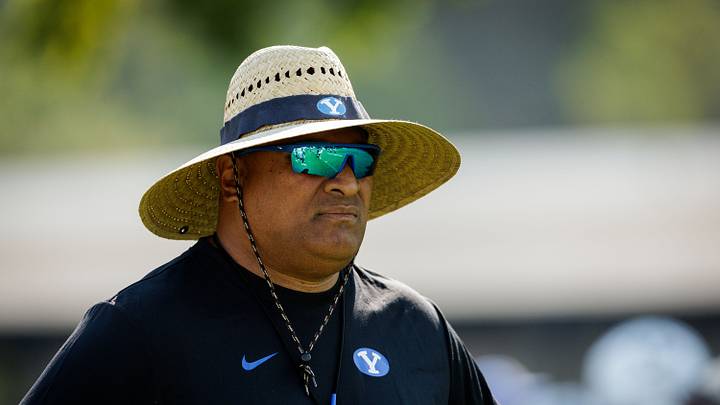
BYU appears to be starting this season the same way it ended last season: rumors of a frustrated head coach pleading for the resources to compete at the highest level. While the threat of Kalani Sitake leaving BYU is certainly not as immediate as it was last December, the feeling of unease when he speaks brings back memories of a day when work productivity dropped by 95% (probably).
In an interview with Ben Criddle of ESPN the FAN, Sitake said the following:
"We’ve been given the challenge of doing the most with the least," Sitake said. "For me, the frustrating part is we’ve been able to do so much, but we can do way more at a faster rate… I’m not going to be the one that makes high demands. These are very simple demands. Things our opponents have in the conference. Not even Texas Tech. The others. If we get an even playing field with that stuff. I should be able to do more."
This is the most open I’ve heard Kalani talk about the resources needed to win. pic.twitter.com/o3OOA1UlYW
— Jarom Jordan (@jaromjordan) August 10, 2026
The full interview is worth a listen, but the tone of the interview was very different from the kumbaya energy that radiated from a press conference last December that presented a head coach and athletic administration in lockstep. What changed? From the interview, it sounds like nothing, which is kind of the issue.
In truth, no one but Sitake and his bosses know what was promised and what has been done since, but we can look back at previous years and see where he was in terms of resources compared to their peers to help educate why Kalani feels that BYU has so far to go. Bear with us. We are going to get into the weeds on finances. As a financial accountant that loves BYU football, this article is my Super Bowl. Let’s get into it.
As a private university, BYU has no public reporting requirement, but it does report athletic budget performance to the Department of Education through the EADA Database, which shows summary-level spending on recruiting, individual sports, and coaches’ salaries. That is our source for private schools like BYU, with 2024-2025 the most recent year available. Public school figures come from the Knight-Newhouse database, which queries official NCAA reporting. Please note that NIL funds used for recruiting are not reported here and therefore are not in the numbers we will discuss.
Total Revenue and Expenses

In 2024-2025, the most recent year of available data, BYU ranked 5th in the Big 12 in total athletic department revenue at $153.6 million per year, which is significant considering BYU only received a half share of media revenue from the Big 12 during this season. That extra +/- $16 million, coupled with ramped donations after stellar football and men’s basketball seasons, could mean BYU will eclipse Arizona State ($166 million) as the top Big 12 earner when the next report comes out. That is incredible, but for many, the goal of college athletics is not to make money, but to spend it. BYU reported a $16 million surplus from athletics, the highest reported income in the league by about $4 million. That means BYU athletics is sustainable, but clearly does not have the luxury to live outside its means like other public schools in the league operating at a loss.
Looking at football specifically, revenue is not nearly the indicator for success that spending is. BYU ranked 5th in reported football spending (not including NIL) behind Arizona State, TCU, Texas Tech, and Utah, who outspent BYU by an average of $10.3 million per year. When Kalani says he is trying to get the resources other schools are getting, this is the provable source of his frustration. This is before we get to Penn State, which blows every Big 12 team out of the water in both revenue and spending. You can see why the Big 12 has such an uphill battle, and why it took a miracle to keep Sitake in Provo.
Coaching Pool and Recruiting

Football spend goes to a lot of different places — coaching salaries, nutrition, sports science, strength and conditioning, among others. BYU’s private status keeps us from seeing where its $44.5 million goes, but the EADA does tell us that BYU spends $2.4 million on recruiting for all men’s sports compared to $1.8 million at the 4 aforementioned Big 12 schools and $3.7 million at Penn State. What this does not tell us is how much of that total is used by non-football sports. Those international basketball recruiting trips are not cheap, after all. From a coach’s salary perspective, we are forced to make estimates for BYU based on reports from December about Sitake’s new salary, but it’s safe to say he and his staff are on par with the rest of the league.
Headcount

Based on reported staff directories from around the Big 12, BYU’s total on-field coaching staff, strength and conditioning, nutrition, and training staff are all roughly in line with the rest of the league plus Penn State. The one area BYU lags behind is in recruiting staff, where BYU reports half of the headcount of Penn State and the Big 12’s big 4. This also doesn’t include salaries for those staff, which could affect the quality as well as quantity of people employed. BYU has done a terrific job expanding the size of its football coaching and support staff since joining the Big 12, but certainly more resources are needed in recruiting to keep up with the biggest names in the sport.
Basketball’s Role

Here is the uncomfortable question no one wants to answer: what is basketball’s role in all this? It’s no secret that with entry to the Big 12 and the hiring of Kevin Young, BYU athletics has gone all-in on basketball, which has been a very positive development for BYU financially and reputationally. That said, resources are finite, and only nine universities successfully funded both a top 25 football and basketball program. None had both programs in the top 10.
We won’t answer the question as to how BYU should allocate their resources, but can partially answer how they are allocating resources today. BYU was 4th in the Big 12 in basketball spending behind only Arizona, Kansas, and Baylor and an average of $5 million higher than the Big 12’s big 4 football spenders. BYU spent 2.62x more on football than basketball compared to 4.37x for the big 4 and 6.18x at Penn State. The schools with a lower football-to-basketball spend ratios were schools you would expect: Houston, Kansas, Baylor, Arizona, Cincinnati, and Kansas State. Whether or not that is good or bad for BYU is up for debate, but one can understand why this would be a source of frustration for a football head coach that is top 10 in wins since 2020.
NIL
BYU’s NIL budget compared to the rest of the league and Penn State will remain a mystery, but we can make assumptions based on the following:
1. The Athletic estimates the average Big 12 basketball roster will cost $13.8 million this upcoming season, and BYU’s recruiting class ranked 8th in the Big 12.
2. Using ESPN’s recent estimates for P4 starters for each position, the average P4 starting lineup (not including depth) is $14.7 million. BYU’s recruiting class ranked well in the top half of the Power 4 last season.
3. The stated House settlement revenue share cap is $20.5 million. Any “NIL” deal above that amount must be approved through the NCAA clearinghouse to ensure the deal is legitmately NIL and within market rates.
If you can figure out the math on how all that works, be my guest, but welcome to 2026 in college sports. BYU will obviously be extremely cautious to stay within NCAA guidelines, which puts BYU’s two high-level coaches in a near-impossible position when it comes to roster building. Whether or not BYU and their donors have the money to spend is irrelevant. BYU will not, and cannot, go over that cap unless the proposed deals are 100% approved and within the rules. Other schools around the country may not care that those rules exist. Such is life at BYU.
Where does that leave us

Fortunately, progress is being made. BYU’s total athletic department spend has almost doubled from 2022 ($79.7 million) to 2025 ($136.8 million), but so have a lot of other schools. From a resource and competitive advantage standpoint, BYU has been a massive beneficiary of P4 membership and the NIL era, but they still have room to grow. The good news is, BYU operates at an almost excessive surplus with more revenue on the way shortly from just media rights. The proposed Protect College Sports Act would increase the revenue share cap from $20.5 million to nearly $50 million, which will ease some of the NIL constraints being placed on both major BYU coaches.
From a football perspective, there are "simple demands" that can be met within BYU's current athletic budget. Expanding recruiting staffs and budgets to match the league’s top spenders and increasing the staff salary pool to attract top talent should not be problem with BYU's current surplus plus the additionally media share. All those things were theoretically promised when Sitake extended his contract. Expanding NIL budgets is significantly more complicated as BYU presumably has the money but is unwilling and unable to exceed certain thresholds imposed by the NCAA for a variety of reasons while other schools have more tolerance for that risk. Such is the nature of working at BYU.
Despite online rumors, no one outside the building truly knows what was promised or delivered and funds are finite. However, a visibly frustrated Kalani just a month before kickoff tells us that BYU still has some real decisions to make about resource allocation. If BYU doesn't decide to allocate resources like a school invested in football, one of the best coaches in BYU history might move to a school that has already made that decision.
Sign up to ourfree newsletterand follow us onXandFacebookfor the latest news.
 Add us as a preferred source on Google
Joe Wheat has covered BYU since 2020. He specializes in passionate opinions fueled by statistics and advanced analytics. Joe’s goal in writing is to celebrate the everyday fan by understanding what they are feeling and giving them the data to understand why.