
Maryland Football vs. Virginia Tech: Key Storylines and What’s at Stake
In this story:
Maryland enters Week 3 with a noticeable shift in tone, intensity, and expectations as the Terps prepare for their first Power 4 opponent of the season... Virginia Tech. After a controlled 2–0 start, Mike Locksley frames this matchup as the team’s “first test,” a true gauge of where Maryland stands in a rapidly evolving college football landscape shaped by the transfer portal and regional rivalries. With deep coaching ties between Locksley and Hokies head coach James Franklin adding historical texture to the matchup, the focus remains firmly on execution, maintaining offensive rhythm, sharpening defensive eye discipline, and proving Maryland is ready to defend the Shell against elevated competition.
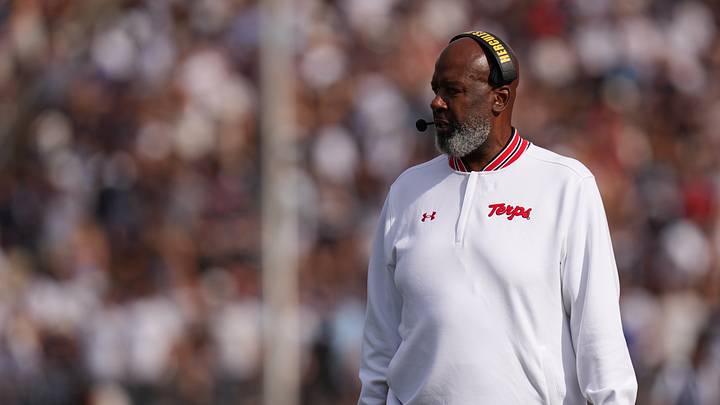
At today’s press conference, Locksley made it clear that Maryland’s 2–0 start is only a prelude to the real evaluation ahead. He described the first two weeks as an “audit”, a chance to assess fundamentals, rotations, and early-season cohesion, but emphasized that none of that carries weight now as the Terps prepare for what he called their “first test.”
The progression of opponents was a central theme. An FCS opener, followed by what he labeled a “formidable” Group of Five challenge in UConn, and now a true “upgrade” in both talent and physicality with Virginia Tech. Locksley highlighted the Hokies’ front seven as a significant step up, noting that the trenches will demand a different level of precision and toughness. He reiterated that Maryland’s record is “2 and 0 unfinished,” underscoring that momentum from the first two games means nothing unless the Terps prove they can match the elevated competition and execute at a higher standard this week.
Virginia Tech’s 2–0 start has Maryland’s staff fully locked in, and Locksley used today’s press conference to outline exactly why the Hokies present a far more complex challenge than anything the Terps have faced so far. He pointed first to Virginia Tech’s defensive front seven, calling it the unquestioned strength of their roster. Interior lineman Kemari Copeland was highlighted as a “stout, twitchy” disruptor, while Cortez Harris, a Riverdale Baptist product and Penn State transfer familiar to Maryland’s staff, adds versatility on the edge. Linebacker Noah Chambers, a DeMatha alum, “runs the show” and gives the unit its identity. After recording seven sacks in their last outing, that front poses a direct threat to Maryland’s offensive rhythm and protection schemes.
Offensively, Locksley noted that Virginia Tech remains a run-first operation, using the ground game to set up run-action concepts. Quarterback Ethan Grunkemeyer's athleticism and ability to extend plays adds another layer, and Locksley expects to see additional packages for a second quarterback. He also emphasized how the Hokies embody the “new landscape” of college football, with Coach Franklin bringing roughly a dozen transfers, including tight end Luke Reynolds, to accelerate system installation and roster familiarity. All of it, Locksley stressed, makes Virginia Tech a far more complete and dangerous opponent than the Terps have seen so far.
Maryland’s keys to success this week center on continuing Malik Washington's evolution and winning the battle up front. Locksley stressed that Washington's shift from “pressing” in Week 1 to operating in a true offensive “flow” in Week 2 must carry over against Virginia Tech’s aggressive front. That means trusting his reads, distributing the ball, and letting playmakers like Chris Durr Jr, with his short‑area burst, and Na'eem Abdul-Rahim Gladding, whose consistency has earned the staff’s trust, drive the offense rather than trying to do too much himself.
Complementing that rhythm is a run game still developing behind younger backs, with Iverson Howard's hard running on the 90‑yard touchdown drive at UConn serving as a model for the physicality Maryland needs. Locksley was blunt regarding this week's matchup, stating none of it matters if Maryland doesn’t elevate its trench play. Against a Virginia Tech front that just posted seven sacks, Maryland must be sharper, tougher, and more connected up front to keep Washington in rhythm and maintain offensive balance.
Locksley closed the briefing by underscoring how much this matchup means for Maryland’s broader identity, both on the field and within the region. He reiterated the importance of “The Shell,” calling for a full sellout and pointing to the 10,000 students who packed the opener as proof that the program’s energy is building. A loud, engaged home crowd, especially under the lights, is part of Maryland’s formula for making SECU Stadium a genuinely difficult place to play.

Beyond Saturday, Locksley tied the moment to his long-term scheduling philosophy, emphasizing the value of regional rivalries with ACC opponents and familiar foes like West Virginia. Maryland, he said, should “play where we recruit,” using these matchups to showcase the Terps’ brand in the backyards of local prospects. With a model built around one local FCS opponent, one regional rival, and one “anybody, anytime” challenge before Big Ten play, Locksley framed Week 3 not just as a test, but as a reflection of the program’s culture, strategy, and connection to its home.
Stay up to date with the Terrapins by bookmarking Maryland On SI and follow us on Twitter.
 Add us as a preferred source on Google
Michael is a passionate sports writer who covers Major League Baseball, the NFL, college football, Maryland University, Rutgers University, and Monmouth football. With published work at FanSided, The Rutgers Wire (USA Today), and The League Winners, Michael delivers insightful analysis, in-depth features, and timely coverage that connects fans to the heart of the game. His work highlights key storylines and standout performances across both professional (NFL & MLB) and collegiate sports (Football, Baseball, Basketball, and Wrestling), with a strong focus on New Jersey-based programs.