
Georgia Exposed a Serious Problem With Pete Golding's Defense
In this story:
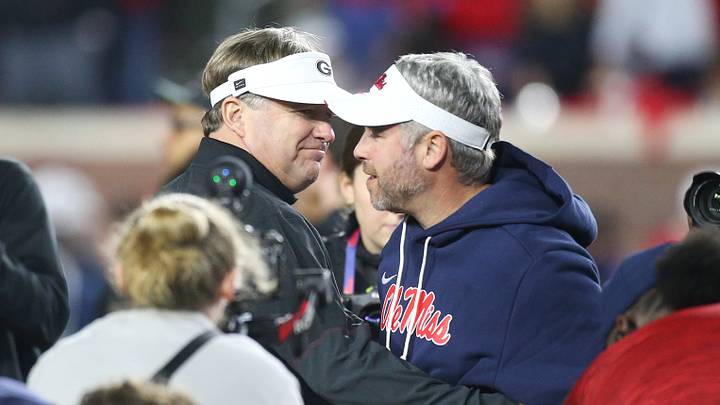
Georgia's 42-7 demolition of Ole Miss on Saturday was about as ugly as it gets for the Rebels. However, the final score was only part of the problem. More concerning was how easily the Bulldogs exposed a defense that has struggled to establish any consistency throughout the 2026 season.
Pete Golding's unit surrendered 481 total yards, including 295 on the ground, as Georgia controlled the game from the opening kickoff. The Bulldogs averaged 7.6 yards per play and scored 42 points without needing to do anything particularly extraordinary offensively.
For Ole Miss, this was not simply a bad Saturday. It was yet another example of a defense that has repeatedly struggled against championship-caliber competition.
Ole Miss Continues to Struggle Against Quality Offenses

The biggest concern surrounding Golding's defense has been its inability to stop the run. Georgia's 295 rushing yards were not even the most an opponent has rushed for against Ole Miss this season. Florida previously rushed for 302 yards against the Rebels, exposing many of the same weaknesses that resurfaced Saturday.
Entering the Georgia matchup, Ole Miss was allowing 148.9 rushing yards per game, ranking near the bottom of the SEC. Following Saturday's performance, that average has climbed to 165.1 yards per contest.
Those numbers are particularly concerning for a team with College Football Playoff aspirations. Defenses do not necessarily need to shut down every opposing offense, but they must be capable of controlling the line of scrimmage and forcing opponents into uncomfortable situations.
Ole Miss has repeatedly failed to do that.
Georgia found consistent success running between the tackles, forcing the Rebels to commit additional resources to stopping the ground game. That opened opportunities elsewhere, and the Bulldogs took advantage.
The secondary offered little resistance, either.
Georgia quarterback Gunner Stockton completed just nine passes, but four went for touchdowns. Wide receiver Talyn Taylor finished with 140 receiving yards and three touchdowns, including a 58-yard score in the first quarter and a 65-yard touchdown in the fourth.
The Bulldogs averaged 12.4 yards per pass attempt, demonstrating just how damaging their limited opportunities through the air became.
When a defense cannot consistently stop the run or contain opposing receivers, there are very few ways to compensate.


Golding Has Yet to Deliver a Championship-Caliber Defense
The season-long numbers paint an equally concerning picture. Ole Miss is allowing 394.7 total yards and 26 points per game through nine contests. Its run defense has been among the SEC's weakest, while opposing quarterbacks have consistently found opportunities to attack the secondary.
The Rebels have also struggled to generate consistent pressure. Against Georgia, Ole Miss managed just one sack, allowing Stockton to operate comfortably while the Bulldogs dictated the pace of the game.
Golding entered the season with an established reputation as a defensive coordinator, including his previous experience at Alabama. Expectations were understandably high for a defensive unit that needed to take another step forward to support an offense with legitimate postseason aspirations.
Instead, the same problems have continued to surface.
There have been positive performances throughout the season, and it would be unfair to suggest that Ole Miss has been incapable of playing good defense. However, the inability to replicate those performances against higher-quality opponents raises legitimate questions about Golding's defensive philosophy, preparation and personnel decisions.
Saturday's loss was especially troubling because Georgia did not need to exploit some complicated schematic weakness. The Bulldogs won the physical battle, found open receivers and consistently moved the football.
Following the game, Golding acknowledged the shortcomings and said the coaching staff would have to evaluate the performance. That evaluation needs to extend well beyond Saturday's game plan.
Ole Miss Cannot Afford More Defensive Disappointments
Ole Miss entered the season expecting to compete for an SEC championship and another College Football Playoff appearance. Those ambitions require more than an explosive offense and a few timely defensive stops.
The Rebels need a defense capable of keeping games competitive when the offense struggles. Against Georgia, they received nothing of the sort.
Georgia did not create the Rebels' defensive problems on Saturday. It simply made them impossible to ignore.
And with the postseason approaching, Golding is running out of opportunities to prove that his defense can be part of a championship-caliber team.
Sign up for our free newsletter and follow us on Facebook and X for the latest news.
 Add us as a preferred source on Google

Cooper Ferguson is a sophomore at the University of Mississippi pursuing a degree in Integrated Marketing Communications. He is a staff writer for The Daily Mississippian, covering football and soccer while contributing sports coverage for the campus community. Outside of journalism, Cooper enjoys following sports, playing golf, weightlifting, and supporting Arsenal FC.