
Dakorien Moore's Unexpected Outlook on Oregon Ducks' Turbulent Season
In this story:
After opening the 2026 season ranked No. 2 in the AP Poll, the No. 23 Oregon Ducks have dropped three games, lost their starting quarterback, Dante Moore, and fired their offensive coordinator. However, despite all the setbacks, the Ducks still found a way to take down No. 12 Ohio State on the road in front of 103,551 fans.
Still, the significance of the win cannot overshadow the reality of Oregon's season. A road victory over Ohio State does not erase the Ducks' three losses, two of which came against unranked opponents, or suddenly put them back in control of their postseason destiny.

With the College Football Playoff picture becoming increasingly crowded, Oregon's path to a spot in the 12-team field is now considerably narrower, and much of what happens next is out of its hands.
That is a difficult position for a team that entered the season with national championship aspirations.
ESPN's preseason Football Power Index ranked Oregon No. 4 nationally, giving the Ducks a 64.7 percent chance of making the College Football Playoff and a 9.8 percent chance of winning the national championship. The model also projected Oregon to finish with a 10.2-2.3 record.
Those expectations made the Ducks' midseason struggles even more difficult to ignore. After a 21-10 loss to Illinois dropped Oregon to 4-3, questions surrounding the team's identity, consistency and ability to compete with the nation's best became increasingly difficult to avoid.

Given how the season has unfolded, one might expect some regret or disappointment inside Oregon's locker room. The Ducks have certainly had opportunities they would like back, and their postseason hopes are no longer entirely in their control.
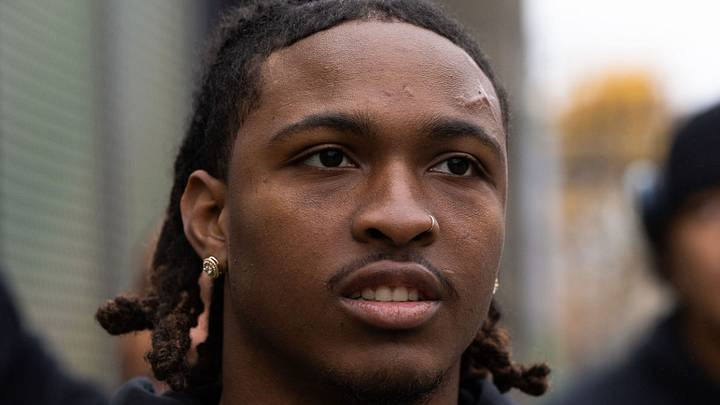
However, that is not necessarily how Oregon sophomore wide receiver Dakorien Moore views the season.
Dakorien Moore Doesn't See Oregon's Setbacks as Regrets
Following the Ducks' 41-28 upset of Ohio State, Moore was asked about the possibility of looking back on the season with regret. His response offered a different perspective on how Oregon is approaching its remaining games.
"I wouldn't say that we're living in a regret moment because we don't ever take an L as a loss. We always learn we learn from everything that we do, whether it's good or whether it's bad. We're gonna learn from it."
That mentality has become increasingly evident in how Oregon has responded to its most difficult stretches of the season. Rather than allowing its early struggles to dictate the rest of its campaign, the Ducks have made several adjustments that have helped them rediscover the identity that made them one of the nation's most anticipated teams entering the year.

One of the biggest changes came on the coaching staff. Following the loss to Illinois, coach Dan Lanning made the decision to move on from offensive coordinator Drew Mehringer, handing the offensive play-calling duties to assistant quarterbacks coach Jay Johnson.
The change came after an offense that had struggled to find consistency, including converting just 35 percent of its third-down opportunities through the first seven games. Under Johnson, Oregon began playing with a faster tempo and a more defined offensive identity, something that became increasingly apparent in its performances against Northwestern and Ohio State.


Against Ohio State, Lanning demonstrated his willingness to take risks, including a fake punt in Oregon territory and a decision to go for it on fourth-and-goal from the 1.5-yard line rather than settle for a field goal before halftime. The Ducks converted the opportunity into a touchdown and took a lead they would never relinquish.
Oregon also had to work through adversity at quarterback. After Dante Moore suffered a season-ending concussion against USC, backup Dylan Raiola faced his own struggles, including multiple interceptions and a difficult performance against UCLA that ultimately resulted in him being benched.

Rather than allowing those struggles to continue, the coaching staff worked to simplify the offense and help Raiola regain his confidence. He responded with a 336-yard, three-touchdown performance against Northwestern before following it up with another composed outing against the Buckeyes.
Perhaps the biggest difference, however, has been Oregon's ability to respond when things do not go according to plan.
Oregon's Midseason Lessons Pay Off Against Ohio State
The Ducks found themselves trailing Ohio State 14-0 early in one of the most hostile environments in college football. In previous stretches of the season, an early deficit or a costly mistake could send Oregon into a downward spiral. This time, the Ducks responded with 38 unanswered points, eventually silencing the crowd at Ohio Stadium and handing the Buckeyes a 41-28 loss.
So, through all the highs and lows, how has Oregon managed to keep its locker room from falling apart?
For Moore, maintaining a consistent mentality and staying connected as a team have been central to that process.

“Staying level definitely carried us all the way through.. we're gonna go out there, play free, do our thing, and whether it's the win a lot to come up the board, we're gonna still be connected as a team,” said Moore.
That ability to stay connected will be just as important as Oregon enters the final stretch of its regular season. The Ducks have done what they can to keep their postseason hopes alive, but there is little room for error moving forward.
The win over Ohio State was arguably a necessary step if Oregon wanted to keep even a slim chance of reaching the College Football Playoff. Not only did the Ducks get the result they needed, but they did so convincingly, overcoming an early deficit and taking down a top-15 opponent on the road.
Ultimately, Oregon cannot change what happened earlier in the season, and its postseason fate will depend partly on how the rest of the college football landscape unfolds. But the Ducks can control how they finish.

For a team that entered the season with national championship expectations, the road to that destination looks considerably different than anyone anticipated. Still, if Moore's perspective is any indication, Oregon isn't interested in spending the remainder of its season wondering what could have been.
Instead, the Ducks are focused on what they can take from the experience, how they can continue to improve and what they can accomplish with the opportunities still in front of them.
Sign up to our free newsletter and follow us on Facebook, X and Instagram for the latest news.
 Add us as a preferred source on Google

Olivia Cleary, commonly known as Liv, is a fourth-year student at the University of Oregon. While pursuing a degree in journalism, Olivia has submersed herself in the world of Oregon athletics. Olivia is an intern within the athletic department. This role has provided her with a unique perspective as she has created relationships with staff, administrators, and student-athletes. Olivia is eager to share her insights and analysis on the Ducks and the broader world of college sports.