
Film Room: How Ole Miss' Offense Has Kept Rolling After Lane Kiffin's Departure
In this story:
The Ole Miss-Lane Kiffin saga was one of the biggest stories in college football last season. The LSU Tigers hired away the highly touted coach before the Rebels began their run at the College Football Playoff, leaving interim head coach Pete Golding to lead his team through adversity in the highest-pressure environment possible.
Golding took the Rebels all the way to the national semifinals, earning himself a promotion to head coach this off-season. However, questions remained about how Ole Miss would look on offense after losing Kiffin and offensive coordinator Charlie Weis Jr.
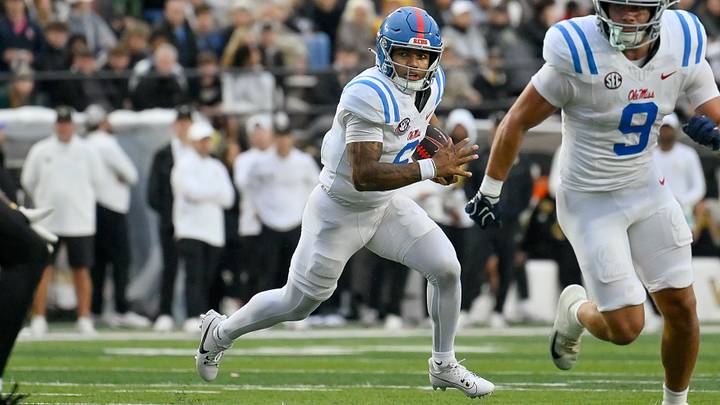
Luckily for the fans in Oxford, new offensive play-caller John David Baker has kept their attack rolling. The Rebels sport the ninth-best scoring offense in the country and quarterback Trinidad Chambliss is on the short list of Heisman Trophy candidates.
Now, the Rebels head to Austin to face a Texas Longhorns team that is reeling after back-to-back losses to unranked Oklahoma and Florida. If the Longhorns want to keep their playoff hopes alive, they will need to stop the Rebels' high-flying offense.
So, what makes the Rebels so potent in the first place, and what can Texas do to stop them?
How The Rebels Kept Moving Forward

Baker has, wisely, decided to model the 2026 Ole Miss offense after the successful one that came before it.
“I would say 80% of it is exactly the same that it’s been," Baker said at a press conference before the season.
Through six games in 2026, that has been the case. Baker has adopted Kiffin and Weis's 'Veer-and-Shoot' scheme, which means big splits from the wide receivers, up-tempo play calling and constant threats on the end zone.
Many expected Baker to run the ball more than his predecessors, but so far he has maintained 54.11% pass-rate, the 22nd-highest in the country. He has taken full advantage of an excellent group of Rebel pass-catchers, four of whom already have more than 225 yards of receiving this season.
The spacing of Baker's scheme has made it easy for Chambliss to get the ball into the hands of his weapons. Take this play for example:

Here the Rebels align in a 2x2 look on the left hash, with wide receiver Traylon Ray split all the way past the numbers to the field side. Before the snap, Chambliss motions running back Kewan Lacy out near Ray, and a Louisville defensive back follows him closely, indicating that the Cardinals are going to stay in the single-high look that they are showing initially.
Chambliss has a single-high beating route combination to the field, with Lacy running a slot fade and Ray running a bender. So, if he confirms that that is the look he is getting, Ray will be the first read.

The Cardinals are indeed running cover three, a single-high coverage, meaning the outside corner has to expand with Lacy's fade while the defensive back that followed him has to play a seven-yard hook zone.
This leaves Ray's bender wide-open, and after Chambliss briefly reads the center field safety, he rips the ball to him for a big gain.
The extreme spacing of Ole Miss's offense left Ray in an ocean of space, with neither the corner, defensive back or safety anywhere near close enough to make a play.
So, what can Texas do to counter this aerial assault?
How Texas Can Stop the Rebels

While Texas' defense had its struggles against Florida, the Longhorns still sport one of the nation's top units. Defensive coordinator Will Muschamp's squad ranks seventh in the country in yards per game allowed, second in yards per play and has given up just eight touchdowns in six games.
They have faced two Veer-and-Shoot offenses, the Texas State Bobcats and Tennessee Volunteers, who put up a combined 17 points on offense. Muschamp implemented different strategies against both, using his traditional run-crushing fronts against the Bobcats and getting more experimental with the pass rush against the Volunteers.
Muschamp will need to innovate again against Baker; however, his general philosophy for stopping the scheme will be the same: stop the run from undermanned boxes on early downs so that Texas can stay in two-high coverage and play aggressively in the secondary.
If Texas can do both of those things, and execute whatever wrinkle Muschamp adds, then they can right the ship on the season and get back in the playoff hunt.
Sign up to our free newsletter and follow us on Facebook, X and Instagram for the latest news.
 Add us as a preferred source on Google

Carter Long is a sophomore Journalism and Sports Media student at the University of Texas at Austin. He is also a general sports reporter for the Daily Texan on the baseball beat. Long is from Houston and supports everything H-town.