%22%3E%0A%3Cpath%20d%3D%22M0%2019.3162V6.95508H7.61346V19.2111C7.61346%2022.0005%209.05591%2023.185%2011.0715%2023.185C13.0871%2023.185%2014.5296%2022.096%2014.5296%2019.3735V6.95508H22.1526V19.1538C22.1526%2026.8055%2017.701%2029.8146%2011.0142%2029.8146C4.32735%2029.8146%200%2026.7386%200%2019.3162Z%22%20fill%3D%22white%22%2F%3E%0A%3Cpath%20d%3D%22M24.1401%2018.2273V18.1604C24.1401%2011.4736%2029.3559%206.47754%2036.0523%206.47754C40.9814%206.47754%2044.3058%208.87525%2046.1972%2012.3047L40.0166%2015.9251C39.1856%2014.3203%2038.001%2013.2026%2035.9472%2013.2026C33.4158%2013.2026%2031.7536%2015.4093%2031.7536%2018.1031V18.17C31.7536%2021.0835%2033.4826%2023.1278%2035.9472%2023.1278C38.0583%2023.1278%2039.2429%2021.9719%2040.1695%2020.3098L46.35%2023.7965C44.4586%2027.1208%2041.3253%2029.8433%2035.7562%2029.8433C29.5469%2029.8433%2024.1401%2025.1721%2024.1401%2018.2273Z%22%20fill%3D%22white%22%2F%3E%0A%3Cpath%20d%3D%22M47.9261%206.95508H55.4153V22.9558H65.9423V29.356H47.9165V6.95508H47.9261Z%22%20fill%3D%22white%22%2F%3E%0A%3Cpath%20d%3D%22M75.5228%206.80249H82.9452L92.3927%2029.3658H84.2634L83.0789%2026.3568H75.2362L74.0803%2029.3658H66.0752L75.5228%206.80249ZM81.2161%2021.0455L79.1719%2015.6005L77.1276%2021.0455H81.2257H81.2161Z%22%20fill%3D%22white%22%2F%3E%0A%3Cpath%20d%3D%22M101.707%206.95508H114.259C117.364%206.95508%20119.313%207.66197%20120.631%208.97069C121.433%209.77311%20122.006%2010.9194%20122.006%2012.4574V12.5243C122.006%2015.1799%20120.402%2016.8134%20118.004%2017.6445C120.889%2018.4756%20122.742%2020.0135%20122.742%2023.0895V23.1564C122.742%2026.7386%20119.8%2029.3656%20114.135%2029.3656H101.717V6.95508H101.707ZM114.641%2014.1578C114.641%2013.1643%20113.839%2012.6198%20112.244%2012.6198H109.015V15.7531H112.282C113.877%2015.7531%20114.651%2015.2086%20114.651%2014.2151V14.1482L114.641%2014.1578ZM112.788%2020.367H109.015V23.6913H112.759C114.393%2023.6913%20115.224%2023.0226%20115.224%2022.0578V21.9909C115.224%2021.0357%20114.422%2020.3574%20112.788%2020.3574V20.367Z%22%20fill%3D%22white%22%2F%3E%0A%3Cpath%20d%3D%22M124.309%2011.8844H131.579V15.4093C132.572%2013.0402%20134.167%2011.5023%20137.052%2011.636V19.3545H136.288C133.212%2019.3545%20131.579%2021.0549%20131.579%2024.9237V29.3753H124.309V11.8844Z%22%20fill%3D%22white%22%2F%3E%0A%3Cpath%20d%3D%22M138.303%2023.4145V11.894H145.572V21.0837C145.572%2022.5835%20146.47%2023.4527%20147.559%2023.4527C148.648%2023.4527%20149.642%2022.593%20149.642%2021.0837V11.894H156.911V29.3754H149.642V27.0445C148.524%2028.487%20146.757%2029.7957%20144.292%2029.7957C140.614%2029.7957%20138.303%2027.3598%20138.303%2023.4241V23.4145Z%22%20fill%3D%22white%22%2F%3E%0A%3Cpath%20d%3D%22M159.137%206H166.655V10.6426H159.137V6ZM159.271%2011.8844H166.541V29.3658H159.271V11.8844Z%22%20fill%3D%22white%22%2F%3E%0A%3Cpath%20d%3D%22M168.91%2011.8844H176.179V14.3203C177.297%2012.8779%20179.064%2011.4736%20181.529%2011.4736C185.206%2011.4736%20187.518%2013.9096%20187.518%2017.8452V29.3657H180.249V20.1761C180.249%2018.6763%20179.351%2017.807%20178.262%2017.807C177.173%2017.807%20176.179%2018.6668%20176.179%2020.1761V29.3657H168.91V11.8844Z%22%20fill%3D%22white%22%2F%3E%0A%3Cpath%20d%3D%22M188.436%2027.2546L190.9%2023.1279C193.011%2024.4366%20195.38%2025.0766%20197.367%2025.0766C198.074%2025.0766%20198.428%2024.9142%20198.428%2024.5035V24.4366C198.428%2024.0832%20198.112%2023.8634%20196.345%2023.4145C191.922%2022.3255%20189.209%2021.1409%20189.209%2017.5205V17.4536C189.209%2013.6135%20192.285%2011.4641%20196.832%2011.4641C199.708%2011.4641%20202.564%2012.1997%20204.675%2013.4797L202.373%2017.7975C200.52%2016.7754%20198.275%2016.164%20196.804%2016.164C196.097%2016.164%20195.782%2016.3551%20195.782%2016.7085V16.7754C195.782%2017.1288%20196.164%2017.3485%20197.921%2017.7975C202.344%2018.8865%20205%2020.0997%20205%2023.6819V23.7488C205%2027.5603%20202.153%2029.767%20197.415%2029.767C194.024%2029.767%20190.948%2028.9072%20188.455%2027.2355L188.436%2027.2546Z%22%20fill%3D%22white%22%2F%3E%0A%3Cpath%20fill-rule%3D%22evenodd%22%20clip-rule%3D%22evenodd%22%20d%3D%22M214.368%204.36764C220.191%20-1.45588%20229.632%20-1.45588%20235.456%204.36764C241.279%2010.1912%20241.279%2019.6324%20235.456%2025.4559L224.912%2036L214.368%2025.4559C208.544%2019.6324%20208.544%2010.1912%20214.368%204.36764ZM217.009%207.55761C216.948%207.86849%20216.916%208.39718%20216.916%209.14566V10.4189C216.916%2011.1832%20216.948%2011.7198%20217.013%2012.0267C217.078%2012.3317%20217.278%2012.6168%20217.617%2012.8762C217.956%2013.1376%20218.403%2013.3316%20218.958%2013.4623C219.512%2013.593%20220.1%2013.6584%20220.837%2013.6584C221.573%2013.6584%20222.217%2013.591%20222.769%2013.4524C223.322%2013.3158%20223.761%2013.1178%20224.086%2012.8604C224.411%2012.6029%20224.605%2012.3178%20224.666%2012.0069C224.728%2011.6961%20224.759%2011.1674%20224.759%2010.4189V9.14566C224.759%208.38134%20224.728%207.84473%20224.662%207.53781C224.597%207.23287%20224.397%206.94971%20224.058%206.68834C223.72%206.42696%20223.272%206.23291%20222.718%206.10223C222.163%205.97154%20221.536%205.90619%20220.839%205.90619C220.102%205.90619%20219.459%205.97352%20218.906%206.11213C218.352%206.24875%20217.914%206.44677%20217.589%206.70418C217.265%206.9616%20217.071%207.24673%20217.009%207.55761ZM222.276%2024.8638C225.876%2024.8638%20227.557%2024.2064%20227.557%2021.862V21.858V21.3155C227.557%2019.6581%20226.516%2018.971%20223.252%2018.3136C222.278%2018.1136%20221.908%2017.9136%20221.908%2017.3136V16.9414C221.908%2016.6543%20222.177%2016.5117%20222.413%2016.5117C222.749%2016.5117%20222.918%2016.7137%20222.918%2016.9414V18.1136H227.391V17.3988C227.391%2015.4563%20226.347%2014.4266%20222.177%2014.4266C219.15%2014.4266%20216.896%2015.3414%20216.896%2017.3711V17.7433C216.896%2019.5155%20217.805%2020.3155%20221.201%2021.0303C221.28%2021.0472%20221.355%2021.063%20221.427%2021.0781C222.329%2021.2674%20222.647%2021.3341%20222.647%2021.9174V22.2897C222.647%2022.6619%20222.546%2022.8045%20222.142%2022.8045C221.67%2022.8045%20221.637%2022.5471%20221.637%2022.262V21.2897H216.894V21.7471C216.894%2024.149%20218.476%2024.8638%20222.276%2024.8638ZM228.424%2024.5569H232.925V14.7355H228.424V24.5569ZM229.955%2013.5019H232.925V6.06064H230.092V9.411L228.193%206.06064H225.359V13.5019H228.193V10.1199L229.955%2013.5019ZM221.269%2012.152C221.204%2012.2688%20221.055%2012.3262%20220.825%2012.3262L220.827%2012.3282C220.604%2012.3282%20220.459%2012.2767%20220.398%2012.1758C220.336%2012.0748%20220.305%2011.8074%20220.305%2011.3758V7.90068C220.305%207.51852%20220.352%207.28684%20220.445%207.20962C220.538%207.13239%20220.675%207.09279%20220.851%207.09279C221.059%207.09279%20221.198%207.14031%20221.265%207.23734C221.332%207.33239%20221.366%207.55416%20221.366%207.90068V11.3203C221.366%2011.7579%20221.334%2012.0352%20221.269%2012.152Z%22%20fill%3D%22white%22%2F%3E%0A%3C%2Fg%3E%0A%3Cdefs%3E%0A%3CclipPath%20id%3D%22clip0_15191_23562%22%3E%0A%3Crect%20width%3D%22240%22%20height%3D%2236%22%20fill%3D%22white%22%2F%3E%0A%3C%2FclipPath%3E%0A%3C%2Fdefs%3E%0A%3C%2Fsvg%3E%0A)
UCLA Bruins Insider Podcast: Baseball Advances in CWS
In this story:
In today's episode of the UCLA Bruins Insider Podcast, we talk about the Bruins advancing to the next round of the College World Series after beating Murray State 6-4 in the first game in Omaha.
To watch today's episode, view below:
Following the game, coach John Savage spoke to the media about the game and looking forward to their matchup against the LSU Tigers. Below is a transcription of the media availability courtesy of UCLA Athletics:
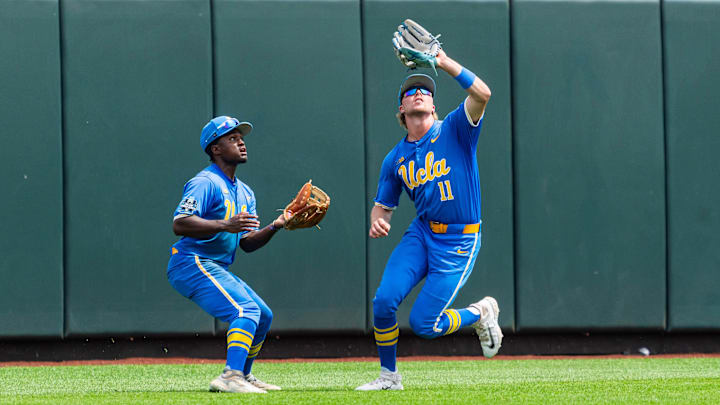
Q. You said it was a big team effort, but it felt like your No. 9 hitter, in all phases of the game, was electric tonight. Phoenix Call—the two plays early on defensively, the sac bunt, going first to third right in the face of the left fielder in the fourth inning—sparked things before that. Could you talk a little bit about Phoenix's impact overall and how he's such a spark plug for the whole team today?
JOHN SAVAGE: Phoenix is a phenomenal athlete. He's a high school shortstop who can play center field with anybody, probably in the tournament. You can see him move—we've seen him move as the season goes along here. He's getting more confident, more familiar with the position. He's never played second in his life; he played short his whole young career, and then center field, because he can really move and run. He's not your typical second baseman, I guess, in some ways, but he's a dynamic player, and we have him in the 9-hole. He's almost like a lead-off guy in many ways. He can swing the bat. He had a really good Cape Cod last summer and really grew up last year at YD, and that's really carried over to this season. Most of his errors were really early in the year. He's been phenomenal, really, from about early April on. He can run, he can bunt, he sprays the ball all over the ballpark, and he does have a little power at times. So he's coming into his own. He's still a very young player, but he's an elite player.
Q. You mentioned in your opening statement, you phrased it as you pitched out of plenty of problems today. Barnett’s four walks in 4.1 was the most this season. I was very impressed with the pitching staff in general being able to pitch out of so many jams today. And then you look at the Super Regional as well—the final 16 innings of that series, zero runs. Could you talk about the strength of the pitching staff lately?
JOHN SAVAGE: We finally got to know ourselves probably about April on, middle of April. We're not going to blow anybody away—clearly, you can tell that. Hawk can do that a little bit, and a couple of relievers can do that, but we've got to pitch. It was pretty unusual for Mike to walk four guys—that's very unusual for Mike. I think the first five hitters were 3–2 counts. It was like, “Oh boy,” 28 pitches in the first inning. It wasn't quite like Mike. But they all have a little niche. They all know what they can do. I have a good feel for them in terms of pitch calling. It's a blend—it's a change, it's a breaking ball, it's a slider, it's a cutter, it's a fastball. It's not just one go-to pitch. A lot of these guys are somewhat starters that are relievers. Some guys are three- and four-pitch guys—even if it's one inning, some guys are throwing four pitches, which is a little unusual nowadays. Usually, you see two pitches out of a reliever. So we do have some guys that really have starter profiles, but not big stuff. That's why we can get into trouble a little bit, because they can get hit. O'Connor got in trouble. Moss got in trouble. Souza got in trouble. Really the only one who didn't get in trouble was Hawk. It's baseball. It's Omaha. You expect trouble. If you're not expecting trouble, you'll be out of here pretty quick. So you better be able to pitch with traffic and pitch out of problems. That's the nature of championship baseball.
Q. Historically in your time at UCLA, you've really liked to have roles on the pitching staff. This one has been different for you. Is that more based on personnel or more based on an evolution for you and the way you think about it?
JOHN SAVAGE: We have roles. We have a long guy. We have a left-on-left. We have a seventh inning, eighth inning, ninth inning. A lot of times, our starters aren't going six innings. We're not getting the quality start we normally would. We would take four innings out of our starter. We have that much confidence—our bullpen, our pitching staff is built from the back to the front. It's not a UCLA true model, but at the same time, Delvecchio went down, so he went here; Moss had a back. I mean, we do have some traditional starters, but for one reason or another—Barnett's one, he could have won his 13th game today. He's had a phenomenal year. But is he a true Friday guy? I think there would be certainly some conversation on that. But at the end of the day, they're winning pitchers, and they know how to make pitches. Even the guys that pitched out of some problems made some massive pitches today—3-1 slider, 3-2 slider, 3-1 change, 3-2 change, 3-2 inner half. If you really look at the game and look at some things, we didn't pitch poorly, but we didn't pitch—I wouldn't call it “good-good”—but we pitched well enough.
Q. I was wondering if you could give any insight into what the starting pitching might look like later in the week, given that both Moss and May threw today?
JOHN SAVAGE: It's a tournament, so you don't label your rotation in a tournament. You kind of look at matchups, and you look at video, and you determine what happened the day before. We still certainly have Stump available. Stump is ready to go. But we'll have to see and look at it tonight and make a decision more likely. We've got to see who wins tonight's game, too. It's tournament time; you go day by day.
Q. First and third, Roch comes up—safety squeeze. I think that took a lot of people by surprise. Was that a planned effort there or was it situational, time to do it?
JOHN SAVAGE: I said on ESPN, "Fans, do not harpoon me. Please, please." That was on his own. That was not us. I'm like, “Come on, Roch, what are we doing here?” But you know what, it's a baseball play, and he did that in the Big Ten Tournament. If you saw that play in the Big Ten Tournament, he pushed with first and third and got a double out of it. He pushed it a little harder, and this clearly wasn't hard enough. But it led to four runs—kind of the difference in the game. And you know, how can you blame a guy for playing baseball? But it was not—let's be clear—it was not called from the bench.
Q. Will you watch the game tonight as a staff, or have you guys scouted both teams and you're done with that?
JOHN SAVAGE: We've scouted them—both teams. A lot of Synergy. But it's nice to get a feel for what they're doing in the ballpark, right? Ballpark plays different. So you've got one eye on Synergy and you're writing a report, and you've got one eye on the live game. But for the most part, it's several hundred pitches per hitter, and you're really digging deep, but you do kind of like to see what's going on in Omaha.
Q. You have a really young lineup. A lot of people see that as a disadvantage. How do you see that as an advantage?
JOHN SAVAGE: Got good, young players. We've got to keep them. We've got to hold on to them. Gotta keep on retaining them. They're very good players. We wore it last year—we clearly did. We did not win many games last year. I didn't think we were going to win as few as we did. But at the end of the day, it's paid off. We played a lot of guys that probably weren't quite ready—Dean West did not play very much last year. He was hurt. Dean played the last weekend of the year; I think he got on base 11 times against Stanford. He has one of the best hand-eye coordinations in the country, best zone discipline in the country. Phenomenal player. He didn't play very much last year because of injury. V played a lot. Roch played a lot. Roman played quite a bit. Phoenix played a little bit. Cash played quite a bit. We're kind of getting the payoff now, clearly. And I don't like to say that we're young. I said this in the press conference a couple of days ago: A lot of these guys have played over 100 Division I games—115 Division I games. You can't play the young card too much. I think that's a mistake. Good, young players that are coming into their own—you can talk about that. But you see a lot of sophomores. I'm sure you guys saw that little thing that went out—we have 37 kind of homegrown players that we recruited. So right now, it's a pretty good formula. Last year, it wasn't a great formula. So it evolves, and anything good takes time.
Q. I believe I looked at y'all’s record. I think you're all undefeated in the postseason right now. How much confidence does it give you all coming here to Omaha?
JOHN SAVAGE: Well, I don't want to talk about it. I don't really want to talk about it. You know, that’s what the postseason is—there's a lot of teams up here that haven't lost that are still up here. It's one game in a four-team bracket. So where do you want to be? Do you want to be here? Yeah, you want to win the first game, no question about it. But we've got a long, long way to go. We're playing good baseball. I thought the Big Ten Tournament really kind of kick-started it. We played well against Northwestern after Friday. We won the league—co-champs with Oregon. Came here, I thought we played really well. We didn't play well against Nebraska. We learned from that, and we haven't lost since. We've just got to keep going one day at a time.
Ensure you follow on X (Twitter) @UCLAInsideronSI and @cmorenoNBA and never miss another story on the Bruins' College World Series run this year.
Please let us know your thoughts on the major win when you like our Facebook page WHEN YOU CLICK RIGHT HERE.
 Add us as a preferred source on Google
Connor Moreno is an alumnus of Arizona State and New Mexico State. Before joining the On SI team, he covered the NBA's Phoenix Suns as a beat writer, and now he serves as our UCLA Bruins writer for SI.
Follow cmorenoNBA