
Mark Byington Lost His Dad Two Years Ago, But He's Keeping His Memory Alive
In this story:
The street lights off in the distance offer a temporary reprieve, but Mark Byington is still hundreds of yards from a break in the darkness as he glides up Interstate 77. It’s the middle of the night--call it 3:00 a.m.--and Byington’s only defense against the pitch-black sky are his headlights as he goes north out of Charleston, S.C.
But, there’s bad news for Byington. There’s no defense against what he’s facing.
Byington’s dad, Audrey Dale Byington–better known as Dale–passed away two days earlier. Dale had been battling health issues, and the timing of his death wasn’t shocking, but it rocked Byington’s world. Only the two remaining games Byington–in his first season as Vanderbilt’s head coach–was set to coach in the 2024 Charleston Classic, and the worry he had for his other family members, had kept him sane in the three days.
Now, Byington had no choice but to confront the reality he’d been trying not to let wreck him. His father’s funeral was the next day. Everyone he could think of calling was asleep. It was quiet. He was alone.
“All you have is your thoughts,” Byington told Vandy on SI. “It was hitting me hard.”
A few days before, on the morning of November 22, Byington received the news on a phone call from one of his brothers. Dale passed away the day before. Byington didn’t know what to do. As he looks back, he admits he probably wouldn’t have coached that night against Seton Hall if he’d processed everything. But Dale’s passing didn’t fully register outside of the initial shock and a few somber moments with his brother Chris in the hotel room.
Byington didn’t tell anyone what happened, and coached Vanderbilt to a 76-60 win that night. Byington’s family believes Dale was pulling the strings, just like he was later in the season when Tennessee wing Chaz Lanier missed a game-tying free throw and allowed Byington to beat Tennessee in his first matchup with the Volunteers. Byington told his players the news and that he didn’t know what would be next for him after the Seton Hall game.
He was humbled that his players came up to him one-by-one to hug him and express their condolences, but it all hit him when he shut the door to his hotel room later that night. Vanderbilt’s Saturday off day was agonizing. Byington walked up and down the street, then up and down again, then up and down again, checking in on his family members and wondering if he was doing the right thing by staying.
But, he knew Dale Byington well enough to know what he would say.
“A lot of people would say ‘well, he would want you to do it,’” Byington said, “It wouldn't even be that. He would expect me to do it. It wasn't an option. He would’ve been like ‘you coach, you do your job, you take care of business. You’ve got an obligation.’”
When Byington pulled into the driveway after 4:00 a.m. and completed the roughly six-hour drive from Charleston, South Carolina, to Salem, Virginia, the sadness loomed inside of him. But, deep down, he knew the way his father raised him had resonated.

THE STORIES are ones that Dale Byington wouldn’t be caught telling himself, but his children and wife have no issue sharing them and giving him the credit that he seemingly never desired. One of the most memorable things about Dale was the way he would go “undercover,” as his son Chris Byington says. A lot of the stories about Dale doing so were never told to his kids until years later.
When Thanksgiving approached and he found out some of the kids on the youth basketball teams he coached were in need, Dale would go out of his way to make sure they had Thanksgiving dinner. In other cases, he’d hear that a family had fallen on hard times and would slip them money without anyone else knowing. Chris recalls that if someone said they had something wrong with their car, yard or house, his dad would be at their place before his mom had even hung up the phone with them.
“You had to get to know him for him to really open up to you, but once you did he was on your side forever,” Chris Byington said. “Just a really good guy. Would give his shirt off his back for anyone that needed help.”
Those who knew Dale–a longtime medical salesman who worked to get hospitals that didn’t have MRI machines access to mobile ones for a long stretch of his career–rave about his work ethic and what Mark calls his “no excuse” mentality. But Dale didn’t let his work define him.

Dale loved the environment his three sons created at home and that he had the opportunity to teach them about life and the things he loved. He was always hands-on and coached all of Mark’s youth sports teams besides soccer–those who knew him laugh and recall that he didn’t know anything about soccer. Dale loved sports–particularly baseball–and was a die-hard St. Louis Cardinals fan. He was also a Pittsburgh Steelers fan, but Chris thinks the Dallas Cowboys fandom he and Mark possessed eventually rubbed off a bit. Dale denied it.
Mark describes Dale as a small-town outdoorsman whose upbringing in Jonesville, Virginia–a small coal-mining town where his father was a coal miner, farmer and worked in construction–influenced him.
Dale didn’t like to be inside for long stretches, so he’d come home and would work outside until it was no longer feasible. He may be inside around dinner time, but he’d more often be seen outside mowing, building sheds, building docks and doing everything to avoid sitting still. Dale also built lawn chairs, swings, cabinets, dressers and every bed Mark slept in until he went to college. He was a great builder.
“He did not pass that down to me,” Mark jokes.
When the family would go to someone’s house, Chris recalls that Dale would be out back raking leaves or doing maintenance on their trees while everyone else visited. Everyone seemed to know to just let him do his own thing. His sons also knew what it meant when he said they all had to go cut wood.
If those words were uttered, Dale had probably rented land and was about to take them there to cut firewood all day so he could fill the two fireplaces in the house instead of turning the heat on in the winter. They’d work all day for a nickel or quarter and he’d tell them how lucky they were and how much money they were making while they looked down at their bleeding hands. He was also notorious for asking the boys’ friends to help with outdoor projects when they were over.
But he’d never have anyone do something he wouldn’t do himself. There was no job too small for him and rarely a job worth hiring someone to do–much to the chagrin of his wife Trula, at times. Dale was insistent that life didn’t hand you things, and he knew from his own experience. Dale was one of five kids and was the first one in his family to go to college, earn a degree and advanced degrees. His family wasn’t in a position to do that financially, but Dale spent every summer from age 12 until college hanging sheet rock alongside his father and made enough money to go to college when the time came.
Dale met Trula in college, leading to a 59-year marriage. Trula was more modern, while Dale was old-fashioned, but Mark remembers them as one and the same. Before Dale passed, he emphasized to his sons the importance of taking care of their mother. Trula can confidently say that her sons have taken the order to heart. Dale was a man of few words at times, but the ones he chose were direct and meaningful.
“Values and character were extremely important to him,” Mark said. “That was always doing things the right way and being the right person, being a good person. Those things, it was just the culture of every single day and everything that he did, how he lived.”
Dale lived that way until the end.
Toward the end, while he was in hospice, he asked Trula if he was going home. She replied that he wasn’t going to yet, because he needed to get stronger. Dale didn’t like that because it sounded like quitting. How he approached fighting to the end reminded Trula of Jim Valvano’s words about keeping on.
Dale wasn’t all talk, either. When he and Trula discussed his path toward physical therapy, he broke the news to her. He was doing leg raises at night.
“He said ‘I believe you don’t ever give up,” Trula said. “He’d never give up.”

MARK BYINGTON WAS STROLLING down King Street in Charleston after his dad’s passing and was looking for a suit to wear to the funeral because he doesn’t bring any on road trips to coach in. He went rack-to-rack, pulling price tags out of each suit that looked appealing to him. Every one he found was expensive.
Then, he thought about it. Dale probably wouldn’t want him to wear an expensive suit to his funeral. Mark describes his late father as “one of the cheapest people in the world.” So, he went to the discount section and bought something there that he thought would be more appropriate.
When Mark was a kid, his friends would take a few dollars to the general store. Dale would send Mark with two quarters and would ask where his change was. Mark generally bought a 25-cent soda and a few pieces of gum. He was hardly splurging. But, he picked up on some of his dad’s economically sound habits.
“It’s like ‘how you’re raised, you end up that way,’” Mark said.
Dale didn’t make his sons chop firewood and pick rocks up out of his garden just so he could get labor out of them. Neither did he make Mark get jobs--namely as a youth basketball referee and at Food Lion, where he stocked shelves before being promoted to cashier--as a high schooler for no reason. Dale had a vision that the labor would teach his sons to have a work ethic, which Mark realizes all these years later. Mark’s first reflex when asked what he learned from his dad is to mention how he taught him to work.
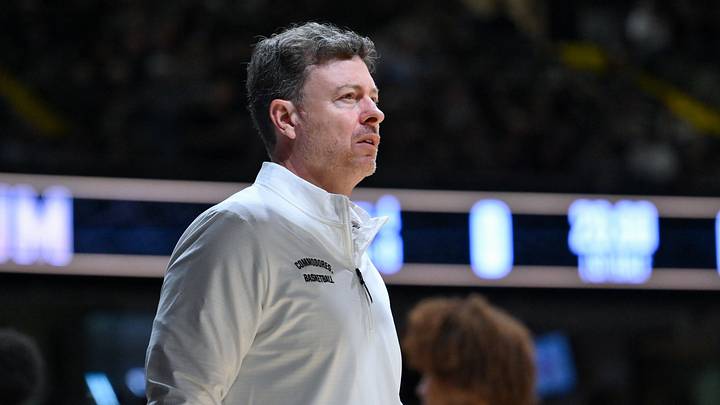
Those who know Mark see his willingness to work tirelessly manifest in his role as Vanderbilt basketball’s head coach. He guided the Commodores to the NCAA Tournament in his first year and took it again in 2025-26 while winning 27 games. He’s been a part of a number of nearly sleepless nights in the pursuit of making the program one of the country’s best.

Chris is referred to as Dale Jr. because of all his similarities with his father, but Trula can see some of her husband in Mark while he coaches. Dale maintained his emotions and hardly lashed out, which makes Mark gritting his teeth on the sideline instead of being fiery meaningful to her. Dale also believed everyone had a place on the team and that not everyone could be the star. Mark often indicates that he believes that by shouting out standout defenders in press conferences rather than only acknowledging leading scorers.
Some foundational elements are the same, but Mark doesn’t model his coaching after his father’s. Mark has retained a few core pieces every year at Vanderbilt. Dale probably would’ve had to adjust his methods to deal with modern players, although those who know him say he was far more patient than he came across as.
“He was a different style of coach,” Mark said, chuckling. “I think now you’ve got to mix in some praise with criticism. If he was quiet, I was doing something right. And then if I wasn't doing something right, there was a criticism. So if the car ride was quiet and he didn't say anything, I must have played pretty good.”
With Dale on the sideline, Mark normally did. For some of Mark’s childhood, Dale was the head coach while Chris was his assistant and Mark was the star player. One of Mark’s youth basketball teams they coached was so dominant that the league kept changing the rules to try to level the playing field. Legend has it that Mark once scored 43 points in a 46-6 win while playing for that team. Dale also coached Mark’s youth football teams while Chris sat at the top of the stands keeping stats–which became repetitive because Mark would score multiple times a game on their signature play 44 cross back.
All these years later, Mark appreciates the memories of playing for his dad. At Dale’s celebration of life, his family saw that others also do. Brian Gordon, the preacher at the event, got in front of the crowd and spoke about the impact playing for Dale as a kid had on his life. The biggest catalyst for healing in the grieving process for Mark was hearing stories like that about his dad and how he impacted others.
Two years later, the stories still get Mark to surrender a smile as he tells them. He doesn’t appear to have any plans to stop telling them, either.
Whenever Chris comes to Nashville for a game, he and Mark often veer off into his office after all the crowds dissipate. In there, they reminisce. Whether they intend to talk about Dale or not, he almost always comes up.
They look at the pictures Mark has scattered around his workspace. They tell funny stories about their father. They remember how he impacted them and think about how they wish he was there.
“He certainly has grieved for his father and it’s very private in terms of that,” Trula said, “But he knows what his dad expects and he will measure up.”

DALE WAS IN the front seat, navigating the highway on the way to a getaway with his three boys behind him. Only, they weren’t in seats of their own. The family van didn’t have those. It only had carpet, which all three boys laid on with no seatbelts.
The van rides often led to family vacation, the legendary Byington camping and fishing trips or a St. Louis Cardinals series–which they went to once a year. Mark still remembers the trips fondly–outside of his time trying, which he decided wasn’t for him after five minutes–and learned something from his father’s approach toward them.
“It’s not about some of the things that you can buy, but it’s about the life experiences,” Mark said. “It’s something I actually took with my son.”
Mark now leads trips of his own with his son, Chase, and hopes Chase has similarly positive memories of them one day. Mark’s best memories with Chase are riding up the coast of California in a rented convertible together and going on the water together, which they often do at the lake back in Virginia.
Dale’s imprints are also on Mark’s parenting in the way Mark pushes Chase to operate with a sense of gratitude for everything and understand the value of hard work. Mark admits that he’s harder on Chase than Dale was on him. That’s in part because Mark was one of three and Chase is his only child, but it also has something to do with the way Mark has seen the world and all that it has to offer.
Just like Dale was on Mark to keep working even in the midst of hardship and be disciplined, Mark is on Chase in that way–as evidenced by his tendency to make him do pushups when he was a kid.
“His culture that he really stresses–it’s just to work hard,” Chase said after committing to Vanderbilt in the winter. “If I work hard, then I can go anywhere I want to in life and that was the big thing. He doesn't really let me get many days where I sit around and do nothing; it doesn't make him happy.”
Sounds familiar. Sounds like what Mark would’ve said about Dale when he was young.
Dale and Trula’s parenting partnership led to their three sons all becoming successful, and Chase appears to be on the same trajectory as a freshman walk-on at Vanderbilt.
At one point in the last few years of Dale’s life, Mark and Chase met Dale and Trula--a now-retired educator, once referred to as the "Salem City Schools MVP"--in Virginia when Dale remarked that Chase had a great-looking Vanderbilt shirt on. Mark told Chase to give Dale the shirt, which he did. So, Chase took it off his back and gave it to his grandfather.
Dale never got to see Chase commit to Vanderbilt or take the floor in a Vanderbilt uniform, but surely he had indications Chase was heading in the right direction. If Mark knows anything about his father, that meant something to him.
“He's proud of the family. He was proud of the last name,” Mark said. “He always would talk about that. It was like ‘hey, Byingtons, we got to be different. You don't get in trouble. You’ve got to act a certain way, carry yourself a certain way.’ That would be his messaging, but it would be the proudness he had in the name and not disparaging the reputation.”

MARK REMEMBERS thinking about his father as a man who did not cry for as long as he knew him. It would take something particularly moving for Dale to shed a tear, especially in front of others.
That’s why the night is still etched into Mark’s memory.
It was Father’s Day dinner at Hall’s Chophouse. Mark landed on Hall’s as the destination because he knew his dad appreciated food, and steak in particular–which Chris jokes that his dad would’ve eaten seven days a week if the opportunity presented itself–and that he’d never had a steak like the one he’d receive there. The Byingtons lived a simple life and weren’t into fancy things, but they embraced the finer things in life on this night.
When Dale was a few bites into his steak, Mark looked over at him and saw tears welling up in his eyes.
“Dad, you okay?” Mark said.
“This is unbelievable,” Mark recalls Dale saying before sticking his fork into Trula’s plate to try what she ordered.
When Mark had to get up to greet someone after the meal was over, Chris recalls the bill lying on the table and telling his parents not to flip it open to look at the price. Dale couldn’t resist and had an audible reaction when seeing that it was a few hundred dollars, though. “He might’ve been tearing up over the bill.” Chris jokes.
“I think he was ready to dig in and help pay for it,” Trula said.
Dale never took money for granted because of the way he grew up and how intentional he had to be with his finances in order to best position himself in life. The good news for Dale that night was that he didn’t have to pay. Mark was still a young professional, but was starting to become a riser in the coaching industry and could afford to treat his family.
As a result, the bill was on him. Mark made the gesture because he figured his dad would appreciate it, and he left that night knowing that he did. From Mark’s description of his father and what he valued, it’s not difficult to assume that he wasn’t merely emotional because of the quality of the steak. Clearly it had something to do with the fact that his son had gone out of his way to do something for him and that he’d made enough of his life to be able to do so.
Mark and his dad lived differently, but Mark always knew Dale was going to be supportive of him.
Dale was a simple man and believed that you don’t mess with happy. Mark is a more curious person and has made more ambitious choices in life. Perhaps no move was bolder than Mark’s decision to leave James Madison—a place in which he’d just won 32 games in a season, was loved and was close to his family—for Vanderbilt—which needed a makeover and subjected him to the gauntlet of the SEC.
To that, Dale told Trula and Chris “I hope Mark knows what he’s doing.”
Chris circled back after Mark started to establish himself and declared that he believed his brother knew what he was doing. Through his health issues that limited his speaking, Dale made it clear that he agreed.
“I could tell he was proud of me,” Mark said, “I could tell in his actions.”
Follow us on Twitter/X, Facebook, YouTube, Instagram, and TikTok for the latest news.
 Add us as a preferred source on Google

Joey Dwyer is the lead writer on Vanderbilt Commodores On SI. He found his first love in college sports at nearby Lipscomb University and decided to make a career of telling its best stories. He got his start doing a Notre Dame basketball podcast from his basement as a 14-year-old during COVID and has since aimed to make that 14-year-old proud. Dwyer has covered Vanderbilt sports for three years and previously worked for 247 Sports and Rivals. He contributes to Seth Davis' Hoops HQ, Basket Under Review and Mainstreet Nashville.
Follow joey_dwy