%20%20--%3E%0A%3Csvg%20version%3D%221.1%22%20id%3D%22Layer_1%22%20xmlns%3D%22http%3A%2F%2Fwww.w3.org%2F2000%2Fsvg%22%20xmlns%3Axlink%3D%22http%3A%2F%2Fwww.w3.org%2F1999%2Fxlink%22%20x%3D%220px%22%20y%3D%220px%22%0A%09%20width%3D%2239px%22%20height%3D%2240px%22%20viewBox%3D%220%200%2039%2040%22%20enable-background%3D%22new%200%200%2039%2040%22%20xml%3Aspace%3D%22preserve%22%3E%0A%3Cpath%20fill%3D%22%23FFFFFF%22%20d%3D%22M38.5%2C7H28.2v26h10.3V7z%22%2F%3E%0A%3Cpath%20fill-rule%3D%22evenodd%22%20clip-rule%3D%22evenodd%22%20fill%3D%22%23FFFFFF%22%20d%3D%22M26.1%2C25.5c0%2C5.8-4.1%2C7.5-12.9%2C7.5C3.9%2C33%2C0%2C31.2%2C0%2C25.2v-1.1h11.6%0A%09v2.4c0%2C0.7%2C0.1%2C1.4%2C1.2%2C1.4c1%2C0%2C1.2-0.4%2C1.2-1.3v-0.9c0-1.6-0.9-1.6-3.5-2.2C2.2%2C21.7%2C0%2C19.7%2C0%2C15.3v-0.9C0%2C9.3%2C5.5%2C7%2C12.9%2C7%0A%09c10.2%2C0%2C12.8%2C2.6%2C12.8%2C7.4v1.8h-11v-2.9c0-0.6-0.4-1.1-1.2-1.1c-0.6%2C0-1.2%2C0.4-1.2%2C1.1v0.9c0%2C1.5%2C0.9%2C2%2C3.3%2C2.5%0A%09c8%2C1.6%2C10.5%2C3.3%2C10.5%2C7.5V25.5z%22%2F%3E%0A%3C%2Fsvg%3E%0A)
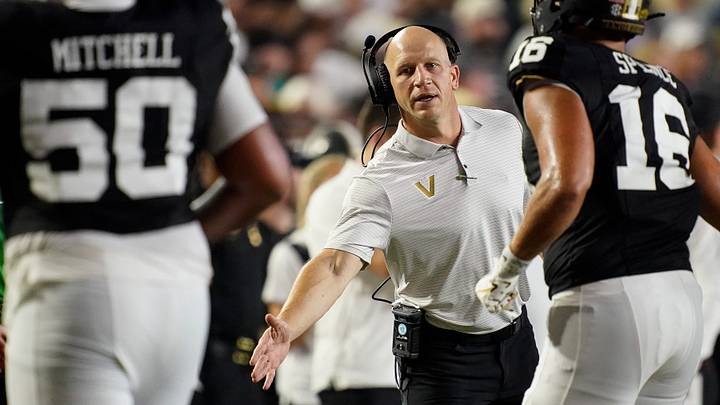
Vanderbilt Coach Clark Lea’s Biggest Breakthrough Had Nothing to Do With Football
In this story:
NASHVILLE — Before Clark Lea was a Vanderbilt football player, and then the Vanderbilt football head coach, and then the back-to-back Coach of the Year in the Southeastern Conference, he played college baseball. He was a catcher.
A catcher with a crippling problem.
Lea had what baseball players call the “yips.” As a freshman at Birmingham-Southern College, he developed a mental block when it came to the routine positional task of receiving pitches. Then, after transferring to Belmont, he compounded it with an inability to accurately throw them back to the pitcher. Consider how often a catcher performs those two tasks—practices and games—and you can understand the depth of the problem.
For Lea, it was nothing short of an existential crisis. Being a college athlete meant so much to him—too much, really—that this problem burrowed into his psyche.
“So much of who I was, was wrapped up in trying to create success within that career, beyond just the dream of playing,” the 44-year-old tells Sports Illustrated in his Vandy office. “There was something that was missing for me that I was trying to fill with performance. And so when it starts to feel like life and death, you start to hold it really tight.
“It was bad. And those were things where you just didn’t talk about it.”
Eventually, his coach at Belmont, Dave Jarvis, did talk to Lea about it. Jarvis encouraged him during practice to think about anything but throwing the ball back to the pitcher—how class went that day, what he was going to have for dinner that night, something to remove the paralyzing fear of a simple task he could no longer master.
“He was working from the conscious side of his brain,” recalls Jarvis, still the coach of the Bruins, now in his 30th year. “Almost everything we do athletically happens from the subconscious side—you’re just reacting, not thinking. I was trying to give him a sweet distraction from thinking about what could happen if he throws the ball away.”

Not much worked. Lea said he felt “the skills kind of fall away.” He faced a difficult reckoning for a young athlete: confronting his own failure and finding a different way to succeed. The humbling lessons learned in that instance would be applied again later in life, when he turned a floundering head coaching tenure into a football miracle.
Nashville has always been home for Clark Lea. His father, Clark Sr., was the team physician for the Nashville Sounds, a Minor League Baseball franchise. He went to Montgomery Bell Academy, an all-boys school with strong academic and athletic credentials. Coming back home to Belmont made sense, and so did his next move, at least geographically—he enrolled at Vanderbilt.
The bigger adjustment was giving up the baseball dream and reconnecting with his football past. After not playing the sport for two years, Lea was granted a walk-on spot by Commodores coach Bobby Johnson in 2002.
His position: fullback, the ultimate self-sacrifice role on a football team. His job: hurtling his body into defenders and moving them on behalf of his more talented teammates. After the angst of catching, it was heaven.

“Think about it like this,” Lea says. “You go from a game where it’s all fine motor skills in baseball, and you’re losing yourself in the inability to execute fundamental things. Well, in football, to me, it was more effort-based. I could just cut loose. I loved it.”
In three seasons at Vandy, Lea had nine carries for 20 yards and three catches for 39 yards. He also found his career path. He sent out roughly 250 letters in 2005 looking for coaching jobs and wound up working two of them in Los Angeles at once—as a volunteer assistant at UCLA and coordinating the defense for the freshman team at Harvard-Westlake High School.
On a typical day, Lea arrived before dawn at the UCLA weight room to make milkshakes for the players, then went to the coaches’ offices to staple papers, pour coffee and generally make himself as useful as possible. By early afternoon, he reported to Harvard-Westlake for practice. After that, he went back to UCLA to work at night.
The bug had fully taken hold by then, leading Lea to full-time assistant jobs at South Dakota State, UCLA, Bowling Green, Syracuse and Wake Forest. In 2017, Wake defensive coordinator Mike Elko got the same job at Notre Dame under Brian Kelly. He brought Lea with him to coach linebackers.
When Elko moved to Texas A&M after one season in South Bend, Kelly elevated Lea to coordinate the defense. He was 36 years old and had never called a defense, but his strategic acumen was readily apparent. Perhaps more importantly, Lea had honed a rare ability to connect and communicate with players.
Under Lea, the Fighting Irish had their two best scoring defense averages between 2013 and ’22, allowing 18.2 points in ’18 and 17.9 in ’19. He was still young, but his credentials were established. When Lea’s alma mater fired Derek Mason after a winless pandemic season in 2020, he was the natural choice of new athletic director Candice Storey Lee to come home and start the reclamation project.
Lea and Lee, both Vandy athletes, were linked together from that point on. But the athletic program—specifically football—was still languishing far behind its SEC peers. What had been an institutionally accepted disadvantage at the elite academic school became an even bigger challenge as college sports launched into a more professionalized model.
“When I took this job, I recognized the state of the program was very similar to when I had gotten here as a player,” Lea says. The Commodores were 6–29 in his playing days, and his first team followed that track by going 2–10 and winless in the SEC.

Year 2 was progress—the Commodores went 5–7, with late-season upsets of Kentucky and Florida. Lea thought he had turned the corner. But Year 3 was a crashing backslide, going 2–10 and again winless in league play. It ended with a succession of November blowouts, including a 48–24 rout at rival Tennessee.
In shock as the season unraveled, Lea felt like he had the yips all over. Was he actually losing his grasp on how to lead a program?
The roster was largely his players, but they lost some key pieces to the transfer portal and the others were not performing at a high enough level. He’d handpicked the coaching staff, but they weren’t delivering.
“What was glaring to me walking off the field in Knoxville in ’23,” Lea says, “was that we had to change.”
Like the struggling baseball player who gave up on that sport to make a career pivot, Lea had to initiate “somewhat of a purge.” He had to tear down his own program and start over.
“I knew almost too much about the history of this program,” Lea says. “So coming in, one of my great fears was loss of staff because I felt like staff retention had been a black eye here—the level of turnover year in, year out was a part of what was keeping the program from growing.
“But also you always have to say, At what expense? So hanging on to staff members for the sake of retention becomes a recipe for mediocrity when the systems aren’t right. We needed to change systems.”
The pursuit of change led Lea to the Chihuahuan Desert and the far corner of New Mexico. He was impressed by the way perennial FBS doormat New Mexico State had dominated Auburn that season, and he set his sights on Aggies offensive coordinator Tim Beck.
The interview was odd. Head coach Jerry Kill sat in on it, then the three men all went to dinner together. By the time it was all said and done, Lea had acquired a large chunk of the New Mexico State program: Beck as offensive coordinator; running backs coach Ghaali Muhammad-Lankford; safeties coach Melvin Rice; Kill himself as special assistant to the head coach and offensive consultant; and several players, most notably a street-fighter quarterback named Diego Pavia.

Lea’s program needed some grit. The New Mexico State crew supplied it. Armed with that and a bolstered NIL war chest, Vanderbilt changed trajectory immediately.
With Pavia as the driving force, Vandy shocked Alabama on the way to a 7–6 season in 2024—and Lea won his first SEC Coach of the Year award. Last year, after Pavia won an injunction for an extra year of eligibility, the program took another quantum leap to 10–3, entering the College Football Playoff discussion for the first time. The Commodores crushed Tennessee for the first time in Lea’s tenure, and he took home the second SEC COY award.
Pavia was the Heisman Trophy runner-up, a previously incomprehensible thing for a Vanderbilt player. Then the program pulled off its greatest recruiting coup in history, getting local five-star quarterback prospect Jared Curtis to flip his commitment from Georgia to the Commodores. (Curtis will not be the starter in the season opener Saturday against Austin Peay—that job goes to veteran Blaze Berlowitz. But the strong-armed Curtis will play early, and it would not be a shock to see him become the starter at some point.)
Lea could have stayed locked into futile persistence as a baseball player. He could have been similarly stubborn with his staff and roster after three seasons as head coach at Vandy. Instead, he confronted his own shortcomings and changed.
The internal reaction in both situations: relief.
“I was putting so much pressure on myself,” Lea says. “You just had to come face-to-face with the idea that, like, Hey, this may not work out. There’s kind of a relief in letting go of expectations and then just shift and focus on what we can do today. What am I learning today and what are my actions today to take a small step forward? That became a way healthier way to approach the program.”
From a personality standpoint, Lea and the New Mexico State posse were an odd fit. They’re the rough-hewn sort—Beck and Kill are both small-town Kansas products in their 60s—while Lea is a cerebral guy with two Vanderbilt degrees and a massive wall of books in his office.
“He’s off-the-charts smart,” Kill says of Lea. “Every once in a while I tell him, ‘You got to talk a little bit of Kansas to me, boy, because I don’t understand a f---ing thing you’ve said.’ ”
Second-year defensive coordinator Steve Gregory spent a long time in the NFL as a player and coach, and grew up in New York. He describes himself as a “smack you in the mouth kind of guy.” But like the Las Cruces cabal, Gregory found it easy to reconnect with Lea, after the two spent time together on the Syracuse staff more than a decade ago.
“He’s a thinker, a philosopher,” Gregory says. “He’s always trying to find hidden messages to relate.”

Upon arrival in Nashville, Beck recalls Lea asking, rather hopefully, if he’s a reader. Beck’s response: “Sorry to disappoint you, but no.”
Among the most dog-eared books on Lea’s shelf:
- The Man Watching, a biography of North Carolina women’s soccer coach Anson Dorrance, who won 22 national championships with the Tar Heels. That one is full of yellow Post-it notes where Lea has flagged passages.
- Thinking, Fast and Slow, which examines two modes of human thought—instinctive and emotional (fast) and deliberate and logical (slow).
- The Warrior Ethos, which studies the warrior code in the military.
- Liturgies of the Wild, which attempts to reconnect modern people with the values of ancient myth.
“Once I got into coaching, [reading] just was a way for me to kind of nourish my curiosity and learn,” Lea says. “But I think we’ve got to be careful anymore because there’s so much content that is all noise, and I think you can just drown in it. The scary part is it feels as though it is serving some deeper purpose, but it’s really just a distraction.”
Lea is trying to walk the line with his team between providing wisdom and perspective without further contributing to noise and distraction. His approach is a unique blend of thoughtful articulation and some profane, gut-level football speak. He doesn’t sound like anyone else in his profession.
“He’s not a coach who’s trying to be another coach,” says Vanderbilt general manager Barton Simmons, who has known Lea since high school. “He’s not a photocopy of a photocopy. He’s authentic.”
At one August practice, in the middle depths of preseason camp when fatigue was high and the excitement of game week seemed far away, Lea carried a bullhorn and said little. He guided the teams through various stages of drills but otherwise let his assistants do most of the talking until the end.
When he called the team into a huddle beneath one goalpost on the practice field, Lea beeped softly on his whistle twice. Silence ensued, followed by a call-and-response mantra with the players.
“Chest, chin and—” Lea says.
“Eyes,” the players responded.
That was his reminder to be present and pay attention, focusing their body on him. He had other instances in which they finished oft-repeated slogans for him.

“Verbal repetition is just a part of the environment, the culture that we built,” Lea explains later. “A shared understanding should have shared language. To me, it’s a powerful reinforcer of alignment within our environment.”
Instead of sounding like a guy with all the answers, Lea calls on various players to get their thoughts on how that day’s practice went. Then he weighs in with his own feedback, noting things the Commodores didn’t do well but also praising the spirited, intense competition in a goal-line drill.
“That was the most fun I’ve ever had on that field,” Lea tells the team. “That was f---ing fun.”
The onetime baseball player lost the fun of being an athlete for a time, then rediscovered it in another sport. He lost the joy of coaching, then rediscovered it with a program reinvention. He’s been humbled and learned from it. Clark Lea has never had all the answers, but he’s not afraid to make a radical pivot in search of them.
PODCAST: Listen to SI’s college sports podcast, Others Receiving Votes, hosted by Pat Forde, below or on Apple and Spotify. Watch the show on SI’s college YouTube channel or on SI TV.
 Add us as a preferred source on Google
Pat Forde is a senior writer for Sports Illustrated who covers college football and college basketball as well as the Olympics and horse racing. He cohosts the Others Receiving Votes podcast for SI and is a regular contributor to the Tony Kornheiser Show podcast. He previously worked for Yahoo Sports, ESPN and The (Louisville) Courier-Journal. Forde has won 28 Associated Press Sports Editors writing contest awards, has been published three times in the Best American Sports Writing book series, and was nominated for the 1990 Pulitzer Prize. A past president of the U.S. Basketball Writers Association and member of the Football Writers Association of America, he lives in Louisville with his wife. They have three children, all of whom were collegiate swimmers.
Follow ByPatForde