
Bernie Taupin: The Brown Dirt Cowboy
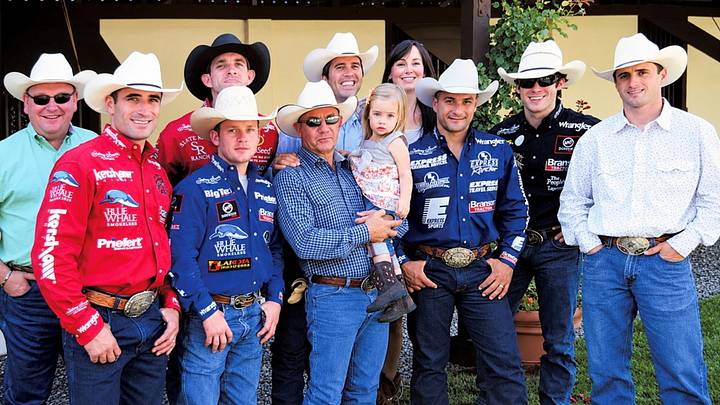
Seeing PBR the first time, Bernie Taupin had a bird’s-eye view of one of the most notorious wrecks in bull riding history: Tuff Hedeman’s violent collision with Bodacious at the 1995 World Finals.
“Bird’s-eye” is a literal description: Taupin was high above the dirt in the nosebleed seats at MGM Grand Garden Arena in Las Vegas – still on the outside of a sport that would become a decades-long infatuation, welcome him as a true insider and rock ’n’ roll ambassador, ultimately lead him to co-own a legendary bull, and pass on his devotion to the sport to his daughter Charley.
At his bull-riding baptism on October 28, 1995, Taupin arrived anonymously. There was no wristband VIP treatment, even though he was already a megastar: the Brown Dirt Cowboy poet and storyteller behind Elton John’s biggest hits. Taupin, it can be stated, loathes the p-word, though the lyrics printed on yesteryear’s gatefold albums fans pored over and committed to memory carry rhythmic imagery that seems to qualify as bona fide poetry – tales of outlaws and misfits amid howling old owls and horny-back toads, whippoorwills of freedom and honky cats heading back to the woods, all roads leading home.
Taupin and John struck a distinctive partnership and would sell 300 million records, including 50 in the Top 40. While many of the songs drew on mythical Americana, Taupin grew up in hardscrabble northern England – flat land where potato farms far outnumbered movie theaters. He was a country boy at heart and in his blood, and with a predilection for country music, a fascination with U.S. history, and growing wanderlust, America was always on his mind.
“I was breastfed on rock ‘n’ roll and the incoming influx of people like the Beatles and the Stones in my early teenage years, and all that sort of kind of blew my skirt up. But nothing more than when I discovered narrative country music,” Taupin said over Zoom from his ranch in southern California.
Blame it in part on World War II. An affable gum-chewing American serviceman from Kentucky left over in England from the conflict that ended in 1945 shared with Taupin a stack of records by the Louvin Brothers, Johnny Cash, and Lefty Frizzell. The music put him under spell, dreaming of galloping across a place where time moved slower. Marty Robbins, particularly his bittersweet cowboy ballad “El Paso,” hit the hardest. He knew he wanted to write cowboy stories.
“I soaked up that narrative country music like a sponge,” Taupin said. “I was infatuated with the American West and wanted ultimately to find my way to where these songs and this history came from. Luckily in 1970 we got the opportunity to come to California, and I jumped at it like a snapping turtle, man. I could not wait to get here. I embraced it 100 percent, and I never went back.”
As Taupin recounted in his self-effacing, best-selling memoir Scattershot: Life, Music, Elton & Me: “Elvis got Graceland. George Harrison, his beloved Friar Park. Me? I got Roundup Valley Ranch, a thirty-acre horse facility cradled in the hills of the Santa Ynez Valley above Santa Barbara.”
There, his American dream included grunt chores and animals, and Taupin immersed himself in the sport of horse cutting – the equestrian discipline mixing elegance and power that requires riders to separate a single calf from a herd.
“A cutting horse in motion is like sitting on the back of a 1,200-pound Ferrari,” he said.
Taupin could easily afford one of those cars. He may have grown up in farmhouses lacking hot water and electricity but could now consume, if he wanted, life’s every available luxury. Still, cutting horses were no rich man’s vanity project. He’d do it the right way, the hard way. You couldn’t plant him in his penthouse; as the song goes, he was going back to his plow. That meant working the ranch and getting up at 4 a.m. to train for the complex and highly competitive sport where to compete, you almost had to be born in the saddle.
“I got into the whole world of cutting horses and ended up basically dropping out of the musical thing and really getting into the Western lifestyle,” Taupin said. “You can’t be a weekend warrior in that game. If you’re gonna cowboy seriously, you have to take it seriously, or else nobody’s gonna take you seriously.”

A quarter century after moving to California, Taupin was in Las Vegas for a cutting event when he learned that Professional Bull Riders was staging its World Finals. He had never heard of PBR, assuming bull riding was something seen as part of a rodeo – not a standalone sport hosting its fifth world championship.
The image he witnessed of Bodacious smashing Hedeman in the face remains vivid, the stubborn cowboy staying on the bull only to be head-butted again, this time catapulted in the air, coming down and bouncing violently off the bull’s back like a wet rag doll.
“It was gladiatorial, brutal and unforgiving,” Taupin wrote in Scattershot. “The maximum in extreme sport, it was eight seconds of treacherous gravitational acrobatics between man and beast.”
Seeing Hedeman walk out of the arena was like witnessing a real-life phoenix rising from the ashes. That impressed a writer preoccupied with plumbing the extraordinary. But the lasting impression of the night was a high-energy show that reimagined Western heritage with “a fanfare of explosions and patriotic fervor...to completely reconfigure rodeo’s small-town aesthetic.” PBR amped up a centuries-old sport into a modern rock-show production.
An introduction was made, and he would meet Randy Bernard, PBR’s CEO, who became a lifelong friend. Ever the mental diarist and romantic drawn to quixotic underdogs, Taupin perked up hearing that Bernard was running the scrappy, improvisational operation playing to boisterous crowds from what was basically a desk in a broom closet in an office building in Colorado Springs.
Tight with the head honcho, his seat at the bull ridings would no longer tempt nosebleeds. Taupin essentially had a golden ticket, and he and his daughter Charley would attend events dirtside – the cute blonde blue-eyed girl given the run of the place, scooting around backstage amid modern-day gladiator bull riders behind clanking bucking gates.
These were not staged appearances of a celebrity swiftly glomming onto a rising sport. Taupin was under the radar, tight with the riders and crew, shunning the cameras and attention. He was a serious working cowboy awed by an audacious, dangerous David versus Goliath undertaking, showing a ferocious yet tender world to a little cowgirl-in-training scampering about, both fully embraced by their new salt-of-the-earth bull-riding family.
“It’s hard to emphasize how entrenched I was,” Taupin said. “I got to know everybody.”
When the tour stopped in California, he’d invite the riders to Santa Barbara for private events at the Roundup Valley Ranch. “All the guys would come, and I’d throw them on cutting horses,” he said.
The guests were like rough-and-tumble characters in a Merle Haggard song, guys like Chase Outlaw and Ryan Dirteater with names sounding Hollywood-manufactured but real as the muddy dirt covering their boots. They were non-assuming cowboys with simple values about right and wrong, joined by unpretentious men from modest beginnings in Brazil pursuing their own American dream with romantic Latin names like Valdiron de Oliveira, Edevaldo da Silva Frerreri, his good friend Guilherme Marchi, and three-time World Champion Adriano Moraes.
“We had a blast, so much fun and everyone loved it, especially Charley,” Taupin remembered. “These were the kind of characters, that before I got to PBR, who I wrote songs about and who inspired me to write songs.”
Taupin is an avid reader, and one of his favorite books is W. Somerset Maugham’s The Moon and Sixpence, depicting a man following his dream even if it means sacrificing everything – something he recognized in these modest, largely unheralded athletes putting life and limb at risk.
Beyond the riders, he would come to know bull fighters like Rob Smets, PBR Medical Director Dr. Tandy Freeman, the gate men and stock contractors, the TV commentators, and the inimitable entertainer Flint Rasmussen, “a guy who took the cheesy Raggedy Andy cliché of rodeo clowning and turned it into a form of hyper-stylized entertainment,” he wrote.
To this day, one of Taupin’s cherished friends is Michael Gaffney – a.k.a. G-Man, 1997 PBR World Champion and current coach of the Austin Gamblers. Gaffney also happened to be the rider who forged Little Yellow Jacket’s most memorable rivalry, helping etch Taupin’s name into bull riding lore.

“I consider G-Man’s family and our family related now,” Taupin said. “Michael’s wife (Dr. Robyn Gaffney, a surgical pathologist, who specializes in diagnosing cancer) is my wife’s best friend. They are like uncles and aunts to my kids. We go to them every year for Thanksgiving. It’s magical. (PBR) created a whole new world for me.”
Gaffney, the soft-spoken son of an Air Force pilot, cherishes the wonderful times the families shared.
“I consider Bernie one of my dearest friends and one of the kindest human beings I’ve ever known,” he said. “His genuine appreciation for the sport of bull riding and his lifelong love of the cowboy way of life are what first brought our paths together through the PBR. What began as a shared passion has grown into a friendship that means the world to me.”

Another deep friendship would lead Taupin to Little Yellow Jacket – still one of PBR’s most well-known and beloved bulls.
Through Bernard, Taupin became close with Tom Teague, the hard-working son of a North Carolina tenant farmer who, with moxie, southern good-old-boy charm and bull-dogged persistence, built one of the nation’s most successful trucking companies. Teague was a friend of racing legend Dale Earnhardt Sr. and, after attending PBR, said he believed the sport could become a smaller version of NASCAR.
Teague made sure the nascent bull riding organization – a little engine that could – kept chugging along with a shot at the success Earnhardt helped NASCAR find. With his back to the wall, Bernard came to Teague asking him for $3.1 million to secure the sport’s media rights. Teague immediately sent the money, much to his chief financial officer’s dismay.
Both sons of farmers, Taupin and Teague would travel the world together. When Teague presented Taupin the opportunity to invest in an extraordinary young bull who had just won a world championship, he trusted his friend just as Teague had placed his faith in Bernard. The powerful bull with the peculiar, mismatched horns – one pointed straight and the other cockeye-curved down – would win two more world titles.
“The thing I loved about Little Yellow Jacket was that bull was kind of docile in the pens; you could actually go in with him and rub him down on his head, and he was fine,” Taupin said. “But once you put that strap and saddle on him, man, he was like a rocket there.”

Fittingly, Taupin’s bull was also a character. With his buck-off time averaging under three seconds, he knew he was good at launching riders off his strong back, and he appreciated the chance to take a bow for acknowledgement of the pleasure. After ending the battle in a blink, he would strut around the arena basking in the limelight and cheers like Elton John in his duck suit in front of 400,000 fans packing Central Park.
With the personality came performance. Little Yellow Jacket understood the game at a rare level, according to PBR co-founder and 9-time World Champion Ty Murray.
“The great bulls have their little signature things that make them trickier. Little Yellow Jacket was skipping and bouncing on his front end with continued forward movement that would always mess up your rhythm and timing and get you back a little bit,” Murray said. “That’s what makes them very hard, because what the sport comes down to is rhythm and timing.”
In 2004, every wily stutter step move worked, and the bull was undefeated until Taupin’s buddy Michael Gaffney rode him for 96.5 points in Nampa, Idaho – tying the highest score in PBR history at the time. Later that year, 34-year-old Gaffney rode him again for 93.75 points, becoming the oldest rider to ever successfully cover a world champion bull.
When Bernard moved his growing staff to Pueblo into a new building at the center of a riverfront redevelopment, his flair for the dramatic immediately greeted visitors at the entrance with a life-size bronze statue depicting a bull ride. Fans voted for Adriano Moraes – a familiar face at Taupin’s ranch – and the affable Brazilian was depicted astride Little Yellow Jacket, putting the sport’s first three-time World Champion rider on top of its first three-time World Champion bull.

Bernie Taupin’s most enduring and productive creative relationship is with Elton John. They were brought together in 1967 after both answered an advertisement seeking new musical talent. When John – known as Reg Dwight at the time – said that he could write melodies but not lyrics, he was handed a sealed envelope containing Taupin’s poems. John read them on the London Underground ride home, then composed music to the words. Soon afterward, an introduction was arranged, launching one of the most unique and productive partnerships in rock history.
That partnership put Bernie Taupin into the Songwriters Hall of Fame and the Rock and Roll Hall of Fame and brought him the lofty honor of CBE (Commander of the Order of the British Empire). It remains very much alive. “As long as Elton and I are above ground, we’ll continue to work together,” Taupin said.
Next year will mark 60 years since they became one of history’s most prolific and popular songwriting duos – a bond he has described as being with his “soul brother.”
Taupin’s immediate focus is promoting his cathartic new album, The Sea Has No Mercy, released in late October. He has long been an ardent admirer of Graham Greene, the magnificent writer he and his father revered – a keen scrutinizer of human life. On this album, Taupin turns that scrutiny inward.
He describes the new record as “Bernie Taupin at 76 years old, looking back on his life looking at his life currently and looking into the future. It’s about understanding your legacy, talking about where you come from, what you’ve learned about the roots of your raising…I’m incredibly proud of it. There’s so much about me in this record. It’s a testament to my life basically and everything I wanted to say right now.”

Taupin seemed relaxed and content, graciously conversational in sharing with a stranger popping onto his computer screen his passion for Americana and bull riding and the enduring friendships it has forged. But he became most animated – and most personally fulfilled – when he returned, again and again, to one subject: his daughter, Charley.
The non-conformist kid who grew up in England mystified by mountain music and the holy grail of small-town America and viewing the apex of humanity as nothing more than living hard and honest as a genuine cowboy now proudly calls his daughter “a 100-percent real-deal cowgirl.”
Considering the people Bernie Taupin seems to most respect in stories immortalizing them, and the recurring sources of his inspiration, there’s no higher compliment. No matter the storm, Charley Taupin can wear her father’s glowing endorsement like strong, shiny armor to conquer anything this life throws at her.
 Add us as a preferred source on Google

Andrew Giangola, who has held high-profile public relations positions with Pepsi-Cola, Simon & Schuster, Accenture, McKinsey & Co., and NASCAR, now serves as Vice President, Strategic Communications for PBR. In addition to serving in high-profile public relations positions over the past 25 years, Andrew Giangola is the author of the critically acclaimed books The Weekend Starts on Wednesday: True Stories of Remarkable NASCAR Fans and Love & Try: Stories of Gratitude and Grit in Professional Bull Riding, which benefits injured bull riders and was named the best nonfiction book of 2022 at the 62nd Annual Western Heritage Awards. Giangola graduated from Fordham University, concentrating in journalism, when he was able to concentrate. He lives in Brooklyn with his wife Malvina.