%22%3E%0A%3Cpath%20d%3D%22M0%205.12903H12.8817C17.559%205.12903%2020.5268%206.30107%2022.3762%208.13977C23.9569%209.7204%2024.7848%2011.6881%2024.7848%2014.3978V14.4731C24.7848%2018.3118%2022.7848%2020.9892%2019.5805%2022.5375L25.7203%2031.5052H15.6558L10.6774%2023.9676H8.79565V31.5052H0V5.12903ZM12.6236%2017.6773C14.7311%2017.6773%2016.0107%2016.7311%2016.0107%2015.1182V15.043C16.0107%2013.344%2014.6881%2012.5161%2012.6558%2012.5161H8.81716V17.6773H12.6236Z%22%20fill%3D%22white%22%2F%3E%0A%3Cpath%20d%3D%22M25.8506%2021.3008V21.2256C25.8506%2015.4191%2030.6785%2010.4514%2037.4527%2010.4514C44.2268%2010.4514%2048.9795%2015.3546%2048.9795%2021.1503V21.2256C48.9795%2027.032%2044.1516%2031.9997%2037.3774%2031.9997C30.6032%2031.9997%2025.8506%2027.0965%2025.8506%2021.3008ZM40.7752%2021.3008V21.2256C40.7752%2019.1933%2039.2699%2017.5697%2037.3882%2017.5697C35.5064%2017.5697%2034.0763%2019.1933%2034.0763%2021.1503V21.2256C34.0763%2023.2578%2035.5817%2024.8814%2037.4634%2024.8814C39.3451%2024.8814%2040.7752%2023.2578%2040.7752%2021.3008Z%22%20fill%3D%22white%22%2F%3E%0A%3Cpath%20d%3D%22M50.4629%2021.3762V21.301C50.4629%2014.7849%2054.3768%2010.4516%2059.237%2010.4516C62.3661%2010.4516%2064.0972%2011.8064%2065.4198%2013.2795V4H73.9681V31.5052H65.4198V28.9784C64.022%2030.4837%2062.4413%2031.9891%2059.3123%2031.9891C54.3338%2031.9891%2050.4629%2027.6558%2050.4629%2021.3655V21.3762ZM65.6133%2021.258V21.1827C65.6133%2019.1505%2064.1402%2017.4945%2062.1833%2017.4945C60.2263%2017.4945%2058.7532%2019.1182%2058.7532%2021.1827V21.258C58.7532%2023.3332%2060.2263%2024.9461%2062.1833%2024.9461C64.1402%2024.9461%2065.6133%2023.3225%2065.6133%2021.258Z%22%20fill%3D%22white%22%2F%3E%0A%3Cpath%20d%3D%22M76.0537%2021.3333V21.2581C76.0537%2015.1183%2080.4623%2010.4409%2086.6451%2010.4409C93.9569%2010.4409%2097.3439%2015.5269%2097.3439%2021.7849C97.3439%2022.2366%2097.3439%2022.7634%2097.3009%2023.215H84.0752C84.6773%2025.0215%2086.1074%2025.9677%2087.9569%2025.9677C89.5053%2025.9677%2090.7848%2025.2473%2092.1397%2023.8602L96.731%2027.5161C94.6988%2030.1505%2091.7956%2031.9999%2087.344%2031.9999C80.6021%2031.9999%2076.043%2027.7419%2076.043%2021.3333H76.0537ZM89.5375%2019.4516C89.344%2017.4946%2088.1827%2016.3656%2086.6773%2016.3656C85.172%2016.3656%2084.2257%2017.5699%2083.9677%2019.4516H89.5483H89.5375Z%22%20fill%3D%22white%22%2F%3E%0A%3Cpath%20d%3D%22M98.7305%2021.3008V21.2256C98.7305%2015.4191%20103.558%2010.4514%20110.333%2010.4514C117.107%2010.4514%20121.859%2015.3546%20121.859%2021.1503V21.2256C121.859%2027.032%20117.031%2031.9997%20110.257%2031.9997C103.483%2031.9997%2098.7305%2027.0965%2098.7305%2021.3008ZM113.655%2021.3008V21.2256C113.655%2019.1933%20112.15%2017.5697%20110.268%2017.5697C108.386%2017.5697%20106.956%2019.1933%20106.956%2021.1503V21.2256C106.956%2023.2578%20108.462%2024.8814%20110.343%2024.8814C112.225%2024.8814%20113.655%2023.2578%20113.655%2021.3008Z%22%20fill%3D%22white%22%2F%3E%0A%3Cpath%20fill-rule%3D%22evenodd%22%20clip-rule%3D%22evenodd%22%20d%3D%22M131.368%204.36764C137.191%20-1.45588%20146.632%20-1.45588%20152.456%204.36764C158.279%2010.1912%20158.279%2019.6324%20152.456%2025.4559L141.912%2036L131.368%2025.4559C125.544%2019.6324%20125.544%2010.1912%20131.368%204.36764ZM134.009%207.55761C133.948%207.86849%20133.916%208.39718%20133.916%209.14566V10.4189C133.916%2011.1832%20133.948%2011.7198%20134.013%2012.0267C134.078%2012.3317%20134.278%2012.6168%20134.617%2012.8762C134.956%2013.1376%20135.403%2013.3316%20135.958%2013.4623C136.512%2013.593%20137.1%2013.6583%20137.837%2013.6583C138.573%2013.6583%20139.217%2013.591%20139.769%2013.4524C140.322%2013.3158%20140.761%2013.1178%20141.086%2012.8604C141.411%2012.6029%20141.605%2012.3178%20141.666%2012.0069C141.728%2011.6961%20141.759%2011.1674%20141.759%2010.4189V9.14566C141.759%208.38134%20141.728%207.84473%20141.662%207.53781C141.597%207.23287%20141.397%206.94972%20141.058%206.68834C140.72%206.42696%20140.272%206.23291%20139.718%206.10223C139.163%205.97154%20138.536%205.90619%20137.839%205.90619C137.102%205.90619%20136.459%205.97352%20135.906%206.11213C135.352%206.24875%20134.914%206.44677%20134.589%206.70418C134.265%206.9616%20134.071%207.24673%20134.009%207.55761ZM139.276%2024.8638C142.876%2024.8638%20144.557%2024.2064%20144.557%2021.862V21.858V21.3155C144.557%2019.6581%20143.516%2018.971%20140.252%2018.3136C139.278%2018.1136%20138.908%2017.9136%20138.908%2017.3136V16.9414C138.908%2016.6543%20139.177%2016.5117%20139.413%2016.5117C139.749%2016.5117%20139.918%2016.7137%20139.918%2016.9414V18.1136H144.391V17.3988C144.391%2015.4563%20143.347%2014.4266%20139.177%2014.4266C136.15%2014.4266%20133.896%2015.3414%20133.896%2017.3711V17.7433C133.896%2019.5155%20134.805%2020.3155%20138.201%2021.0303C138.28%2021.0472%20138.355%2021.063%20138.427%2021.0781C139.329%2021.2674%20139.647%2021.3341%20139.647%2021.9174V22.2897C139.647%2022.6619%20139.546%2022.8045%20139.142%2022.8045C138.67%2022.8045%20138.637%2022.5471%20138.637%2022.262V21.2897H133.894V21.7471C133.894%2024.149%20135.476%2024.8638%20139.276%2024.8638ZM145.424%2024.5569H149.925V14.7355H145.424V24.5569ZM146.955%2013.5019H149.925V6.06064H147.092V9.411L145.193%206.06064H142.359V13.5019H145.193V10.1199L146.955%2013.5019ZM138.269%2012.152C138.204%2012.2688%20138.055%2012.3262%20137.825%2012.3262L137.827%2012.3282C137.604%2012.3282%20137.459%2012.2767%20137.398%2012.1757C137.336%2012.0748%20137.305%2011.8074%20137.305%2011.3758V7.90068C137.305%207.51852%20137.352%207.28684%20137.445%207.20962C137.538%207.13239%20137.675%207.09279%20137.851%207.09279C138.059%207.09279%20138.198%207.14031%20138.265%207.23734C138.332%207.33239%20138.366%207.55416%20138.366%207.90068V11.3203C138.366%2011.7579%20138.334%2012.0352%20138.269%2012.152Z%22%20fill%3D%22white%22%2F%3E%0A%3C%2Fg%3E%0A%3Cdefs%3E%0A%3CclipPath%20id%3D%22clip0_15247_3552%22%3E%0A%3Crect%20width%3D%22157%22%20height%3D%2236%22%20fill%3D%22white%22%2F%3E%0A%3C%2FclipPath%3E%0A%3C%2Fdefs%3E%0A%3C%2Fsvg%3E%0A)
Cowboys Don’t Go for Second Place. Neither Does Gavin Adcock.
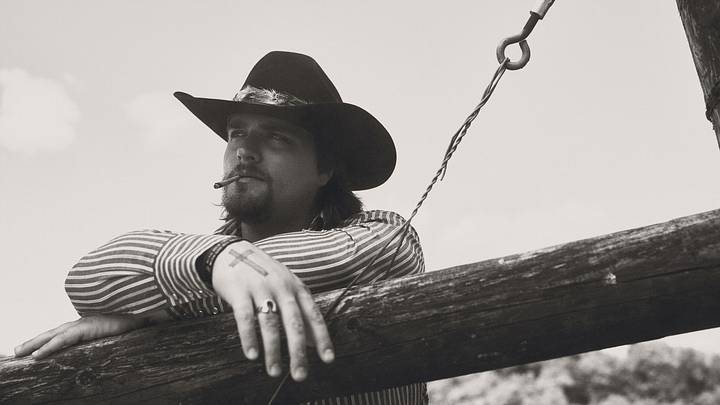
If there is a single word that runs like a load-bearing beam through everything Gavin Adcock says and does, it is authenticity.
Not the word itself as he doesn't lean on it the way any other artist might, as if saying the word is the same as possessing the thing, but the reality of it, the daily practice of it.
His fanbase did not materialize from a label campaign or a viral algorithm trick. It grew the way loyal audiences always grow, one believer at a time, each one arriving because they heard something true.
"Just authenticity," he says, with the quietness of a man stating something he has never had to think twice about. "When they hear me spit out that first line, they believe it."
Gavin Adcock is 28 years old. He has written hundreds of songs. He has torn a knee up, lost a football career, signed with Warner Nashville, built one of the most genuine fanbases in contemporary country music, and released albums of fourteen, eighteen, twenty-four, and now twenty-six songs, each one a selective, ruthless distillation of everything that came before.
He is not in a hurry, and that lack of urgency is itself a statement. In an industry that rewards the manufactured breakthrough and the quarterly pivot, he has proceeded at the speed of craft: steadily, stubbornly, with the patience of someone who has been writing forever and understands, even then, that the work would take exactly as long as it needed to.
The rodeo world knows this patience, too. You don't step into the arena before you're ready. You prepare in the dark, in the practice pen, in the quiet years nobody writes about, and then one day the gate opens, the lights come up and you are ready because you put in the time when nobody was watching.
That gate has opened for Gavin Adcock, and the crowd is on their feet. Somewhere in the dust and the noise and the roar of it all, a cowboy at heart is doing exactly what he always knew he would do, and the first line, as always, lands true.
Rodeo On SI had the opportunity to sit down Gavin, and here’s how it went.
SI: You started writing songs back in high school, but it wasn't until that knee injury in 2021, stuck in a full leg cast, that you really dove into music. You posted one video, it took off, and suddenly you were shifting from nose tackle to Nashville. When you look back at that moment now, does it feel like fate stepping in, or more like life giving you a nudge you didn't know you needed?
GA: I’m glad that I did. I loved music growing up, but I'm glad I didn't start my music career until I did. I feel like I would have messed it up a little bit along the way. I felt like I was more mature when I started.
I tore up my knee playing, and football has been my love my whole life. Something over the past few months before had told me I wanted to make music. So, I tore my knee up and then immediately started writing songs and found out that I was pretty good at it.
I was writing by myself forever. Then eventually I met a handful of people. My group of writers isn't necessarily that big. I write with about 12 people and that's about the circle I stay in. We usually have two to three or four of us at a time.
SI: You’ve got 26 tracks on this album, writing alongside legends like Rhett Akins, Morgan Wallen, JoyBeth Taylor, ERNEST, and so many more. Did you set out to make an album this big, or did it just keep growing?
GA: My first album was 14, my second album was 18, my third album was 24, and I wasn't going to go down from that. So, I decided we were going to beat ourselves. We had about 120 songs to choose from, and I picked the best 26.

SI: They’re all so real and so good. Do you have a favorite track, or does that change day to day?
GA: I really like "Having One Now." It's a good old Western-sounding song, good to dance to. Every time I play it, there are a few couples in the pit that start dancing and spinning each other around. And I really like "Working Man." That one means a lot to me and my fans. My music video for it, I took videos of guys on the job and made it a whole music video, and I'm not in it at all. We could have come up with a cheesy skit, but I just figured keeping it simple meant a lot to them.
SI: You co-wrote all but three tracks. How do you decide when to take an outside cut?
GA: I don't take a lot of outside cuts. But if I do, it's usually from somebody I write with all the time who kind of gets me. And at the same time if I don't take a song and let it out, somebody else is going to make it a hit and use it against me. So, if I like it, I better cut it.
SI: “Lowball Me" has a great grit to it. What's the story behind it, and what's the funniest moment someone tried to lowball you?
GA: I’d go to the stockyard when I was a little kid with my daddy. And if something came in that was a bargain, he'd sure as hell buy it. Sometimes he walked away with a steal, something that was like 30, 40 cents per pound cheaper than it should have been. He'd sell it over the next few weeks and make some money on it.
The guys I wrote this with, Dan Isbell and Paul Sikes, well Dan went to an estate sale. The man selling the stuff, his stepdad had left it all to him, and he was from New Jersey. He came down to Tennessee to sell it.
Dan and his brother went and started asking what he wanted for things, and the man kept saying, "Just offer me something and I'll take it. I'm ready to get it all out of here."
They kept going, $10 for this, $20 for that, just getting a steal left and right because the dude was basically saying: lowball me.
So, we took that idea and turned it into a breakup love song. She leaves him the next morning and tells him she's getting out, leaves all her stuff, thinking she'll come back for it later. But he's so ticked off he takes it all out in the yard, puts up a yard sale sign, and when people come by, he goes, "Offer me something and you can have it."
SI: That’s going to get a lot of people thinking twice about going back to the same mistake.
GA: No doubt. My fans are a little psycho. They're just like me. (laughs)
SI: You’ve got a lot of blue-collar energy in your music. What's one "Workin' Man" habit that would surprise people?
GA: I’m not much of a construction worker I tell everybody I can't really fix a bowl of cereal. I used to do a lot of ranch hand stuff: working and doctoring cattle, cutting and castrating bulls. I'd fix fences every once in a while, but it'd be a patch job, it wouldn't look great, but it'd keep the cattle in. And I'm an early riser. Most artists sleep till 10, 11, sometimes lunch. I'm up by 7:30 or 8:00 every morning. My daddy wouldn't even go on vacation when we were kids. Someone had to take care of the cows.
SI: When you brought Treaty Oak Revival in, how did you know which song and were the right fit?
GA: They came to Nashville, as Sam came for some Red Bull event they were doing. We'd always wanted to write together, so me and Tim got together and wrote this one song: "Us Again."
I got in the studio and we kind of dissected how we wanted to play it out a couple different tempos, a couple different takes. Then I sent the track without the vocals on it and said, "How's this sound?" And Sam was like, "Sounds real good, dude. Let's do it."
So, I got in the studio, they got in the studio individually, and we put it all together. We've been really excited about this one. It's probably one of the most anticipated songs on the album, just because we're two of the rowdiest acts in all of country music and maybe all of music, period.
SI: ERNEST has such a specific energy. How did that one come together?
GA: Ernest is one of the most talented writers in all of Nashville! He's got probably 20-something number ones, and when Ernest writes a hit, he usually sends it to somebody else and they cut it.
When me and him got together to write this one, I came in with the first verse and chorus and kind of got stuck on it. So, I took it to Ern, and we finished writing it in about 10 to 12 minutes. He's a damn dictionary.
Some people will go to sing a melody and they're singing gibberish, but this dude is putting together real words. He used to be a rapper when he started out, under the name Snow.
We wrote it, I cut it, and I thought: Ern never really gets to do his more commercial hits. I want him on this. So, I sent it to him, and he was all for it.
SI: You have a track on this album called “18”. If you could sit your 18-year-old self-down, what would you tell him?
GA: I would tell him very little. Because 18-year-old me would take whatever advice older me gave him and he would screw it all up. So, I wouldn't tell him much just some real basic stuff.
I wouldn't tell him how his life's going to turn out. I'd just say: treat people with respect, always stand up for what you believe in, and don't ever let the world get you down.
Because if you're successful, people are going to come after you no matter what. I'd probably leave it at that, because if I told him too much, he'd have had some kind of ego. And it turned out pretty good, so I wouldn't tell him too much.
SI: You write with such depth. You're still in your twenties, but your songs feel like they come from someone who's lived a lot more life. Where does that depth come from?
GA: A little bit of everything. A lot of this stuff is life I've lived. There are other situations I've run into with other people, things that can happen to anybody. I do feel like I've lived a lot more life than some people. I've done a little bit of everything in my 28 years and it blows my mind.
I'll tell my tour manager a story from 10 or 12 years ago, some crazy thing I did, and they'll go, "Man, we've known each other for three years and I've never heard that." They've told me before: "You've lived a lot more life than some people." And I don't know, I just always lived fast and hard and had a good time.
SI: From a fan perspective, what do you want people to hear when they listen to this record?
GA: Just authenticity. When they hear these songs, when they hear me spit out that first line, they believe it. They're bought in. They feel like I'm sitting right next to them in whatever situation they're in. They can say, "Gavin's lived this. I can live through this. I can make it."
A lot of people come up to me and say, "Gavin, you saved my life with your music." And that blows my mind because I'm just writing the best songs I can.
I always tell them: I have struggles in my life as well. I have bad days. And no matter what it is, you can get through it. You just have to realize it's really easy to go "poor me, I'm the only person going through this." You have to step back and remember there are 30,000 people within a hundred-mile radius going through the exact same thing.
 Add us as a preferred source on Google
Tresha Glowacki grew up on a dairy farm in East Tennessee, where hard work and storytelling went hand in hand. Now living in Texas, she’s a devoted writer with a love for all things Western-horses, rodeos, and music. Her writing reflects the life she lives: grounded, spirited, and full of heart. When she’s not riding or writing, she’s spending time with her kids and animals that keep her world turning.