
5 Facts to Know About 1958 Topps Sport Magazine All-Star Cards

In this story:
As Topps celebrates its 75th anniversary in 2026, there are many milestone marks in the collectible company's chronicle. But one of the more notable ones has to be 1958, when Topps inserted All-Star cards into its standard baseball card sets. While there are technically other candidates for the title of first All-Star cards, the 1958 ones are the first normal, standard issued cards of players designated as All-Stars.
Topps inserted a 21-card set of All-Star players at the end of the 1958 set. Some of the excellence of the set was the idea-- who wouldn't want another card of Ted Williams, Mickey Mantle, Willie Mays, or Hank Aaron? Some was in the execution-- a star-spangled photo with either a red (American League) or blue (National League) background. Some, of course, was the players. It's the lone active Topps All-Star card of Ted Williams. It captures a bevy of young stars (particularly in the National League) that would be hard to replicate. And the cards aren't hard to find-- even before accounting for a massive recent find of 1958 and 1959 cards. Here's the story.
RELATED: 5 Great Baseball Card Easter Eggs (Hidden Secrets and Cameos)
1. Sport Magazine picked the All-Stars
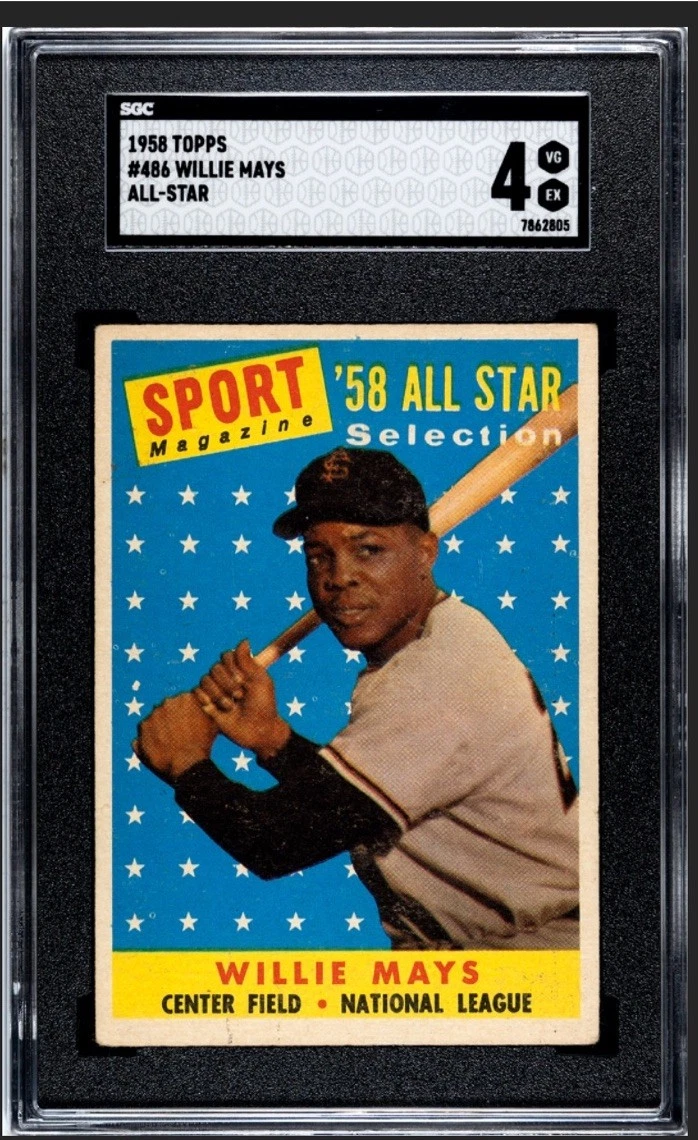
Topps labeled 20 players as All-Stars, including a left-handed and right-handed pitcher for each team. That 21st card is a joint card of the two All-Star managers, the pennant winners from 1957 (and 1958) of Casey Stengel and Fred Haney. But it's important to note that Topps didn't pick the players. The players weren't the lineups from the All-Star Game, because Topps couldn't wait that late to print the cards. (And incidentally, there had been a ballot-box stuffing scandal in 1957 anyway and players picked the All-Stars in 1958 and for several years thereafter). Sport Magazine picked the players-- and did a pretty good job, nabbing a dozen Hall of Famers.
2. There's a couple of surprises in the set
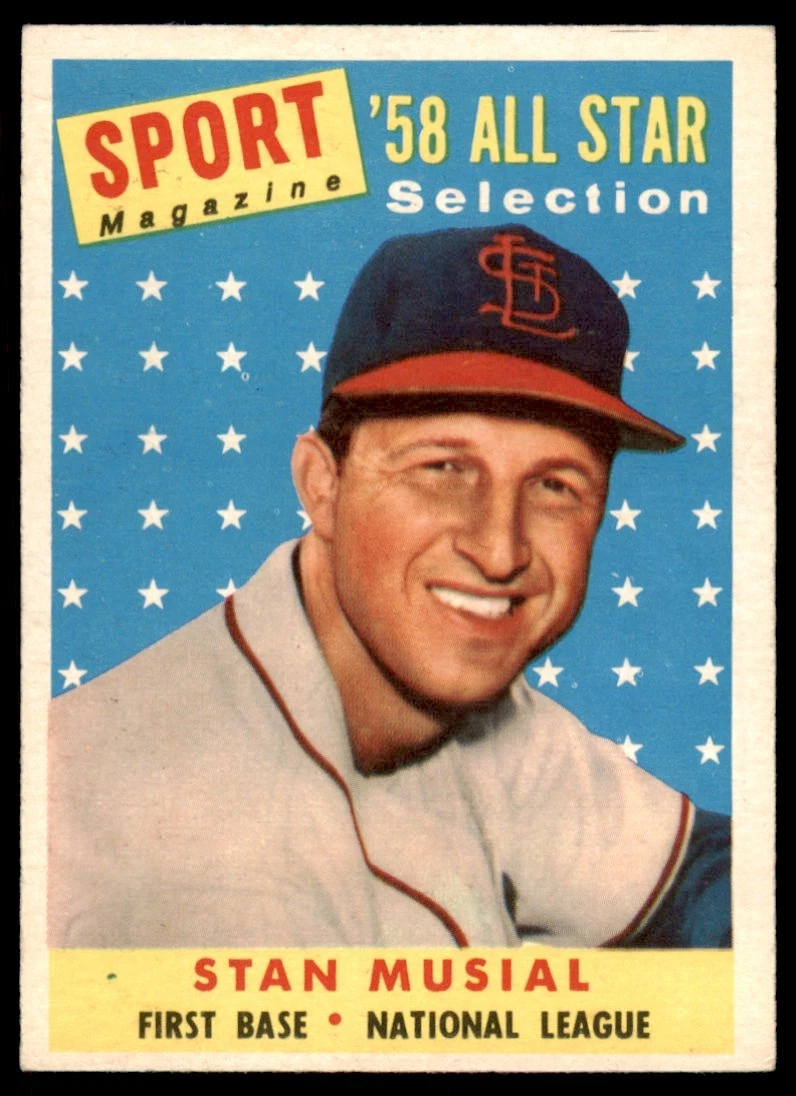
Stan Musial didn't have a Topps card before the 1958 set. He had signed with Bowman and had cards with that company in 1952 and 1953, but hadn't appeared on any card since. Topps's Sy Berger later told that Musial agreed to return to Topps in 1958 in exchange for a charitable contribution of $1,500 to a charity chosen by Cardinals owner Augie Busch. In later years, Musial picked the charity, but the 1958 All-Star Musial is a rare sight.
Likewise, the 1958 Topps All-Star is Ted Williams's final Topps card. Williams signed with Fleer, which produced its own Ted Williams-centric sets in 1959 and 1960, and so Williams had no further Topps cards as an active player.
3. As high-numbers, they're somewhat rare (some more than others)

The 1958 set came in the days when Topps printed and sold the cards in six different series over the year. The All-Stars are high number cards, in fact the last 21 cards in the set. In general, the high number cards are more scarce and valuable. But Topps, likely seeing the chance to please collectors, triple-printed the Musial and Mantle cards. In the case of Musial, it keeps the price surprisingly low for such a classic card (raw versions sell for around $20 and a SGC 6.5 went for $80 recently). In the case of Mantle, there's still a premium on high-grade cards (A PSA 9 sold for $8,540 last year).
4. The manager card doubles as a checklist.
The card of the two managers is surprisingly expensive in sales-- likely because it's a checklist. The back of the card has a checklist and finding it in an unmarked condition is always rare. So yes, Casey Stengel was popular, but finding a card that's not marked on is the real issue. A PSA 9 of the card went for over $2,200 in 2015, although lower-grade but unmarked versions are much more affordable, usually below $30.
5. The success of the All-Star set led Topps to keep experimenting.
Yes, you can draw a line from 1958's Topps All-Stars to wild days of junk wax with Score putting a base card, a Rifleman card, a cartoon All-Star card, an artsy Dream Team card, and likely a checklist of a star in a given set. Most immediately, in 1960, Topps started the all-star rookie ("gold cup") set. All-Star cards have come and gone and been reimagined, but the trend toward more subsets and more cards of noteworthy players has certainly stayed.
TOP TRENDING COLLECTIBLES ARTICLES:
 Add us as a preferred source on Google
Joe is a journalist and writer who covers college and professional sports. He has written or co-written over a dozen sports books, including several regional best sellers. His last book, A Fine Team Man, is about Jackie Robinson and the lives he changed. Joe has been a guest on MLB Network, the Paul Finebaum show and numerous other television and radio shows. He has been inside MLB dugouts, covered bowl games and conference tournaments with Saturday Down South and still loves telling the stories of sports past and present.