
A Different Way to Evaluate Rookie Cards
In this story:
Sports card values are a highly debated topic. What causes them to rise, or whether a player is overvalued, are questions with a wide range of opinions. Here's a theory that doesn’t get discussed enough but could help explain it. For the sake of argument, let’s say there are two main drivers: the card itself and the player featured on it. The card side of things can include factors like how rare or condition-sensitive it is, whether it’s part of a premium or iconic set, or if it’s considered the flagship rookie of that player. Then there’s the player side, which refers to how strong the player’s overall market is. This is where there may be a common misconception. What if, instead of championships, MVPs, and other accolades being what sustain a player's market value, it’s actually their overall popularity? Titles and awards can certainly boost a player’s fame, but maybe it’s that fame itself, not the accomplishments, that truly drives demand for their cards.
RELATED: The Secret to Card Collecting: Invest in the Set, Not the Player
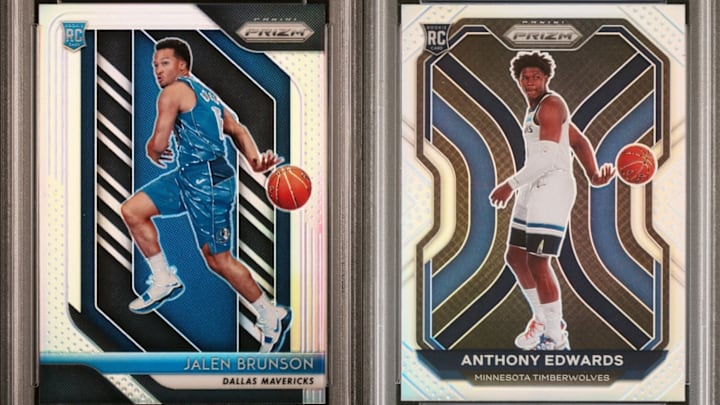
Let’s see how this plays out by comparing two statistically similar basketball stars: Jalen Brunson and Anthony Edwards. Both are two-time All-NBA selections who averaged within 1.6 points of each other this past season and led their teams to the conference finals. Yet despite that, Anthony Edwards' Silver Prizm rookie card in a PSA 10 last sold for over $700, while Brunson’s went for under $300 (with Edwards' card population being more than three and a half times larger).
Maybe we can apply this theory to better understand their price gap. Edwards has a bold, electrifying style of play. He’s the one posterizing defenders and drawing comparisons to Jordan and Kobe in terms of mindset and presence. He also has over five times as many Instagram followers as Brunson. Perhaps he's more expensive because he’s simply the more popular player.
This Anthony Edwards-Michael Jordan side-by-side is wild 🤯 pic.twitter.com/uNVkNAIXvB
— Action Network (@ActionNetworkHQ) May 11, 2024
Let’s take this a step further and apply the theory to a pair of retired players: Dirk Nowitzki and Dennis Rodman. While Rodman is undoubtedly an all-time great and a Hall of Famer, it would be hard to argue he was a better player than Dirk, who has 7x more All-Star appearances, a Finals MVP, a regular season MVP and more. Yet just a few weeks ago, a 1998 SkyBox Premium Star Rubies of Dennis Rodman in a PSA 7 sold for $36,000, while a Dirk from the same set sold the very next day for $24,400, even though Dirk’s card is from his rookie year. On the surface, that gap seems unreasonable. But let's take a look at their popularity.
Rodman wasn’t just a basketball player. He was a pop culture figure who appeared on magazine covers like Rolling Stone and Sports Illustrated, not just for what he did on the court, but for who he was off of it. He acted in Hollywood movies, starred in reality TV shows, and even appeared in WWE events. He also played for the Chicago Bulls next to Michael Jordan, and that association alone carries its own level of fame. Dirk may have been the better player, but Rodman was more culturally relevant. Maybe that makes all the difference.
In 1998, Dennis Rodman famously skipped a Bulls practice before Game 4 of the NBA Finals to appear with Hulk Hogan and the nWo on WCW Nitro
— B/R Wrestling (@BRWrestling) April 27, 2020
His appearance on the show set up a feud with Karl Malone and the two faced off in a match just one month after competing in the Finals pic.twitter.com/rIhCqVgqcZ
Now it’s important to reiterate that even within this theory, a player’s market isn’t the only factor that determines a given card’s value. This would simply be something to keep in mind when comparing rookie card markets between players. And if this is the case, then instead of asking, “How many championships or awards will this player win 10 years from now?” the more relevant question might be, “How popular will this player be a decade from now?”
TOP TRENDING COLLECTIBLES ARTICLES:
 Add us as a preferred source on Google
Jason is an experienced basketball card collector with a focus on writing and educating others about the sports card industry. Find him on Instagram @jeancardz