
Five Fun Facts About the 1959 Topps Baseball Set
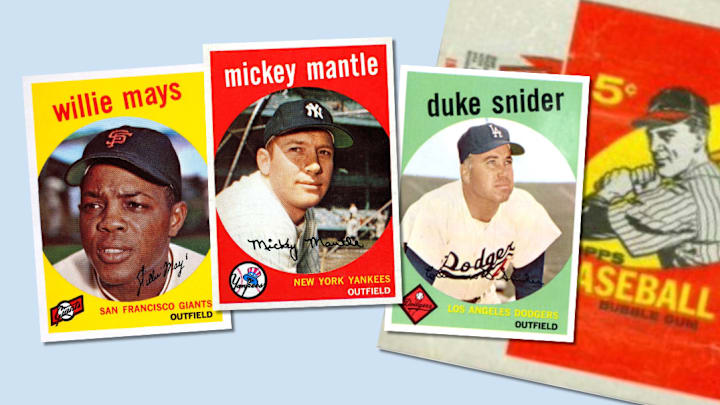
The 1959 Topps set may be as close to an under-the-radar offering as Topps vintage sets come, but a new book by Phil Coffin of the Society for American Baseball Research has propelled this set back into the spotlight. (Buy the book here.)

As the book's subtitle suggests, Coffin offers up an essay on each of the set's 572 cards. If you're keeping score at home, that's 572 essays in all. (These SABR folks are thorough, aren't they!) Recently, Collectibles on SI caught up with Coffin to learn five fun facts about the 1959 Topps set.
Baseball's First Rookie Cards

Though the Hobby was still decades away from any real buzz around rookie cards, the 1959 Topps set provided the Hobby's earliest hype in the form of 31 "Rookie Stars" cards. Selected in conjunction with the Sporting News, not a single one of the players made the Hall of Fame. Still, the overall concept was a good one that within a decade produced rookie cards of many of the game's biggest stars including Pete Rose, Rod Carew, Nolan Ryan, and Johnny Bench.
The Missing Rookie Star

Phil noted that the set's "Rookie Stars" included Dodger shortstop Bob Lillis, whose playing career proved far from spectacular. Meanwhile, the 1959 Dodgers really did have a rookie star at shortstop, Maury Wills, who would win the National League's Most Valuable Player award only three years later. Wills, however, had no card at all in the 1959 set. In fact, he didn't earn his first real Topps card until 1967! The reason? When Wills was still a minor leaguer, the scout from Topps didn't believe Wills had any shot of ever reaching the majors, hence chose not to offer him a trading card contract. Wills held a grudge and wanted nothing to do with Topps for nearly a decade!
Negro Leagues Legacy

RELATED: Five Drop-Dead Gorgeous Baseball Cards for Larry Doby Day
Though the set came out 12 years after Jackie Robinson made his historic Brooklyn Dodger debut, the echoes of a segregated national pastime still ran deep. In all, the 1959 Topps set included at least 19 former Negro Leaguers:
- Connie Johnson #21
- Al Smith #22
- Willie Mays #50
- Sam Jones #75
- Minnie Minoso #80
- Bob Boyd #82
- Jim Pendleton #174
- Charley Beamon #192
- Gene Baker #238
- Jim Gilliam #306
- Don Newcombe #312
- Harry Simpson #333
- George Crowe #337
- Ernie Banks #350
- Hank Aaron #380
- Elston Howard #395
- Larry Doby #455
- Bob Thurman #541
- Roy Campanella "Symbol of Courage" #550
Bespectacled Backstops

Per Phil Coffin: "Very few players wore glasses on the field in the 1950s, but for several years the Senators had two catchers who wore glasses: the better-known Clint Courtney and you’ve-never-heard-of-him Steve Korcheck (284), whose professorial look was well earned. He received bachelor’s, master’s and doctoral degrees from George Washington University and was later the president of a community college in Florida."
Gus Zernial's Biggest Assist

RELATED: Five Fun Facts About the 1984 Topps Baseball Set
Outfielder Gus Zernial is credited with 18 assists in 1951, which was good enough tops in the American League. However, his biggest assist of the season came off the field. As Coffin tells it, "Gus Zernial had just established himself as a slugger when a magazine asked him during the 1951off-season to take part in a photo shoot with a young starlet...When Zernial’s Athletics were in New York that season...DiMaggio asked about the starlet, Zernial passed along information, and that’s how Joe D met Marilyn Monroe!"

Thanks to Phil Coffin for providing his insights on the 1959 Topps set. His book, "When Baseball Was Still Topps," can be ordered through McFarland Press or wherever fine books are sold.
TOP TRENDING COLLECTIBLES ARTICLES:
 Add us as a preferred source on Google
Jason A. Schwartz is a collectibles expert whose work can be found regularly at SABR Baseball Cards, Hobby News Daily, and 1939Bruins.com. His collection of Hank Aaron baseball cards and memorabilia is currently on exhibit at the Atlanta History Center, and his collectibles-themed artwork is on display at the Honus Wagner Museum and PNC Park.