%22%3E%0A%3Cpath%20d%3D%22M0%204.9397H7.3484V12.6932H14.0649V4.9397H21.4133V26.912H14.0649V19.037H7.3484V26.912H0V4.9397Z%22%20fill%3D%22white%22%2F%3E%0A%3Cpath%20d%3D%22M23.6572%204H31.0299V8.55326H23.6572V4ZM23.7788%209.77664H30.9003V26.9121H23.7788V9.77664Z%22%20fill%3D%22white%22%2F%3E%0A%3Cpath%20d%3D%22M32.7241%2029.861L34.9197%2025.5589C36.8317%2026.5635%2038.7519%2027.1955%2041.1014%2027.1955C43.7669%2027.1955%2045.1848%2025.8101%2045.1848%2023.4281V22.9258C44.2125%2024.0276%2042.6084%2025.2834%2040.2264%2025.2834C35.8028%2025.2834%2032.6025%2022.1399%2032.6025%2017.4084V17.3436C32.6025%2012.5392%2035.8676%209.37134%2039.8213%209.37134C42.3329%209.37134%2043.8074%2010.3112%2045.0632%2011.5994V9.77643H52.1848V22.5855C52.1848%2025.7533%2051.5285%2027.9246%2049.9568%2029.4883C48.4174%2031.0277%2046.0679%2031.9999%2042.2357%2031.9999C38.4035%2031.9999%2035.4868%2031.2464%2032.7241%2029.8691V29.861ZM45.2172%2017.3679V17.3031C45.2172%2015.8285%2044.091%2014.6376%2042.3572%2014.6376C40.6234%2014.6376%2039.4972%2015.8609%2039.4972%2017.3679V17.4327C39.4972%2018.9073%2040.6234%2020.0658%2042.3572%2020.0658C44.091%2020.0658%2045.2172%2018.8748%2045.2172%2017.3679Z%22%20fill%3D%22white%22%2F%3E%0A%3Cpath%20d%3D%22M54.3145%204H61.436V12.0695C62.5379%2010.6597%2064.2636%209.37155%2066.6779%209.37155C70.2914%209.37155%2072.5437%2011.7535%2072.5437%2015.6181V26.9202H65.4221V17.9109C65.4221%2016.4364%2064.5471%2015.5857%2063.4777%2015.5857C62.4082%2015.5857%2061.436%2016.4364%2061.436%2017.9109V26.9202H54.3145V4Z%22%20fill%3D%22white%22%2F%3E%0A%3Cpath%20d%3D%22M80.8983%2023.6146L84.8196%2018.9398C87.2016%2020.7627%2089.9319%2021.5162%2092.5083%2021.5162C93.8289%2021.5162%2094.388%2021.1678%2094.388%2020.5764V20.5116C94.388%2019.8796%2093.6993%2019.5393%2091.3417%2019.0694C86.4157%2018.0648%2082.0812%2016.6551%2082.0812%2012.0046V11.9398C82.0812%207.76732%2085.3463%204.53467%2091.4065%204.53467C95.6437%204.53467%2098.7792%205.5393%20101.323%207.54857L97.7421%2012.5069C95.6681%2011%2093.1889%2010.3437%2091.1472%2010.3437C90.0454%2010.3437%2089.543%2010.7245%2089.543%2011.2511V11.3159C89.543%2011.9155%2090.1426%2012.2882%2092.4597%2012.7257C98.0743%2013.7627%20101.842%2015.3912%20101.842%2019.8148V19.8796C101.842%2024.4977%2098.0419%2027.3172%2092.1437%2027.3172C87.6877%2027.3172%2083.6692%2026.0614%2080.874%2023.6146H80.8983Z%22%20fill%3D%22white%22%2F%3E%0A%3Cpath%20d%3D%22M102.838%2018.4374V18.3726C102.838%2013.5682%20106.605%209.39575%20112.187%209.39575C115.955%209.39575%20118.62%2011.3402%20119.941%2014.1354L114.829%2017.0196C114.229%2015.9178%20113.476%2015.2939%20112.317%2015.2939C110.81%2015.2939%20109.684%2016.6145%20109.684%2018.3078V18.3726C109.684%2020.1631%20110.81%2021.4513%20112.228%2021.4513C113.484%2021.4513%20114.205%2020.8194%20114.893%2019.7256L120.071%2022.6747C118.531%2025.5347%20115.931%2027.3495%20111.847%2027.3495C106.638%2027.3495%20102.838%2023.2338%20102.838%2018.4374Z%22%20fill%3D%22white%22%2F%3E%0A%3Cpath%20d%3D%22M121.164%204H128.286V12.0695C129.387%2010.6597%20131.113%209.37155%20133.528%209.37155C137.141%209.37155%20139.393%2011.7535%20139.393%2015.6181V26.9202H132.272V17.9109C132.272%2016.4364%20131.397%2015.5857%20130.327%2015.5857C129.258%2015.5857%20128.286%2016.4364%20128.286%2017.9109V26.9202H121.164V4Z%22%20fill%3D%22white%22%2F%3E%0A%3Cpath%20d%3D%22M140.867%2018.405V18.3402C140.867%2013.5033%20144.886%209.36328%20150.533%209.36328C156.18%209.36328%20160.142%2013.4466%20160.142%2018.2753V18.3402C160.142%2023.177%20156.123%2027.317%20150.476%2027.317C144.829%2027.317%20140.867%2023.2337%20140.867%2018.405ZM153.295%2018.405V18.3402C153.295%2016.6469%20152.04%2015.2939%20150.468%2015.2939C148.896%2015.2939%20147.705%2016.6469%20147.705%2018.2753V18.3402C147.705%2020.0335%20148.961%2021.3865%20150.533%2021.3865C152.104%2021.3865%20153.295%2020.0335%20153.295%2018.405Z%22%20fill%3D%22white%22%2F%3E%0A%3Cpath%20d%3D%22M161.203%2018.405V18.3402C161.203%2013.5033%20165.222%209.36328%20170.869%209.36328C176.516%209.36328%20180.477%2013.4466%20180.477%2018.2753V18.3402C180.477%2023.177%20176.459%2027.317%20170.812%2027.317C165.165%2027.317%20161.203%2023.2337%20161.203%2018.405ZM173.631%2018.405V18.3402C173.631%2016.6469%20172.376%2015.2939%20170.804%2015.2939C169.232%2015.2939%20168.041%2016.6469%20168.041%2018.2753V18.3402C168.041%2020.0335%20169.297%2021.3865%20170.869%2021.3865C172.44%2021.3865%20173.631%2020.0335%20173.631%2018.405Z%22%20fill%3D%22white%22%2F%3E%0A%3Cpath%20d%3D%22M182.139%204H189.26V26.9121H182.139V4Z%22%20fill%3D%22white%22%2F%3E%0A%3Cpath%20fill-rule%3D%22evenodd%22%20clip-rule%3D%22evenodd%22%20d%3D%22M199.368%204.36764C205.191%20-1.45588%20214.632%20-1.45588%20220.456%204.36764C226.279%2010.1912%20226.279%2019.6324%20220.456%2025.4559L209.912%2036L199.368%2025.4559C193.544%2019.6324%20193.544%2010.1912%20199.368%204.36764ZM202.009%207.55761C201.948%207.86849%20201.916%208.39718%20201.916%209.14566V10.4189C201.916%2011.1832%20201.948%2011.7198%20202.013%2012.0267C202.078%2012.3317%20202.278%2012.6168%20202.617%2012.8762C202.956%2013.1376%20203.403%2013.3316%20203.958%2013.4623C204.512%2013.593%20205.1%2013.6583%20205.837%2013.6583C206.573%2013.6583%20207.217%2013.591%20207.769%2013.4524C208.322%2013.3158%20208.761%2013.1178%20209.086%2012.8604C209.411%2012.6029%20209.605%2012.3178%20209.666%2012.0069C209.728%2011.6961%20209.759%2011.1674%20209.759%2010.4189V9.14566C209.759%208.38134%20209.728%207.84473%20209.662%207.53781C209.597%207.23287%20209.397%206.94972%20209.058%206.68834C208.72%206.42696%20208.272%206.23291%20207.718%206.10223C207.163%205.97154%20206.536%205.90619%20205.839%205.90619C205.102%205.90619%20204.459%205.97352%20203.906%206.11213C203.352%206.24875%20202.914%206.44677%20202.589%206.70418C202.265%206.9616%20202.071%207.24673%20202.009%207.55761ZM207.276%2024.8638C210.876%2024.8638%20212.557%2024.2064%20212.557%2021.862V21.858V21.3155C212.557%2019.6581%20211.516%2018.971%20208.252%2018.3136C207.278%2018.1136%20206.908%2017.9136%20206.908%2017.3136V16.9414C206.908%2016.6543%20207.177%2016.5117%20207.413%2016.5117C207.749%2016.5117%20207.918%2016.7137%20207.918%2016.9414V18.1136H212.391V17.3988C212.391%2015.4563%20211.347%2014.4266%20207.177%2014.4266C204.15%2014.4266%20201.896%2015.3414%20201.896%2017.3711V17.7433C201.896%2019.5155%20202.805%2020.3155%20206.201%2021.0303C206.28%2021.0472%20206.355%2021.063%20206.427%2021.0781C207.329%2021.2674%20207.647%2021.3341%20207.647%2021.9174V22.2897C207.647%2022.6619%20207.546%2022.8045%20207.142%2022.8045C206.67%2022.8045%20206.637%2022.5471%20206.637%2022.262V21.2897H201.894V21.7471C201.894%2024.149%20203.476%2024.8638%20207.276%2024.8638ZM213.424%2024.5569H217.925V14.7355H213.424V24.5569ZM214.955%2013.5019H217.925V6.06064H215.092V9.411L213.193%206.06064H210.359V13.5019H213.193V10.1199L214.955%2013.5019ZM206.269%2012.152C206.204%2012.2688%20206.055%2012.3262%20205.825%2012.3262L205.827%2012.3282C205.604%2012.3282%20205.459%2012.2767%20205.398%2012.1757C205.336%2012.0748%20205.305%2011.8074%20205.305%2011.3758V7.90068C205.305%207.51852%20205.352%207.28684%20205.445%207.20962C205.538%207.13239%20205.675%207.09279%20205.851%207.09279C206.059%207.09279%20206.198%207.14031%20206.265%207.23734C206.332%207.33239%20206.366%207.55416%20206.366%207.90068V11.3203C206.366%2011.7579%20206.334%2012.0352%20206.269%2012.152Z%22%20fill%3D%22white%22%2F%3E%0A%3C%2Fg%3E%0A%3Cdefs%3E%0A%3CclipPath%20id%3D%22clip0_15247_3714%22%3E%0A%3Crect%20width%3D%22225%22%20height%3D%2236%22%20fill%3D%22white%22%2F%3E%0A%3C%2FclipPath%3E%0A%3C%2Fdefs%3E%0A%3C%2Fsvg%3E%0A)
Painting a New Path: After Devastating Football Injury, JT Thomas Is Redefining What It Means to Win
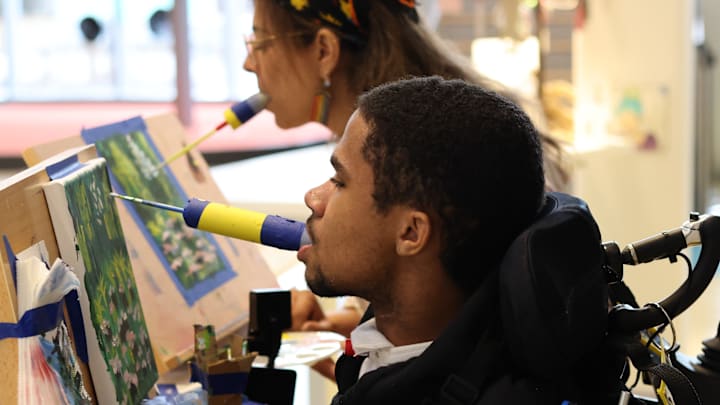
The first time Julie Villhard told him to try painting with his mouth, Jatayvion “JT” Thomas didn’t hesitate.
“Huh?”
Then came the second response.
“No.”
It wasn’t defiance. It was instinct. A 17-year-old who had spent his life moving—running, cutting, chasing, colliding—was now being asked to sit still and relearn the world in a way that didn’t make sense yet.
Villhard didn’t push. She didn’t need to. She had seen this moment before—the pause, the doubt, the quiet calculation.
“Trying something new doesn’t hurt anyone,” Thomas said.
So he gave in. Just once.
Seven months later, that moment sits at the center of a story that stretches far beyond a hospital art room in St. Louis—a story about control, identity, community and a kid who, even now, insists he’s still winning.
A Friday night, a touchdown—and a life altered in an instant
Before the paintbrush, before the easel, before the long hours in a therapy chair, there was a Friday night in September.
Thomas—5-foot-8, 150 pounds, undersized but relentless—had built his reputation as a grinder in Palmyra. A wide receiver for most of his career, he shifted to running back as a senior and, in his words, “really popped off.”
That night, Sept. 12, 2025 at Macon, he delivered one of those moments small-town football lives on.
“It was pretty early in the game,” Thomas said. “We’re down by like two scores. It was F-belly to the left, right up the middle. I didn’t think I was gonna score … but I broke a few tackles.”
Thirty-five yards later, he was in the end zone. It was the final score of his career at Palmyra.

Later in the game, on defense, Thomas was injured while making a tackle. The details are not the story. What followed is.
He was rushed to a hospital in Columbia and eventually diagnosed with a spinal cord injury affecting his C4 and C5 vertebrae—an injury that left him paralyzed from the neck down.
In the immediate aftermath, fear gave way to something else in Palmyra.
Support.
A town that refused to let him fall alone
In the hours and days after the injury, the town rallied.
Prayer vigils filled the night air. Fundraisers sprang up. Teammates, coaches, teachers, neighbors—people who had watched Thomas grow up—showed up in every way they could.
That support hasn’t faded.
“It means a lot to me because they’re with me every step through this journey,” Thomas said. “It’s really kept me to keep grinding and keep fighting.”
His community remains his biggest inspiration. Not football. Not statistics. Not even the comeback.
The people.
And they haven’t stopped showing up.
Teammates made the trip to see him. Friends carved out weekends to sit with him, talk, laugh—and eventually, paint alongside him.
Even after he returned home, briefly went back to the hospital, and came home again, the rhythm didn’t change.
“Shoutout to my Palmyra community,” Thomas said. “Shoutout to my caregivers … my football team and my coaches and to my parents.”
He meant every word.
Inside a place built for more than recovery
When Thomas arrived at Ranken Jordan Pediatric Bridge Hospital in November, the most critical phase of his care had passed.
What came next was different.
Ranken Jordan isn’t designed to feel like a hospital. It looks, Villhard says, more like a school or a museum. The goal is simple, but not easy—to help kids rebuild not just physically, but emotionally and mentally.
Their Care Beyond the Bedside model pushes patients out of their rooms and into experiences. Music. Art. Fresh air. Movement and engagement in whatever form is possible.
Control, in small pieces, given back.
“When they come, they’ve lost a lot of control,” Villhard said. “I really make it my goal … to help them gain some control of something again.”
For Thomas, that something became art.
From grid painting to four-hour sessions
Before the brush ever touched his mouth, Thomas started with something simpler.

Villhard, who has been instrumental to JT's recovery, set up a grid—letters across the top, numbers down the side. He would call out coordinates. She would paint.
“I’m going to be your hands and arms,” she told him.
It didn’t take long for her to notice something.
He saw the picture before it existed.
His color choices. His placement. His instincts. There was something there.
By the fourth session, the idea surfaced.
What if he tried it himself?
JT laughed.
Villhard didn’t.
“I said, ‘Oh no, we’re doing this,’” she said.
The first attempt was tentative. Controlled, but cautious.
By the third, it was something else entirely.
“Super controlled movements,” Villhard said. “He’s a really good student. He would watch me really closely … ‘Do that again. Do that again.’”
Soon, he was painting for hours at a time—sometimes four hours on a single piece. Sometimes finishing the next day. Sometimes painting late into the night.
They’ve completed around 20 paintings together.
Each one a little more confident than the last.


‘It takes your head away from things’
There’s a physical challenge to painting with your mouth. That part is obvious.
Balance. Precision. Endurance. Control.
But for Thomas, the real impact shows up somewhere else.
“It takes your head away from things,” he said. “You’re more focused on the painting than what’s going on around you.”
At 17, navigating a life-altering injury, that kind of focus matters.
“Going through an injury at 17 years old is tough,” he told Ranken Jordan. “Depression is a real thing, so painting gives me an outlet.”
It became routine. Structure. Purpose.
He paints consistently now—not just because he enjoys it, but because people are watching.
And buying.
The first sale—and the moment it felt real
The first painting wasn’t supposed to be anything more than practice.
Then someone walked in.
An officer from the hospital stopped, looked at the piece, and told him he would like to purchase it..
“I was like, ‘Oh, you do?’” Thomas said. “And it kind of shocked me.”
It sold for $100.
JT’s reaction was a stunned, “Wow,” but the reality of what he could achieve was realized almost instantaneously.
That moment flipped a switch.
“I’m pretty dedicated to it,” Thomas said. “Ever since I’ve started, I’ve been consistent with it, because I’ve sold a bunch of paintings. You got to stay consistent if you’re going to sell.”
Now, he’s thinking bigger.
“I plan to do bigger projects in the future, because I’m talented.”
It’s not arrogance. It’s belief—rebuilt, piece by piece.
A new identity begins to take shape
There’s a moment Villhard still thinks about.
Thomas had done an interview with a local outlet. Somewhere in the conversation, he said something simple. He wanted people to know he is a painter now.
“That about broke me,” Villhard said.
Because that was the goal all along. Not to replace football. Not to erase what was lost.
But to give him something new to own.
“He was a little football star,” she said. “Now this is his way of inspiring through art.”
And he has embraced it fully.

He jokes about being the GOAT. Calls people over to watch him work. Goes live on social media mid-painting, pulling Villhard into the frame.
“He’s got a pretty fun personality,” she said. “He jokes … but he’s really the sweetest person.”
Friends, laughter—and painting side by side
Weekends at Ranken Jordan didn’t feel like isolation. They felt like something closer to normal.
Friends would show up. Teammates. Classmates.
Villhard had an idea. Why not have them try it too?
She’d nudge them. JT would seal the deal.
“They got to paint with their mouths too,” he’d tell them.
They’d laugh. Struggle. Try.
And in those moments, something returned—familiar rhythms of friendship. Jokes. Competition. Lightness.
“They would be so impressed with him,” Villhard said. “And they would joke and laugh … he would get back some of the stuff he was missing.”
Not everything.
But enough.
From a hospital room to a museum wall
The paintings didn’t stay inside Ranken Jordan for long.
Thomas began sharing his work online through his “Four JT’s Journey” page, a nod to JT's jersey No. 4, building a following that now stretches into the thousands.
Support poured in—not just from Palmyra, but from across the country.
“That’s what really keeps him going,” said Alicia Denning, who runs the page. “Not even just his community … people all over the United States.”
Then came something bigger.
An opportunity to submit work to a youth exhibition at the Saint Louis Art Museum.
One of his pieces was selected.
It’s called Let There Be Light—a tree with the sun breaking through behind it.
“I knew which one they were going to pick,” said Villhard, who described it as a "great piece" that took a lot of time to complete.

The exhibition opens in May and runs through the fall.
Hospital staff plan to attend together. So will the people who have watched this unfold from the beginning. And, of course, there are sure to be some new fans of JT Thomas who will swing by.
Giving back while still learning to move forward
Even as he builds something new, Thomas hasn’t lost sight of others.
He’s already donated proceeds from his work to charity, including efforts supporting Down syndrome awareness. More pieces are set to be auctioned at a Ranken Jordan fundraiser later this year.
“At 17, to be a philanthropist already is a big deal,” Villhard said.
It fits who he is.
A grinder. A competitor.
Someone who doesn’t just want to succeed—but to matter.
Home, healing—and what comes next
After months in hospitals, Thomas only recently returned home.
“It’s been good to be home,” he said.
The transition hasn’t been linear. There have been return trips to the hospital. Adjustments. Challenges.
But the direction is forward.
He continues physical and occupational therapy, focused on regaining as much mobility as possible. Following graduation, college is part of the plan—a member of his Future Farmers of America (FFA) chapter, he wants to study agriculture business management.
And painting hasn’t stopped.
Ranken Jordan sent him home with supplies. The Palmyra School District stepped in, too—working together with Villhard to gather additional supplies he would need for his return home that would allow him to continue painting.
The setup is there. So is the drive.
Still competing—just in a different way

Ask Thomas what drives him, and the answer hasn’t changed.
“I’ve always been a grinder,” he said.
That mindset shows up everywhere now. In the hours spent painting. In the therapy sessions. In the way he talks about what’s ahead.
Even in the small things.
There’s a senior tradition at his school—Senior Assassin, a game played with water guns, built on stealth and surprise.
“I’m going to win Senior Assassin,” he said.
He’s also on prom court. He plans to win that, too.
And he means it.
The moment that started it all—revisited
Back in that art room, the moment still lingers. The hesitation. The laugh. The quite decision to try.
Villhard remembers telling him something early on.
“I’m going to make you famous,” she said.
He didn’t miss a beat.
“I’m already famous.”
She smiled.
“Okay,” she told him. “I’m going to make you a famous painter.”
He laughed then.

Now, it doesn’t sound so far-fetched.
Because somewhere between that first reluctant brushstroke and a museum exhibition in St. Louis, JT Thomas found something no one could take from him.
Not football. Not movement. Not control in the way he once knew it.
But something just as real.
A way forward.
And if you ask him, he’ll probably tell you the same thing he tells everyone else—half serious, half smiling.
He’s still the GOAT.
Just doing it differently now.
Recommended Articles
 Add us as a preferred source on Google
Levi’s sports journalism career began in 2005. A Missouri native, he’s won multiple Press Association awards for feature writing and has served as a writer and editor covering high school sports as well as working beats in professional baseball, NCAA football, basketball, baseball and soccer. If you have a good story, he’d love to tell it.