
Breaking Down MSU Basketball's Early Rebounding Problem
In this story:
Defend, rebound, and run.
The formula for Michigan State basketball's success has been relatively straightforward with Tom Izzo. MSU stands at 6-1 to start Year 32 under Izzo, but that "rebound" part of the equation is starting to be an issue that the Spartans must address soon.
'It's un-American'

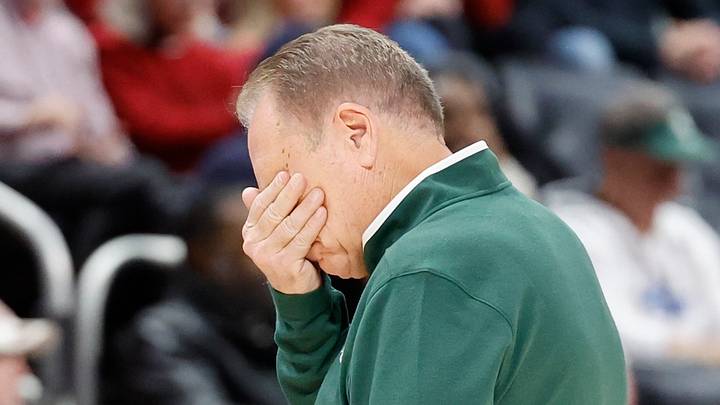
"Michigan State shouldn't get out-rebounded three, four times," Izzo said following his team's 70-67 win over Arkansas on Thanksgiving Day. "It's un-American. It doesn't happen."
It's been happening. MSU has lost the rebounding battle in all three of its games against high-major competition this season. Duke finished with a plus-2 advantage, Tennessee finished with a plus-4 advantage, and Arkansas finished with a plus-3 advantage.
Entering the season, Michigan State was just 12-20 overall (.375) since 2022-23 during games where it lost the rebound battle. That's just 32 instances over 141 total games (22.7% of the time). The fact that the Spartans have begun this season 2-1 against real competition despite getting out-rebounded each time is a little bit remarkable.

A big portion of the problem has been on the defensive glass. MSU has allowed its opponents to get an offensive rebound on 30.3% of all opportunities, per KenPom, which ranks 140th in the country. That is a serious, serious drop-off from last year's team, which only gave up 22.4% of possible offensive rebounds, which was the very best number in the nation.
Michigan State seems relatively fine on its own offensive glass. Its percentage there is 40.2%, which currently ranks 25th nationally. The issue is that those early "buy" games seem to be inflating that figure. MSU had offensive board rates of 29.0% against Duke, 27.9% against Tennessee, and 24.1% against Arkansas. Last year's team had a season-wide rate of 37.8%, including a 36.8% mark during Big Ten regular-season play.
Diagnosing the Issue
It's not a super big revelation that this Michigan State team isn't fantastic at rebounding. All the guards on this team have forced Izzo to use a lot more small lineups than normal. There have been points where four-man Cam Ward, who stands at about 6'8" or 6'9", has had to play center. That big-man duo of Jaxon Kohler and Carson Cooper aren't part of the equation anymore.
Like many other issues this current team faces, it's going to be on the center group of Anton Bonke, Ethan Taylor, and Jesse McCulloch to pick it up -- not necessarily as rebounders, but as players in general. Izzo has been rotating who the starting center is over the last few games.
"It's motivational," Izzo said Thursday when asked about why he's switching up the starting center. "I'm trying to motivate somebody, and so I will continue to motivate until they pick who I start. Not me. They pick who I start."
 Add us as a preferred source on Google

A 2025 graduate from Michigan State University, Cotsonika brings a wealth of experience covering the Spartans from Rivals and On3 to his role as Michigan State Spartans Beat Writer on SI. At Michigan State, he was also a member of the world-renowned Spartan marching band for two seasons.
Follow jacobcotsonika