
In Penn State's Loss to Rutgers, a Program's Foundation Is Exposed
In this story:
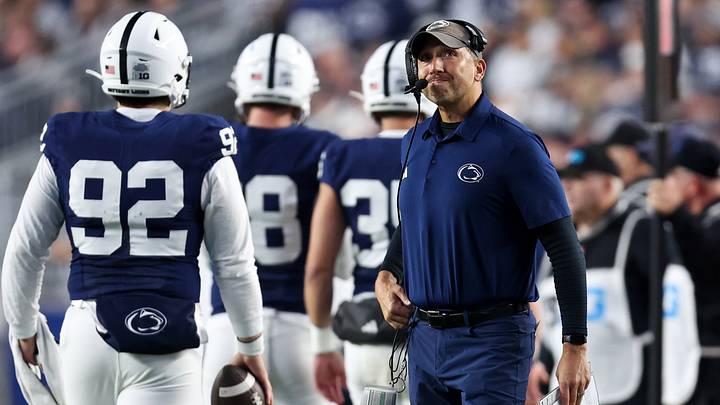
STATE COLLEGE | Penn State football coach Matt Campbell composed himself before entering the Beaver Stadium media room Saturday night, maintaining an outward homeostasis in breaking down the many breakdowns of his team's 25-24 loss to Rutgers. That self-regulation is one Campbell's finer traits, serving well his long view of college football coaching.
But there comes a time to raise a voice, pound a lectern and activate the rage side every coach possesses. Campbell certainly doesn't owe anyone outside his locker room a thunderdome level of accountability, but some moments require them. Saturday was one.
Before Campbell softly qualified another blown double-digit lead and some familiar fourth-quarter relapses, fans leaving Beaver Stadium vented about officials, run games, defensive coverages, ticket-price increases, former coaches for some reason and, most loudly, what they perceive as the lack of a cutthroat instinct from their football team. And from the head coach at the top.
For Penn State, Rutgers has been a buy game wrapped in a conference contract since 2014 and essentially a guaranteed win for longer than that. The Nittany Lions had beaten Rutgers 18 consecutive times before Saturday, and former coach James Franklin went 10-0 against the Scarlet Knights. His teams did not allow a touchdown in five home games vs. Rutgers from 2014-2023.
The last time Rutgers beat Penn State in 1988, Campbell was an 8-year-old in Ohio. Many of his players from Texas and Nebraska and Iowa had no historical context or connection to this game. Those Nittany Lions who Campbell retained knew only that they beat Rutgers every year, even last year when they probably shouldn't have.
But Saturday? That was the kind of loss that causes groundshakes. Penn State has not lost to an eight-loss team at least since joining the Big Ten. Rutgers arrived to State College on Saturday with a 2-8 record, one healthyish quarterback who didn't throw a pass in practice last week and its best player (receiver KJ Duff) out for the year.
The Scarlet Knights accumulated nine yards of offense in the first quarter. They averaged 2.6 yards rushing, converted just 24 percent of their third downs and attempted one pass longer than 20 yards (which went incomplete). And they still won.
Campbell tried to address the unease about his program, that it hasn't been able to drag second-half, double-digit leads to the finish line twice this season, including at home against Wisconsin. That it nearly frittered away a 22-point advantage against Washington.
"You just felt like you never had the ability to put the final blow in, and I think that's continued to be
a challenge for this team," Campbell said. "Something that we continue to string to work on, but obviously we haven't figured it completely out yet."
Penn State coach Matt Campbell after the Nittany Lions gave up 16- and 14-point leads in a 25-24 loss to Rutgers. pic.twitter.com/0ZRNrwZ588
— Mark Wogenrich (@MarkWogenrich) November 22, 2026
That will be among the first slides of Campbell's postseason presentation deck, because it's become a root element of his program. That was the kind of loss that prompts donors to write emails, administrators to call meetings and coaches to update their resumes. It embarrassed a brand, even if much of Penn State's sideline is still new to it.



"The way Rutgers' mentality was and the way our mentality was were just a little different," Penn State defensive end Ikenna Ezeogu said. "... I mean, they probably thought [it was] more of a rivalry game. We just continued to keep it as a regular game."
Certainly, this was a one-way rivalry game, which was the point. Penn State was 33-2 against the Scarlet Knights entering Saturday. One of those losses came in 1918. Penn State fans even liked to remind Rutgers that their program flipped Saquon Barkley from his commitment in 2015.
But Penn State has bigger concerns than this dunking. Campbell's program already had gone through its teaching phase, the four-game losing streak that first-year coaches need to harden the players who want to stay and weed out those who don't. During its recent three-game win streak, Penn State demonstrated that it had worked out issues with its run game and ball protection and second-half lead-holding.
Three inchworm steps forward, one giant step back. Penn State led 16-0 in the first half, 24-10 in the fourth quarter and 24-17 with 6 seconds left. Then Rutgers found its genie's lamp and uncorked one of the best plays you'll ever see between a running back and wide receiver.
Antwan Raymond's absurdly prescient flip to Ben Black III punctuated a comeback by a team that every excuse to dissolve into the Beaver Stadium night. And it laid bare the fact that Penn State had no excuse to be in that position.
About that, Campbell was clear. He didn't raise a voice while cutting to the core of Penn State's worst traits of 2026.
"To me, our ability to do hard things is still escaping this team from becoming its best," Campbell said. "Hard is playing great defense in the third and fourth quarter. Hard is playing great offense down on the one-yard line and down on a fourth-and-one situation.
ONE OF THE CRAZIEST TOUCHDOWNS YOU WILL SEE TODAY!@RFootball scores off a pitch on the last play of the game pic.twitter.com/Zal37iSvM9
— FOX College Football (@CFBONFOX) November 22, 2026
"Those are the hard things," Campbell said. "I felt like we made great strides at times, but obviously we took a step backwards tonight, and that's disappointing. It all starts with the head football coach. We'll figure it out from there."
If Penn State's loss to Rutgers does anything positive, it will act as the offseason catalyst to figuring it out. Penn State should expect to be an annual playoff contender in a 24-team field. It should expect to host games more than occasionally. Under Franklin, it was.
Campbell wants to build a roster that's tough but needs talent to support that. For Penn State, closing the talent gap means closing the checkbook gap. In December and January, the program will confront its own internal appetite for spending money to acquire the talent for which the "hard" becomes easier. Penn State must spend on multiple marquee positions (quarterback, edge rusher and receiver chief among them) to avoid a repeat of 2026.
Sign up to our free Penn State Nittany Lions newsletter, follow us on social media and add Penn State on SI as a Preferred Source on Google.
 Add us as a preferred source on Google

Mark Wogenrich is the editor and publisher of Penn State on SI, the site for Nittany Lions sports on the Sports Illustrated network. He has covered Penn State sports for more than two decades across three coaching staffs, three Rose Bowls and one College Football Playoff appearance.
Follow MarkWogenrich