%22%3E%0A%3Cpath%20d%3D%22M0.0221339%205.15112H8.83163V15.0009L16.3131%205.15112H26.5392L17.3534%2016.5946L26.7162%2031.4911H16.2245L11.0672%2023.1464L8.8095%2025.8911V31.4911H0V5.15112H0.0221339Z%22%20fill%3D%22white%22%2F%3E%0A%3Cpath%20d%3D%22M27.3584%204.02197H36.19V9.46704H27.3584V4.02197ZM27.4912%2010.9279H36.0351V31.4687H27.4912V10.9279Z%22%20fill%3D%22white%22%2F%3E%0A%3Cpath%20d%3D%22M38.1816%2021.3091V21.2427C38.1816%2015.4877%2042.6971%2010.4854%2049.4038%2010.4854C53.9192%2010.4854%2057.1066%2012.8095%2058.7003%2016.1739L52.569%2019.6269C51.8607%2018.3209%2050.9532%2017.5684%2049.5587%2017.5684C47.7437%2017.5684%2046.3935%2019.1399%2046.3935%2021.1763V21.2427C46.3935%2023.3897%2047.7437%2024.9391%2049.4481%2024.9391C50.9532%2024.9391%2051.8164%2024.1866%2052.6354%2022.8585L58.8331%2026.4C56.9959%2029.8308%2053.875%2032%2048.9832%2032C42.7413%2032%2038.1816%2027.064%2038.1816%2021.3091Z%22%20fill%3D%22white%22%2F%3E%0A%3Cpath%20d%3D%22M60.3164%204.02213H68.8603V17.2585L73.265%2010.9281H82.5615L76.1204%2019.2727L82.6722%2031.4688H73.5307L70.5646%2025.8245L68.8603%2028.0158V31.4688H60.3164V4V4.02213Z%22%20fill%3D%22white%22%2F%3E%0A%3Cpath%20d%3D%22M81.7207%2028.9896L84.6203%2024.1422C87.0994%2025.6916%2089.8883%2026.4442%2092.2124%2026.4442C93.0314%2026.4442%2093.4519%2026.2671%2093.4519%2025.758V25.6916C93.4519%2025.2711%2093.0757%2025.0055%2091.0172%2024.4964C85.8156%2023.2126%2082.6282%2021.8181%2082.6282%2017.5683V17.5019C82.6282%2012.9865%2086.2361%2010.4631%2091.5927%2010.4631C94.9792%2010.4631%2098.3215%2011.3264%20100.801%2012.8315L98.1002%2017.9003C95.9089%2016.705%2093.2749%2015.9746%2091.5484%2015.9746C90.7294%2015.9746%2090.3531%2016.196%2090.3531%2016.6165V16.6829C90.3531%2017.1035%2090.7958%2017.3691%2092.8765%2017.8782C98.078%2019.162%20101.199%2020.5786%20101.199%2024.8062V24.8726C101.199%2029.3438%2097.8567%2031.9557%2092.2788%2031.9557C88.2946%2031.9557%2084.6867%2030.9375%2081.7428%2028.9896H81.7207Z%22%20fill%3D%22white%22%2F%3E%0A%3Cpath%20fill-rule%3D%22evenodd%22%20clip-rule%3D%22evenodd%22%20d%3D%22M111.368%204.36764C117.191%20-1.45588%20126.632%20-1.45588%20132.456%204.36764C138.279%2010.1912%20138.279%2019.6324%20132.456%2025.4559L121.912%2036L111.368%2025.4559C105.544%2019.6324%20105.544%2010.1912%20111.368%204.36764ZM114.009%207.55761C113.948%207.86849%20113.916%208.39718%20113.916%209.14566V10.4189C113.916%2011.1832%20113.948%2011.7198%20114.013%2012.0267C114.078%2012.3317%20114.278%2012.6168%20114.617%2012.8762C114.956%2013.1376%20115.403%2013.3316%20115.958%2013.4623C116.512%2013.593%20117.1%2013.6583%20117.837%2013.6583C118.573%2013.6583%20119.217%2013.591%20119.769%2013.4524C120.322%2013.3158%20120.761%2013.1178%20121.086%2012.8604C121.411%2012.6029%20121.605%2012.3178%20121.666%2012.0069C121.728%2011.6961%20121.759%2011.1674%20121.759%2010.4189V9.14566C121.759%208.38134%20121.728%207.84473%20121.662%207.53781C121.597%207.23287%20121.397%206.94972%20121.058%206.68834C120.72%206.42696%20120.272%206.23291%20119.718%206.10223C119.163%205.97154%20118.536%205.90619%20117.839%205.90619C117.102%205.90619%20116.459%205.97352%20115.906%206.11213C115.352%206.24875%20114.914%206.44677%20114.589%206.70418C114.265%206.9616%20114.071%207.24673%20114.009%207.55761ZM119.276%2024.8638C122.876%2024.8638%20124.557%2024.2064%20124.557%2021.862V21.858V21.3155C124.557%2019.6581%20123.516%2018.971%20120.252%2018.3136C119.278%2018.1136%20118.908%2017.9136%20118.908%2017.3136V16.9414C118.908%2016.6543%20119.177%2016.5117%20119.413%2016.5117C119.749%2016.5117%20119.918%2016.7137%20119.918%2016.9414V18.1136H124.391V17.3988C124.391%2015.4563%20123.347%2014.4266%20119.177%2014.4266C116.15%2014.4266%20113.896%2015.3414%20113.896%2017.3711V17.7433C113.896%2019.5155%20114.805%2020.3155%20118.201%2021.0303C118.28%2021.0472%20118.355%2021.063%20118.427%2021.0781C119.329%2021.2674%20119.647%2021.3341%20119.647%2021.9174V22.2897C119.647%2022.6619%20119.546%2022.8045%20119.142%2022.8045C118.67%2022.8045%20118.637%2022.5471%20118.637%2022.262V21.2897H113.894V21.7471C113.894%2024.149%20115.476%2024.8638%20119.276%2024.8638ZM125.424%2024.5569H129.925V14.7355H125.424V24.5569ZM126.955%2013.5019H129.925V6.06064H127.092V9.411L125.193%206.06064H122.359V13.5019H125.193V10.1199L126.955%2013.5019ZM118.269%2012.152C118.204%2012.2688%20118.055%2012.3262%20117.825%2012.3262L117.827%2012.3282C117.604%2012.3282%20117.459%2012.2767%20117.398%2012.1757C117.336%2012.0748%20117.305%2011.8074%20117.305%2011.3758V7.90068C117.305%207.51852%20117.352%207.28684%20117.445%207.20962C117.538%207.13239%20117.675%207.09279%20117.851%207.09279C118.059%207.09279%20118.198%207.14031%20118.265%207.23734C118.332%207.33239%20118.366%207.55416%20118.366%207.90068V11.3203C118.366%2011.7579%20118.334%2012.0352%20118.269%2012.152Z%22%20fill%3D%22white%22%2F%3E%0A%3C%2Fg%3E%0A%3Cdefs%3E%0A%3CclipPath%20id%3D%22clip0_15247_3595%22%3E%0A%3Crect%20width%3D%22137%22%20height%3D%2236%22%20fill%3D%22white%22%2F%3E%0A%3C%2FclipPath%3E%0A%3C%2Fdefs%3E%0A%3C%2Fsvg%3E%0A)
Meet the Creators of North America's First Women-Owned Sneaker Store
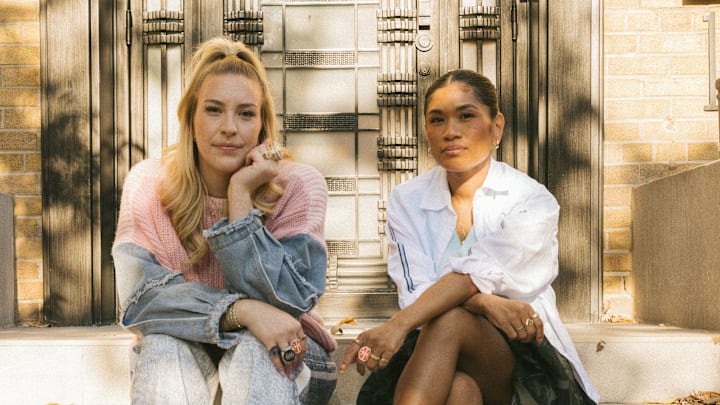
In the vibrant and ever-evolving landscape of Toronto's retail scene, a unique destination has carved out a significant space for itself: MakeWay sneaker store.
Co-owned by Abby Albino and Shelby Weaver, MakeWay is more than just another sneaker store; it is the first and only sneaker boutique for women and is completely run and funded by women. MakeWay is specifically designed to celebrate and serve the often-overlooked female sneakerhead community.
Since its inception, this women-owned and women-funded enterprise has not only curated an impressive selection of footwear but has also cultivated a welcoming community hub. Along with the store, they have collaborated with Nike on the Party-6000 x Makeway, their favorite silhouette last year.
Kicks On SI spoke with Albino and Weaver about launching Makeway, why Toronto is a top-tier sports city, and their collaboration with Nike Party 6000.

What is your sneakerhead origin story?
Albino: One thing about Filipinos is that we love to play basketball. It’s like a rite of passage and our obsession. Around 1996, I played basketball, and I was obsessed with Anfernee “Penny” and Grant Hill. I fell in love with the Arizona Flight 96, the Olympic.
Those are my jam. By the end of the season, I screwed them up and asked my dad for a second pair. It was a pretty big ask, but thankfully, he obliged and got my second pair. I wore those for two or three basketball seasons. Years later, I went on eBay and I found a dead stock pair, brand new in a box.
Weaver: When I first started playing basketball, the UNC VC Shocks first came out. That was when I could only get one pair of basketball shoes for the entire season. I called the Canadian version of Dick's Sporting Goods, called Cleve Sporting Goods, to get my basketball shoes, but they only had the VC shock in a men's eight.
My mom was like, "They're not going to fit you." My mom did the thumb check and said, "I'll buy you these shoes, but if I'm buying them, you're wearing them all year." I wore them all year with like, five pairs of socks, clomping around playing basketball.
Next season, the Toronto Tempo will make their WNBA debut. In your view, what makes Toronto such a great sports city?
Albino: We've always had professional teams here and just got our WNBA Tempo team, which is really exciting. But the diversity of the people speaks to fashion. You'll see a friend group at the park, and it'll be like one Asian person, one Black person, one white person, and one Middle Eastern person. What is special about Toronto is that we celebrate each other's differences in a way; instead of being a melting pot, we are truly like a cultural mosaic.

How did you go from playing sports to working in the sports industry?
Albino: So I started in public relations with MLSE, supporting the Maple Leafs, the Raptors, and Toronto FC, which is an MLS franchise. I also worked for Nike on the Canadian side, with their main marketing agency here in Toronto.
At Nike, I learned a lot about the sneaker industry from behind the scenes. I then moved over to Canada basketball, which is where I am now, overseeing, business operations and brand strategy, and community engagement work, and the commercial side of the business helps generate revenue so that our teams can play at a high level without having to worry about the cost associated with international travel and all that good stuff.
Weaver: Abby, at the time, was working for Nike on the agency side, and I had another business called MacHouse outside of the Raptors, which was a sneaker customization studio. We both were sneaker heads, but we noticed the gaps in the industry for women who loved sneakers.
The impetus of Makeway was always to be female-driven, female-led, and female-focused. We never considered opening just a sneaker store, even though we love sneakers and basketball. When we started seeing all of these like pain points for the female consumer, we felt like almost a duty or an interest to do something about it.
After all of the work you put in, how was it to officially launch Makeway?
Albino: We opened in November 2020 during a very strict lockdown during COVID-19. Only a couple of people could be in the store. That weekend, there was a huge outbreak of COVID, so we had to close down again. It turned out to be a blessing in disguise because we were able to build our digital presence while we didn't have to try to figure out both the in-person and digital side at the same time.
By the time we are ready to open in May, we've already amassed a community that was so excited just to be in our store. We had people already baked in because they were like, "Oh, I've been waiting for the store to reopen."
Weaver: My basketball career ended a lot sooner than I wanted because of some health issues. So when I graduated college, I moved to Toronto from a smaller city out east, Halifax, Nova Scotia. It's not a small town, but a smaller city out east of Nova Scotia called Halifax Nova Scotia. I started in sports, working as an administrative assistant at MLSE, which is the company I still work for, even though I just work for the Raptors now.
That's where Abby and I met as two young females working in sports, and we became friends as we were moving up our careers. I worked on the business side for five years, and then moved over to the basketball side around 10 years ago, and I've been on the front office basketball side ever since. I loved working in all the sports, but basketball is definitely my passion.

How did you collaborate with Nike on the release of the Party 6000
Albino: I think Nike saw in the us the ability to rally the women's community, and they didn’t have a lot of women collaborators. They say that something was going on up in Toronto, The Party-6000 x Makeway.
The shoe itself is something that Shelby and I have identified early on. We could take that shoe and we could dress it up, we could dress it down, we could wear it all the time. It was easy enough for us to find so much so that, like, at any given moment, I think Shelby and I had one pair of triple white p6 1000, and then about six or seven on nice just in case we needed a new pair. We took that as our shoe.
So Nike approached us and wanted to do a collaboration, and the P6000 was our first choice. It happened at a time when they were showing love back into the silhouette, and the universe gave us the opportunity. We were able to call it the Party-6000 x Makeway.
Weaver: The P-6000 was a shoe that we loved. We used to buy them all on eBay for $70 on eBay. We racked them up because we were wearing them so much, and people started to recognize them as our shoes. We started throwing a party called Party 6000.
We had friends who owned bars that were throwing these very Toronto-identified parties that were less about partying and more about community building. When Nike offered us a sneaker collab, they knew we were going to pick the P-6000. Allowing us to essentially change the name of the shoe was cool.
For the activation, we threw a giant Party 6000 that was almost like an amalgamation of all the Party 6000s we've ever done. We continue to throw that party to this day. It's like something that's very core to core to like who we are and like how we see building community and bringing people together.
More Sneakers News
Asics brings exclusive Japanese sneakers to the US.
Cameron Brink showed off her player-exclusive logo for New Balance.
Sean Wortherspoon addsY2K-style to Teva's rugged outdoor shoes and sandals.
Under Armour's iconic logo inspired new UA Halo shoes.
Zendaya's first shoe with On is out now.
 Add us as a preferred source on Google
Rashad Grove is a contributing writer for Sports Illustrated's FanNation and a sneakerhead based in Princeton, New Jersey. His work has appeared on BET.com, Ebony Magazine, MTV.com, Forbes, Billboard, HipHopDX, and Philadelphia Inquirer. You can follow him on all social media platforms at @thegroveness, and he can be reached at rgrove319@gmail.com
Follow thegroveness