%20%20--%3E%0A%3Csvg%20version%3D%221.1%22%20id%3D%22Layer_1%22%20xmlns%3D%22http%3A%2F%2Fwww.w3.org%2F2000%2Fsvg%22%20xmlns%3Axlink%3D%22http%3A%2F%2Fwww.w3.org%2F1999%2Fxlink%22%20x%3D%220px%22%20y%3D%220px%22%0A%09%20width%3D%2239px%22%20height%3D%2240px%22%20viewBox%3D%220%200%2039%2040%22%20enable-background%3D%22new%200%200%2039%2040%22%20xml%3Aspace%3D%22preserve%22%3E%0A%3Cpath%20fill%3D%22%23FFFFFF%22%20d%3D%22M38.5%2C7H28.2v26h10.3V7z%22%2F%3E%0A%3Cpath%20fill-rule%3D%22evenodd%22%20clip-rule%3D%22evenodd%22%20fill%3D%22%23FFFFFF%22%20d%3D%22M26.1%2C25.5c0%2C5.8-4.1%2C7.5-12.9%2C7.5C3.9%2C33%2C0%2C31.2%2C0%2C25.2v-1.1h11.6%0A%09v2.4c0%2C0.7%2C0.1%2C1.4%2C1.2%2C1.4c1%2C0%2C1.2-0.4%2C1.2-1.3v-0.9c0-1.6-0.9-1.6-3.5-2.2C2.2%2C21.7%2C0%2C19.7%2C0%2C15.3v-0.9C0%2C9.3%2C5.5%2C7%2C12.9%2C7%0A%09c10.2%2C0%2C12.8%2C2.6%2C12.8%2C7.4v1.8h-11v-2.9c0-0.6-0.4-1.1-1.2-1.1c-0.6%2C0-1.2%2C0.4-1.2%2C1.1v0.9c0%2C1.5%2C0.9%2C2%2C3.3%2C2.5%0A%09c8%2C1.6%2C10.5%2C3.3%2C10.5%2C7.5V25.5z%22%2F%3E%0A%3C%2Fsvg%3E%0A)
Like Him Now?
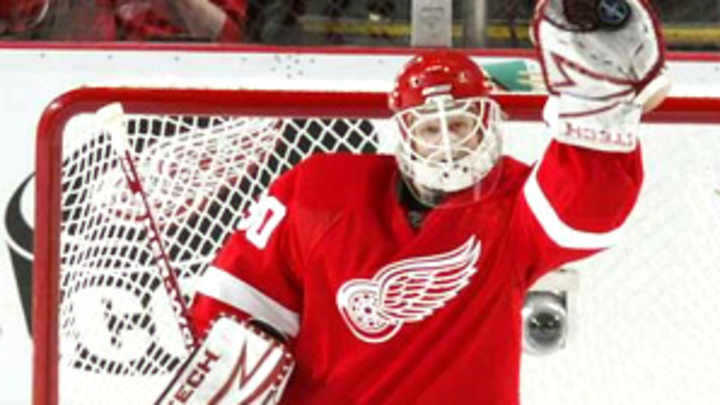
Osgood has been perceived as the worst goalie to backstop a Cup champion, which raises this possibility: In June will he be dismissed as the worst goalie to lead a team to two Cups? The thought is as absurd as the original conceit that Osgood was just along for the ride with the title-winning 1998 Red Wings when he put up a 2.12 goals-against average and a .918 save percentage in the playoffs. In 13 seasons, 10 with Detroit, Osgood has won 363 regular-season games (15th alltime) and 53 in the playoffs through Sunday. His regular-season winning percentage of .631 ranks first among the top 20 goalies in career wins. "Toss out those numbers without a name, add the Cup, and 80 percent of people would say that's near Hall of Fame credentials," Detroit winger Darren McCarty says. "Then say it's Ozzie, and the number'll drop to 50 percent. Or less."
The negativity can be blamed on some of Osgood's memorable low points, starting in 1994 when he was left sobbing at his locker after his giveaway led to a shocking series-winning third-period goal by San Jose's Jamie Baker in Game 7 of the first round. Other dodgy goals followed, notably Jamie Langenbrunner's overtime shot from a different zip code in Game 5 of the '98 conference final in Dallas. Forgotten is Osgood's shutout that eliminated the Stars in Game 6.
Yet Detroit thought it needed an upgrade and, in 2001, acquired Hasek and waived Osgood, who was picked up by the Islanders. Osgood helped New York, and then St. Louis (2003-04), reach the playoffs, but he returned to Detroit in August 2005 a new man. During the '04-05 lockout Osgood reinvented his style, a remarkable act by a 300-win goalie of whom Wings G.M. Ken Holland says, "He was an NHL goalie who had high school technical skills." Osgood introduced some butterfly into his repertoire and improved his speed. The stream of pucks that once leaked through him slowed to a trickle.
While the old Ozzie -- baseball cap tugged down, eyes averted -- has receded beneath a calm and confident demeanor, so has the hoary notion that he is a mere passenger on the Detroit bandwagon. "Not his fault we have a good team," goalie coach Jim Bedard says. Cocooned by a puck-moving, rebound-clearing defense that allowed 21 shots or fewer in six of his first eight playoff starts this spring, Osgood keeps inching from mockery toward belated stardom. "I don't brag about myself," he says. "I don't have to be a star. I just want to be part of the Red Wings." The now great and powerful Oz has spoken.
 Add us as a preferred source on Google
Along with the pages of Sports Illustrated, you'll find senior writer Michael Farber in the Hockey Hall of Fame. Farber joined the staff of Sports Illustrated in January 1994 and now stands as one of the magazine's top journalists, covering primarily ice hockey and Olympic sports. He is also a regular contributor to SI.com. In 2003 Farber was honored with the Elmer Ferguson Award from the Hockey Hall of Fame for distinguished hockey writing. "Michael Farber represents the best in our business," said the New York Post's Larry Brooks, past president of the Professional Hockey Writers' Association. "He is a witty and stylish writer, who has the ability to tell a story with charm and intelligence." Farber says his Feb. 2, 1998 piece on the use and abuse of Sudafed among NHL players was his most memorable story for SI. He also cites a feature on the personal problems of Kevin Stevens, Life of the Party. His most memorable sports moment as a journalist came in 1988 when Canadian Ben Johnson set his controversial world record by running the 100 meters in 9.79 seconds at the Summer Olympic Games, in Seoul. Before coming to Sports Illustrated, Farber spent 15 years as an award-winning sports columnist and writer for the Montreal Gazette, three years at the Bergen Record, and one year at the Sun Bulletin in Binghamton, NY. He has won many honors for his writing, including the "outstanding sports writing award" in 2007 from Sports Media Canada, and the Prix Jacques-Beauchamp (Quebec sportswriter of the year) in 1993. While at the Gazette, he won a National Newspaper award in 1982 and 1990. Sometimes Life Gets in the Way, a compendium of his best Gazette columns, was published during his time in newspapers. Farber says hockey is his favorite sport to cover. "The most down-to-earth athletes play the most demanding game," he says. Away from Sports Illustrated, Farber is a commentator for CJAD-AM in Montreal and a panelist on TSN's The Reporters (the Canadian equivalent of ESPN's The Sports Reporters in the United States, except more dignified). Farber is also one of the 18 members on the Hockey Hall of Fame selection committee. Born and raised in New Jersey, Farber is a 1973 graduate of Rutgers University where he was Phi Beta Kappa. He now resides in Montreal with his wife, Danielle Tétrault, son Jérémy and daughter Gabrielle.