%20%20--%3E%0A%3Csvg%20version%3D%221.1%22%20id%3D%22Layer_1%22%20xmlns%3D%22http%3A%2F%2Fwww.w3.org%2F2000%2Fsvg%22%20xmlns%3Axlink%3D%22http%3A%2F%2Fwww.w3.org%2F1999%2Fxlink%22%20x%3D%220px%22%20y%3D%220px%22%0A%09%20width%3D%2239px%22%20height%3D%2240px%22%20viewBox%3D%220%200%2039%2040%22%20enable-background%3D%22new%200%200%2039%2040%22%20xml%3Aspace%3D%22preserve%22%3E%0A%3Cpath%20fill%3D%22%23FFFFFF%22%20d%3D%22M38.5%2C7H28.2v26h10.3V7z%22%2F%3E%0A%3Cpath%20fill-rule%3D%22evenodd%22%20clip-rule%3D%22evenodd%22%20fill%3D%22%23FFFFFF%22%20d%3D%22M26.1%2C25.5c0%2C5.8-4.1%2C7.5-12.9%2C7.5C3.9%2C33%2C0%2C31.2%2C0%2C25.2v-1.1h11.6%0A%09v2.4c0%2C0.7%2C0.1%2C1.4%2C1.2%2C1.4c1%2C0%2C1.2-0.4%2C1.2-1.3v-0.9c0-1.6-0.9-1.6-3.5-2.2C2.2%2C21.7%2C0%2C19.7%2C0%2C15.3v-0.9C0%2C9.3%2C5.5%2C7%2C12.9%2C7%0A%09c10.2%2C0%2C12.8%2C2.6%2C12.8%2C7.4v1.8h-11v-2.9c0-0.6-0.4-1.1-1.2-1.1c-0.6%2C0-1.2%2C0.4-1.2%2C1.1v0.9c0%2C1.5%2C0.9%2C2%2C3.3%2C2.5%0A%09c8%2C1.6%2C10.5%2C3.3%2C10.5%2C7.5V25.5z%22%2F%3E%0A%3C%2Fsvg%3E%0A)
The Olympic swimming icon who might have been

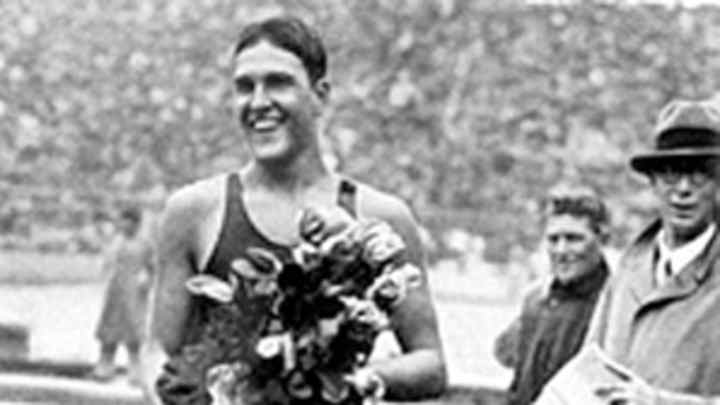
In the whole history of the Olympics, only four American swimmers have achieved lasting celebrity. Johnny Weissmuller and Buster Crabbe went on to Hollywood as Tarzan; Eleanor Holm, gorgeous and notorious, starred in the World's Fair Aquacade; and Mark Spitz won all those golds at Munich in 1972. Now, maybe Michael Phelps will become number five. We'll see. But, except for a little accident of history, Sunny Boy Kiefer would definitely have been included in that exalted group.
You've probably never heard of Kiefer. But the historical hiccup that interrupted his career was something called World War II. Starting in 1935 when he was just 17, Kiefer set backstroke records just about every time he jumped into the pool, climaxing his work by taking the only men's backstroke gold at the 1936 Berlin Olympics. But more important, Keifer didn't reach his peak until almost a decade later. Had there been the Tokyo Olympics of 1940 and the London Games of '44, Sunny Boy would've have surely won them in a breeze. He'd be to the backstroke what Pablo Casals was to the cello.
But it was wartime, and Kiefer became a naval officer who helped write the guidelines that taught thousands of American sailors to swim. After the war, he started his own swimwear company. Among other things he invented was the nylon suit, which finally helped someone else break his Olympic record after 16 years. He also improved championship pools so that swimmers could race faster. Starting in the 1960s, Kiefer pioneered a program that saw the construction of public pools across his hometown of Chicago so that inner-city kids could cool off and learn to swim. Aquatics International magazine has called Kiefer "a combination of Thomas Edison, Abraham Lincoln and George Washington."
But then, it's really Edison, Lincoln, Washington and Charlie Chaplin. You see, for several years Kiefer also starred in a comedy act, the highlight of which was his race against a seal named Sharkey. The seal made $900 a week, Kiefer $600. But that was big money back then. Kiefer says it allowed him to develop new products for his company, pay for a new driveway for his house and father another daughter.
He also reveals that he let Sharkey the Seal win because Kiefer was, aquatically, the top banana.
Kiefer, you see, is still very much alive. He's 90 years old, married 67 to Joyce. His square name is Adolph, which, unfortunately, has not been an especially popular moniker for some time, But precisely because of his name and his German heritage, an Adolf made a special effort to meet him in Berlin in 1936. Yes, Hitler came by the pool and shook his hand, which, of course, he would not do for Kiefer's good friend, Jesse Owens.
"If I knew then what I know now," Kiefer says, "I woulda pushed him into the pool."
Seventy-two years on, for this Olympics, the erstwhile Sunny Boy and his Joyce watch the swimming from Beijing every night. In the morning, he swims 45 minutes and then goes to his office at Kiefer & Associates. "I'm still a working man," he says.
Even now, Adolph Kiefer is still very much a work in progress.

Frank Deford is among the most versatile of American writers. His work has appeared in virtually every medium, including print, where he has written eloquently for Sports Illustrated since 1962. Deford is currently the magazine's Senior Contributing Writer and contributes a weekly column to SI.com. Deford can be heard as a commentator each week on Morning Edition. On television he is a regular correspondent on the HBO show Real Sports With Bryant Gumbel. He is the author of 15 books, and his latest,The Enitled, a novel about celebrity, sex and baseball, was published in 2007 to exceptional reviews. He and Red Smith are the only writers with multiple features in The Best American Sports Writing of the Century. Editor David Halberstam selected Deford's 1981 Sports Illustrated profile on Bobby Knight (The Rabbit Hunter) and his 1985 SI profile of boxer Billy Conn (The Boxer and the Blonde) for that prestigious anthology. For Deford the comparison is meaningful. "Red Smith was the finest columnist, and I mean not just sports columnist," Deford told Powell's Books in 2007. "I've always said that Red is like Vermeer, with those tiny, priceless pieces. Five hundred words, perfectly chosen, crafted. Best literary columnist, in any newspaper, that I've ever seen." Deford was elected to the National Association of Sportscasters and Sportswriters Hall of Fame. Six times at Sports Illustrated Deford was voted by his peers as U.S. Sportswriter of The Year. The American Journalism Review has likewise cited him as the nation's finest sportswriter, and twice he was voted Magazine Writer of The Year by the Washington Journalism Review. Deford has also been presented with the National Magazine Award for profiles; a Christopher Award; and journalism honor awards from the University of Missouri and Northeastern University; and he has received many honorary degrees. The Sporting News has described Deford as "the most influential sports voice among members of the print media," and the magazine GQ has called him, simply, "The world's greatest sportswriter." In broadcast, Deford has won a Cable Ace award, an Emmy and a George Foster Peabody Award for his television work. In 2005 ESPN presented a television biography of Deford's life and work, You Write Better Than You Play. Deford has spoken at well over a hundred colleges, as well as at forums, conventions and on cruise ships around the world. He served as the editor-in-chief of The National Sports Daily in its brief but celebrated existence. Deford also wrote Sports Illustrated's first Point After column, in 1986. Two of Deford's books, the novel, Everybody's All-American, and Alex: The Life Of A Child, his memoir about his daughter who died of cystic fibrosis, have been made into movies. Two of his original screenplays have also been filmed. For 16 years Deford served as national chairman of the Cystic Fibrosis Foundation, and he remains chairman emeritus. He resides in Westport, CT, with his wife, Carol. They have two grown children – a son, Christian, and a daughter, Scarlet. A native of Baltimore, Deford is a graduate of Princeton University, where he has taught American Studies.