%20%20--%3E%0A%3Csvg%20version%3D%221.1%22%20id%3D%22Layer_1%22%20xmlns%3D%22http%3A%2F%2Fwww.w3.org%2F2000%2Fsvg%22%20xmlns%3Axlink%3D%22http%3A%2F%2Fwww.w3.org%2F1999%2Fxlink%22%20x%3D%220px%22%20y%3D%220px%22%0A%09%20width%3D%2239px%22%20height%3D%2240px%22%20viewBox%3D%220%200%2039%2040%22%20enable-background%3D%22new%200%200%2039%2040%22%20xml%3Aspace%3D%22preserve%22%3E%0A%3Cpath%20fill%3D%22%23FFFFFF%22%20d%3D%22M38.5%2C7H28.2v26h10.3V7z%22%2F%3E%0A%3Cpath%20fill-rule%3D%22evenodd%22%20clip-rule%3D%22evenodd%22%20fill%3D%22%23FFFFFF%22%20d%3D%22M26.1%2C25.5c0%2C5.8-4.1%2C7.5-12.9%2C7.5C3.9%2C33%2C0%2C31.2%2C0%2C25.2v-1.1h11.6%0A%09v2.4c0%2C0.7%2C0.1%2C1.4%2C1.2%2C1.4c1%2C0%2C1.2-0.4%2C1.2-1.3v-0.9c0-1.6-0.9-1.6-3.5-2.2C2.2%2C21.7%2C0%2C19.7%2C0%2C15.3v-0.9C0%2C9.3%2C5.5%2C7%2C12.9%2C7%0A%09c10.2%2C0%2C12.8%2C2.6%2C12.8%2C7.4v1.8h-11v-2.9c0-0.6-0.4-1.1-1.2-1.1c-0.6%2C0-1.2%2C0.4-1.2%2C1.1v0.9c0%2C1.5%2C0.9%2C2%2C3.3%2C2.5%0A%09c8%2C1.6%2C10.5%2C3.3%2C10.5%2C7.5V25.5z%22%2F%3E%0A%3C%2Fsvg%3E%0A)
Irish 'home' rout hardly rekindles memories of once-superb rivalry

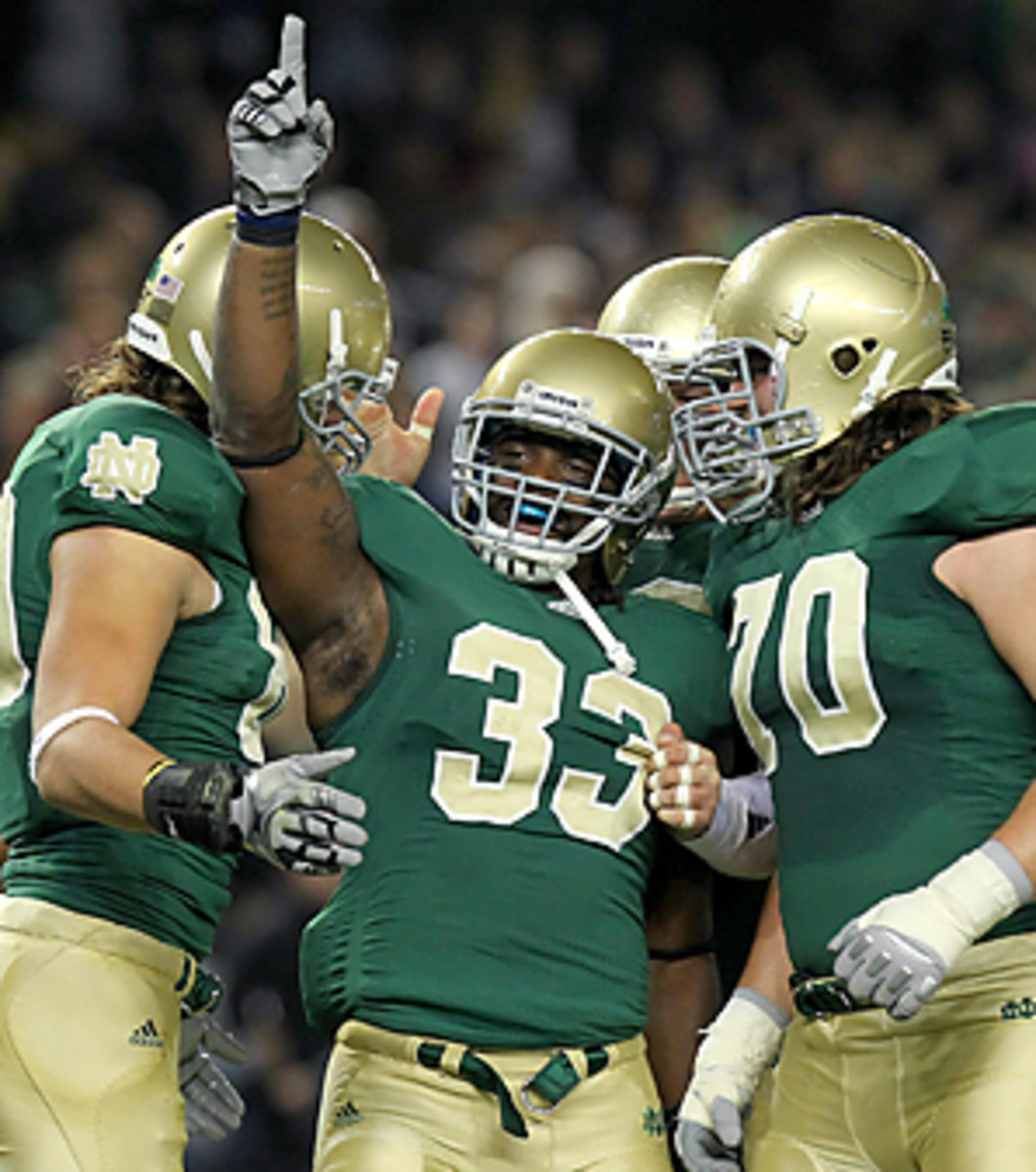
NEW YORK -- Notre Dame and Army are never again going to hook up for the kind of games that made their rivalry, more than 50 years ago, the biggest in the country. Times have changed and both teams long ago fell from the upper echelons of college football. Nevertheless, there was a tangible feeling of history in the air when the teams met at chilly Yankee Stadium on Saturday night. How else to explain the sellout crowd of 54,251 that saw the Fighting Irish thump the Black Knights 27-3? Neither team entered the game ranked among the top 25. Their combined record was 11-9. The only thing at stake was Notre Dame's eligibility for a bowl game (Army qualified last week). And yet people came anyway.
Army and Notre Dame had traded punches in the Bronx on 22 previous occasions -- 20 times from 1925 to 1946, when both were annually among the top teams in the nation. Connections to that era remain, flesh and blood reminders of a past preserved in black and white. Johnny Lujack, 85, who won the Heisman Trophy as a Fighting Irish quarterback in 1947, was Notre Dame's honorary captain. Pete Dawkins, who won the Heisman in 1958 and led the Black Knights to their last victory over the Irish, did the honors for Army.
One other thing about the history of this rivalry: Notre Dame usually won handily -- the Irish hold a healthy 37-8-4 edge in the series. In that respect, Saturday night went true to form. The Black Knights drove 78 yards in 16 plays the first time they had the ball and settled for a field goal. They were completely shut down after that by a Notre Dame defense that has clearly progressed since its 35-17 loss to Navy on Oct. 23. The Irish concentrated on taking away Army fullback Jared Hassin and forcing the Black Knights to beat them on the edge. Army ran for 61 yards on that first possession, but would rush for just 74 more the rest of the night, while finishing 28 points below their season average.
Spearheading the Notre Dame defense was sophomore inside linebacker Manti Te'o, who was stout in the middle and dominating when he ranged side to side. Big, fast and strong, he forced the action all night. After so many years of thinking of the Fighting Irish as an offensive force, it seems unusual for the face of this team to be a 6-foot-2, 245-pound linebacker. He finished the night with a game-high TK tackles, a number that seems low to those who saw him play.
But more than the redoubtable Te'o, the star of the night was the new Yankee Stadium, which sparkled under a full moon. This was a home game for Notre Dame -- West Point's ticket allotment was a paltry 5,000 -- and the decidedly pro-Irish crowd was buzzing before the opening kickoff. There were none of the distractions that marred this afternoon's Illinois-Northwestern clash at Wrigley Field. The gridiron fit easily between home plate and deepest centerfield, where only the far corners of the end zone seemed a bit close to the outfield wall.
The game was far from a classic, just a clash between two teams in the midst of trying to rebuild programs that had fallen into different states of disrepair -- there hasn't been a winning season at West Point since 1996, while the Fighting Irish are four years removed from their last appearance in a BCS bowl. Army's turnaround has been keyed by its triple-option offense; Notre Dame's has been led by its defense, which hasn't allowed a touchdown since a 28-27 loss to Tulsa on Oct. 30. Both teams are now 6-5, and probably headed to the postseason.
It was the setting and the memories that made this night special rather than the quality of the football. There will be better days ahead for both programs, but few nights will be more memorable. "New York is a lot of things," said Notre Dame coach Brian Kelly after the game, "but tonight it was a college football town." Wake up the echoes indeed.

Staff writer Mark Beech, who has written extensively on college football, horse racing and NASCAR, among other subjects, cites his 2007 profile of Olympic gold medal-winning freestyle wrestler Henry Cejudo as his most memorable SI assignment. "I was at a NASCAR race in Charlotte on a Sunday afternoon and got a call from an editor asking me if I could fly straight to Colorado Springs to start work on a story about Cejudo for the next week's issue," says Beech. "I knew nothing about him at all but spent the next six days learning everything I could mostly through interviews, since there was no real record of him in the press at the time. The story was much bigger and more deeply affecting than I could have ever imagined, and I thought it came off very well considering the amount of time I had to write and report." During his tenure at SI Beech has also written on the NHL, soccer and college basketball. He writes a weekly auto racing column (Racing Fan) for SI.com, and also provides coverage of major horse racing stakes for the website. He says college football is his favorite sport to cover "for all the tradition and regional passions." Beech has been with Sports Illustrated since 1997. Before joining SI he spent five years in the U.S. Army, reaching the rank of captain, and serving primarily with the 84th Engineer Battalion (Combat) (Heavy) at Schofield Barracks, Hawaii. Beech received a B.S. in civil engineering from the United States Military Academy in 1991 and an M.S. in journalism from the Columbia University Graduate School of Journalism in 1997. He and his wife, Allison Keane, have an infant son, Nathaniel, and reside in Westchester County, NY.