%20%20--%3E%0A%3Csvg%20version%3D%221.1%22%20id%3D%22Layer_1%22%20xmlns%3D%22http%3A%2F%2Fwww.w3.org%2F2000%2Fsvg%22%20xmlns%3Axlink%3D%22http%3A%2F%2Fwww.w3.org%2F1999%2Fxlink%22%20x%3D%220px%22%20y%3D%220px%22%0A%09%20width%3D%2239px%22%20height%3D%2240px%22%20viewBox%3D%220%200%2039%2040%22%20enable-background%3D%22new%200%200%2039%2040%22%20xml%3Aspace%3D%22preserve%22%3E%0A%3Cpath%20fill%3D%22%23FFFFFF%22%20d%3D%22M38.5%2C7H28.2v26h10.3V7z%22%2F%3E%0A%3Cpath%20fill-rule%3D%22evenodd%22%20clip-rule%3D%22evenodd%22%20fill%3D%22%23FFFFFF%22%20d%3D%22M26.1%2C25.5c0%2C5.8-4.1%2C7.5-12.9%2C7.5C3.9%2C33%2C0%2C31.2%2C0%2C25.2v-1.1h11.6%0A%09v2.4c0%2C0.7%2C0.1%2C1.4%2C1.2%2C1.4c1%2C0%2C1.2-0.4%2C1.2-1.3v-0.9c0-1.6-0.9-1.6-3.5-2.2C2.2%2C21.7%2C0%2C19.7%2C0%2C15.3v-0.9C0%2C9.3%2C5.5%2C7%2C12.9%2C7%0A%09c10.2%2C0%2C12.8%2C2.6%2C12.8%2C7.4v1.8h-11v-2.9c0-0.6-0.4-1.1-1.2-1.1c-0.6%2C0-1.2%2C0.4-1.2%2C1.1v0.9c0%2C1.5%2C0.9%2C2%2C3.3%2C2.5%0A%09c8%2C1.6%2C10.5%2C3.3%2C10.5%2C7.5V25.5z%22%2F%3E%0A%3C%2Fsvg%3E%0A)
Auburn not the only worry for Oregon players stuck studying
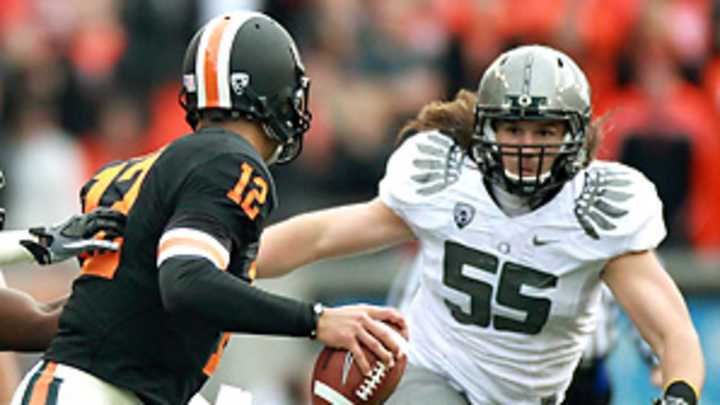
SCOTTSDALE, Ariz. -- Oregon linebackers Casey Matthews and Spencer Paysinger will be college football players for one more game, but they're no longer college students. Shortly before Christmas break, the two seniors packed up their belongings, rented U-Hauls and drove home to Southern California. Upon returning to Eugene, Matthews had to sleep on a futon in his mostly deserted house. Paysinger took up residence on a friend's couch.
"It's a really comfortable couch," said Paysinger.
They're not alone. Monday night's Oregon-Auburn BCS National Championship Game will feature a mishmash of players in varying states of their academic careers. Some have already graduated and are now officially football players, period. Other seniors or soon-to-be NFL draft entrants are temporarily enrolled in classes solely as a formality. And most of Oregon's team is missing the first week of winter quarter back on campus.
College administrators routinely cite potential academic disruptions as one of the biggest hindrances toward staging a Division I-A playoff. But in allowing the BCS to push back this year's title game to its latest date yet (Jan. 10), it sure seems that point is moot. The NCAA's principle bylaw on amateurism states that athletes are "an integral part of the student body," but the typical student body doesn't attend class at a resort.
That's essentially what Oregon's players are doing this week at their headquarters, the Fairmont Scottsdale Princess. Upon returning from practice and changing clothes, players are required to spend 2:30 to 4:30 studying in a makeshift academic center set up under a large tent on the property.
"We made a deal with the school president or someone where we have to do two hours of study hall every day," said tackle Mark Asper. "The sun's shining, it's really nice, we're in warm weather instead of gloomy, cloudy dismal Eugene, and we get to spend it in a tent ... in uncomfortable wedding chairs."
Athletic Director Rob Mullens said Oregon's athletic department and provost office began formulating a plan for the week even before the Ducks clinched their appearance in Monday's game, consulting schools like Ohio State that have dealt with the same scenario. Players can meet with tutors and access class materials online.
"We brought a lot of staff with us to make sure we got all the work done we needed to get done," said Mullens. "They've got everything they can do remotely."
Auburn, which runs on a semester schedule, doesn't face nearly the same problem. Classes don't resume there until the day of the game. Told about his opponents' academic obligations, Auburn guard Lee Ziemba cringed. "I didn't know that. That's rough."
Bowl season first began drifting past the traditional Jan. 1 end date upon the BCS' formation 12 years ago, then moved as much as a full week later when the double-hosting model (two BCS bowls in one city) began four years ago. This year, seven bowls will be played after New Year's, as well as Friday's Delaware-Eastern Washington FCS championship game, moved this year from its traditional mid-December date to accommodate a larger playoff field.
In its most recent report entitled "Restoring the Balance: Dollars, Value and the Future of College Sports," the Knight Commission on Intercollegiate Athletics specifically addressed football's prolonged postseason. Under a section entitled "Treating College Athletes as Students," the authors wrote: "Given the NCAA's stated principle, we note our disappointment that the current football postseason structure has been extended so that games now occur well into the second term ... and thus create conflicts with academic obligations. We recommend that all postseason competition for football end by a set date very early in January, before the beginning of winter term or quarter classes."
The report was released last June, a year after the BCS signed a new contract with ESPN that sets next year's title game for Jan. 9 and the two after that for Jan. 7. Weekends are reserved for the NFL playoffs, and the networks prefer airing special events on Mondays or Thursdays whenever possible.
"By extending [the postseason] to try to play it at a time the networks want it played intrudes on the mission of the NCAA," said Knight Commission Executive Director Amy Perko.
Granted, few are particularly clear on the NCAA's mission these days after five soon-to-be-suspended Ohio State Buckeyes played in Tuesday's Sugar Bowl, but presumably missing an entire week of school isn't part of it.
Of course, the game's timing is no inconvenience for Oregon players like Paysinger, Matthews, cornerback Talmadge Jackson and defensive tackle Brandon Bair, all of whom have completed their undergraduate degrees. NCAA rules allow for an athlete to compete in postseason events that occur after their final academic term, so long as they remain eligible. Generally, the rule more directly affects athletes in spring sports like golf and baseball, where championships often run past the end of the school year.
In this case, however, the game falls smack dab in the middle of the school year, which means that while most Oregon students returned to class this week, some of the "student-athletes" representing the school in Arizona this week aren't actually students.
"For me, it's really relaxing," said Paysinger, who received his degree in economics last year. "I'm done with school. During the day, everyone has to go to a study session from 2:30 to 4:30. While they're in school, I'm in my room watching TV."
Kick up your feet, Spencer. You earned it. A comfy room at the Fairmont sure beats those wedding chairs under the tent.
 Add us as a preferred source on Google
Senior Writer, Sports Illustrated Stewart Mandel first caught the college football bug as a sophomore at Northwestern University in 1995. "The thrill of that '95 Rose Bowl season energized the entire campus, and I quickly became aware of how the national media covered that story," he says. "I knew right then that I wanted to be one of those people, covering those types of stories." Mandel joined SI.com (formerly CNNSI.com) in 1999. A senior writer for the website, his coverage areas include the national college football beat and college basketball. He also contributes features to Sports Illustrated. "College football is my favorite sport to cover," says Mandel. "The stakes are so high week in and week out, and the level of emotion it elicits from both the fans and the participants is unrivaled." Mandel's most popular features on SI.com include his College Football Mailbag and College Football Overtime. He has covered 14 BCS national championship games and eight Final Fours. Mandel's first book, Bowls, Polls and Tattered Souls: Tackling the Chaos and Controversy That Reign Over College Football, was published in 2007. In 2008 he took first place (enterprise category) and second place (game story) in the Football Writers Association of America's annual writing contest. He also placed first in the 2005 contest (columns). Mandel says covering George Mason's run to the Final Four was the most enjoyable story of his SI tenure. "It was thrilling to be courtside for the historic Elite Eight upset of UConn," Mandel says. "Being inside the locker room and around the team during that time allowed me to get to know the coaches and players behind that captivating story." Before SI.com Mandel worked at ESPN the Magazine, ABC Sports Online and The Cincinnati Enquirer. He graduated from Northwestern University in 1998 with a B.S. in journalism. A Cincinnati native, Mandel and his wife, Emily, live in Santa Clara, Calif.