%20%20--%3E%0A%3Csvg%20version%3D%221.1%22%20id%3D%22Layer_1%22%20xmlns%3D%22http%3A%2F%2Fwww.w3.org%2F2000%2Fsvg%22%20xmlns%3Axlink%3D%22http%3A%2F%2Fwww.w3.org%2F1999%2Fxlink%22%20x%3D%220px%22%20y%3D%220px%22%0A%09%20width%3D%2239px%22%20height%3D%2240px%22%20viewBox%3D%220%200%2039%2040%22%20enable-background%3D%22new%200%200%2039%2040%22%20xml%3Aspace%3D%22preserve%22%3E%0A%3Cpath%20fill%3D%22%23FFFFFF%22%20d%3D%22M38.5%2C7H28.2v26h10.3V7z%22%2F%3E%0A%3Cpath%20fill-rule%3D%22evenodd%22%20clip-rule%3D%22evenodd%22%20fill%3D%22%23FFFFFF%22%20d%3D%22M26.1%2C25.5c0%2C5.8-4.1%2C7.5-12.9%2C7.5C3.9%2C33%2C0%2C31.2%2C0%2C25.2v-1.1h11.6%0A%09v2.4c0%2C0.7%2C0.1%2C1.4%2C1.2%2C1.4c1%2C0%2C1.2-0.4%2C1.2-1.3v-0.9c0-1.6-0.9-1.6-3.5-2.2C2.2%2C21.7%2C0%2C19.7%2C0%2C15.3v-0.9C0%2C9.3%2C5.5%2C7%2C12.9%2C7%0A%09c10.2%2C0%2C12.8%2C2.6%2C12.8%2C7.4v1.8h-11v-2.9c0-0.6-0.4-1.1-1.2-1.1c-0.6%2C0-1.2%2C0.4-1.2%2C1.1v0.9c0%2C1.5%2C0.9%2C2%2C3.3%2C2.5%0A%09c8%2C1.6%2C10.5%2C3.3%2C10.5%2C7.5V25.5z%22%2F%3E%0A%3C%2Fsvg%3E%0A)
Goalie fights are a guilty pleasure

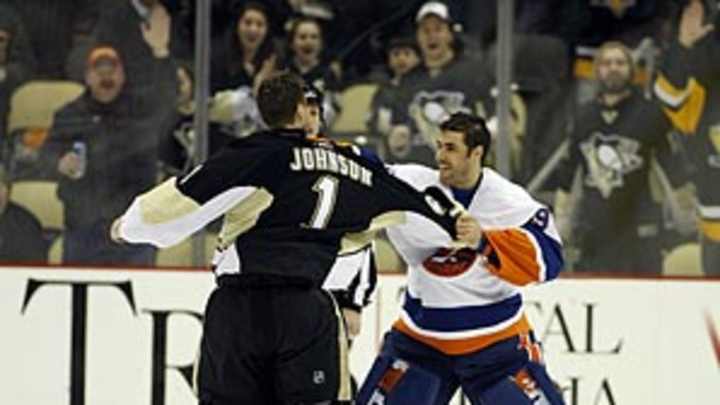
New York Islanders goalie Rick DiPietro, bless him, finally found yet another way to get injured: by taking a solid left hook last week from Pittsburgh Penguins netminder Smokin' Brent Johnson flush in the face.
Injured reserve is the only reserve in the rambunctious DiPietro, who conceded that he started the endgame mess by coming out of his crease to deliver a high forearm on the pot-stirring Matt Cooke, a petulant act that ultimately led to the facial fractures and swollen knee that will keep the Islanders' brittle goalie out of the lineup until sometime next month. Since signing that Idi Amin Goaltender for Life contract in September 2006 -- 15 years, $67.5 million -- DiPietro has played only 163 games, and just 38 since the start of 2008-09, because of a plethora of injuries.
As Mark Spector as Sportsnet.ca notes, DiPietro is in the Islanders trainer's room so much that when he walks through the door, everyone shouts, "Norm!"
The DiPietro-Johnson fight rippled through the NHL, eliciting more comment than the slugfest between the Boston Bruins and Dallas Stars last Thursday that featured three fights in the first four seconds, a rank embarrassment that new NHLPA director Don Fehr should remember the next time the NHL mentions that it would like to crack down on so-called staged fights.
(The antecedent of that mess was the November 2008 gong show between the teams, precipitated by a Steve Ott hip check. Former Star Mike Modano called the debacle of his team's 5-1 loss, which also featured the antics of Sean Avery, "idiotic and stupid ... one of the most embarrassing things I've ever seen.") Anyway, the question of the day: why do we fuss over fighting goalies?
The answer: the idiocy of the goalie fight constitutes the NHL's guilty little pleasure.
"When two goaltenders go at it, everybody's like 'Wow,'" Philadelphia Flyers coach Peter Laviolette says. "Everybody. Coaches. Players. 'The goalies are going to go!'"
GALLERY:Wild NHL goalie fights
"It just seems so wrong," said Flyers enforcer Jody Shelley, a smile creasing his face. "Doesn't it?"
There is something medieval about two men with overstuffed pillows on their legs and wearing the modern equivalent of breastplates slugging it out, an Arthurian moment in our Facebook world. Late in an ill-tempered game last month between the Flyers and Ottawa Senators, fans in Philadelphia's Wells Fargo center took up the chant, "goalie fight, goalie fight." Clearly goalie fights appeal to some of our oldest, and basest, impulses.
There are, of course, two other explanations for the NHL's utter fascination with the goalie fight:
Frequency. The goalies don't engage each other often. According to hockeyfights.com, the Boswell of on-ice fisticuffs, Johnson-DiPietro was the first goalie dustup in about three years. They are, in that sense, special. In the same way people venture out of their houses to view a lunar eclipse, the hockey world turns eagerly to the video of Johnson's one-punch knockout.
"Because they don't happen very often, they're very passionate," Nashville Predators assistant coach Brent Peterson says. "Very aggressive. Detroit-Colorado ... that was pretty exciting. (The Avalanche's Patrick Roy fought Chris Osgood as well as Mike Vernon in the late 1990s. That's 1,337 career wins and four Conn Smythe Trophies duking it out.) You don't want to see a guy break his hand on a guy's face or fall to the ground and hurt himself, but it's a thing that doesn't happen very often so guys around the league get excited about it.
"Back in the day there were a lot of goalies who could beat the crap out of a lot of guys. They're frustrated forwards, I guess. They're frustrated enforcers behind the mask."
Premeditation. The goalie fight does not simply occur, the result of a spasm of anger or an invitation proffered at the faceoff circle. The two greatest sounds in sports are the utter silence of 80,000 people in an Olympic stadium before the start of the men's 100 meters and the distinct crackle of electricity as boxers thread their way from the dressing room to the ring for the start of a heavyweight championship bout. An NHL goalie fight carries some of the same anticipation because like boxers, at least one goalie, maybe both, skate slowly to their engagement.
"Guys challenge you from down the ice, 180 feet, and then they meet in the middle," Peterson says. "It's a unique thing."
"It's got to be business," Shelley says, "because when it happens, it's like a production. The long skate. They take the mask off. They're ripping at the Velcro (on their equipment). Then they got to try to throw punches in that chest protector."
"There was a five-on-five brawl in Toronto my rookie year, and I had just replaced Beezer, who had been pulled," says Flyers goalie Brian Boucher, referring to John Vanbiesbrouck. "There's a delayed penalty and (Curtis Joseph) is at the Toronto bench, 30 or 40 seconds. He's on the bench, drinking water and then he starts coming in on me. I'm like, 'What are you doing?' Are we going to go?'
"I'm in a tough position. I don't want to get thrown out of the game and have to have Beezer go back in. I'm like, 'what am I going to do? Is Beezer going to be pissed if I go and start fighting?'
"When a guy gets pulled, he probably expects that's it for the night. He doesn't expect his backup to go in and start throwing punches and get tossed out. Cujo and I got our gloves off and we're just dancing, grabbing on to each other, and I'm saying 'Are we going to go?'
"He never answered me. If he had said yes or had thrown a punch, I would have had to fight, but I wasn't going to initiate it. That's the closest I've come to a fight in the NHL. So when Cujo signed with Phoenix (in 2005), the first day I met him, I went up to him and said, "Should we finish what you started?'"
DATER:Boston Brawl puts discipline czar in tough spot
HACKEL:DiPietro knuckles down

Along with the pages of Sports Illustrated, you'll find senior writer Michael Farber in the Hockey Hall of Fame. Farber joined the staff of Sports Illustrated in January 1994 and now stands as one of the magazine's top journalists, covering primarily ice hockey and Olympic sports. He is also a regular contributor to SI.com. In 2003 Farber was honored with the Elmer Ferguson Award from the Hockey Hall of Fame for distinguished hockey writing. "Michael Farber represents the best in our business," said the New York Post's Larry Brooks, past president of the Professional Hockey Writers' Association. "He is a witty and stylish writer, who has the ability to tell a story with charm and intelligence." Farber says his Feb. 2, 1998 piece on the use and abuse of Sudafed among NHL players was his most memorable story for SI. He also cites a feature on the personal problems of Kevin Stevens, Life of the Party. His most memorable sports moment as a journalist came in 1988 when Canadian Ben Johnson set his controversial world record by running the 100 meters in 9.79 seconds at the Summer Olympic Games, in Seoul. Before coming to Sports Illustrated, Farber spent 15 years as an award-winning sports columnist and writer for the Montreal Gazette, three years at the Bergen Record, and one year at the Sun Bulletin in Binghamton, NY. He has won many honors for his writing, including the "outstanding sports writing award" in 2007 from Sports Media Canada, and the Prix Jacques-Beauchamp (Quebec sportswriter of the year) in 1993. While at the Gazette, he won a National Newspaper award in 1982 and 1990. Sometimes Life Gets in the Way, a compendium of his best Gazette columns, was published during his time in newspapers. Farber says hockey is his favorite sport to cover. "The most down-to-earth athletes play the most demanding game," he says. Away from Sports Illustrated, Farber is a commentator for CJAD-AM in Montreal and a panelist on TSN's The Reporters (the Canadian equivalent of ESPN's The Sports Reporters in the United States, except more dignified). Farber is also one of the 18 members on the Hockey Hall of Fame selection committee. Born and raised in New Jersey, Farber is a 1973 graduate of Rutgers University where he was Phi Beta Kappa. He now resides in Montreal with his wife, Danielle Tétrault, son Jérémy and daughter Gabrielle.