%20%20--%3E%0A%3Csvg%20version%3D%221.1%22%20id%3D%22Layer_1%22%20xmlns%3D%22http%3A%2F%2Fwww.w3.org%2F2000%2Fsvg%22%20xmlns%3Axlink%3D%22http%3A%2F%2Fwww.w3.org%2F1999%2Fxlink%22%20x%3D%220px%22%20y%3D%220px%22%0A%09%20width%3D%2239px%22%20height%3D%2240px%22%20viewBox%3D%220%200%2039%2040%22%20enable-background%3D%22new%200%200%2039%2040%22%20xml%3Aspace%3D%22preserve%22%3E%0A%3Cpath%20fill%3D%22%23FFFFFF%22%20d%3D%22M38.5%2C7H28.2v26h10.3V7z%22%2F%3E%0A%3Cpath%20fill-rule%3D%22evenodd%22%20clip-rule%3D%22evenodd%22%20fill%3D%22%23FFFFFF%22%20d%3D%22M26.1%2C25.5c0%2C5.8-4.1%2C7.5-12.9%2C7.5C3.9%2C33%2C0%2C31.2%2C0%2C25.2v-1.1h11.6%0A%09v2.4c0%2C0.7%2C0.1%2C1.4%2C1.2%2C1.4c1%2C0%2C1.2-0.4%2C1.2-1.3v-0.9c0-1.6-0.9-1.6-3.5-2.2C2.2%2C21.7%2C0%2C19.7%2C0%2C15.3v-0.9C0%2C9.3%2C5.5%2C7%2C12.9%2C7%0A%09c10.2%2C0%2C12.8%2C2.6%2C12.8%2C7.4v1.8h-11v-2.9c0-0.6-0.4-1.1-1.2-1.1c-0.6%2C0-1.2%2C0.4-1.2%2C1.1v0.9c0%2C1.5%2C0.9%2C2%2C3.3%2C2.5%0A%09c8%2C1.6%2C10.5%2C3.3%2C10.5%2C7.5V25.5z%22%2F%3E%0A%3C%2Fsvg%3E%0A)
Nothing says ouch more than watching a grisly sports injury
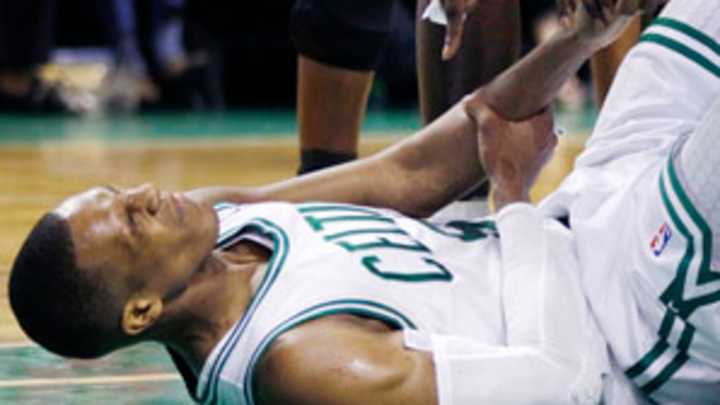

On Sunday, after President Obama decided not to release photos of the newly deceased Osama bin Laden, I opened my sports section to a picture in which "Rajon Rondo's arm is bent into an unnatural position," as the caption said with clinical detachment.
The photo captured the exact instant in which the Celtic guard's left elbow was dislocated, hinging backward as his forearm doglegged to one side during Game 3 against the Heat. It looked as though Rondo's arm, like the caption describing it, might require clinical detachment.
Over breakfast, I imagined Rondo's elbow swinging freely with a 180-degree range of motion -- as on a classroom skeleton -- and soon I was bent into an unnatural position myself, over my Cheerios, wondering if it was possible to un-see the image. (It was not, and I spent the morning feeling a variation on the famous palindrome of Napoleon's exile to Elba: Able was I ere I saw elbow.)
There are two kinds of people in this world: Those who like to see grisly injuries replayed repeatedly -- slow-mowed, blown-up, flash-frozen -- and those of us who avert our gaze while driving past a horrifying car accident. I'm in the latter camp, but I'm distinctly in the minority, which is why the phrase "rubbernecking delay" has long been a staple of radio traffic reports.
And so a YouTube video called "Worst Sports Injuries" has attracted more than 17.5 million rubberneckers, looky-loos and other voyeurs to a montage of carnage. These photographs of limbs "bent into unnatural positions" and served up for the private edification of the world's web surfers, are a kind of injury porn, right down to the musical soundtrack.
Call me squeamish -- please do -- for there is much to be said in praise of squeamishness. The word gets a bad rap. Its second definition (after "easily made to feel sick") is "having strong moral views." Chaucer wrote this line in 1386, in Middle English, but it requires little translation today: "He was somdel squaymous of fartyng." It's the people who are not squaymous of fartyng, and other social offenses, that we need to worry about. Especially if you're like me, and are frequently seated next to them on airplanes.
Jeff Van Gundy, who witnessed some horrors in his time as coach of the Knicks, said on the Celtics-Heat telecast that he didn't want to look at Rondo's injury again, even as it was being replayed. To which Mark Jackson replied that he could tell, from his former coach's reaction, that Van Gundy was from the suburbs -- as if squeamishness has anything to do with toughness.
No one questions the toughness of Peter Schmeichel, the former Manchester United goalkeeper and captain. Yet when Coventry City defender David Busst had his right leg shattered below the knee in front of Schmeichel during a match in 1996, the keeper went behind his own goal and vomited. He later required counseling. Busst, whose career ended that day, required 22 operations just to save his leg from amputation. And yet various videos of the injury have attracted some 3.5 million views online, despite -- more likely because of -- headlines that warn: "David Busst Horrific Injury."
It was 20 years before Joe Theismann could watch a replay of his own career-ending injury, in which his right tibia was snapped "like a breadstick" by Lawrence Taylor. It's a wonder he could watch it at all. But then "serious sport," as George Orwell wrote, "is bound up with ... sadistic pleasure in witnessing violence."
How else to explain why videos of Sabres goalie Clint Malarchuk having his jugular cut by a skate in 1989 -- his blood pouring onto the ice like spilled paint -- have had multimillion viewings online? Nine spectators reportedly fainted that night, while two suffered heart attacks, hardly recommendations. Yet the video is so ubiquitous that Malarchuk himself has seen it "maybe 100 times," he told the Calgary Herald. "You go to YouTube, punch in my name and you get three different angles of it. Pretty graphic stuff. I've seen it so many times I've almost become detached from it.
The only things I've ever become detached from are my front teeth. As a 12-year-old first baseman, I had them shattered by a thrown baseball while daydreaming during a Little League practice, which might have triggered the squeamishness with which I have been blessed more or less ever since. If that accident had happened today, some parent/paparazzo would have captured the moment on cell cam, and I'd have a souvenir video to go with the false teeth and root canal.
In the absence of such a memento, I'll have to make do with "The Worst Sports Injuries Of All Time," two minutes and 20 seconds of nauseating human misery, witnessed so far by 500,000 people -- the same number that watched Wilbur Wright fly around the Statue of Liberty in 1909, some of them no doubt motivated by the same rubbernecking impulse.
"This is bad it made me feel sick watch at your own risk," warned the punctuation-averse person who selected the images for "Worst Sports Injuries Of All Time". And uploaded them to YouTube. And set them to a sympathetic soundtrack of Ozzy Osbourne singing "Crazy Train."

Special Contributor, Sports Illustrated Steve Rushin was born in Elmhurst, Ill. on September 22, 1966 and raised in Bloomington, Minn. After graduating from Bloomington Kennedy High School in 1984 and Marquette University in 1988, Rushin joined the staff of Sports Illustrated. He is a Special Contributor to the magazine, for which he writes columns and features. In 25 years at SI, he has filed stories from Greenland, India, Indonesia, Antarctica, the Arctic Circle and other farflung locales, as well as the usual locales to which sportswriters are routinely posted. His first novel, The Pint Man, was published by Doubleday in 2010. The Los Angeles Times called the book "Engaging, clever and often wipe-your-eyes funny." His next book, a work of nonfiction, The 34-Ton Bat, will be published by Little, Brown in 2013. Rushin gave the commencement address at Marquette in 2007 and was awarded an honorary Doctor of Letters for "his unique gift of documenting the human condition through his writing." In 2006 he was named the National Sportswriter of the Year by the National Sportswriters and Sportscasters Association. A collection of his sports and travel writing—The Caddie Was a Reindeer—was published by Grove Atlantic in 2005 and was a semifinalist for the Thurber Prize for American Humor. The Denver Post suggested, "If you don't end up dropping The Caddie Was a Reindeerduring fits of uncontrollable merriment, it is likely you need immediate medical attention." A four-time finalist for the National Magazine Award, Rushin has had his work anthologized in The Best American Sports Writing, The Best American Travel Writing and The Best American Magazine Writing collections. His essays have appeared in Time magazine andThe New York Times. He also writes a weekly column for SI.com. His first book, Road Swing, published in 1998, was named one of the "Best Books of the Year" by Publishers Weekly and one of the "Top 100 Sports Books of All Time" by SI. He and his wife, Rebecca Lobo, have four children and live in Connecticut.