%20%20--%3E%0A%3Csvg%20version%3D%221.1%22%20id%3D%22Layer_1%22%20xmlns%3D%22http%3A%2F%2Fwww.w3.org%2F2000%2Fsvg%22%20xmlns%3Axlink%3D%22http%3A%2F%2Fwww.w3.org%2F1999%2Fxlink%22%20x%3D%220px%22%20y%3D%220px%22%0A%09%20width%3D%2239px%22%20height%3D%2240px%22%20viewBox%3D%220%200%2039%2040%22%20enable-background%3D%22new%200%200%2039%2040%22%20xml%3Aspace%3D%22preserve%22%3E%0A%3Cpath%20fill%3D%22%23FFFFFF%22%20d%3D%22M38.5%2C7H28.2v26h10.3V7z%22%2F%3E%0A%3Cpath%20fill-rule%3D%22evenodd%22%20clip-rule%3D%22evenodd%22%20fill%3D%22%23FFFFFF%22%20d%3D%22M26.1%2C25.5c0%2C5.8-4.1%2C7.5-12.9%2C7.5C3.9%2C33%2C0%2C31.2%2C0%2C25.2v-1.1h11.6%0A%09v2.4c0%2C0.7%2C0.1%2C1.4%2C1.2%2C1.4c1%2C0%2C1.2-0.4%2C1.2-1.3v-0.9c0-1.6-0.9-1.6-3.5-2.2C2.2%2C21.7%2C0%2C19.7%2C0%2C15.3v-0.9C0%2C9.3%2C5.5%2C7%2C12.9%2C7%0A%09c10.2%2C0%2C12.8%2C2.6%2C12.8%2C7.4v1.8h-11v-2.9c0-0.6-0.4-1.1-1.2-1.1c-0.6%2C0-1.2%2C0.4-1.2%2C1.1v0.9c0%2C1.5%2C0.9%2C2%2C3.3%2C2.5%0A%09c8%2C1.6%2C10.5%2C3.3%2C10.5%2C7.5V25.5z%22%2F%3E%0A%3C%2Fsvg%3E%0A)
A guide to sports fighting terms
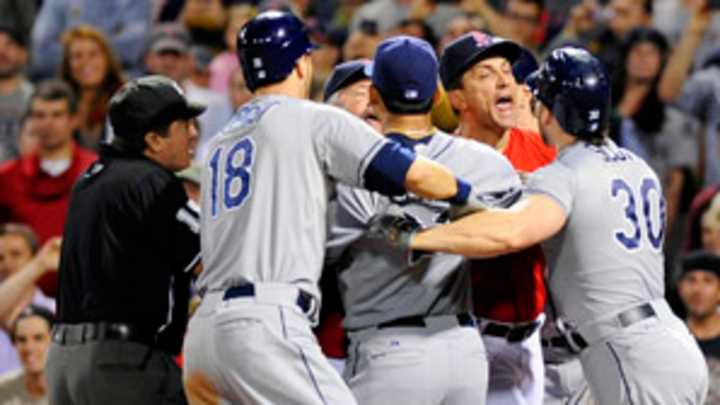
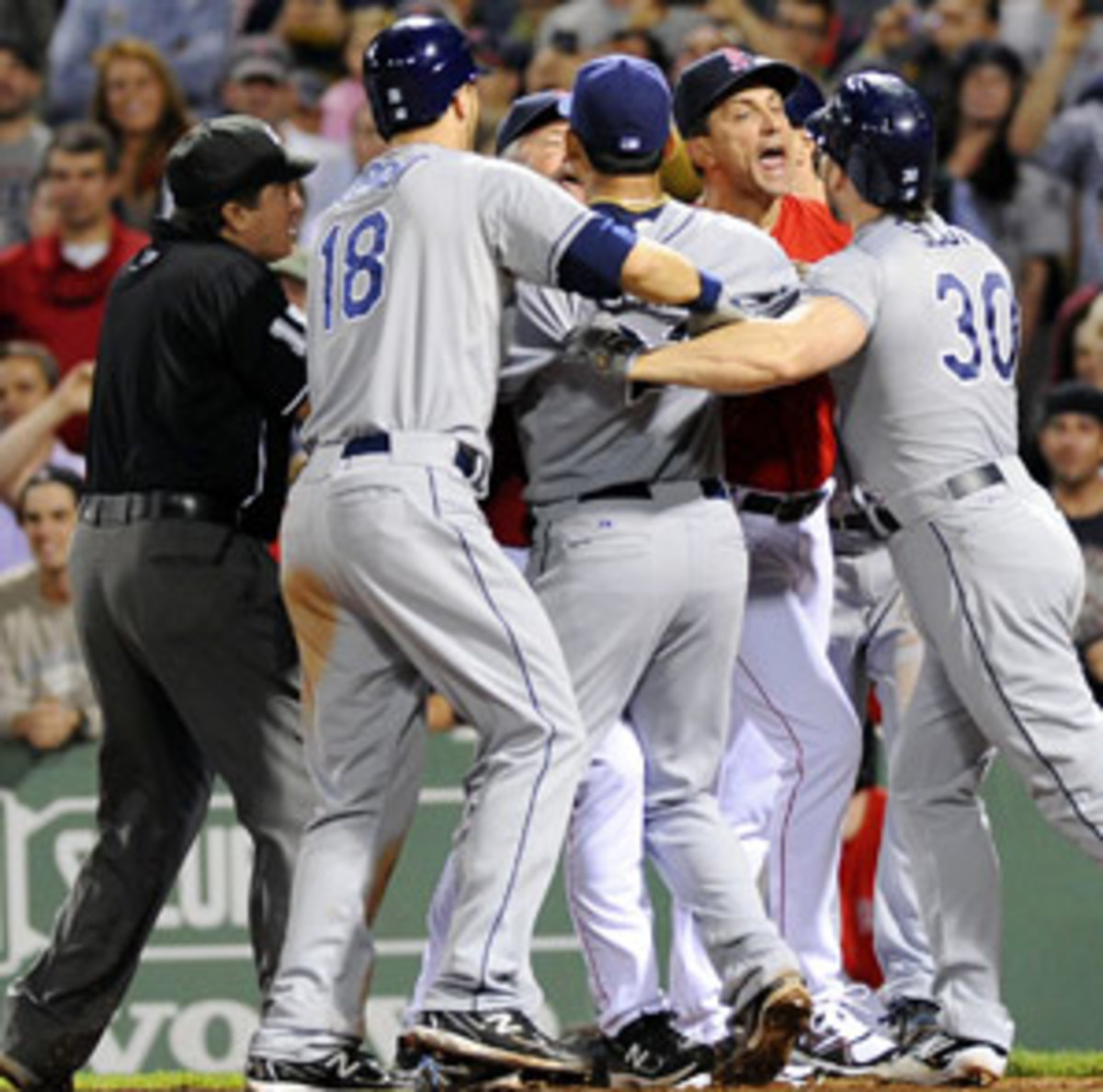
The non-fight last week between the Rays and Red Sox was called a "bench-clearing brawl" in headlines and highlight reels, when in fact it was just 50 people milling about the infield, the two sides barely even interacting, in the grand tradition of freshman mixers and wedding receptions.
This imprecision of language happens all the time in sports fights, which are frequently described in inverse proportion to their seriousness, so that a harmless tussle is a "bench-clearing brawl" while a forearm to the teeth is a "love tap."
It can be confusing. As a wrestling referee vainly attempts to restore calm during a cage match, so we ought to at least try to impose order on the chaotic language of sports fights, defining their escalation from least to most serious, as in Homeland Security's old color-coded terror chart.
What we need is a brief taxonomy, suitable for lamination. It would tell us definitively that the lowest level of sports fight is what foreign tabloids call "argy-bargy." This is a verbal dispute that may or may not lead to "handbags," a blanket term for the innocuous pushing and shoving seen in European soccer, as if two old ladies were swinging their handbags at one another. See also "handbags at 20 paces," which sometimes leads to a "dustup."
A dustup becomes a "punch-up" after two or more players square off, put up their dukes and "drop the gloves," one of hockey's many contributions to the sports-fight lexicon. We now have a "set-to." If the fighters' teammates are to do any "bench-clearing," this would be a good time, for once a punch is thrown the set-to has escalated -- depending on the sport and nation, and the gravity of the punches thrown -- to a "ruckus," "rumpus," "skirmish" or "scrap." A scrap, with no e, is marginally worse than a "scrape," with one. At the very least, we now have a bit of a "brouhaha."
In fights overseas, incidentally, the phrase "a bit" is meant as an intensifier, so that "a bit of aggro" -- in, say, Australian rules football -- will be worse than unadorned aggro. Aggro, in this case, refers to aggressive or violent behavior, covering the entire spectrum of sports fighting. A bit of aggro is, in my limited understanding, not as bad in Australia as a bit of "biffo," but then Australia has as many words for fighting as the Inuit have for puncturing the myth that they have a lot of words for snow.
But back to our sports fight. The aforementioned punch-up ushers in the official start of what are often called "fisticuffs," a word -- like scissors or underpants -- that only exists as a plural, so that both parties had better be throwing punches before anyone utters the f-word. When only one party is punching, he is throwing a "haymaker" (swinging freely as if scything down hay) or possibly "starting the lawnmower" (if his opponent is still on the ground). None of this is meant to condone or glorify fighting, any more than Webster intended to glorify aardvarks, quidnuncs or zoysias. Rather, it's an effort to cut through sport's many euphemisms -- like a scissors through underpants -- and arrive at a common understanding.
So then: Assuming that several others combatants have now joined the "fray" (or "fracas"), this fight has become a bona fide "bench-clearer." At this point, announcers are likely to call it a "melée," a French word meaning "baseball fight". (In fact, it means confused fighting, skirmishing or scuffling, which is what most baseball fights consist of.) But those announcers will be wrong. This is well beyond a melée. This is a full-scale "rhubarb" -- or even a "slobberknocker," in which participants, as the name suggests, endeavor to knock the slobber from one another.
As the principals in this rhubarb roll by in a cartoon cloud of stars and pound signs, fans of professional wrestling might recognize the fight as a "Pier-Six brawl," or "Pier-Sixer." Quite why Pier 6 is presumed to be tougher than all the other piers on the waterfront is a linguistic mystery. Suffice to say that the residents of Pier 6 long ago developed a reputation for wanton violence. (Indeed, their colleagues at Pier 1 still fear for the safety of their imported wicker furniture.)
A Pier-Sixer is total chaos. It's what is commonly called a "free-for-all" and less commonly -- but more poetically -- called a "foofaraw", which is how you say "free-for-all" with a mouthful of loose teeth.
A free-for-all, in turn, is sometimes referred to as "pandemonium" (from "Pandaemonium," the capital of Hell in Milton's Paradise Lost) or "bedlam" (an ancient corruption of the "Bethlehem" in London's Bethlehem psychiatric hospital).
For whatever reason, the very worst fights -- those at the top of our taxonomy --are named for places both real and imagined. The worst of these fights (though not of these places) is "donnybrook." For sheer pandemonium, nothing tops -- perhaps bottoms is a better verb -- a full-on donnybrook.
Donnybrook is now a prosperous suburb of Dublin, but was once the site of an annual fair renowned for violence and general mayhem. The Donnybrook Fair was banned more than 150 years ago, but lives on to this day whenever athletes get together for a bit of biffo, aggro, argy-bargy.
Or whatever you choose to call it.
 Add us as a preferred source on Google
Special Contributor, Sports Illustrated Steve Rushin was born in Elmhurst, Ill. on September 22, 1966 and raised in Bloomington, Minn. After graduating from Bloomington Kennedy High School in 1984 and Marquette University in 1988, Rushin joined the staff of Sports Illustrated. He is a Special Contributor to the magazine, for which he writes columns and features. In 25 years at SI, he has filed stories from Greenland, India, Indonesia, Antarctica, the Arctic Circle and other farflung locales, as well as the usual locales to which sportswriters are routinely posted. His first novel, The Pint Man, was published by Doubleday in 2010. The Los Angeles Times called the book "Engaging, clever and often wipe-your-eyes funny." His next book, a work of nonfiction, The 34-Ton Bat, will be published by Little, Brown in 2013. Rushin gave the commencement address at Marquette in 2007 and was awarded an honorary Doctor of Letters for "his unique gift of documenting the human condition through his writing." In 2006 he was named the National Sportswriter of the Year by the National Sportswriters and Sportscasters Association. A collection of his sports and travel writing—The Caddie Was a Reindeer—was published by Grove Atlantic in 2005 and was a semifinalist for the Thurber Prize for American Humor. The Denver Post suggested, "If you don't end up dropping The Caddie Was a Reindeerduring fits of uncontrollable merriment, it is likely you need immediate medical attention." A four-time finalist for the National Magazine Award, Rushin has had his work anthologized in The Best American Sports Writing, The Best American Travel Writing and The Best American Magazine Writing collections. His essays have appeared in Time magazine andThe New York Times. He also writes a weekly column for SI.com. His first book, Road Swing, published in 1998, was named one of the "Best Books of the Year" by Publishers Weekly and one of the "Top 100 Sports Books of All Time" by SI. He and his wife, Rebecca Lobo, have four children and live in Connecticut.