%20%20--%3E%0A%3Csvg%20version%3D%221.1%22%20id%3D%22Layer_1%22%20xmlns%3D%22http%3A%2F%2Fwww.w3.org%2F2000%2Fsvg%22%20xmlns%3Axlink%3D%22http%3A%2F%2Fwww.w3.org%2F1999%2Fxlink%22%20x%3D%220px%22%20y%3D%220px%22%0A%09%20width%3D%2239px%22%20height%3D%2240px%22%20viewBox%3D%220%200%2039%2040%22%20enable-background%3D%22new%200%200%2039%2040%22%20xml%3Aspace%3D%22preserve%22%3E%0A%3Cpath%20fill%3D%22%23FFFFFF%22%20d%3D%22M38.5%2C7H28.2v26h10.3V7z%22%2F%3E%0A%3Cpath%20fill-rule%3D%22evenodd%22%20clip-rule%3D%22evenodd%22%20fill%3D%22%23FFFFFF%22%20d%3D%22M26.1%2C25.5c0%2C5.8-4.1%2C7.5-12.9%2C7.5C3.9%2C33%2C0%2C31.2%2C0%2C25.2v-1.1h11.6%0A%09v2.4c0%2C0.7%2C0.1%2C1.4%2C1.2%2C1.4c1%2C0%2C1.2-0.4%2C1.2-1.3v-0.9c0-1.6-0.9-1.6-3.5-2.2C2.2%2C21.7%2C0%2C19.7%2C0%2C15.3v-0.9C0%2C9.3%2C5.5%2C7%2C12.9%2C7%0A%09c10.2%2C0%2C12.8%2C2.6%2C12.8%2C7.4v1.8h-11v-2.9c0-0.6-0.4-1.1-1.2-1.1c-0.6%2C0-1.2%2C0.4-1.2%2C1.1v0.9c0%2C1.5%2C0.9%2C2%2C3.3%2C2.5%0A%09c8%2C1.6%2C10.5%2C3.3%2C10.5%2C7.5V25.5z%22%2F%3E%0A%3C%2Fsvg%3E%0A)
Artist Leroy Neiman chose to see sport as a razzle-dazzle of glory
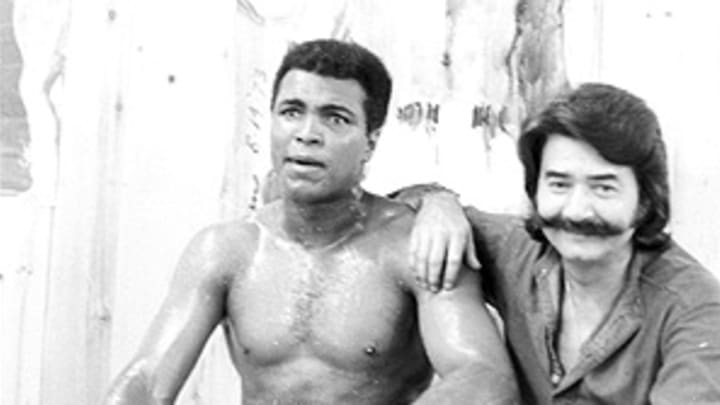
Framed in my library is a sketch that Leroy Neiman dashed off of me on the back of a menu when he was watching me speak several years ago. Leroy, who died on June 20, was somewhat better known for another sketch, the so-called "nymphette" that has appeared in Playboy since 1955 -- but of course, he's ever famous for simply being our most celebrated sports artist.
This is hardly to say he was acclaimed. Rather, he was dismissed as a garish showoff, who was all about colors and celebrity -- more of a Peter Max, without any of the grace or subtlety of Norman Rockwell, who he was often popularly compared to. Unschooled sports fans paid well for Neiman canvasses, though, and Leroy appeared unbothered by the unrelenting criticism.
Part of the professional disdain was no doubt manifested by envy -- his television ubiquity and his illustrious physical recognition -- highlighted by that great, sweeping nineteenth-century mustache. One bitter cold night in Manhattan, Leroy found himself in the wrong part of town with no cabs in sight. He was, as was his winter wont, wearing his full-length mink coat, when he realized he was about to be set upon by three thugs. When he turned to face them, though, one cried out, "You're the guy who paints all the sports stars," and rather than mug him, they found him a cab.
Personally, Leroy was not at all flamboyant, but courteous, gentle and wonderfully philanthropic. Maybe it wasn't great art that he sold, but it ended up funding great art schools. His studio, just off Central Park, was a huge, aircraft hangar of a room; but it was a warm, welcoming place.
It's odd that sport, so gritty and vivid, so naturally celebrating the best of the human form, has not produced an accepted master since George Bellows' fashioned his boxing paintings a century ago. Ironically, just now, as Neiman passes on, a Bellows exhibit is showcased at the National Gallery in Washington. At the National Art Museum of Sport in Indianapolis, there are many fairly recent glorious works, but none are so well regarded as "Stag at Sharkey's," which Bellows painted back in 1909 -- lurid and dark and mean.
But Neiman's sold. Maybe we simply don't want to display sports art that shows the squalid side. After all, the iconic athletic piece remains the discus thrower, which was carved twenty-five hundred years ago. It is clean and graceful and elegant, a male Venus de Milo. So criticize Leroy Neiman for making bright beauty of sport, but it seems what we prefer.
And as the simple sketch he did of me fades, I'll prize it still -- not for its craft or its value, but for the kind, generous man who chose to see sport, above a handlebar, as a razzle-dazzle of glory.
 Add us as a preferred source on Google
Frank Deford is among the most versatile of American writers. His work has appeared in virtually every medium, including print, where he has written eloquently for Sports Illustrated since 1962. Deford is currently the magazine's Senior Contributing Writer and contributes a weekly column to SI.com. Deford can be heard as a commentator each week on Morning Edition. On television he is a regular correspondent on the HBO show Real Sports With Bryant Gumbel. He is the author of 15 books, and his latest,The Enitled, a novel about celebrity, sex and baseball, was published in 2007 to exceptional reviews. He and Red Smith are the only writers with multiple features in The Best American Sports Writing of the Century. Editor David Halberstam selected Deford's 1981 Sports Illustrated profile on Bobby Knight (The Rabbit Hunter) and his 1985 SI profile of boxer Billy Conn (The Boxer and the Blonde) for that prestigious anthology. For Deford the comparison is meaningful. "Red Smith was the finest columnist, and I mean not just sports columnist," Deford told Powell's Books in 2007. "I've always said that Red is like Vermeer, with those tiny, priceless pieces. Five hundred words, perfectly chosen, crafted. Best literary columnist, in any newspaper, that I've ever seen." Deford was elected to the National Association of Sportscasters and Sportswriters Hall of Fame. Six times at Sports Illustrated Deford was voted by his peers as U.S. Sportswriter of The Year. The American Journalism Review has likewise cited him as the nation's finest sportswriter, and twice he was voted Magazine Writer of The Year by the Washington Journalism Review. Deford has also been presented with the National Magazine Award for profiles; a Christopher Award; and journalism honor awards from the University of Missouri and Northeastern University; and he has received many honorary degrees. The Sporting News has described Deford as "the most influential sports voice among members of the print media," and the magazine GQ has called him, simply, "The world's greatest sportswriter." In broadcast, Deford has won a Cable Ace award, an Emmy and a George Foster Peabody Award for his television work. In 2005 ESPN presented a television biography of Deford's life and work, You Write Better Than You Play. Deford has spoken at well over a hundred colleges, as well as at forums, conventions and on cruise ships around the world. He served as the editor-in-chief of The National Sports Daily in its brief but celebrated existence. Deford also wrote Sports Illustrated's first Point After column, in 1986. Two of Deford's books, the novel, Everybody's All-American, and Alex: The Life Of A Child, his memoir about his daughter who died of cystic fibrosis, have been made into movies. Two of his original screenplays have also been filmed. For 16 years Deford served as national chairman of the Cystic Fibrosis Foundation, and he remains chairman emeritus. He resides in Westport, CT, with his wife, Carol. They have two grown children – a son, Christian, and a daughter, Scarlet. A native of Baltimore, Deford is a graduate of Princeton University, where he has taught American Studies.