%20%20--%3E%0A%3Csvg%20version%3D%221.1%22%20id%3D%22Layer_1%22%20xmlns%3D%22http%3A%2F%2Fwww.w3.org%2F2000%2Fsvg%22%20xmlns%3Axlink%3D%22http%3A%2F%2Fwww.w3.org%2F1999%2Fxlink%22%20x%3D%220px%22%20y%3D%220px%22%0A%09%20width%3D%2239px%22%20height%3D%2240px%22%20viewBox%3D%220%200%2039%2040%22%20enable-background%3D%22new%200%200%2039%2040%22%20xml%3Aspace%3D%22preserve%22%3E%0A%3Cpath%20fill%3D%22%23FFFFFF%22%20d%3D%22M38.5%2C7H28.2v26h10.3V7z%22%2F%3E%0A%3Cpath%20fill-rule%3D%22evenodd%22%20clip-rule%3D%22evenodd%22%20fill%3D%22%23FFFFFF%22%20d%3D%22M26.1%2C25.5c0%2C5.8-4.1%2C7.5-12.9%2C7.5C3.9%2C33%2C0%2C31.2%2C0%2C25.2v-1.1h11.6%0A%09v2.4c0%2C0.7%2C0.1%2C1.4%2C1.2%2C1.4c1%2C0%2C1.2-0.4%2C1.2-1.3v-0.9c0-1.6-0.9-1.6-3.5-2.2C2.2%2C21.7%2C0%2C19.7%2C0%2C15.3v-0.9C0%2C9.3%2C5.5%2C7%2C12.9%2C7%0A%09c10.2%2C0%2C12.8%2C2.6%2C12.8%2C7.4v1.8h-11v-2.9c0-0.6-0.4-1.1-1.2-1.1c-0.6%2C0-1.2%2C0.4-1.2%2C1.1v0.9c0%2C1.5%2C0.9%2C2%2C3.3%2C2.5%0A%09c8%2C1.6%2C10.5%2C3.3%2C10.5%2C7.5V25.5z%22%2F%3E%0A%3C%2Fsvg%3E%0A)
Medals quickly elude U.S. fencers Mariel Zagunis and Seth Kelsey

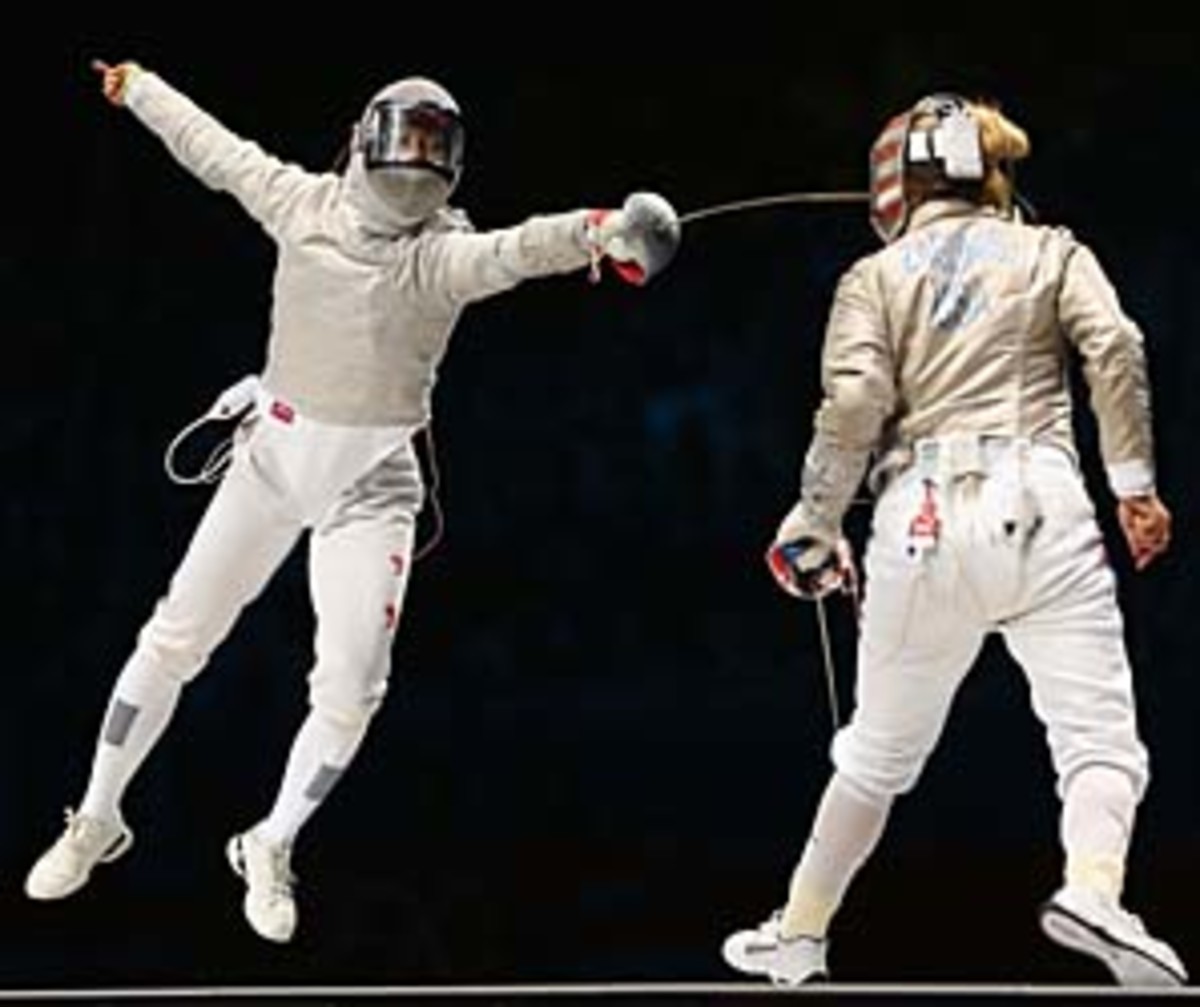
LONDON -- At the Games of the XXX Olympiad, the sabre is the event that is, to paraphrase English philosopher Thomas Hobbes, nasty, British and short. The hits just keep on comin'. Mariel Zagunis, the American flag bearer here, was on the piste for just 89 seconds of actual fencing time in her semifinal bout against Kim Jiyeon, the two recording a combined 28 touches. That is one touch for every three or so seconds. The earth rotates quickly on its axis in sabre. Sometimes too fast.
Zagunis, a two-time Olympic champion, was the 13-8 favorite to win again and she held a 12-5 lead against Kim, three touches from a berth in the gold medal bout. The sabre favors aggression, and Zagunis is nothing if not forward-moving on the piste and forward-thinking in her ability to conceptualize her sport. But with the virtual finish line in sight, her brain went what the British might call "walkabout."
Later, after a desultory loss in the bronze medal bout, Zagunis explained her London Bridge-sized collapse against Kim as that most human of frailties: a lapse of concentration. When asked what she had been thinking, she replied, "I wish I could tell you what I was thinking, but obviously I wasn't thinking."
Zagunis's seemingly insurmountable lead had vanished at warp speed as 12-5 became 12-10 before she scored another touch. That would be her last. Kim won 10 of the final 11 touches. Zagunis kept storming down the pitch at the deft South Korean, who would evade the attack and counter. At that point, Zagunis, rushing to finish the match, looked like she had run out of ideas. Good ones, anyway.
In the mixed zone, Zagunis essentially said she would be the last person to take anything away from the eventual gold medalist. In fact, she was the last person to take something away from Kim. Although she conceded that the South Korean was talented, the 27-year-old Zagunis said that when she loses, it invariably is not because she has been out-fenced but because she has beaten herself. The bravado was the sort of thing many sports fans like to hear -- "swagger" has become an admirable trait -- but it rang hollow coming from the top-seed in the tournament. Zagunis said she was "in disbelief" in the aftermath of the two losses, which sounds more pleasing to the ear than, say, "in denial."
There was another fourth-place medal for American fencing Wednesday, one that was greeted with greater equanimity even though Seth Kelsey lost both his epee semifinal and third-place matches in extra time. "Got to take your chances," he said with a small smile. "You win some, you lose some."
The epee suits Kelsey because, unlike the saber, it is a more contemplative weapon. The 6'-4" Kelsey, who has simian arms that help him score distant touches, is uncommonly deliberate on the piste, delighted by low-scoring matches and willing to take his chances on one touch in extra time. In another sporting context, it might be said that he is trying to take the air out of his epee.
Kelsey practically invites passivity warnings, which advance the bout to the ensuing period. The tactic failed against peripatetic Venezuelan lefthander Ruben Limardo Gascon in the semifinal and again in a more engaging bronze-medal match, when Kelsey was barely scraped on the right foot by South Korea's Jinsung Jung. (In epee, touches are permitted anywhere on the body.)
Maybe it was simply a case of modest expectations -- Kelsey never had won a bout in two previous Games -- or his victory over top-seeded Nikolai Novosjolov of Estonia in the second round, but he managed a matter-of-fact smile when his long day was done. Earlier when asked how he would spend the three hours between his quarterfinal and semifinal match, the 17th seed said, "No idea, I've never been in this position before."

Along with the pages of Sports Illustrated, you'll find senior writer Michael Farber in the Hockey Hall of Fame. Farber joined the staff of Sports Illustrated in January 1994 and now stands as one of the magazine's top journalists, covering primarily ice hockey and Olympic sports. He is also a regular contributor to SI.com. In 2003 Farber was honored with the Elmer Ferguson Award from the Hockey Hall of Fame for distinguished hockey writing. "Michael Farber represents the best in our business," said the New York Post's Larry Brooks, past president of the Professional Hockey Writers' Association. "He is a witty and stylish writer, who has the ability to tell a story with charm and intelligence." Farber says his Feb. 2, 1998 piece on the use and abuse of Sudafed among NHL players was his most memorable story for SI. He also cites a feature on the personal problems of Kevin Stevens, Life of the Party. His most memorable sports moment as a journalist came in 1988 when Canadian Ben Johnson set his controversial world record by running the 100 meters in 9.79 seconds at the Summer Olympic Games, in Seoul. Before coming to Sports Illustrated, Farber spent 15 years as an award-winning sports columnist and writer for the Montreal Gazette, three years at the Bergen Record, and one year at the Sun Bulletin in Binghamton, NY. He has won many honors for his writing, including the "outstanding sports writing award" in 2007 from Sports Media Canada, and the Prix Jacques-Beauchamp (Quebec sportswriter of the year) in 1993. While at the Gazette, he won a National Newspaper award in 1982 and 1990. Sometimes Life Gets in the Way, a compendium of his best Gazette columns, was published during his time in newspapers. Farber says hockey is his favorite sport to cover. "The most down-to-earth athletes play the most demanding game," he says. Away from Sports Illustrated, Farber is a commentator for CJAD-AM in Montreal and a panelist on TSN's The Reporters (the Canadian equivalent of ESPN's The Sports Reporters in the United States, except more dignified). Farber is also one of the 18 members on the Hockey Hall of Fame selection committee. Born and raised in New Jersey, Farber is a 1973 graduate of Rutgers University where he was Phi Beta Kappa. He now resides in Montreal with his wife, Danielle Tétrault, son Jérémy and daughter Gabrielle.