%20%20--%3E%0A%3Csvg%20version%3D%221.1%22%20id%3D%22Layer_1%22%20xmlns%3D%22http%3A%2F%2Fwww.w3.org%2F2000%2Fsvg%22%20xmlns%3Axlink%3D%22http%3A%2F%2Fwww.w3.org%2F1999%2Fxlink%22%20x%3D%220px%22%20y%3D%220px%22%0A%09%20width%3D%2239px%22%20height%3D%2240px%22%20viewBox%3D%220%200%2039%2040%22%20enable-background%3D%22new%200%200%2039%2040%22%20xml%3Aspace%3D%22preserve%22%3E%0A%3Cpath%20fill%3D%22%23FFFFFF%22%20d%3D%22M38.5%2C7H28.2v26h10.3V7z%22%2F%3E%0A%3Cpath%20fill-rule%3D%22evenodd%22%20clip-rule%3D%22evenodd%22%20fill%3D%22%23FFFFFF%22%20d%3D%22M26.1%2C25.5c0%2C5.8-4.1%2C7.5-12.9%2C7.5C3.9%2C33%2C0%2C31.2%2C0%2C25.2v-1.1h11.6%0A%09v2.4c0%2C0.7%2C0.1%2C1.4%2C1.2%2C1.4c1%2C0%2C1.2-0.4%2C1.2-1.3v-0.9c0-1.6-0.9-1.6-3.5-2.2C2.2%2C21.7%2C0%2C19.7%2C0%2C15.3v-0.9C0%2C9.3%2C5.5%2C7%2C12.9%2C7%0A%09c10.2%2C0%2C12.8%2C2.6%2C12.8%2C7.4v1.8h-11v-2.9c0-0.6-0.4-1.1-1.2-1.1c-0.6%2C0-1.2%2C0.4-1.2%2C1.1v0.9c0%2C1.5%2C0.9%2C2%2C3.3%2C2.5%0A%09c8%2C1.6%2C10.5%2C3.3%2C10.5%2C7.5V25.5z%22%2F%3E%0A%3C%2Fsvg%3E%0A)
Wise beyond his years, LeBron James isn't fazed by Bulls physical play

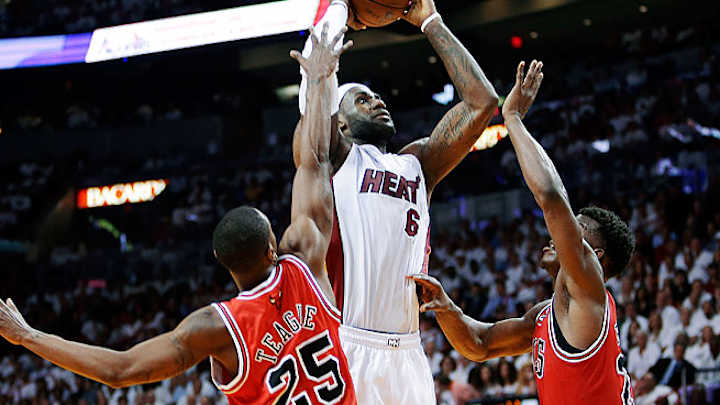
CHICAGO -- When the hard shove came from Nazr Mohammed, it was like the shoe flying at President George W. Bush years ago. Where did that come from? It was surprising enough to make anyone shout. It was one of those things that does not happen anymore.
Twenty or 30 years ago a star like LeBron James would have been wary of more than a two-handed shove to knock him sliding backward on his rear end. But the days of brawls and punches have been drummed out of pro basketball, which explained why James appeared to need a few minutes to work himself back into Game 3 in the conference semifinal here after the ejection of Mohammed early in the second quarter. He was surprised, but the shock wore away soon enough, and by the end of the half he was back to offering advice to teammates and affecting the game in every phase.
"I think his putting together the psychological part of the game is making him the version we see today," said Shane Battier, who at 34 is finishing his second season in Miami with James. "He still has room to grow, and that's the fun part."
Watch: Bulls' Mohammed shoves James to the floor
The psychology of the game?
"He just puts it all together," Battier said after a long thoughtful pause. "Obviously, he has amazing athleticism with a strong knowledge of the game. It's next-level thinking, in terms of what needs to be done in certain points of the game, and how to do it. That comes to all veterans playing in this league. By the end, every veteran says, 'Damn, I wish I had known then what I know now, the game would have been so much easier.'
"The difference is when you're old, like me, you don't have the physical [talent] to do what LeBron can do. That's what makes special players historical -- they buy into the mental, the psychological, the physical, and that raises [them] to a level no one can match."
So the Bulls' intensity, in a perverse way, is doing him a favor by forcing James to raise his level of play?
Battier was shaking his head to show that I was all wrong.
"I don't think they're helping him or hurting him at this point," Battier said. "And that's the difference."
In other words, James is playing at a level beyond the Bulls' ability to influence him with an unexpected shove to the floor.
"A little bit," Battier said. "That's the difference. A younger player may need that physical challenge to get it on. Like LeBron says, he's here to play basketball. It's immaterial. He understands it's a tactic, just like boxing out is a tactic or his defense is a tactic, or trapping pick-and-rolls is a tactic. It's just a tactic."
When James talks about trying to become the greatest player of all time -- greater than Bill Russell, greater than Michael Jordan -- his preps-to-pro background looks suddenly like an attribute rather than a hindrance. When Jordan was finishing his 10th NBA season, he was 32. So was Russell. Those ages are crucial, because they would each play no more than three additional years of championship basketball.
James is 28. When his NBA mileage has reached the limits of Russell and Jordan, James will still only be 31. He will have the wise old head attached to a not-so-old body.
If he wants to play into his mid-30s, he'll be able to become a full-time power forward setting up in the post to pass or score. Until then, he'll continue building on the foundation constructed from experiences gained from this decade of perspective. Already he has learned how to overcome ridiculous expectations. He knows what it's like to be the prodigy loved by everybody, and he knows how to live with being the ingrate despised by everybody. No enemy arena can intimidate him anymore.
This was Dwyane Wade's team when James and Chris Bosh joined him in Miami nearly three summers ago. Wade was the only one who knew how to win a championship. Wade made room for the others to find their way on his home floor and in his locker room. The reason the Heat are James' team now is not simply because of his talent. It's because he worked so hard and overcame so much to earn his sense of what works and what doesn't.
"We've seen everything," Heat coach Erik Spoelstra said for the umpteenth time. "None of this is new to us. Nobody can hide from the fact that the games will be decided between those four lines."
Russell and Jordan had their own pressures and obstacles to overcome. James overcame the attention and scrutiny of his era when he was still young enough to put his experiences to the best kind of use. His immaturity cost him enormously leading up to 2010, but it also taught him the lessons that make him so difficult to beat today.
"It's tough for me to appreciate fully right now," Battier said of his experiences with one of the game's great players. "He's raised my game in the time I've needed it in my career; I'd like to think I've taught him a few things about the thinking outside of basketball. He's been great for me in a lot of different regards. You have so many interactions during the year, they're small. Maybe on the court during a timeout, or maybe in the film session, or maybe after a game, maybe on the bus, maybe at dinner somewhere. Things come up, we talk about it, and that's pretty normal for guys."
The conversations have added up. Ten years of them now, and James is still young, and just now peaking. Nazr Mohammed never really had a chance.

Senior Writer, Sports Illustrated Sports Illustrated Senior Writer Ian Thomsen, who joined the magazine in 1998, is one of SI's top basketball scribes. Along with writing columns and features for SI, Thomsen is a frequent contributor to SI.com. Before joining SI, Thomsen spent six years in Europe as the sports columnist for the International Herald Tribune, the world's largest international English-language daily. While at the paper Thomsen wrote about an array of sports for a global audience, including the major world and European soccer tournaments, the 1995 Rugby World Cup, Olympic Games, Ryder Cups, Grand Slam tennis events, Grand Prix auto races and, very rarely, cricket. Thomsen, who graduated from Northwestern with a journalism degree in 1983, was a feature writer for The National Sports Daily during its short, expensive run of 1990-91. His first job was with The Boston Globe, where he covered Doug Flutie's Boston College Eagles and all three of the Celtics-Lakers NBA Finals of the 1980s. Thomsen was a feature writer at SI before taking on the NBA beat fulltime in 2000. With Luis Fernando Llosa and Melissa Segura, Thomsen covered the 2001 scandal of overaged Little League pitcher Danny Almonte and wrote the first SI cover story on Kobe Bryant in 1998. Thomsen lives with his wife and two children near Boston.