%20%20--%3E%0A%3Csvg%20version%3D%221.1%22%20id%3D%22Layer_1%22%20xmlns%3D%22http%3A%2F%2Fwww.w3.org%2F2000%2Fsvg%22%20xmlns%3Axlink%3D%22http%3A%2F%2Fwww.w3.org%2F1999%2Fxlink%22%20x%3D%220px%22%20y%3D%220px%22%0A%09%20width%3D%2239px%22%20height%3D%2240px%22%20viewBox%3D%220%200%2039%2040%22%20enable-background%3D%22new%200%200%2039%2040%22%20xml%3Aspace%3D%22preserve%22%3E%0A%3Cpath%20fill%3D%22%23FFFFFF%22%20d%3D%22M38.5%2C7H28.2v26h10.3V7z%22%2F%3E%0A%3Cpath%20fill-rule%3D%22evenodd%22%20clip-rule%3D%22evenodd%22%20fill%3D%22%23FFFFFF%22%20d%3D%22M26.1%2C25.5c0%2C5.8-4.1%2C7.5-12.9%2C7.5C3.9%2C33%2C0%2C31.2%2C0%2C25.2v-1.1h11.6%0A%09v2.4c0%2C0.7%2C0.1%2C1.4%2C1.2%2C1.4c1%2C0%2C1.2-0.4%2C1.2-1.3v-0.9c0-1.6-0.9-1.6-3.5-2.2C2.2%2C21.7%2C0%2C19.7%2C0%2C15.3v-0.9C0%2C9.3%2C5.5%2C7%2C12.9%2C7%0A%09c10.2%2C0%2C12.8%2C2.6%2C12.8%2C7.4v1.8h-11v-2.9c0-0.6-0.4-1.1-1.2-1.1c-0.6%2C0-1.2%2C0.4-1.2%2C1.1v0.9c0%2C1.5%2C0.9%2C2%2C3.3%2C2.5%0A%09c8%2C1.6%2C10.5%2C3.3%2C10.5%2C7.5V25.5z%22%2F%3E%0A%3C%2Fsvg%3E%0A)
NBA Champions by Year: Complete History and Results of Every NBA Finals
In this story:
Basketball's most cherished records are set in the regular season, but lasting legacies are created in the NBA Finals. We’re currently just days away from the crowning of the next NBA champions.
Each National Basketball Association season culminates in the NBA Finals, which determine the season's champion between the winners of the Western Conference and Eastern Conference. The best-of-seven game series finale also serves as the stage for players and teams to carve their places in hoops history.
The Knicks currently lead the Spurs 2–0 in the 2026 NBA Finals, and will have a chance to close out the series by Wednesday, June 10 at the earliest if they can manage a sweep. It would be the first NBA Finals win for New York in 53 years.
The origins of the NBA Finals

The NBA recognizes its first champion as the winner of the six-team Basketball Association of America, which began in 1947. The Philadelphia Warriors defeated the Chicago Staggs 4–1 and clinched the title behind Hall of Famer Joe Fulks, who scored 21 of his 37 points in the fourth quarter of Game 5.
The Finals format of determining a champion in a first-to-four-victories series was modeled after Major League Baseball’s World Series, which was the brainchild of John T. Brush. The New York Giants principal owner proposed a best-of-seven games contest between the American League and National League champs, and the “Brush Rules” were adopted in February 1905.
The BAA played its games in major venues, such as Madison Square Garden, Boston Garden and Chicago Stadium, but the best players competed in the National Basketball League. After the NBL's four best teams joined the BAA before the 1948–49 season, the competitors merged in 1949 to create a new pro basketball league—the NBA.
When the NBA expanded from 10 to 12 teams in 1968, the basketball market in America had room for a new upstart league in the American Basketball Association. The ABA promoted a flashy, high-scoring brand of hoops, including the three-point shot, but in 1976, the league folded with four of its teams joining the NBA—Denver Nuggets, Indiana Pacers, New York Nets and San Antonio Spurs.
Every NBA champion in history

George Mikan and the Minneapolis Lakers won the first NBA Finals in 1950, defeating the Syracuse Nationals 4–2. The Lakers featured Hall of Famers in Mikan, Jim Pollard, Slater Martin and Vern Mikkelsen, and with the 6'10" Mikan, they dominated defensively on their narrow home court at Minneapolis Auditorium.
Minneapolis would win three more NBA Finals before the league's defining dynasty took over.
In 1957, the Boston Celtics defeated the St. Louis Hawks 4–3 to capture their first-ever NBA championship. Under legendary coach Red Auerbach, the Celtics won 10 more league crowns over the next 12 seasons. Bill Russell served as the inspirational leader and defensive anchor for all 11 title teams and is the record holder for most NBA championships by a player.
Boston enjoyed another run of success in the 1980s, but it coincided with the emergence of a new Lakers dynasty in Los Angeles.
The Larry Bird vs. Magic Johnson rivalry that elevated college basketball to new heights had the same game-changing impact on the NBA. The two all-time greats faced off in some of the league’s most memorable Finals battles and combined for eight championships in the 80s—Johnson out-dueling Bird 5–3 in Larry O’Brien Trophy wins.
More dynasties would rule the NBA.
In the 1990s, Michael Jordan and the Bulls achieved not one but two three-peats by winning three consecutive titles from 1991 to ‘93 and from ‘96 to ’98. Stephen Curry and the Warriors ushered in a new era of prioritizing the three-pointer when they won the 2015 crown, the first of four championships in an eight-year period.
The Celtics have won the most NBA titles with 18, one more than the Lakers. The Warriors rank third with seven championships. The Bulls and Spurs have won six and five NBA crowns, respectively.
Year | Winning Team | Losing Team | Series Result | Finals MVP |
|---|---|---|---|---|
1947 | Philadelphia Warriors | Chicago Stags | 4–1 | Not awarded |
1948 | Baltimore Bullets | Philadelphia Warriors | 4–2 | Not awarded |
1949 | Minneapolis Lakers | Washington Capitols | 4–2 | Not awarded |
1950 | Minneapolis Lakers | Syracuse Nationals | 4–2 | Not awarded |
1951 | Rochester Royals | New York Knicks | 4–3 | Not awarded |
1952 | Minneapolis Lakers | New York Knicks | 4–1 | Not awarded |
1953 | Minneapolis Lakers | New York Knicks | 4–1 | Not awarded |
1954 | Minneapolis Lakers | Syracuse Nationals | 4–3 | Not awarded |
1955 | Syracuse Nationals | Fort Wayne Pistons | 4–3 | Not awarded |
1956 | Philadelphia Warriors | Fort Wayne Pistons | 4–1 | Not awarded |
1957 | Boston Celtics | St. Louis Hawks | 4–3 | Not awarded |
1958 | St. Louis Hawks | Boston Hawks | 4–2 | Not awarded |
1959 | Boston Celtics | Minneapolis Lakers | 4–0 | Not awarded |
1960 | Boston Celtics | St. Louis Hawks | 4–3 | Not awarded |
1961 | Boston Celtics | St. Louis Hawks | 4–1 | Not awarded |
1962 | Boston Celtics | Los Angeles Lakers | 4–3 | Not awarded |
1963 | Boston Celtics | Los Angeles Lakers | 4–2 | Not awarded |
1964 | Boston Celtics | San Francisco Warriors | 4–1 | Not awarded |
1965 | Boston Celtics | Los Angeles Lakers | 4–1 | Not awarded |
1966 | Boston Celtics | Los Angeles Lakers | 4–3 | Not awarded |
1967 | Philadelphia 76ers | San Francisco Warriors | 4–2 | Not awarded |
1968 | Boston Celtics | Los Angeles Lakers | 4–2 | Not awarded |
1969 | Boston Celtics | Los Angeles Lakers | 4–3 | Jerry West |
1970 | New York Knicks | Los Angeles Lakers | 4–3 | Willis Reed |
1971 | Milwaukee Bucks | Baltimore Bullets | 4–0 | Lew Alcindor |
1972 | Los Angeles Lakers | New York Knicks | 4–1 | Wilt Chamberlain |
1973 | New York Knicks | Los Angeles Lakers | 4–1 | Willis Reed |
1974 | Boston Celtics | Milwaukee Bucks | 4–3 | John Havlicek |
1975 | Golden State Warriors | Washington Bullets | 4–0 | Rick Barry |
1976 | Boston Celtics | Phoenix Suns | 4–2 | Jo Jo White |
1977 | Portland Trail Blazers | Philadelphia 76ers | 4–2 | Bill Walton |
1978 | Washington Bullets | Seattle SuperSonics | 4–3 | Wes Unseld |
1979 | Seattle SuperSonics | Washington Bullets | 4–1 | Dennis Johnson |
1980 | Los Angeles Lakers | Philadelphia 76ers | 4–2 | Magic Johnson |
1981 | Boston Celtics | Houston Rockets | 4–2 | Cedric Maxwell |
1982 | Los Angeles Lakers | Philadelphia 76ers | 4–2 | Magic Johnson |
1983 | Philadelphia 76ers | Los Angeles Lakers | 4–0 | Moses Malone |
1984 | Boston Celtics | Los Angeles Lakers | 4–3 | Larry Bird |
1985 | Los Angeles Lakers | Boston Celtics | 4–2 | Kareem Abdul-Jabbar |
1986 | Boston Celtics | Houston Rockets | 4–2 | Larry Bird |
1987 | Los Angeles Lakers | Boston Celtics | 4–2 | Magic Johnson |
1988 | Los Angeles Lakers | Detroit Pistons | 4–3 | James Worthy |
1989 | Detroit Pistons | Los Angeles Lakers | 4–0 | Joe Dumars |
1990 | Detroit Pistons | Portland Trail Blazers | 4–1 | Isiah Thomas |
1991 | Chicago Bulls | Los Angeles Lakers | 4–1 | Michael Jordan |
1992 | Chicago Bulls | Portland Trail Blazers | 4–2 | Michael Jordan |
1993 | Chicago Bulls | Phoenix Suns | 4–2 | Michael Jordan |
1994 | Houston Rockets | New York Knicks | 4–3 | Hakeem Olajuwon |
1995 | Houston Rockets | Orlando Magic | 4–0 | Hakeem Olajuwon |
1996 | Chicago Bulls | Seattle SuperSonics | 4–2 | Michael Jordan |
1997 | Chicago Bulls | Utah Jazz | 4–2 | Michael Jordan |
1998 | Chicago Bulls | Utah Jazz | 4–2 | Michael Jordan |
1999 | San Antonio Spurs | New York Knicks | 4–1 | Tim Duncan |
2000 | Los Angeles Lakers | Indiana Pacers | 4–2 | Shaquille O'Neal |
2001 | Los Angeles Lakers | Philadelphia 76ers | 4–1 | Shaquille O'Neal |
2002 | Los Angeles Lakers | New Jersey Nets | 4–0 | Shaquille O'Neal |
2003 | San Antonio Spurs | New Jersey Nets | 4–2 | Tim Duncan |
2004 | Detroit Pistons | Los Angeles Lakers | 4–1 | Chauncey Billups |
2005 | San Antonio Spurs | Detroit Pistons | 4–3 | Tim Duncan |
2006 | Miami Heat | Dallas Mavericks | 4–2 | Dwyane Wade |
2007 | San Antonio Spurs | Cleveland Cavaliers | 4–0 | Tony Parker |
2008 | Boston Celtics | Los Angeles Lakers | 4–2 | Paul Pierce |
2009 | Los Angeles Lakers | Orlando Magic | 4–1 | Kobe Bryant |
2010 | Los Angeles Lakers | Boston Celtics | 4–3 | Kobe Bryant |
2011 | Dallas Mavericks | Miami Heat | 4–2 | Dirk Nowitzki |
2012 | Miami Heat | Oklahoma City Thunder | 4–1 | LeBron James |
2013 | Miami Heat | San Antonio Spurs | 4–3 | LeBron James |
2014 | San Antonio Spurs | Miami Heat | 4–1 | Kawhi Leonard |
2015 | Golden State Warriors | Cleveland Cavaliers | 4–2 | Andre Iguodala |
2016 | Cleveland Cavaliers | Golden State Warriors | 4–3 | LeBron James |
2017 | Golden State Warriors | Cleveland Cavaliers | 4–1 | Kevin Durant |
2018 | Golden State Warriors | Cleveland Cavaliers | 4–0 | Kevin Durant |
2019 | Toronto Raptors | Golden State Warriors | 4–2 | Kawhi Leonard |
2020 | Los Angeles Lakers | Miami Heat | 4–2 | LeBron James |
2021 | Milwaukee Bucks | Phoenix Suns | 4–2 | Giannis Antetokounmpo |
2022 | Golden State Warriors | Boston Celtics | 4–2 | Stephen Curry |
2023 | Denver Nuggets | Miami Heat | 4–1 | Nikola Jokic |
2024 | Boston Celtics | Dallas Mavericks | 4–1 | Jaylen Brown |
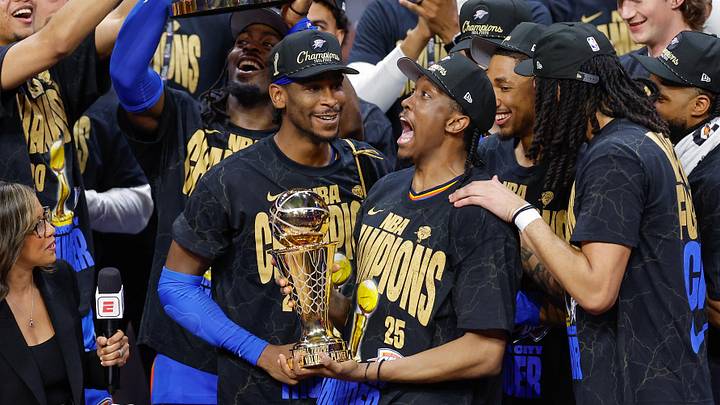
2025 | Oklahoma City Thunder | Indiana Pacers | 4–3 | Shai Gilgeous-Alexander |
Iconic moments and performances in NBA Finals history
The NBA’s all-time greats have produced iconic Finals moments that live on in the memories of basketball fans and in perpetuity on YouTube. The most celebrated plays are the clutch shots that helped teams secure the championship.
Arguably the most iconic shot in NBA history is Michael Jordan’s 20-foot jumper that clinched the Bulls’ 1998 title against the Jazz. Expected to retire after the series, the 34-year-old Jordan scored on a layup to cut Chicago’s deficit to one point, stole the ball from Karl Malone and then crossed over Bryon Russell to bury the go-ahead basket with 5.2 seconds left.
Jordan walked away from basketball (temporarily) after winning his sixth NBA championship.
LeBron James, Jordan’s main competition for GOAT status, has his own Finals highlight with the most historic display of championship-level defense for his home state Cavaliers.
In Game 7 of perhaps the greatest NBA Finals ever against the record-setting 73-win Warriors in 2016, James chased down Andre Iguodala to block his layup attempt and keep the score tied at 89 with less than two minutes remaining. Kyrie Irving’s three-pointer with 53 seconds left gave the Cavaliers the lead for good as Cleveland completed a historic comeback from a 3–1 series deficit.
NBA Finals lore also features dominant one-man performances.
Magic Johnson famously filled in for an injured Kareem Abdul-Jabbar at center in Game 6 of the 1980 Finals, and the 20-year-old rookie totaled 42 points, 15 rebounds and seven assists to lead the Lakers to a title-clinching 123–107 victory.
On one historic occasion, the mere presence of a player provided the inspiration to win the championship. That uplifting scenario took place in Game 7 of the 1970 NBA Finals with New York Knicks center Willis Reed.
Reed wasn't expected to play the series finale against the Lakers after suffering a muscle tear in his right thigh, but he shocked his teammates when he walked onto the court for pregame warmups. The Madison Square Garden crowd greeted him with a standing ovation.
Reed summoned the will and energy to play “on one leg” while trying to defend Wilt Chamberlain. The Knicks captain played 27 minutes and finished with just four points, well below his 21.7-point average, but New York rallied behind Walt Frazier's 36 points and 19 assists to win the franchise’s first NBA championship.
Low TV ratings relegated the NBA Finals to be broadcast on tape delay in the late 1970s and early 1980s. However, viewers who tuned in to Game 5 of the 1976 Finals were treated to an epic three-overtime battle between the Suns and Celtics.
The craziest sequence took place at the end of the second OT when John Havlicek banked in a 15-foot shot for what appeared to be the game-winner. One second was still on the clock, and it was more than enough time for Garfield Heard to sink a 20-foot turnaround jumper to force a third overtime.
Boston eventually would win 128–126 to take a 3–2 series lead en route to the franchise’s 13th NBA crown.
Evolution of the NBA Finals Format
In 1985, the NBA changed its Finals format from 2-2-1-1-1—playing consecutive games on each team's home court before alternating venues with single contests—to a more travel-friendly 2-3-2 schedule.
The late David Stern admitted he made the change in his first year as NBA commissioner at the behest of Celtics patriarch Auerbach, who saw the inconveniences of long cross-country travel during the 1984 Finals between the Celtics and Lakers.
"Although he's not here to defend himself and deny it, I tell you that Red said to me back in ’84, ‘This is too much. Play, travel, play, travel, play, travel,’” Stern told reporters in 2008. “In subsequent years he said it was terrible that we changed it to 2-3-2, but a young commissioner was motivated by the father of us all.”
Higher-seeded teams (due to a better regular-season record) still had the luxury of starting the series at home, but over the years, the 2-3-2 format favored the lower-seeded squad, which got to spend an entire week in its home city playing Games 3, 4 and 5 (if necessary) on its court.
In 2013, the NBA approved a return to the 2-2-1-1 format. It has served as the Finals schedule since 2014 with the higher-seeded team hosting Games 1, 2, 5 and 7 and the lower-seeded team hosting Games 3, 4 and 6.
More NBA Finals From Sports Illustrated
Listen to SI’s NBA podcast, Open Floor, below or on Apple and Spotify. Watch the show on SI’s YouTube channel.
 Add us as a preferred source on Google