%20%20--%3E%0A%3Csvg%20version%3D%221.1%22%20id%3D%22Layer_1%22%20xmlns%3D%22http%3A%2F%2Fwww.w3.org%2F2000%2Fsvg%22%20xmlns%3Axlink%3D%22http%3A%2F%2Fwww.w3.org%2F1999%2Fxlink%22%20x%3D%220px%22%20y%3D%220px%22%0A%09%20width%3D%2239px%22%20height%3D%2240px%22%20viewBox%3D%220%200%2039%2040%22%20enable-background%3D%22new%200%200%2039%2040%22%20xml%3Aspace%3D%22preserve%22%3E%0A%3Cpath%20fill%3D%22%23FFFFFF%22%20d%3D%22M38.5%2C7H28.2v26h10.3V7z%22%2F%3E%0A%3Cpath%20fill-rule%3D%22evenodd%22%20clip-rule%3D%22evenodd%22%20fill%3D%22%23FFFFFF%22%20d%3D%22M26.1%2C25.5c0%2C5.8-4.1%2C7.5-12.9%2C7.5C3.9%2C33%2C0%2C31.2%2C0%2C25.2v-1.1h11.6%0A%09v2.4c0%2C0.7%2C0.1%2C1.4%2C1.2%2C1.4c1%2C0%2C1.2-0.4%2C1.2-1.3v-0.9c0-1.6-0.9-1.6-3.5-2.2C2.2%2C21.7%2C0%2C19.7%2C0%2C15.3v-0.9C0%2C9.3%2C5.5%2C7%2C12.9%2C7%0A%09c10.2%2C0%2C12.8%2C2.6%2C12.8%2C7.4v1.8h-11v-2.9c0-0.6-0.4-1.1-1.2-1.1c-0.6%2C0-1.2%2C0.4-1.2%2C1.1v0.9c0%2C1.5%2C0.9%2C2%2C3.3%2C2.5%0A%09c8%2C1.6%2C10.5%2C3.3%2C10.5%2C7.5V25.5z%22%2F%3E%0A%3C%2Fsvg%3E%0A)
Who Is Larry O'Brien and Why Is the NBA Finals Trophy Named After Him?
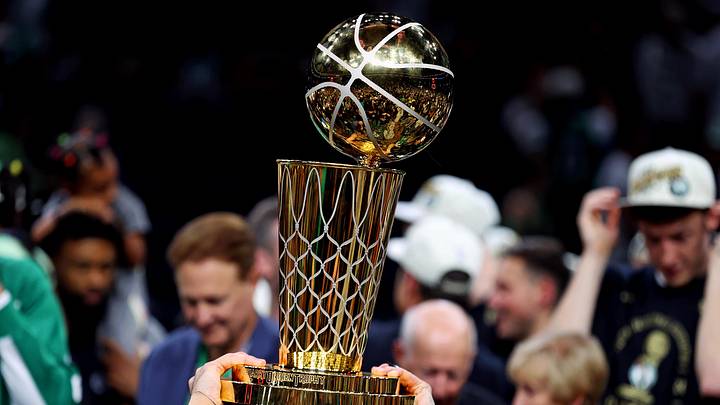
We’re just days away from crowning a new NBA champion, as the Knicks lead the Spurs 2–0 in the 2026 NBA Finals. We’re currently on pace for Jalen Brunson and Karl-Anthony Towns to raise the Larry O’Brien Trophy, though there is still time for Victor Wembanyama & Co. to come back (it would take a historic effort, however, after the team dropped two games at home to start the series).
Lawrence Francis O’Brien Jr., better known as Larry O’Brien, is the namesake of the most prestigious trophy in the NBA. However, O’Brien never played a meaningful game of basketball in his life.
So why is the NBA championship trophy named the Larry O’Brien Trophy?
Let’s break it down.
O’Brien was born on July 7, 1917, in Springfield, Mass., the city that's referred to as the birthplace of basketball and is home to the Naismith Basketball Hall of Fame. The son of Irish immigrants, O’Brien had humble beginnings but developed an interest in and appreciation for politics at a relatively young age.
After graduating from the Northeastern University School of Law in 1942 O’Brien began to carve out a career in the Democratic Party.
Before the NBA: Larry O’Brien’s political career
O’Brien’s first major opportunity came when he joined John F. Kennedy’s 1952 U.S. Senate campaign, for which he managed field operations. This era served as the foundation for his long relationship with the Kennedy family.
Eight years later, O’Brien would serve as Kennedy’s national campaign director. He is credited with playing a crucial role in securing the presidency for JFK. After the inauguration, O’Brien was named Special Assistant to the President. He would often meet with members of Congress and negotiate the Kennedy administration’s goals.
O’Brien was in the motorcade on that fateful day in Dallas in 1963, when President Kennedy was assassinated. After that, O’Brien worked for President Lyndon B. Johnson as Director of Legislative Affairs and Postmaster General.
In 1968, when President Johnson declined to seek the Democrat nomination, O’Brien took a job with Senator Robert F. Kennedy as an adviser. After RFK’s assassination, O’Brien became the national presidential campaign director for Vice President Hubert Humphrey.
After Humphrey lost the election to Richard Nixon, O’Brien was named the chairman of the DNC. His office was the target of the Watergate break-in.
O’Brien becomes NBA commissioner

O’Brien was brought in by the NBA to be commissioner in 1975. At that point, the league was struggling mightily. It wasn’t nearly as popular nationally as it would become in the next decade, it faced financial instability and the ABA was nipping at its heels.
With all these struggles afoot, O’Brien’s background in high-stakes Washington negotiations and management made him the perfect candidate to get the NBA back on track.
With O’Brien at the helm between 1975 and 1983, the NBA went through a number of transformations, not the least of which was its merger with the ABA in 1976.
Just one year into his tenure, O’Brien led the NBA-ABA merger, which resulted in the San Antonio Spurs, Indiana Pacers, Denver Nuggets and New York Nets joining the league.
O’Brien’s NBA accomplishments
Beyond the merger, O’Brien oversaw a number of other monumental projects as NBA commissioner.
The NBA added an expansion franchise, the Mavericks, in 1980. O’Brien orchestrated the then-richest television broadcast deal in the league’s history. He also brought the league to cable TV in deals with USA and ESPN.
He also worked on the settlement of the Oscar Robertson lawsuit, which led to a new free agency system; introduced the salary cap; modified the NBA draft; and oversaw the adoption of the three-point field goal.
The creation of the Larry O'Brien Trophy
O’Brien stepped down as commissioner on November 10, 1983, after almost a decade overseeing the NBA. As he stepped down, the NBA was on the precipice of entering its golden era, with the Celtics and “Showtime” Lakers dominating the rest of the 1980s and then Michael Jordan and the Bulls revolutionizing the game in the ‘90s.
While only commissioner for eight years, O’Brien navigated a tumultuous time for the league and did so expertly. The NBA was in a bad way in the mid-1970s, but, by the end of his tenure, the league was posting record numbers at the gates and in advertising and television ratings.
As a result, the NBA wasted little time in creating a new trophy in O'Brien's honor. It replaced the Walter A. Brown Trophy, awarded to the Basketball Association of America (BAA) and later NBA champions from 1947 to 1976. What became the O’Brien trophy was introduced in ‘77 with the name “World Championship Trophy” before it was named for O’Brien after the end of his tenure in 1984.
The Larry O’Brien Trophy stands at two feet tall and weighs about 15 pounds. It is crafted out of sterling silver and covered with a 24-karat gold overlay. The trophy features a regulation-sized basketball at the top and was redesigned by Victor Solomon for the NBA's 75th anniversary in 2021.
In most cases, the team that wins the championship keeps the trophy. There is, however, one exception. In 2017, Tilman Fertitta purchased the Rockets, and former owner Leslie Alexander (who sold him the team) kept the original 1994 and ’95 trophies. As a result, Houston needed to create replicas, which they commissioned after the sale and revealed in ‘18.
More NBA From Sports Illustrated
Listen to SI’s NBA podcast, Open Floor, below or on Apple and Spotify. Watch the show on SI’s YouTube channel.
 Add us as a preferred source on Google
Nathan Cunningham is a writer for Sports Illustrated and Minute Media. Throughout his career, he has written about collegiate sports, NFL Draft, Super Bowl champions, and more. Nathan has also been featured in FanSided and 90Min. Nathan loves colorful uniforms, mascots and fast-break pull-up 3-pointers. He graduated from BYU in 2016 with a degree in journalism.

Dan Lyons is a staff writer and editor at Sports Illustrated. He joined SI for his second stint in November 2024 after a season as senior college football writer at Athlon Sports and previous three-year run at SI as a writer and editor for the Breaking and Trending News team. When he’s not watching a game, you can find Dan at an indie concert venue or movie theater. Dan has a bachelor’s degree in writing and rhetoric from Syracuse.
Follow dan_lyons76