%20%20--%3E%0A%3Csvg%20version%3D%221.1%22%20id%3D%22Layer_1%22%20xmlns%3D%22http%3A%2F%2Fwww.w3.org%2F2000%2Fsvg%22%20xmlns%3Axlink%3D%22http%3A%2F%2Fwww.w3.org%2F1999%2Fxlink%22%20x%3D%220px%22%20y%3D%220px%22%0A%09%20width%3D%2239px%22%20height%3D%2240px%22%20viewBox%3D%220%200%2039%2040%22%20enable-background%3D%22new%200%200%2039%2040%22%20xml%3Aspace%3D%22preserve%22%3E%0A%3Cpath%20fill%3D%22%23FFFFFF%22%20d%3D%22M38.5%2C7H28.2v26h10.3V7z%22%2F%3E%0A%3Cpath%20fill-rule%3D%22evenodd%22%20clip-rule%3D%22evenodd%22%20fill%3D%22%23FFFFFF%22%20d%3D%22M26.1%2C25.5c0%2C5.8-4.1%2C7.5-12.9%2C7.5C3.9%2C33%2C0%2C31.2%2C0%2C25.2v-1.1h11.6%0A%09v2.4c0%2C0.7%2C0.1%2C1.4%2C1.2%2C1.4c1%2C0%2C1.2-0.4%2C1.2-1.3v-0.9c0-1.6-0.9-1.6-3.5-2.2C2.2%2C21.7%2C0%2C19.7%2C0%2C15.3v-0.9C0%2C9.3%2C5.5%2C7%2C12.9%2C7%0A%09c10.2%2C0%2C12.8%2C2.6%2C12.8%2C7.4v1.8h-11v-2.9c0-0.6-0.4-1.1-1.2-1.1c-0.6%2C0-1.2%2C0.4-1.2%2C1.1v0.9c0%2C1.5%2C0.9%2C2%2C3.3%2C2.5%0A%09c8%2C1.6%2C10.5%2C3.3%2C10.5%2C7.5V25.5z%22%2F%3E%0A%3C%2Fsvg%3E%0A)
No matter what age, sibling rivalry always runs deep

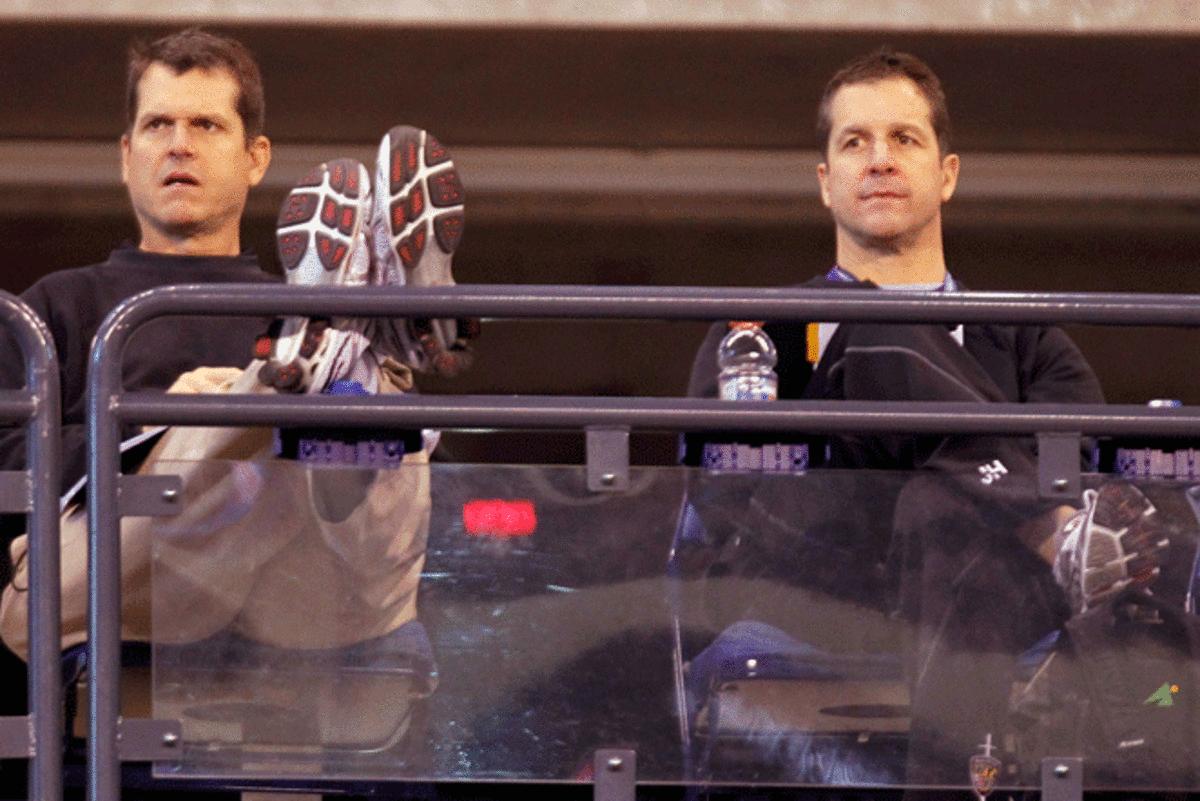
Perhaps you've heard of the sibling rivalry between Jim and John Harbaugh, who'll soon share the Super Bowl stage as they once shared a bedroom. But what exactly is sibling rivalry, and can someone please make it stop, because it's less likely to send you to the Super Bowl than it is to the ER.
Trust me. When he was three years old and could stand on his own, my youngest brother was set in front of a small hockey goal in the basement while his three older brothers fired slap shots at him with a tennis ball. We were trying to knock him over, as if he were one of those frizzy-haired clowns in a carnival midway game, which was a tad dangerous, considering that my oldest brother -- clown-haired himself -- was a high school hockey star with a slap shot slightly harder than Zdeno Chara's.
Yes, my little brother became a high school hockey star in his own right, drafted by the New York Rangers, who liked that his hide had been toughened at an early age by a fusillade of Day-Glo Penn tennis balls. After all, my parents were raising boys, not veal, and my father frequently advised us to develop a thick skin (advice, in hindsight, that we may have taken too literally).
True, my little brother's name is John, and my oldest brother is Jim, just like the Harbaughs. But I don't want parents to encourage their children to compete violently with one another on the grounds that it will make those kids good at sports. It won't. Or it might not. Or even if it does, it's just wrong.
You think I liked it when my brother Tom, a year older, backed me down the shag-carpeted lane of our shared bedroom to dunk over me on the Nerf hoop that hung over the door -- a door whose various dents and dings were covered with a succession of posters that reflected our evolution of interests: Pigs In Space, Fran Tarkenton, Farrah Fawcett.
When he realized that our Nerf basketball was nothing more than a giant sponge, which retained the smell of anything it came into contact with, Tom began to clap the ball over my face like a chloroformed cloth, forcing me to inhale whatever foul substance he had thought to imbue it with. (And there was no limit to his imagination.)
I can't say that made me a better basketball player, though I can now see how sniffing a basketball was -- with the benefit of hindsight -- good training to become a sportswriter.
As the Harbaughs know, this stuff isn't forgotten just because you're middle-aged. Before I could get married in the Catholic church, I was required to spend an afternoon in what is called a pre-Cana counseling course, where grooms-to-be were divided into groups according to birth order. I -- the third of five kids -- was placed at a table of "middle children," a lachrymose group of Jan Bradys who were posed a question by an earnest counselor: "What was the best and worst thing about being a middle child?"
"The worst thing," I answered sincerely, "was always having an older brother to beat me up."
"And the best?" the counselor asked, with furrowed brow, while making ominous notes in my chart.
"Always having a younger brother to beat up," I said.
Ten years later I have four children and they compete to the be first into the van and the first out of the van, the first into the tub and the first out of the tub. They fight every morning over kitchen chairs, favorite spoons, the sole purple cereal bowl and the last frozen waffle.
At night, they fight in their sleep. They can be heard, through the wall, arguing over the covers at four o'clock in the morning. Every game of Sorry! ends in an overturned board, game pieces scattered, tears, recrimination and slamming doors, just as it did when I was eight.
When the name of the game is a shouted apology -- Sorry! -- it's bound to end poorly. But still, "sibling rivalry" is a euphemism, a too-clean phrase for a dirty practice that never ends, no matter how the Harbaughs play nice in their pre-game press conferences.
When I last got together with my three brothers, at Christmas, they still busted my chops over my shoes, my driving, my alleged reluctance -- never grounded in reality -- to pick up a dinner check.
I was talking to Tom one morning over the holidays -- I was in mid-sentence, in fact -- when he reached up and plucked a rogue hair from my ear. Inflicting pain is what brothers do to one another, as one Harbaugh will learn in New Orleans.
It's been years since any of us have come to blows, of course, but if we ever do again, we'll be fine, because the four of us also have a sister who was mostly just an observer of these reindeer games, inuring her to the sight of blood and broken bones.
Amy is now an ER doctor, and the one possible argument in favor of sibling rivalry.

Special Contributor, Sports Illustrated Steve Rushin was born in Elmhurst, Ill. on September 22, 1966 and raised in Bloomington, Minn. After graduating from Bloomington Kennedy High School in 1984 and Marquette University in 1988, Rushin joined the staff of Sports Illustrated. He is a Special Contributor to the magazine, for which he writes columns and features. In 25 years at SI, he has filed stories from Greenland, India, Indonesia, Antarctica, the Arctic Circle and other farflung locales, as well as the usual locales to which sportswriters are routinely posted. His first novel, The Pint Man, was published by Doubleday in 2010. The Los Angeles Times called the book "Engaging, clever and often wipe-your-eyes funny." His next book, a work of nonfiction, The 34-Ton Bat, will be published by Little, Brown in 2013. Rushin gave the commencement address at Marquette in 2007 and was awarded an honorary Doctor of Letters for "his unique gift of documenting the human condition through his writing." In 2006 he was named the National Sportswriter of the Year by the National Sportswriters and Sportscasters Association. A collection of his sports and travel writing—The Caddie Was a Reindeer—was published by Grove Atlantic in 2005 and was a semifinalist for the Thurber Prize for American Humor. The Denver Post suggested, "If you don't end up dropping The Caddie Was a Reindeerduring fits of uncontrollable merriment, it is likely you need immediate medical attention." A four-time finalist for the National Magazine Award, Rushin has had his work anthologized in The Best American Sports Writing, The Best American Travel Writing and The Best American Magazine Writing collections. His essays have appeared in Time magazine andThe New York Times. He also writes a weekly column for SI.com. His first book, Road Swing, published in 1998, was named one of the "Best Books of the Year" by Publishers Weekly and one of the "Top 100 Sports Books of All Time" by SI. He and his wife, Rebecca Lobo, have four children and live in Connecticut.