%20%20--%3E%0A%3Csvg%20version%3D%221.1%22%20id%3D%22Layer_1%22%20xmlns%3D%22http%3A%2F%2Fwww.w3.org%2F2000%2Fsvg%22%20xmlns%3Axlink%3D%22http%3A%2F%2Fwww.w3.org%2F1999%2Fxlink%22%20x%3D%220px%22%20y%3D%220px%22%0A%09%20width%3D%2239px%22%20height%3D%2240px%22%20viewBox%3D%220%200%2039%2040%22%20enable-background%3D%22new%200%200%2039%2040%22%20xml%3Aspace%3D%22preserve%22%3E%0A%3Cpath%20fill%3D%22%23FFFFFF%22%20d%3D%22M38.5%2C7H28.2v26h10.3V7z%22%2F%3E%0A%3Cpath%20fill-rule%3D%22evenodd%22%20clip-rule%3D%22evenodd%22%20fill%3D%22%23FFFFFF%22%20d%3D%22M26.1%2C25.5c0%2C5.8-4.1%2C7.5-12.9%2C7.5C3.9%2C33%2C0%2C31.2%2C0%2C25.2v-1.1h11.6%0A%09v2.4c0%2C0.7%2C0.1%2C1.4%2C1.2%2C1.4c1%2C0%2C1.2-0.4%2C1.2-1.3v-0.9c0-1.6-0.9-1.6-3.5-2.2C2.2%2C21.7%2C0%2C19.7%2C0%2C15.3v-0.9C0%2C9.3%2C5.5%2C7%2C12.9%2C7%0A%09c10.2%2C0%2C12.8%2C2.6%2C12.8%2C7.4v1.8h-11v-2.9c0-0.6-0.4-1.1-1.2-1.1c-0.6%2C0-1.2%2C0.4-1.2%2C1.1v0.9c0%2C1.5%2C0.9%2C2%2C3.3%2C2.5%0A%09c8%2C1.6%2C10.5%2C3.3%2C10.5%2C7.5V25.5z%22%2F%3E%0A%3C%2Fsvg%3E%0A)
What does future hold for football? A look ahead to Super Bowl 100
Fifty, in football, means Mike Singletary, good field position and the best possible seat for a spectator. But bear in mind, as the NFL celebrates the 50th anniversary of the Super Bowl with those golden number 50s on each stadium’s 50-yard line—that 50 is only halfway to the house, and football’s real magic number is 100.
The field, of course, is 100 yards long, and a 100-yard game remains the standard of excellence for a running back or receiver. Every number from 00 to 99—Jim Otto to Warren Sapp—has been worn by an NFL player, but never that sacrosanct figure: 100. Rendered as a Roman numeral, 100 is C, which might as well stand for Change, because the NFL will see an extraordinary amount of it in the 50 years leading up to Super Bowl 100. And what a beautiful visual that is—100—the skinny QB of the 1, sneaking behind the two rotund blockers of the zeroes.
Look for new entries in the Super Bowl 100 series, presented by Gatorade and Microsoft Surface, at SI.com/SB100 and Wired.com/SB100
Chapter 1, Oct. 7 TRAINING
Chapter 2, Oct. 28 EQUIPMENT
Chapter 3, Nov. 18 STADIUMS
Chapter 4, Dec. 9 CONCUSSIONS
Chapter 5, Dec. 16 MEDIA
Chapter 6, Dec. 30 VR
Chapter 7, Jan. 6 NFL IN SOCIETY
Chapter 8, Jan. 13 TRACKING
Chapter 9, Jan. 20 STRATEGY
Chapter 10, Jan. 27 SB 100
ROAD MAP TO
THE FUTURE
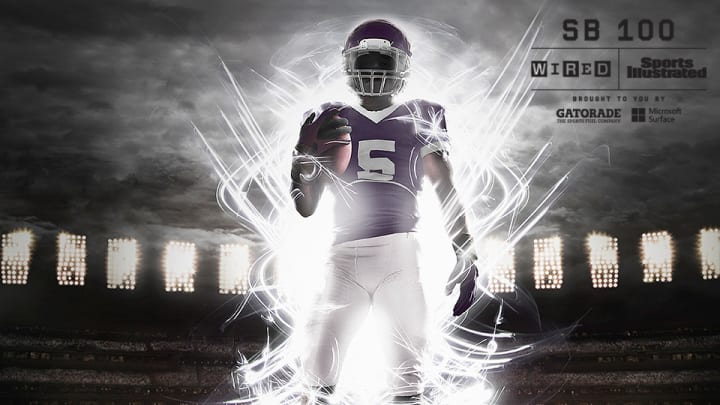
With that number in mind, Sports Illustrated and WIRED are debuting a joint project this week called Super Bowl 100. Throughout the season the two magazines and our websites—SI.com and Wired.com—will explore, in stories and in video, the enormous changes that football will see over the next five decades. The revolution is already under way in player training and tracking, data analysis, stadium and equipment design, and the treatment and prevention of concussions—all leading to a vast array of technological marvels that will make the league, 50 years from now, resemble the love child of Georges Halas and Lucas.
• MORE: Future of training |Science behind J.J. Watt's greatness
By the time the MVP of Super Bowl 100 is given the keys to his flying car, we won’t know what hit us, though virtual reality will allow us to feel as if we’ve just been hit by the gunner on a kickoff team. Speaking of which, our series kicks off here with an exploration of how far athletes might one day go to get an edge. (Data-tracking implants, anyone?) Our series will conclude just before Super Bowl 50 in February, when SI and WIRED will publish a sci-fi dispatch from Super Bowl 100, in the year 2066.
For the moment, however, we remain rooted in the right now, with nearly 50 Super Bowls down and nearly 50 Super Bowls to go, which puts us at a metaphorical midfield, the proper place for the coin flip that gets this whole show started. Call it in the air.
 Add us as a preferred source on Google
Special Contributor, Sports Illustrated Steve Rushin was born in Elmhurst, Ill. on September 22, 1966 and raised in Bloomington, Minn. After graduating from Bloomington Kennedy High School in 1984 and Marquette University in 1988, Rushin joined the staff of Sports Illustrated. He is a Special Contributor to the magazine, for which he writes columns and features. In 25 years at SI, he has filed stories from Greenland, India, Indonesia, Antarctica, the Arctic Circle and other farflung locales, as well as the usual locales to which sportswriters are routinely posted. His first novel, The Pint Man, was published by Doubleday in 2010. The Los Angeles Times called the book "Engaging, clever and often wipe-your-eyes funny." His next book, a work of nonfiction, The 34-Ton Bat, will be published by Little, Brown in 2013. Rushin gave the commencement address at Marquette in 2007 and was awarded an honorary Doctor of Letters for "his unique gift of documenting the human condition through his writing." In 2006 he was named the National Sportswriter of the Year by the National Sportswriters and Sportscasters Association. A collection of his sports and travel writing—The Caddie Was a Reindeer—was published by Grove Atlantic in 2005 and was a semifinalist for the Thurber Prize for American Humor. The Denver Post suggested, "If you don't end up dropping The Caddie Was a Reindeerduring fits of uncontrollable merriment, it is likely you need immediate medical attention." A four-time finalist for the National Magazine Award, Rushin has had his work anthologized in The Best American Sports Writing, The Best American Travel Writing and The Best American Magazine Writing collections. His essays have appeared in Time magazine andThe New York Times. He also writes a weekly column for SI.com. His first book, Road Swing, published in 1998, was named one of the "Best Books of the Year" by Publishers Weekly and one of the "Top 100 Sports Books of All Time" by SI. He and his wife, Rebecca Lobo, have four children and live in Connecticut.