%20%20--%3E%0A%3Csvg%20version%3D%221.1%22%20id%3D%22Layer_1%22%20xmlns%3D%22http%3A%2F%2Fwww.w3.org%2F2000%2Fsvg%22%20xmlns%3Axlink%3D%22http%3A%2F%2Fwww.w3.org%2F1999%2Fxlink%22%20x%3D%220px%22%20y%3D%220px%22%0A%09%20width%3D%2239px%22%20height%3D%2240px%22%20viewBox%3D%220%200%2039%2040%22%20enable-background%3D%22new%200%200%2039%2040%22%20xml%3Aspace%3D%22preserve%22%3E%0A%3Cpath%20fill%3D%22%23FFFFFF%22%20d%3D%22M38.5%2C7H28.2v26h10.3V7z%22%2F%3E%0A%3Cpath%20fill-rule%3D%22evenodd%22%20clip-rule%3D%22evenodd%22%20fill%3D%22%23FFFFFF%22%20d%3D%22M26.1%2C25.5c0%2C5.8-4.1%2C7.5-12.9%2C7.5C3.9%2C33%2C0%2C31.2%2C0%2C25.2v-1.1h11.6%0A%09v2.4c0%2C0.7%2C0.1%2C1.4%2C1.2%2C1.4c1%2C0%2C1.2-0.4%2C1.2-1.3v-0.9c0-1.6-0.9-1.6-3.5-2.2C2.2%2C21.7%2C0%2C19.7%2C0%2C15.3v-0.9C0%2C9.3%2C5.5%2C7%2C12.9%2C7%0A%09c10.2%2C0%2C12.8%2C2.6%2C12.8%2C7.4v1.8h-11v-2.9c0-0.6-0.4-1.1-1.2-1.1c-0.6%2C0-1.2%2C0.4-1.2%2C1.1v0.9c0%2C1.5%2C0.9%2C2%2C3.3%2C2.5%0A%09c8%2C1.6%2C10.5%2C3.3%2C10.5%2C7.5V25.5z%22%2F%3E%0A%3C%2Fsvg%3E%0A)
10 Lamest Rules in NASCAR
10 Lamest Rules in NASCAR
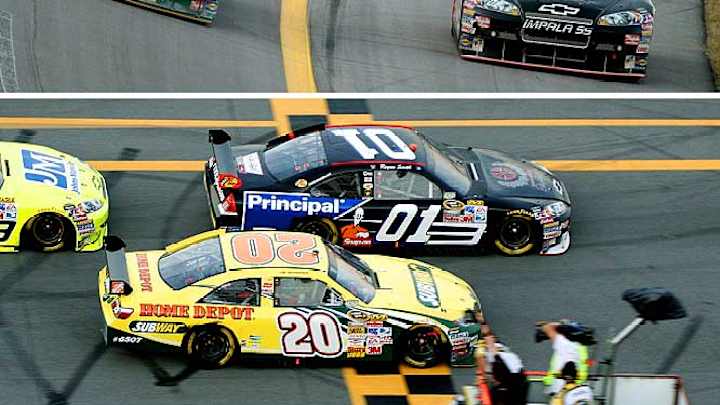
No Passing Below The Yellow Line
At NASCAR's restrictor plate races, you're not allowed to pass below a certain point on the race track. But for a sport based on pushing the limits of speed, it seems pretty silly to limit passing with an out-of-bounds line. The rule caused rookie Regan Smith (#01) to be stripped of his win at Talladega in October 2008 after making an aggressive move towards the track apron to muscle his way by Tony Stewart (#20).<br><br>Which NASCAR rules would you add to the list. Send comments to siwriters@simail.com.
Losing Points For Swearing
People lose championships in sports on last-second shots, an interception, a home run ... but how about a potty mouth? Dale Earnhardt, Jr. smoked the field at Talladega in October 2004, then told a TV audience of millions the win -- "Don't mean s--- right now. Daddy's won here 10 times." It was an innocent slip of the tongue, but in NASCAR's family atmosphere, Earnhardt was proven guilty. To teach him a lesson, the sport took away 25 championship points, and Junior wound up slumping to fifth in the final standings.
Keeping The Win When You Cheat
Three races into the 2008 season, Carl Edwards was riding high with two straight wins at California and Vegas. But NASCAR rained on his parade after finding a faulty oil cover that supposedly gave the car an aerodynamic advantage. Edwards was fined and had 100 points taken away; however, his win still stands in the NASCAR record books.
Top 35 Rule For The Daytona 500
Pittsburgh and Arizona worked through at least two playoff games apiece to get to the Super Bowl. How do you think they would like it if their opponent got a free pass? But that's what happens each season for NASCAR's most important race, in which 35 of the 43 cars automatically make the field based on their success from the previous year. The rule allows rookies like Joey Logano (inset) -- with all but three Sprint Cup starts to his credit -- to make the race by doing nothing more than starting his engine and making a qualifying attempt.
Ending The Race Under A Caution Flag
After fans complained of too many finishes ending under the yellow flag, including the June 2004 Michigan race won by Ryan Newman, NASCAR implemented a green-white-checkered "overtime" system. As long as a crash doesn't occur on the white flag lap, there's a guarantee drivers will be racing hard to the checkered flag. But if a crash occurs on the final lap? All bets are off; and sometimes the field is frozen and fans are robbed of a chance to see cars battle side by side for the finish.
Allowing Other Teams To Make Your Engines and Chasis
Could you imagine a stick-and-ball sport in which one team loans the other team players before the game just so they'll stay competitive? Welcome to the world of NASCAR, where new teams like Stewart-Haas Racing routinely get engines and chassis from their competitors on the race track to cut costs. Suppliers Hendrick and Roush claim that equipment is equal to the ones they provide their own race drivers, but not surprisingly, it's their own organizations in the Chase for the Championship every year, while their clients sit on the outside looking in.
Not Holding Qualifying on Saturday When It's Rained Out Friday
Every week, 47 or 48 cars come to the track to try to make a 43-car field, but sometimes it's a waste of time? Some drivers know before they get to the track that they have no chance to stick around for Sunday; because if it rains on Friday, the sport cancels qualifying altogether and sets the field on an antiquated system. Couldn't the powers that be give the underdogs on the outside looking in just one chance to strut their stuff on Saturday? After all, the presence of speed is what makes cars go 'round in circles ... not the virtues of past performance.
Restrictor Plate Racing
For the last 20 years, NASCAR has put restrictor plates on engines for its two largest tracks -- Daytona and Talladega -- as a "temporary" solution to get speeds under control. It's a Catch 22 for the organization; without the plates, cars nowadays would approach 230 miles an hour entering the turns ... testing the limits of safety. But with the plates, the entire field is stuck together like a caramel candy bar, unable to separate and pass without help. It's not "may the best car and driver win" ... it's a chess match. And if a driver makes a mistake ... a 20-car wreck takes out half the field and tests the limits of safety. Ugh.
Letting Cup Drivers Compete For A Nationwide Series Title
Imagine, if you will, Roger Clemens in his prime ... facing a season's worth of batters in AAA. Those teams would have no chance against him, right? Well, much to everyone's amazement, NASCAR allows this kind of pummeling on a weekly basis, when Sprint Cup regulars step into Saturday's Nationwide events and smash the competition to smithereens. It's been three years since a "AAA" regular has won the title, and entering this season Cup drivers had won 64 of the past 72 events in the series. Ouch.
Keeping the Southern 500 Away From Labor Day Weekend
Back in 1950, Darlington Raceway stood out as a landmark achievement for NASCAR. The 1.33-mile oval -- egg-shaped due to its proximity to a nearby lake -- gained notoriety as the sport's first superspeedway event, as well as the most difficult one to master. Labor Day Weekend was a tradition of Darlington Stripes and a showcase of the sport's top driving talent. That is until NASCAR inexplicably moved the date. Fans have kept going (the race runs in May) but have never forgiven the powers that be for breaking tradition. A replacement race at California proved unpopular, so this offseason NASCAR made another change ... to Atlanta, much to race fans' chagrin.<br><br>Which NASCAR rules would you add to the list. Send comments to siwriters@simail.com.
 Add us as a preferred source on Google