%20%20--%3E%0A%3Csvg%20version%3D%221.1%22%20id%3D%22Layer_1%22%20xmlns%3D%22http%3A%2F%2Fwww.w3.org%2F2000%2Fsvg%22%20xmlns%3Axlink%3D%22http%3A%2F%2Fwww.w3.org%2F1999%2Fxlink%22%20x%3D%220px%22%20y%3D%220px%22%0A%09%20width%3D%2239px%22%20height%3D%2240px%22%20viewBox%3D%220%200%2039%2040%22%20enable-background%3D%22new%200%200%2039%2040%22%20xml%3Aspace%3D%22preserve%22%3E%0A%3Cpath%20fill%3D%22%23FFFFFF%22%20d%3D%22M38.5%2C7H28.2v26h10.3V7z%22%2F%3E%0A%3Cpath%20fill-rule%3D%22evenodd%22%20clip-rule%3D%22evenodd%22%20fill%3D%22%23FFFFFF%22%20d%3D%22M26.1%2C25.5c0%2C5.8-4.1%2C7.5-12.9%2C7.5C3.9%2C33%2C0%2C31.2%2C0%2C25.2v-1.1h11.6%0A%09v2.4c0%2C0.7%2C0.1%2C1.4%2C1.2%2C1.4c1%2C0%2C1.2-0.4%2C1.2-1.3v-0.9c0-1.6-0.9-1.6-3.5-2.2C2.2%2C21.7%2C0%2C19.7%2C0%2C15.3v-0.9C0%2C9.3%2C5.5%2C7%2C12.9%2C7%0A%09c10.2%2C0%2C12.8%2C2.6%2C12.8%2C7.4v1.8h-11v-2.9c0-0.6-0.4-1.1-1.2-1.1c-0.6%2C0-1.2%2C0.4-1.2%2C1.1v0.9c0%2C1.5%2C0.9%2C2%2C3.3%2C2.5%0A%09c8%2C1.6%2C10.5%2C3.3%2C10.5%2C7.5V25.5z%22%2F%3E%0A%3C%2Fsvg%3E%0A)
William Byron Captures Second-Straight Daytona 500 in Thrilling Overtime Finish
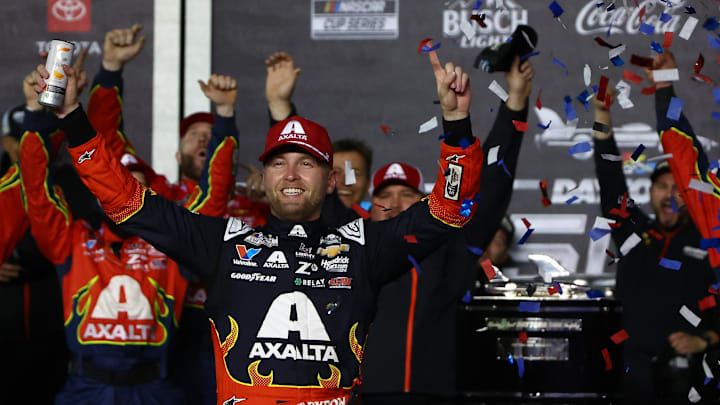
There was more to William Byron’s second straight Daytona 500 victory on Sunday night than just luck. There was a fast car and hard racing, of course. But there was also something providential about the way his number 24 Chevrolet took the checkered flag—almost like someone was running supernatural interference for him. Twice in the race’s final laps, Byron was nearly taken out by the types of catastrophic wrecks that have made the Great American Race such a captivating crapshoot. And twice he avoided disaster by the narrowest of margins. When he found himself in the lead after the second, he was as surprised as anyone.
“Crazy,” he said in the moments after his victory. “I can’t honestly believe that.”
It was a fittingly bizarre and thrilling end to an epic day at Daytona that had seen the 500-mile race turn into a test of endurance for everyone from the drivers to the fans watching at home. With rain expected, NASCAR had started the race about an hour early, but drivers only turned 11 laps before inclement weather brought things to a halt. The ensuing delay lasted more than three hours, going on so long that the Fox broadcast eventually started showing a replay of the 2024 race. The temperature dropped more than 20 degrees.
The race restarted under caution after 5:30 p.m. ET, but when the green flag was just about to wave the rain began again. Out came the red flag as “Here Comes the Rain Again” blared over the track’s sound system. Drivers returned their cars to pit road to wait. This time, the delay was mercifully short. Racing resumed 20 minutes later.
The long day’s journey into night put the Daytona 500 under lights, a compelling setting that made the race even more fun to watch—and a reward for those who’d stuck it out during all the delays. There were 56 lead changes and three-wide racing for much of the night. For his part, the 27-year-old Byron had led five times for all of nine laps before his surprising win.
“I think you can’t underestimate the amount of preparation and teamwork that we had throughout the week,” he said. “We had an awesome car today. We just didn’t have the track position to show it, and the way the fuel savings and strategy worked out....
“Obviously, it worked out in a fortunate way for us, but it’s not all luck to win twice in a row.”

Byron’s first brush with calamity Sunday night came on Lap 196. He was running in 10th place on the outside line, three cars behind Christopher Bell, who was in second, just outside the lead car, driven by Denny Hamlin. Bell’s car got loose and rammed into the outside wall, at which point he began slowing dramatically and sliding back toward the cars racing behind him. As the nose of Bell’s car spun toward the inside, Byron slid down the track to avoid contact. Bell’s Toyota then collided with the car immediately behind Byron—driven by Ryan Preece—lifting it into the air and touching off a scary crash that ultimately involved eight cars.
When the race restarted four laps later, Byron was in ninth, well back in the draft behind the front-running Hamlin. But then Hamlin’s 11 car got turned by cars behind him pushing for the front. As the nose of his car spun toward the wall, Byron went high and slid past him into the lead. About 20 seconds later, he took the checkered flag.
“It’s an amazing race, and obviously a lot of crazy racing out there tonight and just a lot of pushing and shoving,” Byron said afterwards. “Just obviously fortunate it worked out in our favor.”

As unlikely as Byron’s victory seemed, the way it came about was no surprise to those in the sport. Six of the last eight Daytona 500s have gone to overtime, and three of the last five finished under caution. Things get so aggressive in the final laps that rubbing fenders and trading paint is inevitable.
Four-time Cup champion Jeff Gordon is the vice chairman of Byron’s Hendrick Motorsports team. Gordon, who won the Daytona 500 three times before he retired in 2015, described the situation as “bumper cars at 200 mph,” before adding, “You’re going to have a lot of wrecks.”
Byron is the first repeat winner of the Daytona 500 since Hamlin, who won in 2019 and ’20. Next up for the Cup series will be a 400-mile test at Atlanta on Feb. 23.
 Add us as a preferred source on Google
Staff writer Mark Beech, who has written extensively on college football, horse racing and NASCAR, among other subjects, cites his 2007 profile of Olympic gold medal-winning freestyle wrestler Henry Cejudo as his most memorable SI assignment. "I was at a NASCAR race in Charlotte on a Sunday afternoon and got a call from an editor asking me if I could fly straight to Colorado Springs to start work on a story about Cejudo for the next week's issue," says Beech. "I knew nothing about him at all but spent the next six days learning everything I could mostly through interviews, since there was no real record of him in the press at the time. The story was much bigger and more deeply affecting than I could have ever imagined, and I thought it came off very well considering the amount of time I had to write and report." During his tenure at SI Beech has also written on the NHL, soccer and college basketball. He writes a weekly auto racing column (Racing Fan) for SI.com, and also provides coverage of major horse racing stakes for the website. He says college football is his favorite sport to cover "for all the tradition and regional passions." Beech has been with Sports Illustrated since 1997. Before joining SI he spent five years in the U.S. Army, reaching the rank of captain, and serving primarily with the 84th Engineer Battalion (Combat) (Heavy) at Schofield Barracks, Hawaii. Beech received a B.S. in civil engineering from the United States Military Academy in 1991 and an M.S. in journalism from the Columbia University Graduate School of Journalism in 1997. He and his wife, Allison Keane, have an infant son, Nathaniel, and reside in Westchester County, NY.