%20%20--%3E%0A%3Csvg%20version%3D%221.1%22%20id%3D%22Layer_1%22%20xmlns%3D%22http%3A%2F%2Fwww.w3.org%2F2000%2Fsvg%22%20xmlns%3Axlink%3D%22http%3A%2F%2Fwww.w3.org%2F1999%2Fxlink%22%20x%3D%220px%22%20y%3D%220px%22%0A%09%20width%3D%2239px%22%20height%3D%2240px%22%20viewBox%3D%220%200%2039%2040%22%20enable-background%3D%22new%200%200%2039%2040%22%20xml%3Aspace%3D%22preserve%22%3E%0A%3Cpath%20fill%3D%22%23FFFFFF%22%20d%3D%22M38.5%2C7H28.2v26h10.3V7z%22%2F%3E%0A%3Cpath%20fill-rule%3D%22evenodd%22%20clip-rule%3D%22evenodd%22%20fill%3D%22%23FFFFFF%22%20d%3D%22M26.1%2C25.5c0%2C5.8-4.1%2C7.5-12.9%2C7.5C3.9%2C33%2C0%2C31.2%2C0%2C25.2v-1.1h11.6%0A%09v2.4c0%2C0.7%2C0.1%2C1.4%2C1.2%2C1.4c1%2C0%2C1.2-0.4%2C1.2-1.3v-0.9c0-1.6-0.9-1.6-3.5-2.2C2.2%2C21.7%2C0%2C19.7%2C0%2C15.3v-0.9C0%2C9.3%2C5.5%2C7%2C12.9%2C7%0A%09c10.2%2C0%2C12.8%2C2.6%2C12.8%2C7.4v1.8h-11v-2.9c0-0.6-0.4-1.1-1.2-1.1c-0.6%2C0-1.2%2C0.4-1.2%2C1.1v0.9c0%2C1.5%2C0.9%2C2%2C3.3%2C2.5%0A%09c8%2C1.6%2C10.5%2C3.3%2C10.5%2C7.5V25.5z%22%2F%3E%0A%3C%2Fsvg%3E%0A)
What’s Next for Players Era? Inside College Basketball’s Fastest-Growing November Event
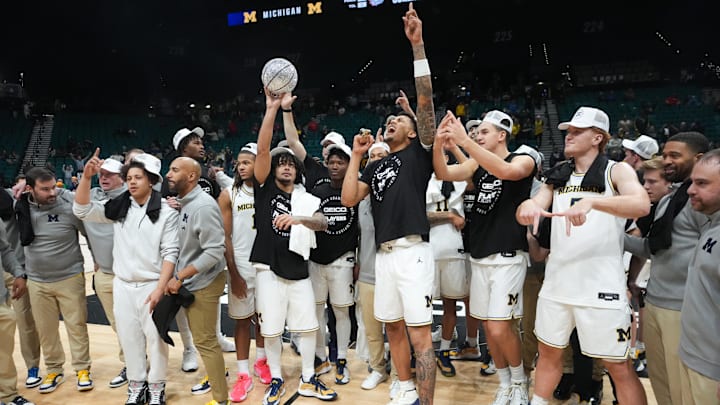
After shaking up college basketball’s early season calendar, what’s next for the Players Era Championship?
The event, built on seven-figure payouts to participating players, is headed full steam ahead toward a third year after growing from eight to 18 men’s teams in its second season in 2025. It has immediately attracted many of the best teams in the sport: The top three teams on KenPom and eight of the top 20 as of Monday played in this year’s event, and similarly strong fields can be expected in 2026.
Its status as a disruptor and the event’s unorthodox format (one that used point differential rather than bracket play to crown a champion) has drawn the ire of some diehard college basketball fans. There are plenty of signs that the event has staying power. Players Era games ranked as the four most watched college basketball games during Feast Week that aired on cable, beating out the Maui Invitational and other events on ESPN. In spite of the significantly larger overhead costs that come with the NIL opportunities the event offers its players, event co-founder Seth Berger told reporters in November that the men’s event this year was already profitable while the four-team women’s event took a slight loss. The event signed a deal with the Big 12 that will grant automatic bids to the top eight teams in the league standings every year, an agreement that sets up Players Era to continue to land top teams.
With this year’s event in the rearview mirror and plans for next year already being laid, Sports Illustrated sat down with Berger about what has gone right so far, what still needs work to earn college hoops fans’ full embrace and what the future of the event looks like.
This interview has been edited and condensed for clarity.
Sports Illustrated: When you set out to build Players Era, did you think becoming this big, this fast was possible?
Seth Berger: Players Era 2025 absolutely exceeded our expectations, and the growth of what we’re building definitely happened faster than we thought possible. I think it speaks to the opportunity for a major U.S. sporting event in November, built around college basketball. And that’s why this is all happening so quickly.

SI: Were there specific challenges this time around with the bigger field that you didn’t anticipate?
SB: Growing from eight to 22 teams (18 men’s, four women’s teams) actually felt like there was six to 10 times more things to do than two and a half.
SI: Were those operational challenges of running the tournament itself? What were the biggest issues?
SB: I’m in my 21st year as a high school coach, 19th as a head coach, and my analogy for what this year felt like was, it seemed that I was coaching a game in the last two minutes that was perpetually tied. The number of things that you try to anticipate to protect against is a ton, and a number of things that you can’t anticipate felt like it was even more. Having said that, the folks said MGM [which hosted the event] and Warner Bros. Discovery [the event’s TV partner] and our internal team, I think did an amazing job. So overall, the experience for the fans and the viewers and most importantly, the teams was great.
SI: A common critique of the event was that the atmosphere felt a bit sterile. Do you think that’s a fair critique? If so, what ways can you guys improve that moving forward?
SB: I did see that reported, and I don’t understand what that meant. Long story short is, I think we could do everything better in 2026. And if I’m running this event for 10 years in Year 9, I’ll be trying to figure out, what can we do better in Year 10? So can we improve the atmosphere?
Absolutely. One of the ways I think we could do that is do a better job of engaging the student bodies of these teams. So I think that’s something we’re trying to look towards in 2026 and beyond. But I think we can do everything better. We can improve the atmosphere, we can improve the format, we can improve the on-ground experience for the teams and the fans and everyone associated with Players Era.
SI: It feels like a lot of the atmosphere criticisms stem from the fact that we’re used to watching these early season events in much smaller gyms. Putting them in NBA-sized arenas likely makes crowd turnout feel watered down. Do you have numbers on tickets you can share?
SB: I was talking with an NCAA official during Day 2, and he asked how did we get this many fans here? And I said, “Is this like a round of 32 game to you?” He said, “No, it actually feels like a Sweet 16 game in terms of the crowd itself.” So I was overwhelmed. We had six times more people in the arenas this year than we did last year, and for almost all of our men’s games, we had more people in the arena than any other Feast Week event has ever had. Of course, we need to do everything we can to try to continue growing crowds and improving the experience, and we will. But this year absolutely exceeded our expectations.
Editor’s note: Berger was unable to provide detailed sales figures to corroborate the claim that Players Era had more people in the arena than any other Feast Week event. Attendance for some, but not all, Players Era sessions is included in ESPN box score data. The highest figure was a Tuesday evening session headlined by a matchup between Tennessee and Houston with a published attendance of 5,110. Other sessions with published attendance figures varied widely. The low-water mark appears to have been 1,629 for a 10 a.m. PT Wednesday tip between Syracuse and Iowa State, while the championship between Gonzaga and Michigan had a listed attendance of 3,947. In comparison to other best attended Feast Week events: The Rady Children’s Invitational announced attendance of 5,008 for its championship game, while The Charleston Classic posted a high-water mark of 4,856 for its semifinals. The ESPN Events Invitational Magic Bracket had two days of attendance in the low 4,000s.

SI: From a format standpoint, did you feel like the point differential model worked how you had hoped, having had some time to reflect? Do you still like the idea of using that in 2026?
SB: We’re going to have 32 teams and four eight-team groups. So the format will, by necessity, be different. And we are definitely thinking about ways to improve the format so it’s easier to understand for the fans and the teams themselves.
SI: Part of the criticism, I think, of the point differential model was maybe more so a criticism of the strange number of teams. Eighteen teams is not a normal college basketball tournament. You guys were working within the restrictions of that. Was this year’s point differential more of a work in progress than how you hoped it would look in its final form?
SB: You’re totally right. And again, every year is always a work in progress and we can always improve. But trying to find a format with 18 teams by necessity, it meant something was gonna be imperfect. And so I think with going to 32 teams, we have an opportunity to make something that is more simple and easily understandable.
SI: Can you provide any further color you might have on what that decision-making process will look like in terms of how you want to format next year’s event [point differential vs. bracket]?
SB: One of the reasons I don’t have more detailed information today is we are in conversations with a number of TV distributors. Whatever partner we end up with, whatever partner we choose, will certainly have input into that process.
SI: How important for Players Era’s future is the partnership with the Big 12? Is an automatic bid structure something you’re exploring with other conferences, too?
SB: The Big 12, in my opinion, is the perfect partner for Players Era. It’s proving its dominance already in 2025 on the court, and it’s got a visionary leader in Brett Yormark, who’s a perfect partner. We have a five-year relationship with them, and so having eight great Big 12 teams anchor our tournament every year means we will have the best event in November in college basketball. We’ve definitely been in conversations with other conferences, and those conversations are ongoing.
SI: From the logistics side of things, I know there was a lot of reaction to the announcement that next year’s event will be over three weeks. Does that mean teams will be sitting in Las Vegas for 20 days? How is this all going to work? Can you take me through some of the early logistics of how the 32-team event might work?
SB: It will be somewhere over 12 to 20 days, let’s say. There will be early groups and then later groups. Most likely what will happen is the early groups will play, go back home and then for the group winners, one team from each group will return back to Las Vegas for the Four Kings, and then the later groups will be set up such that the winners of each group don’t have to go home and come back. We know we can’t take two weeks of a college basketball team’s time. They’ve got their own schedules. They have school and classes and exams. So we’ll be totally sensitive to the team schedules as we’re building this out.
SI: What has the feedback been from schools involved in the 32-team planning, particularly about the logistics of scheduling and maintaining flexibility over a multi-week period? Has that been an issue you guys have heard?
SB: Actually, teams have been great. As they are building out their November and December schedules, we’re just having conversations with them. They’re basically saying once they know when Players Era will be played and which group they will be a part of, then they can build around that. And on the flip side, if they have events that they’re committed to or home and homes that they’re committed to, we work with them when we’re designing the groups.
SI: As the landscape of player payments shifts with revenue sharing now a major part of the equation, do you anticipate changes to the way that you guys pay players and teams for participating?
SB: Credit to the NCAA and the CSC [College Sports Commission] and NIL Go. This is an incredibly rapidly changing environment. They’ve done everything they can to make the rules crystal clear, and we are following the rules in every way. In fact, we filled out around 100 NIL Go forms for athlete contracts as an unaffiliated entity and will have more to come. I fully expect the environment to be different next year and the year after that, and the year after that. The one thing that we have said from jump is, we will always stay within the NCAA and CSC rules, we will never jeopardize an athlete’s eligibility and we will never put a program in jeopardy. I came to this business as a father of a Division I basketball player who had an agent who was trying to rip him off, right? And I’ve coached over 30 Division I kids. We started Players Era to, first and foremost, support college basketball players and will continue to do so.
SI: I assume it has been easier to recruit teams now than the initial rush of getting teams to sign up, but Mick Cronin recently spoke about the fact that the neutral-site games they play will pay UCLA and their players more than Players Era would. As a business model, do you think you guys are in the right place? What will it take to continue to attract the best teams to the event?
SB: It’s a great question. We’ve created an opportunity for other event operators to create great events, which is fantastic for college basketball, for college basketball teams, and for college basketball players. So I expect competition, and I don’t think we’re gonna be the only game of town. Ultimately, that’s great, because if early season college basketball becomes more impactful for the fans, then it’s great for the players and also great for Players Era. I don’t think we’ll ever have a monopoly on all the great teams, and nor should we try to. We’re trying to build a great college basketball event that has true meeting in November, and I think we’re in the process of doing that.
SI: What do you see as the biggest challenge ahead? Is it TV deals? Is it continuing to get high-level teams? Is it some of the regulatory limitations in terms of the number of games you can get teams to play with you guys?
SB: I don’t mean to be evasive on the specific answer. But I really, really believe going from eight to 18 men’s teams and four women’s teams to 32 men’s teams and six women’s teams, everything is exponentially more difficult and the pressure to excel is higher. So I think there’s actually not one big looming thing that fits over us. I think there’s hundreds of really important things that we have to do very well. I was the founder and CEO of And1 back in the day. When we were in our first year of business, we did $1.7 million in revenue. Our second year, we did $5.9 million and then our third year, we did $40 million in revenue. We had to be better at everything because it meant that more consumers were having touchpoints with our brand. More retailers were having our apparel in their stores, right? And everyone has a different experience, so you have to actually have to work harder to sell more product when it’s growing that quickly, as opposed to what happens by inertia. Same thing here, right? Like, to build a 32-team national sporting event in November is a much bigger challenge than building an 18-team event only during Thanksgiving week with all the different things that you have to do. The answer is, we have to do everything better.
SI: You said at your press conference that you wouldn’t rule out growing beyond 32 teams, but you felt like 32 was a pretty strong number to be at and maybe a place you could settle moving forward. I’m curious, along those lines, if you envision the tournament growing in terms of the number of games teams play or if that three-to-four-game sweet spot where most early season tournaments live is where you think Players Era will exist moving forward?
SB: I think so. Teams aren’t going to want their entire Quad 1 schedule to be just Players Era. Coaches have relationships, institutions have home-and-homes, there are other great events that coaches want to play in. I think this is the right number. I think it’s a big enough event that it’s truly meaningful and having a truly meaningful title in November is really valuable for college basketball. But it also gives programs flexibility to do what they want to do.
SI: In talking to [co-founder] Ian Orefice, it was made clear to me that the two north stars of Players Era were to pay the players and create something resembling March Madness in November. Through two years and planning for Year No. 3, how do you feel like you’re capitalizing on those missions?
SB: Those are our two main mission points. Number one, help players monetize their name, image and likeness in a truly meaningful way, and second is create a major national sporting event built around college basketball. I think we’re further along faster than we thought we would be, but still a huge mountain to climb.
More College Basketball from Sports Illustrated
Listen to SI’s new college sports podcast, Others Receiving Votes, below or on Apple and Spotify. Watch the show on SI’s YouTube channel.
 Add us as a preferred source on Google
Kevin Sweeney is a staff writer at Sports Illustrated covering college basketball and the NBA draft. He joined the SI staff in July 2021 and also serves host and analyst for The Field of 68. Sweeney is a Naismith Trophy voter and ia member of the U.S. Basketball Writers Association. He is a graduate of Northwestern University’s Medill School of Journalism.
Follow CBB_Central